
Council rips Bloomington survey for sidelining college students
Bloomington city councilmembers sharply questioned whether a $37,900 community survey that intentionally de-emphasized IU students could reliably guide policy or spending. They also challenged its low response rate, wording, accessibility and lack of useful comparisons.
“What population does this survey actually represent?” Bloomington city council president Isak Asare asked at the council’s regular meeting on Wednesday night (Aug. 5).
The answer was that the city’s latest community survey, by design, mostly reflected older, longer-term, year-round residents and under-emphasized Indiana University students.
That fact shifted the council’s focus on Wednesday from at least some favorable findings to sharp criticism of the administration’s choices about whose views should count when Bloomington asks what residents think.
Several councilmembers questioned whether the results of such a survey should guide city policy or spending decisions. Hopi Stosberg called the treatment of students “pretty appalling.” Sydney Zulich called the consultant’s explanation for the de-emphasis of students “a stunningly insulting answer.”
The criticism came despite at least some findings that reflected favorably on much of life in Bloomington. About 80% of respondents were satisfied with the city’s overall quality of life, and 72% said they would be at least somewhat likely to recommend Bloomington as a place to live. But even the item asking about recommending Bloomington came under scrutiny as councilmember Andy Ruff called it an “odd question.”
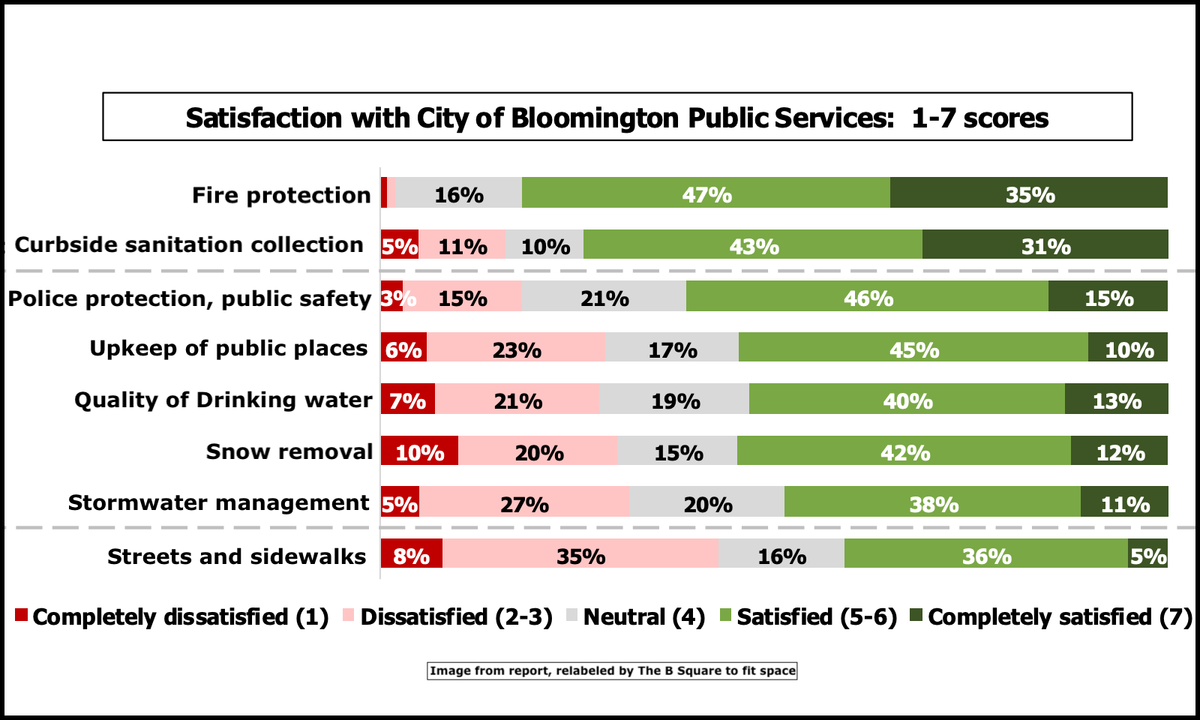
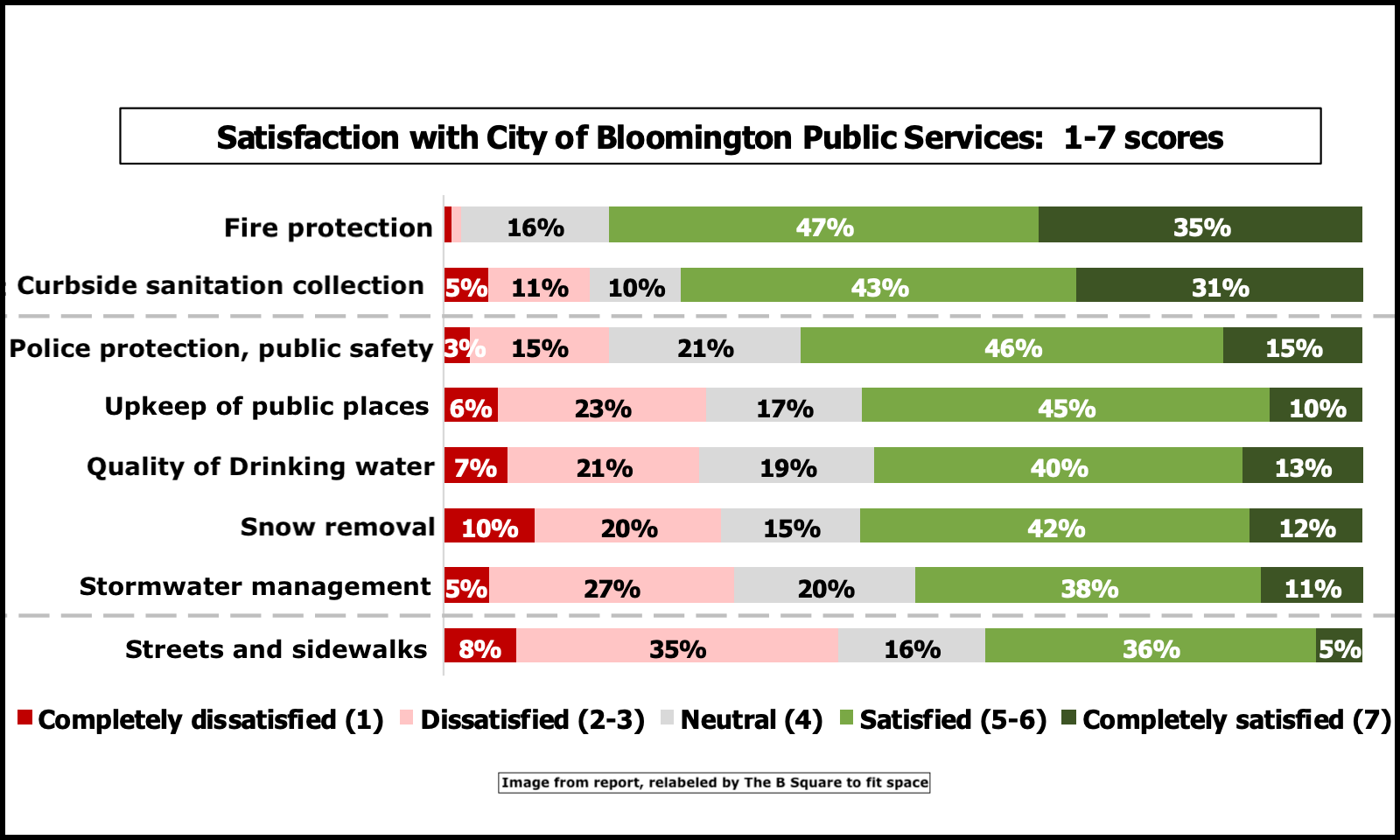
About 76% were dissatisfied with the availability of affordable housing, while streets, sidewalks and homelessness also emerged as prominent concerns. And except for fire, police, and fire protection, satisfaction with public services in the city was below 60%.
The city paid aQity Research & Insights Inc. $37,900 to conduct the survey. The firm received 561 responses between Feb. 18 and April 10. No council action was requested Wednesday.
But it was not clear what the answer to Asare’s basic question was for the consultant and city staff, as the council heads into the 2027 budget review season: “What I’m trying to get at in all of my questioning is what’s the ‘So what?’ for council and the city? … What are the things that we’re claiming that should inform our behaviors, actions, decisions, especially as we’re going into budget here?”
No votes were taken Wednesday night in connection with the presentation of the survey results.
Survey intentionally focused away from students
The explicit wording in the report that was provided in the city council’s meeting information packet highlighted the fact that Indiana University students were de-emphasized: “These [census weighting] targets were adjusted to focus more on permanent Bloomington residents, and slightly less on students at Indiana University.”
Councilmember Hopi Stosberg questioned whether the weighting that the consultant had applied, which was supposed to reflect US Census data, was accurate. She pointed out that the weighting indicated in the table was for 53% of the survey’s respondents as homeowners and renters at 47%. Stosberg said census figures show home ownership closer to 34%.
The explanation for the discrepancy likely stems from the parenthetical in the asterisked footnote to the table: “Respondent sample weighted to align with US Census data for Bloomington (adjusted for permanent residents).”
The geographic distribution showed comparatively few respondents around IU’s campus, Stosberg pointed out. Hardly any respondents identified themselves as full- or part-time students.
“So convince me that this is valid data,” she told aQity president Jeff Andreasen, who joined the meeting through a remote video connection.
Andreasen said the survey was designed to focus on residents more likely to live in Bloomington year-round.
IU students, he said, are often newer to the city, less familiar with municipal services and unlikely to remain in Bloomington for long. The firm therefore sought a sample more representative of “year-round, more permanent residents” who were likely to be taxpayers and engaged with city government.
That approach also accounted for the survey’s larger shares of homeowners, single-family residents, older residents and people living away from campus, Andreasen said.
Stosberg, whose District 3 includes a substantial part of the IU campus, rejected that distinction. Individual students may come and go, she said, but their needs remain relatively constant. Designing a survey that gives their views less weight means the results reflect “a subset of Bloomington, Indiana,” rather than the community as a whole, she said.
Zulich, who represents District 6, with thousands of student resident, and noted that she was very recently a student herself, agreed. “That is a stunningly insulting answer,” Zulich said.
Firm hired without request for proposals
Zulich also asked how the Thomson administration chose aQity. The initial response didn’t address the question, which led Zulich to say: “Thank you for that response. But my question was actually: How did the city decide on this firm to conduct the survey?”
City communications director Desiree DeMolina said the administration had reviewed criticism of the city’s 2023 survey, including complaints about its length, unclear wording, low response rate.
The city had previously worked with aQity on a Parks and Recreation Department survey and had a generally positive experience, DeMolina said. The administration chose the company as a known entity after considering its options.
Zulich asked whether the city had issued a request for proposals. “No,” DeMolina said. The company was hired through a professional services agreement, although she added that the city had shopped around.
The city had used the National Research Center at Polco for its surveys in 2017, 2019, 2021 and 2023. The change in firms and methodology limited the number of direct comparisons that could be made across survey years.
Rosenbarger asked for a list showing which questions had been retained, changed or removed. One of the chief benefits of conducting the survey repeatedly, she said, should be the ability to track changes in public opinion over time.
Rosenbarger also questioned whether a 4% to 5% response rate could support strong conclusions. “It takes a ton of work” to collect representative responses from people who are less likely to participate, she said. That can require door-to-door outreach, telephone calls, community events and incentives.
The people who are hardest to reach, Rosenbarger said, “are the ones that we really need.”
Andreasen told the council that invitations had been sent by email or mail to nearly 7,000 or 8,000 randomly selected residents. He said weighting was used to reduce nonresponse bias and align the results more closely with the survey’s target population.
That’s what prompted Asare to ask: “The follow up for me, I guess pointedly, is: What population does this survey actually represent?” Andreasen said it was primarily Bloomington’s permanent, year-round population—not the city’s complete census population.
What’s the ‘So what?’
Asare also questioned the survey’s headline finding that 72% of respondents would recommend Bloomington as a place to live.
The category included everyone who selected a score of six or higher on a 10-point scale, Asare noted. He asked how councilmembers should interpret the number and, more broadly, how the survey should influence their actions.
“What’s the ‘So what?’ for council and the city?” Asare asked. “What are the things that we’re claiming that should inform our behaviors, actions, decisions, especially as we’re going into budget [review season] here?”
Andreasen said the overall result was positive, but the 18% who were unlikely to recommend Bloomington should not be overlooked. Those respondents’ concerns were linked most strongly to housing affordability and perceptions surrounding Bloomington’s visible unhoused population, he said.
“It’s hard to recommend somebody moving to an area where it’s hard to purchase a home or afford a high rent,” Andreasen said.
Andy Ruff questioned the usefulness of some results without comparisons to similar communities. A finding about satisfaction with safety or Bloomington’s business environment means less, he said, without knowing whether the response is unusually good or bad.
Andreasen said aQity did not have enough comparable national data. Bloomington’s university population makes it difficult to compare the city with other communities of similar size, he said.
Ruff also questioned the value of asking whether respondents would recommend Bloomington. Personal considerations, like whether someone wants friends or relatives to move nearby, could influence that answer independently of the city’s quality of life, he said.
Accessibility, wording questioned
Isabel Piedmont-Smith raised a separate accessibility concern. Some of the report’s data tables were inserted into the council’s information packet as scanned images without digital text, she pointed out, making them unreadable by screen-reading software used by people with visual impairments.
“That should be provided in all cases,” Piedmont-Smith said. She said she was disappointed that much of the report was inaccessible to part of the population.
Andreasen said he would look into whether an accessible version could be provided.
Piedmont-Smith also questioned the wording of a question that asked respondents to rank possible city strategies, including “removing barriers to developing affordable housing.” That wording presupposes that city-imposed barriers are responsible for Bloomington’s affordable-housing shortage, she said, making it a leading question.
Andreasen said the wording was developed jointly by city staff and his firm. The questions were developed in the context of “not what the issue is, or but more: What types of actions or strategies the city could do to address the top issues that people have?” Andreasen said.
Survey rejected as useful
Stosberg closed the discussion by describing the practical implications for an elected official whose district includes both students and longer-term residents.
Students vote and participate in city affairs at comparatively low rates, she said. That makes it harder, but no less important, for elected officials to determine what they need. “Someone doesn’t tend to vote or doesn’t get as involved, does not mean that I don’t also serve those populations,” Stosberg said.
Because a large portion of her constituency was deliberately deemphasized, Stosberg said it would be irresponsible for her to put much weight on the results.
Zulich went further. At a time when city officials have emphasized tight finances, she said, she could not see the survey as a responsible use of taxpayer money. The survey excluded the voices of thousands of students who could become long-term Bloomington residents, Zulich said, even as the community struggles to retain younger workers.
“I don’t know why any young person would want to stay here,” she said, “when we’re so blatantly disrespectful towards them.”



Comments ()