
Advocates say financing plan for Seminary Pointe feasible, if land swap happens
Bloomington Homes for All says Seminary Pointe can become a permanently affordable cooperative with a $1.6M rehab plan. But the proposal depends on a CIB-RDC land swap that is stalled as host-hotel and College Square proposal deadlines loom.
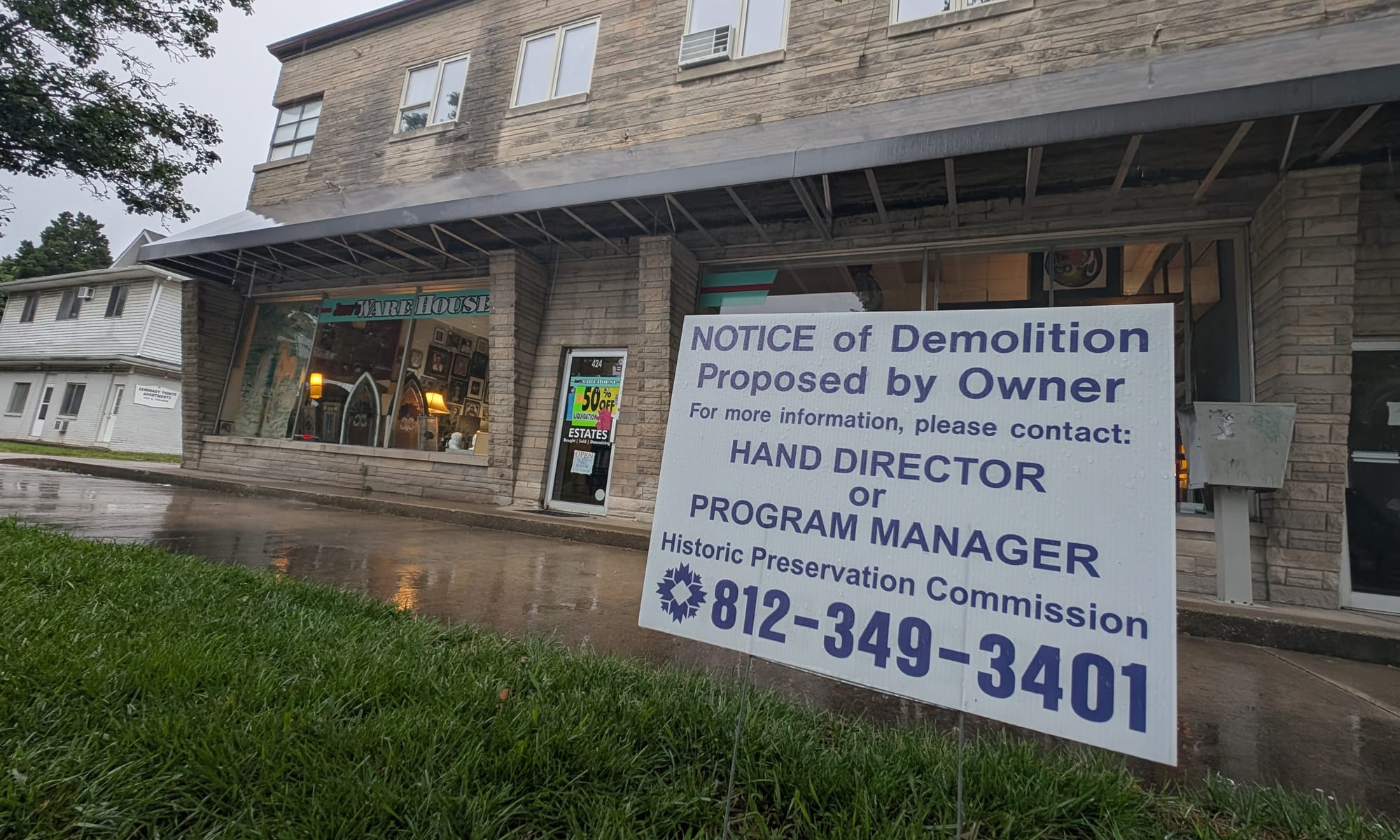
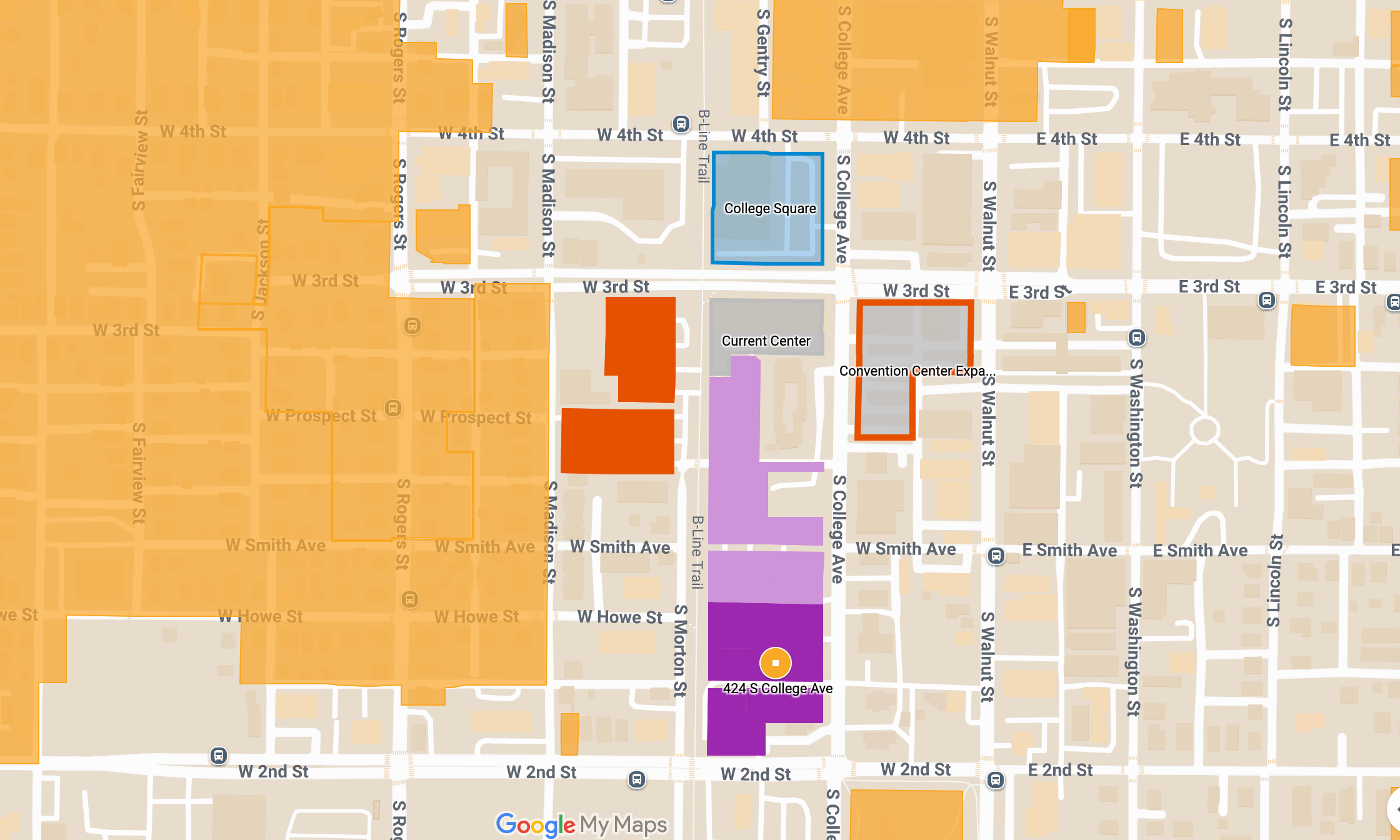
Left: Signs were posted on June 10, giving notice of the pending planned demolition of buildings on the Seminary Pointe block. Right: Land shaded with purple has been transferred by either the city or the county government to the Monroe County capital improvement board (CIB) to support the convention center expansion project. The gray area bordered in orange is the site of the convention center expansion. It’s the dark purple area that the CIB has targeted for a possible land swap for the blue square to the north, which is the College Square property, formerly owned by Bunger & Robertson. The dark yellow areas are historic districts. The 424 S. College address, indicated with a placemark inside the dark purple area, is listed as "contributing" in the city’s 2018 survey. Map by the B Square [dynamic map]
The Seminary Pointe block, north of 2nd Street on College Avenue in downtown Bloomington, is the subject of a detailed cooperative housing proposal that according to advocates is financeable.
But the central premise of the plan, which is a land swap between two local government bodies, is stalled in a procedural impasse that makes that outcome at least uncertain or even unlikely.
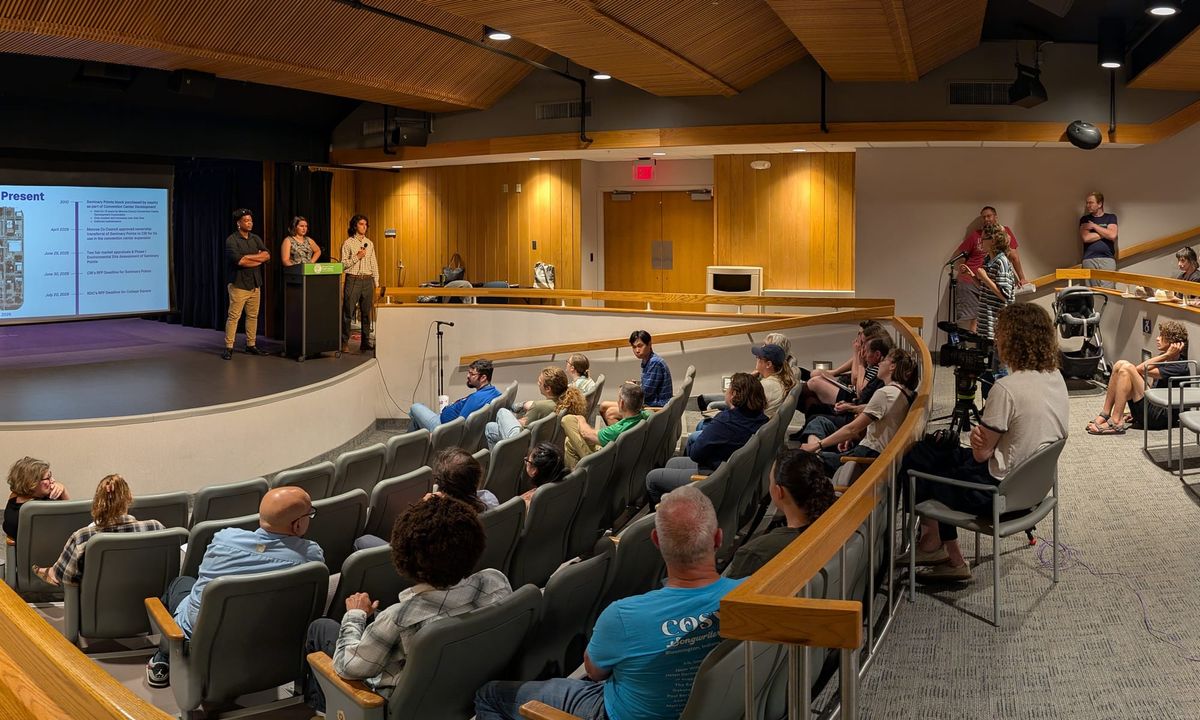
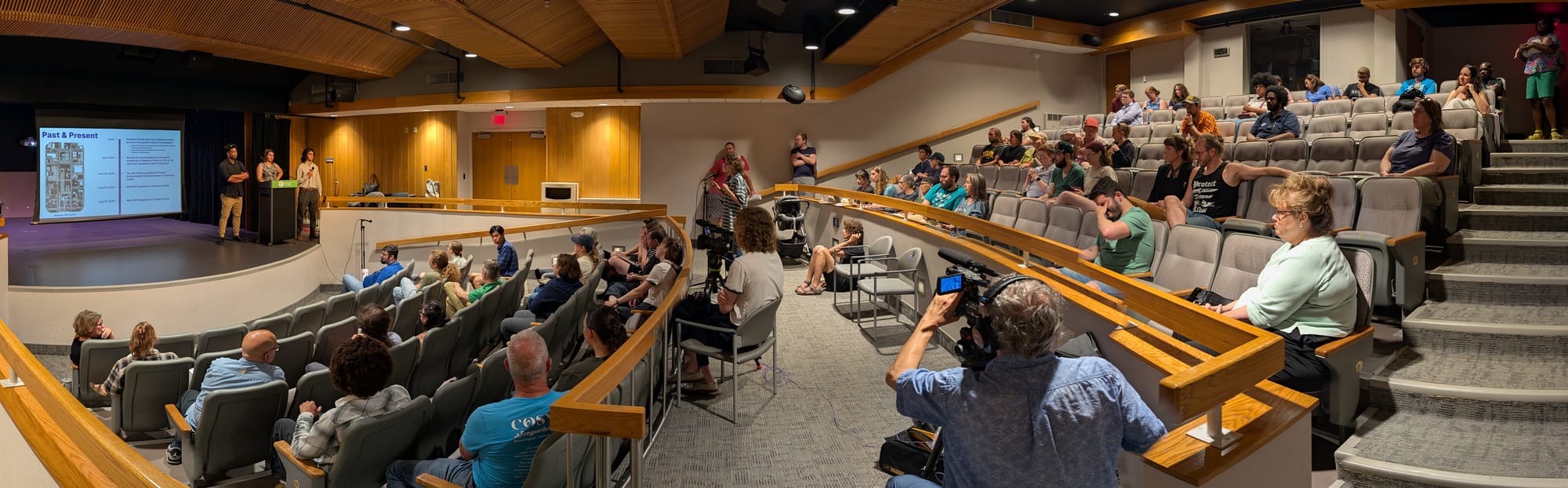
On Saturday at the downtown branch of the Monroe County Public Library, the proposal was presented to a gathering of about 60 people by Bloomington Homes for All, an advocacy group that has emerged over the last several months.
The proposal envisions operating some of the existing buildings through a multi‑stakeholder cooperative, backed by a roughly $1.6 million rehab plan. The capital part of the plan includes demolishing one structurally unsalvageable building, and rehabbing the remaining buildings for long‑term, extremely affordable mixed‑use occupancy.
Seminary Pointe, a cluster of buildings south of the Bloomington Convention Center that is home to some small businesses and 29 units of very low‑rent housing, is now owned by Monroe County’s capital improvement board (CIB). The CIB has a process in place to develop a host hotel there, tied to the convention center expansion, which has started construction and is expected to be complete in early 2027.
The CIB has issued a request for proposals from hotel developers for the Seminary Pointe site with responses due June 30. A recommendation for a preferred hotelier is expected by the CIB’s July 15 meeting.
The targeted real estate to be swapped for Seminary Pointe is College Square, which is now a vacant building with a parking lot north of the convention center. College Square is widely acknowledged as the better location for a host hotel, and is owned by the city’s redevelopment commission (RDC).
Dora Hospitality, which was selected in 2024 by the CIB as its preferred hotelier, negotiated unsuccessfully for more than a year with the RDC for the College Square lot. Now, the RDC has its own open call for proposals there, limited to non‑student‑housing developers. The RDC’s public offering closes July 20.
In the land-swap scenario, the RDC would hand over the real estate to a community land trust.
Procedural barriers to a land swap
In principle, The CIB supports a land swap. Before opening its second hotelier request round, the CIB asked the RDC to pause for 30 days before issuing its public offering for College Square, so that the two entities could negotiate the possibility of a land swap. The RDC declined, but left open the possibility that the CIB could make a proposal in the context of its public offering.
The CIB has not followed that path, citing among other reasons the fact that the minimum offer in the RDC’s public offering is pegged at about $7.6 million, and the appraised value of the Seminary Pointe real estate is expected to be well below that number.
At this stage, the land swap idea would require the two governmental entities to suspend the processes already in the works, with deadlines of June 30 and July 20, to pursue land swap negotiations, or to let their processes run their course, and at the end reject any proposals, in favor of a land swap.
Bloomington Homes for All cooperative housing proposal
Against the backdrop of an RDC-CIB impasse, Bloomington Homes for All is trying to make the case that, if the land questions can be resolved, the cooperative model they are proposing is not just conceptually appealing, but financially credible.
Their structure has two layers. On the bottom layer, Avalon Community Land Trust would take title to the Seminary Pointe land, holding it in perpetuity and using ground‑lease terms to cap land costs and preserve long‑term affordability. On top of that, a new Seminary Pointe Cooperative would own and operate the buildings.
Membership in the cooperative would come from three groups: residential tenants, commercial tenants, and community members. Each member would have a vote, and a board would be elected by those stakeholder groups. Surplus revenue, instead of flowing to private investors, would be reinvested in the property and the nonprofit ownership structure.
Matthew Joseph, a Bloomington resident and member of Bloomington Homes for All, told the audience that the land‑trust layer is what keeps affordability from evaporating as land values climb.
Something that is affordable today, Joseph said, is likely to be out of reach to a similar household 20 years from now, if it is all left to market speculation. By separating the ownership of land from buildings, Avalon would be able to set terms that keep Seminary Pointe’s housing and commercial space permanently below market rates.
The cooperative layer is designed to give current and future tenants meaningful control over that asset. Joseph described it as a way to align incentives: The people who live and work in the buildings would also be the people voting on budgets, improvements, and uses of common areas.
Joseph pointed to his own experience in Bloomington Cooperative Living, where he pays $399 a month in a group house and participates in shared governance, as evidence that cooperative models do more than decrease the rent. They draw residents into decisions about the physical and social environment where they live.
Organizers were careful to distinguish group‑living houses from Seminary Pointe which is primarily one‑bedroom apartments with private kitchens and baths. The cooperative element, they said, is about ownership and governance, not about turning the property into dormitory‑style shared housing. For tenants juggling multiple jobs or family responsibilities, the plan anticipates elected representatives who attend meetings and vote on behalf of a membership that cannot always be in the room.
Alongside the governance framework, the group presented a five‑year construction and financing plan that treats the existing buildings as an asset to be rehabilitated, not cleared.
The first step would be Avalon’s acquisition of the property from the public sector. In year one, the focus would be on immediate exterior and life‑safety work—roof repairs, parking lot improvements, and basic interior upgrades in occupied units. An architect would be hired to design full building‑systems upgrades.
In year two, the only structurally unsalvageable structure, 432 S. College, would be demolished, and the project team would close on construction loans and grants and hire local contractors. Major renovations to the remaining three buildings would run through years three and four. Those would include electrical, HVAC, sewer, and window upgrades. In year five, if a feasibility study supports it, new housing construction would begin on the cleared 432 S. College site.
Sarah Woolford, who is Habitat for Humanity’s housing solutions director and part of the Homes for All team, pegged the core rehab work at roughly $1.6 million. When soft costs, closing and pre‑development expenses, and a 15% contingency are included, the total budget comes to about $2.16 million.
On the income side, Joseph said the pro forma has been reviewed by four mission‑aligned lenders, three of which have already agreed to sign letters of support. The model assumes roughly $422,000 a year in gross revenue, with a vacancy allowance built in. Post‑renovation residential rents are set at $700 per month, aimed at households earning about 45% of area median income (AMI), or around $31,000 a year, according to the proposal from Homes for All.
Commercial rents for the project are penciled in at $8 to $10 per square foot, compared to what Joseph said was a current downtown average of about $16 per square foot.
Operating expenses include professional property management, at least one part‑time staff position focused on Seminary Pointe, and regular contributions to a capital reserve fund.
Joseph said the plan has an annual net operating income of $236,636 against debt service of $192,188, which yields a debt‑service coverage ratio of roughly 1.27, which is comfortably above the 1.15 to 1.20 range that lenders often look for in affordable housing deals, according to Joseph.
One of the plan’s main political selling points is what the spreadsheet leaves out. Joseph emphasized that the numbers are built without assuming any grants or “free money” at all. Philanthropic contributions, city grants, or crowdfunding are treated as upside that would only improve the coverage ratio.
Speaking on Saturday for Bloomington Homes for All, Bryce Greene told the audience that when he first started working on the Seminary Pointe issue, he didn’t know how the RDC members were appointed or how the CIB worked. He concluded, “But now I think this, this is an opportunity for all of us to get involved in shaping the city that we want to see in the future.”
Bloomington Homes for All now thinks it can say: If the CIB and RDC can find a way through their procedural stalemate, the cooperative conversion of Seminary Pointe is not just a nice idea, but a capital project with a defined cost, revenue model, and financing path.
The question that Homes for All is trying to put in front of the two governmental entities, is whether they are willing to set aside their current tracks long enough to consider the land swap that would allow the Homes for All alternative to take shape.


Comments ()