
April 7 deadline looms as Monroe County leaders clash again on North Park as potential jail location
Monroe County commissioners have put North Park back on the table for a new jail, despite the county council’s clear statement they oppose it. A new resolution from commissioners sets tight criteria and heightens pressure ahead of an April 7 deadline, as officials clash over location and cost.
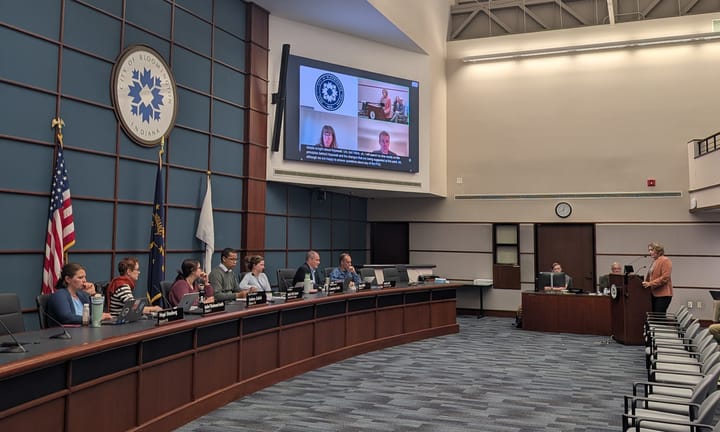
A resolution adopted by Monre County commissioners Thursday morning (March 26) re-establishes North Park as a potential new jail site, even after county councilors rejected North Park in their own resolution, which was adopted about a month ago, on Feb. 24.
The three-member board of commissioners and the seven-member county council, which is the county’s fiscal body, will have to reach agreement, if any progress is to be made on a new jail site.
Even though Thursday’s resolution from commissioners doesn’t explicitly say that North Park is the only site they will consider, it’s not clear what other sites could satisfy the two criteria set forth by the commissioners.
Thursday’s resolution states the county will “unilaterally reject” any site that cannot support future co-location of justice functions, or would cause what it calls “unreasonable delay.” The resolution also asks the county council to commit available cash reserves to begin the project ahead of any bond issuance.
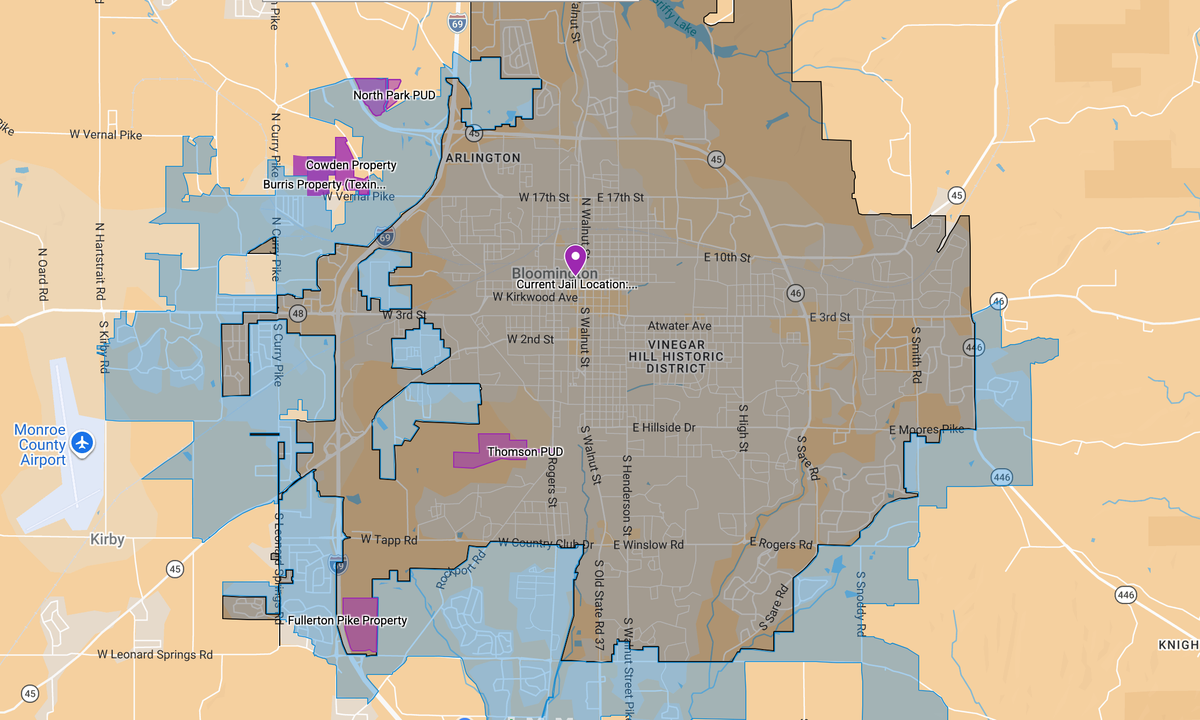
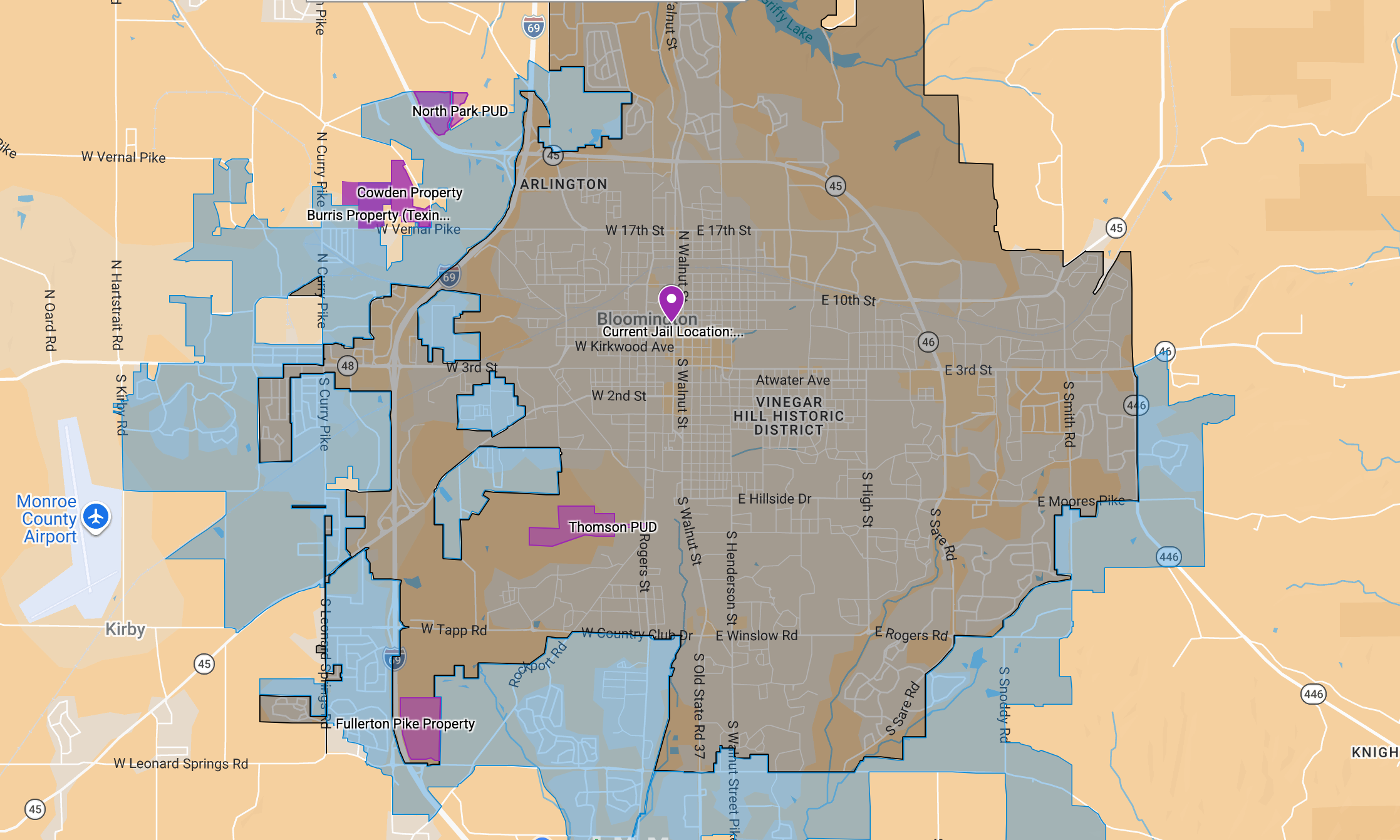
North Park is a roughly 52-acre site towards the northwest edge of Bloomington, just outside the city limits along State Road 46, offering a large, contiguous tract for development. County commissioners say they are still in touch with the property owner and think that a new purchase agreement could be reached, even if the previous one expired.
There don’t appear to be any pieces of land inside the core urban area of Bloomington that have enough space to accommodate a co-located justice facility, in addition to a jail. The one that comes closest to that, the Thomson PUD, would require the relocation of power lines and a substantial debris pile, which likely means Thomson would founder on the “unreasonable delay” criterion.
The resolution adopted by county commissioners on Thursday underscores the urgency of the county council’s looming self-imposed April 7 deadline, to identify a source of funds for a new jail, and to work towards executing a purchase agreement for property. The April 7 deadline was specified in the council’s Feb. 24 resolution. It’s the date of a regular county council meeting.
The council set the April 7 date in part to demonstrate progress on the jail project to the ACLU, ahead of another important deadline. Set to expire on April 15 is a long-running federal settlement agreement in connection with a lawsuit the civil liberties organization filed in 2008 over unconstitutional jail conditions.
There’s a chance that the settlement agreement could be extended if the ACLU lead attorney, Ken Falk, thinks adequate progress is being made towards building a new jail. Once the settlement agreement expires, it opens the door to fresh litigation, based on current conditions at the jail.
On March 30, councilors and commissioners will be in the same room together, for a joint executive session, closed to the public, on the topics of pending litigation and real estate.
By April 7, the full county council’s public take on the commissioner’s resolution will likely have surfaced. But already released is a statement from county council president Jennifer Crossley, who wrote about the renewed inclusion of North Park for consideration: “It seems illogical that elected officials such as the commissioners would want to reconsider a decision made six months ago while we are racing against a timeline that expires in three weeks.”
The decision made six months ago, in late October was the council’s unanimous rejection of the appropriation needed to close the North Park real estate deal.
Crossley’s statement says that for the commissioners to still consider North Park as a viable option “baffles” her “when we had this conversation back on October 28, 2025, during a meeting that lasted almost until midnight.”
Reasons to vote against the appropriation given by public commenters and councilors on the night of last year’s North Park vote included: the project’s steep overall cost and resulting tax burden; uncertainty about whether the county could afford even a scaled-down jail after changes to state law; concerns about moving core justice functions away from the downtown civic center; equity and transportation barriers for people without reliable access to a car; skepticism about building a larger jail rather than investing in mental health, addiction treatment, and other services; and a broader lack of consensus on a financially workable, community-supported plan.
Councilors have since that vote repeatedly stressed that their vote in October meant they were not willing to give further consideration to North Park.
Madeira’s gave remarks during Thursday’s meeting that seemed aimed at mitigating the political fallout of putting North Park back into the conversation—after the city council in late October last year rejected the appropriation needed to close the land deal, and more recently passed resolution stating that the council no longer wished to consider North Park as an option for a jail site.
Madeira acknowledged at the start of her remarks that putting North Park back into the center of the conversation would cause many observers to wonder “why North Park is still a viable property, when the council has so vociferously said no.” To explain that, Madeira said council has not spelled out explicitly what makes North Park unacceptable—leaving the commissioners without a usable standard for evaluating other properties.
From there, Madeira based a defense of North Park on a repeated refrain about what is known and certain:
We know everything about that property. And we know that we can put a jail at that site in a transparent fashion. We know that we can use public dollars efficiently. We know we can minimize waste. We know we can maximize long term value. We know that we can safely put it there in all ways and under all circumstances. We know that we can safely use taxpayer dollars, we know that we can ground our decisions in evidence, and we know that we are not making a hasty decision. We know that we are not making one out of urgency or incomplete information. And that’s the only site where my little empirical brain feels comfortable at this time moving forward.
Madeira described North Park as a “political hot potato.” She stressed that the project requires collaboration with the county council as well as with the city government in Bloomington. The justice center, Madeira said, is a “group project” that depends on transparency and public confidence.
Other commissioners echoed the urgency. Commissioner Lee Jones pointed to the conditions faced by people incarcerated in the current jail and by staff, saying further delay prolongs those conditions. Jones put it like this: “I think it’s important that we keep in mind that there are people actually living in that jail, in the conditions that have been identified as being unconstitutional, the longer we leave them sitting there … it really seems rather cruel to unnecessarily delay this project any longer.”
For her part, president of the board of county commissioners Julie Thomas said, “I don’t want us to spend more time on revisiting and revisiting and revisiting the same ideas and properties and whatnot. I think we are missing out on ‘good’ in a search for ‘perfect.’ And ‘perfect’ is never going to happen with a project like this, ever.” About North Park specifically, Thomas said, “The issues that had been raised about North Park are all easily dealt with, overcome, addressed through other means.”

Comments ()