
Bloomington council delays vote on carless Kirkwood until June 10, after commission review
A Bloomington city council vote on making five blocks of Kirkwood Avenue car-free from April to mid-November was postponed to June 10, after officials said the transportation commission must first review the measure. Debate aired business concerns, and visions for downtown.
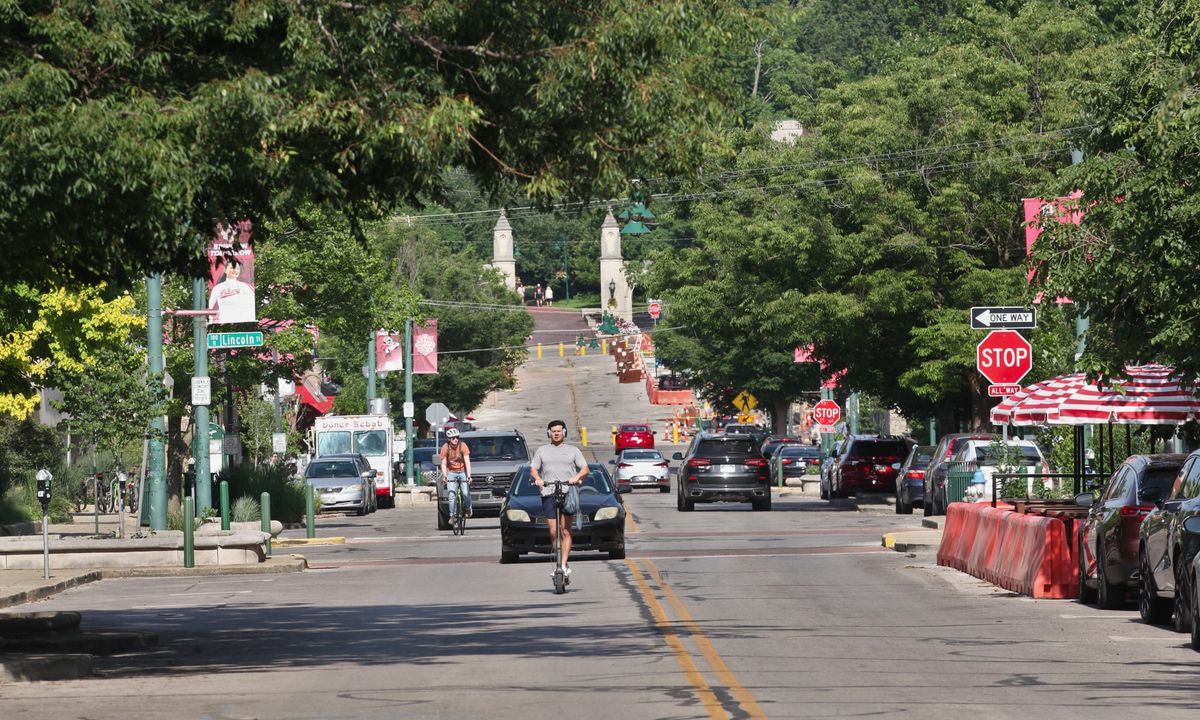
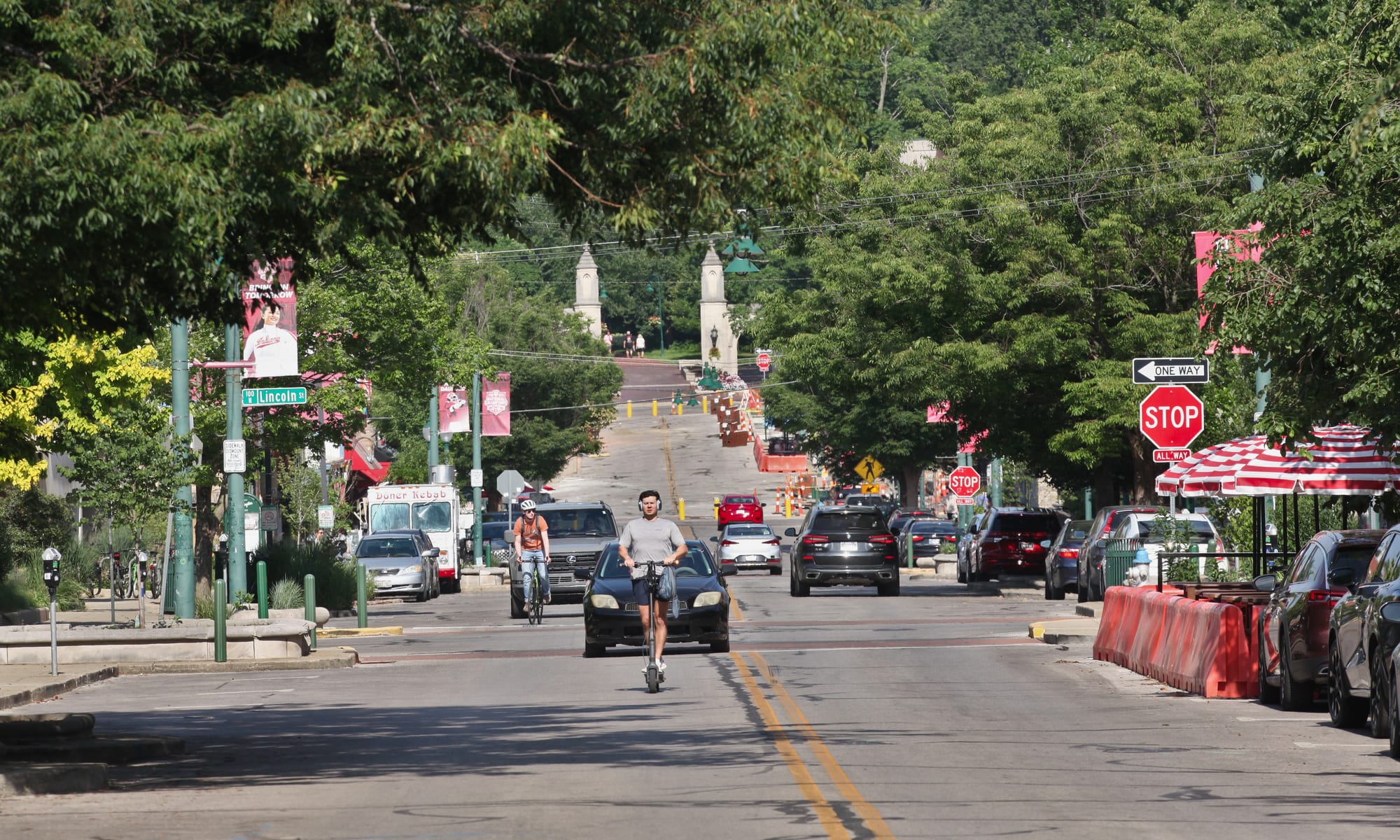
Bloomington’s city council on Wednesday postponed until next week (June 10) an ordinance to make Kirkwood carless for seven and a half months every year. The council did not vote on approval of the ordinance, because a section of city code was interpreted to mean the city’s transportation commission first had to review it.
That review is now due to take place on June 8.
The carless Kirkwood ordinance was the biggest draw for Wednesday’s meeting attendees, who were keen to see the council decide the question of closing five blocks of Kirkwood Avenue, from Indiana Avenue to Walnut Street, every year from April to mid-November.
However, council president Isak Asare clarified at the beginning of the meeting that a vote on the approval of the ordinance would not take place that night, because of a local code requirement that the transportation commission review it first.
The council’s attorney, Larry Allen, later clarified that the specific section in the Bloomington Municipal Code that applies to this situation is BMC 2.02.100(d)(2). It says that the transportation commission’s powers and duties include reviewing “all transportation projects, proposed changes to Title 15 (Vehicles and Traffic), relevant proposed changes to Title 12 (Streets, Sidewalks and Storm Sewers), and other applicable changes to the Bloomington Municipal Code …”
But the council did spend time discussing the ordinance on Wednesday and hearing more public comments. The council’s deliberations unfolded in the context of a lengthy memo sent to the council by city administration, with a number of suggested amendments to the ordinance along with a suggested process to reach a decision.
Councilmember Sydney Zulich brought up her discussions with downtown businesses, and said that they are overwhelmingly against carless Kirkwood. “The majority of the feedback that I hear is that they are not in favor of this,” Zulich said. “There are a couple details that I would like to see hammered out, if this is the route that people want to go down, one of which is the library block, which is not very easily activatable because there's no shade during the summertime.”
Zulich also expressed concern about the amount of money needed to pedestrianize Kirkwood, and whether the city was in the right financial position at this time to be making that investment.
Councilmember Matt Flaherty spoke in favor of the change, pointing to other communities like Bloomington that have solved the challenges that are being raised. “If the mayor wanted to do this, she would have done it already, and so the question is whether or not the council wants to use its legislative authority and budget authority to direct a visionary and transformative change to our downtown, and we certainly have the power to do so,” Flaherty said.
Councilmembers Isabel Piedmont-Smith and Dave Rollo raised concerns about the feasibility of making the changes before 2027, as opposed to enacting them immediately.
Piedmont-Smith also brought up the fact that there are other corridors in Bloomington that deserve the council’s attention. “South Walnut Street is in my district, and it’s much more bleak than Kirkwood. I mean, nobody wants to walk there. Kirkwood is already pretty good,” Piedmont-Smith said.
She continued, “I think this is a good idea. Let’s work towards it. But there are other corridors in Bloomington that are awful. I mean, I wouldn't want to walk on South Walnut. I wouldn't want to bike on South Walnut. It's five lanes of asphalt, no separation between the sidewalk and the street, very little shade. So, if we're going to prioritize where to spend money, there might be other parts of the city that have a greater need for improvement.”
Asare touched on a more fundamental issue related to the Bloomington’s identity: “I think we spend a lot of time trying to be a city that we’re not and not leaning into the city that we really are—and we are a university town, a really great one.” Asare said that university towns across the country have invested in pedestrian areas, which they’ve leveraged heavily for their plan all across economic development.
Asare also spoke about the potential impact of the proposal for families with children. “This city sucks to have small kids in, because there’s nowhere to go with them, right?” he said. “There’s no place for us to just go and be with our kids … and I would love to be able to go downtown after we go out to eat and just like stay downtown.”
A number of opinions were heard from the public mic, both in support and in opposition of carless Kirkwood.
Jim Doering, president of Downtown Bloomington Inc., spoke in opposition. “There are other things we can be doing. We are working with the city right now with a four-year plan to get Kirkwood back up and going again,” he said.
Zach Ammerman, vice chair of Bloomington’s commission on sustainability and resilience, referred to a resolution the commission passed about carless Kirkwood and read out the recommendations the commission made to the city council.
The commission’s recommendations center on support for pedestrianizing Kirkwood, even permanently, in the future. The resolution urges the city council to study other cities that have implemented similar measures to the one now considered for Bloomington and to replicate their success.
“Study those cities to see what they’ve done, and quit trying to reinvent the wheel, just copy and paste. They have already solved a lot of the questions that people are bringing up,” Ammerman said.
Hillary Martell, who is co-owner with her husband of Hartzell’s Ice Cream on Dunn Street, spoke about the practical difficulties businesses like theirs faced last summer when Kirkwood was shut down for car traffic, especially with parking for customers.
Chris Sturbaum, a former member of the city council, also spoke against the proposal and contended that even if there are some notable successes, most cities that have tried similar initiatives have failed, giving Muncie, Indiana as an example of repeated failure.
Paul Rousseau, a resident, spoke in favor of the change and rebutted a point brought up by a few council members by public commenters. “I don’t understand why the ordinance would interfere with street events, because it seems to me that maintaining the momentum for a car-free Kirkwood would enable street events. I’m also baffled by all the talk about the importance of parking, especially for students,” he said.
The Greater Bloomington Chamber of Commerce was represented by Christoper Emge, the organization’s director of government and community relations. He brought up a few challenges that the proposal might have to face.
“A seasonal closure that’s April 1 to November 15 is not a short pilot nor a special event. It’s a seven-and-a-half-month operating model, and that changes the burden of proof quite a bit. Before the council codifies this permanently, the city should look at what the cost benefit analysis is, how it’s funded, evaluated,” Emge said. Managed street closures are not the same as public space, Emge added.
Emge continued: “A successful public space needs two things: daily management and clear accountability. This means someone has to own the experience, not just put up barricades, but make the space work for everyone. Without that structure, this risks becoming what it was last summer ... It became a pedestrian asphalt desert.”
Deputy mayor Gretchen Knapp spoke towards the end of the discussion, stating that the mayor’s office desires a vibrant, exciting Kirkwood. “We are all very much looking forward to the corridor study next year, which I think is going to provide a really exciting, beautiful vision, and I think there are a lot of ways to make Kirkwood be exciting and accessible to everyone,” she said.
Knapp also pointed out that the college towns that were mentioned in the council meeting on Wednesday as successful examples are all different from Bloomington in important ways. “When you talk about Boulder, Charlottesville, Burlington, whatever the place is, I'd ask you to Google what is the MSA [Metropolitan Statistical Area], what is the average income and house price, and what is the city budget, and how many police officers do they have, because I can tell you all of those cities have considerably … larger MSA than ours,” she said.
The meeting ended with a motion to postpone the ordinance on carless Kirkwood to the council’s next meeting on June 10. Andy Ruff dissented on the vote to postpone.
The Bloomington transportation commission is supposed to consider the carless Kirkwood resolution next Monday (June 8) at a meeting set for 7 p.m.

Comments ()