
Bloomington council to weigh liquor-permit rules with reach beyond two new state slots
Bloomington’s council will consider rules for recommending scarce three-way alcohol permits, after a new state law opened two more slots. The framework would favor local, restaurant-based economic development and apply to historic-district permits and any future riverfront district.
Three weeks ago, on May 19, Bloomington’s economic development commission (EDC) spent part of its meeting discussing how the city will handle two new three-way alcohol permits created specifically for Bloomington in the 2026 session of Indiana’s General Assembly.
The city’s economic and sustainable development director, Jane Kupersmith, described how SB 89 fits into the state’s existing liquor-license structure.
“This is a tool that the legislature has applied for years,” Kupersmith told EDC members. “The state has a [population-based] quota system for three-ways … There have been a number of times that the state just assigns additional three-way permits to different municipalities … and in the last session they assigned two additional ones to Bloomington.”
That May discussion is now reflected in a city council agenda item.
At its Wednesday (June 10) meeting, Bloomington’s city council is set to consider a resolution that would establish rules, procedures and public-interest guidelines for alcoholic beverage permits in cases where the city has some role in recommending or objecting to a permit.
The resolution would not itself award a permit. It would set the framework the city says it will use before recommending applications to the Indiana Alcohol and Tobacco Commission.
The immediate impetus is SB 89, which becomes state law on July 1, which allows the ATC to issue Bloomington up to two new three-way permits outside the ordinary population-based quota. A three-way permit allows the sale of beer, wine and liquor for on-premises consumption.
Under Indiana’s quota system, cities and towns generally get one three-way permit, one two-way permit and one one-way permit per 1,500 residents. For Bloomington, Kupersmith said, that formula does not capture the market created by Indiana University. The influx of visitors to Bloomington because of the university means the market is bigger than the population numbers alone would indicate. As Kupersmith put it: “So we actually have a market that’s much larger than what it reads by population data.”
That mismatch between the quota and demand has helped turn existing full liquor licenses into valuable private-market assets. The Indiana Alcohol and Tobacco Commission’s most recent transfer-price report lists 19 Bloomington transfers for three-way permits, with a median sale price of $235,000. The highest Bloomington transfer listed in the report is $305,000.
By comparison, the initial cost of each of the two new Bloomington permits created by SB 89 would be $40,000.
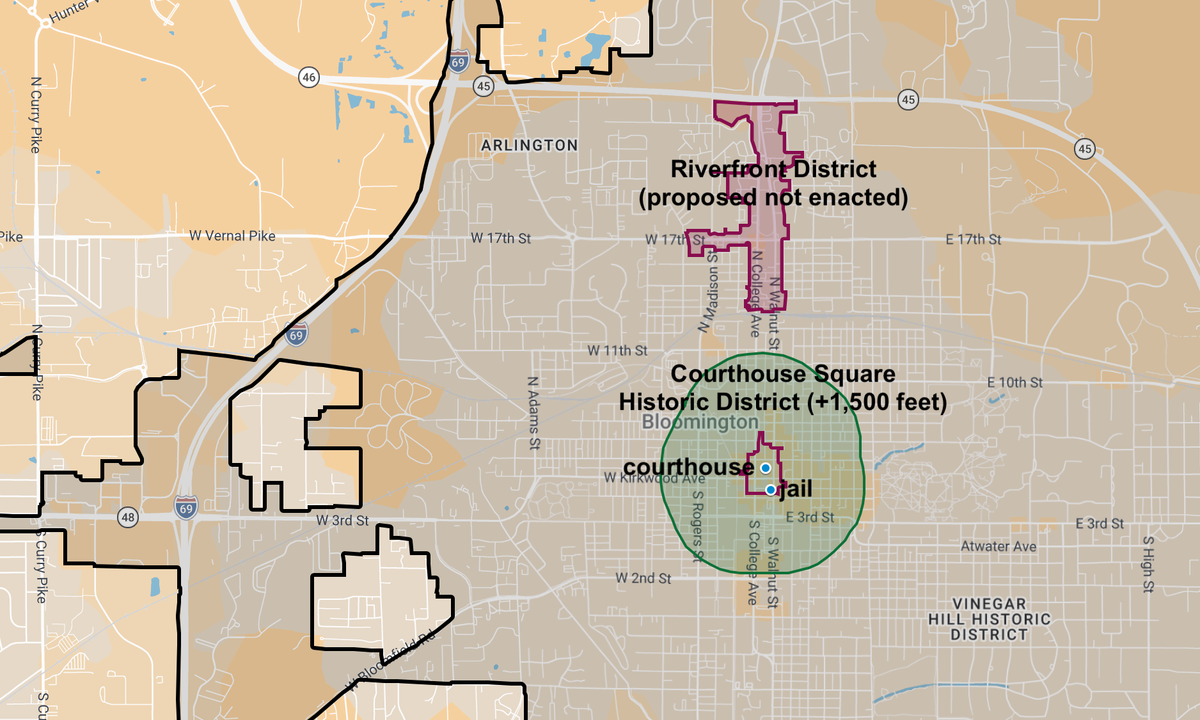
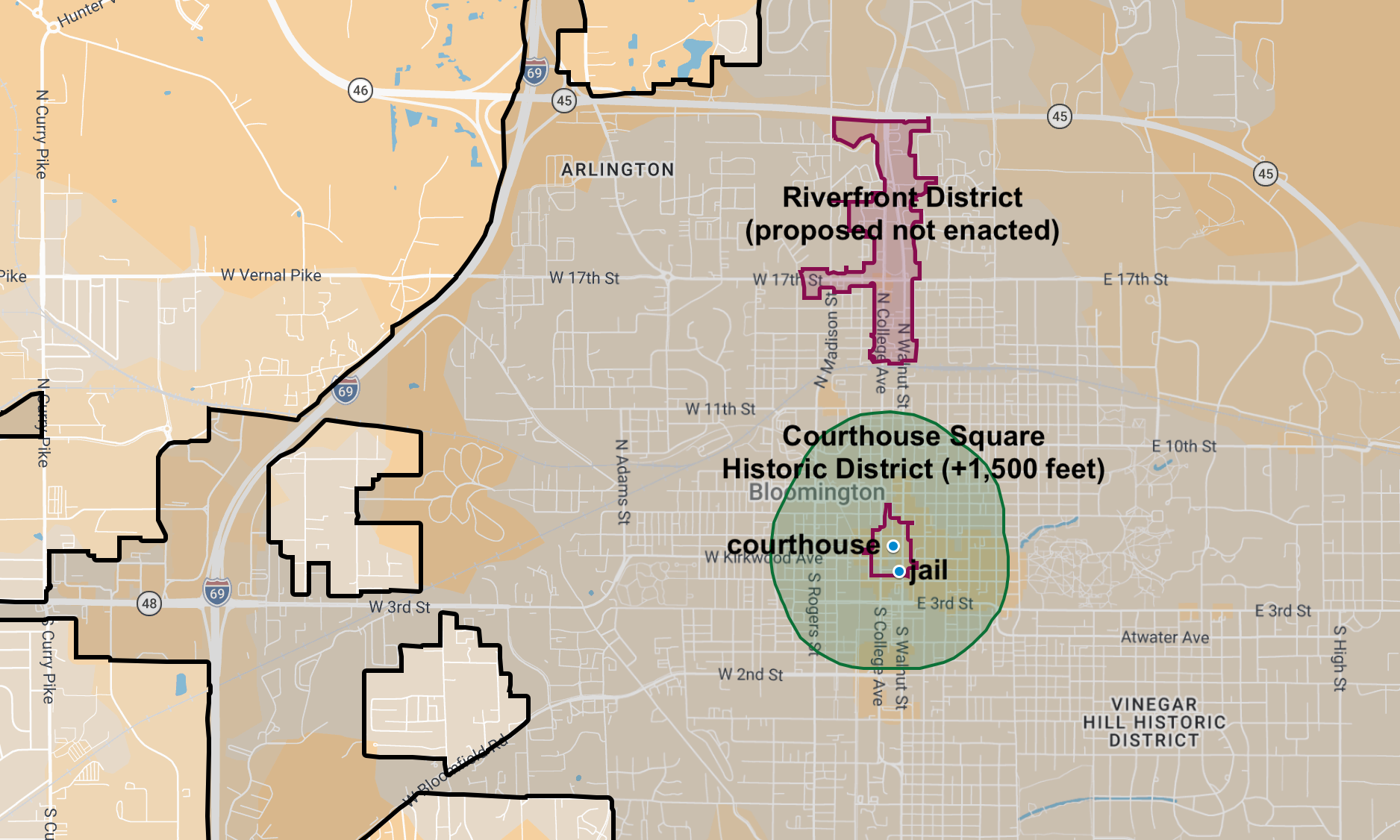
Another cheaper route to a three-way permit that is not constrained by the population-based quota comes through Bloomington’s existing Courthouse Square historic district in downtown. The state statute on the topic allows up to 15 new three-way, two-way or one-way permits for restaurants located inside, or within 1,500 feet of a qualifying historic district. To qualify, a district has to include a county courthouse, or a historic opera house or historic jail and sheriff’s house listed on the National Register of Historic Places. Bloomington’s Courthouse Square district qualifies.
Such permits cost $25,000. The law that allows for 15 extra three-way permits related to a historic district has long been on the books. But the city of Bloomington has never put any regulations in place to make clear what the criteria are for making a recommendation to the ATC.
So Wednesday’s resolution is broader than just the two new SB 89 permits. Its proposed rules would also apply to possible historic-district permits connected to Courthouse Square, as well as to any future riverfront development district program the city might create.
That second category is related to the economic-development idea from last year, that the council did not wind up enacting—a proposed riverfront economic development district around Miller-Showers Park.
In 2025, the city council considered naming the larger area around Miller-Showers Park the “Stadium District.” A companion idea, not acted on by the council, was to establish a municipal riverfront development district using the waterway in Miller-Showers Park as the “river” anchoring the district. The practical effect of such a district would be to open another path to three-way permits outside the population quota.
The proposed June 10 resolution is designed to separate two questions: first, whether the city creates or recognizes a qualifying district; and second, whether the city supports any particular restaurant’s application for a liquor permit inside that district.
The resolution says creation of an eligible district “shall not, by itself,” amount to council approval, endorsement or support for any applicant, premises, business model, permit holder, transfer or renewal. In plain terms, being located in or near enough to a district would not guarantee city backing for a liquor permit.
That distinction matters because additional permits were discussed at the EDC’s meeting on May 19 as economic-development tools, not simply as a way to increase the number of bars.
At the EDC’s May 19 meeting, city council president Isak Asare, who sits on the EDC, described the scarcity of three-way permits as a “huge pain point” for would-be restaurateurs. He said he and other councilmembers have been working on criteria to make clear how the city should evaluate applicants.
Asare said the council needs to think not only about opening a pathway for new restaurants, but also about protecting existing assets and making sure new permits serve broader community goals.
“We don’t want all of these chains coming through,” Asare said. “We don’t want … 27 new bars or something like that, but you want to really think about using this in a way that’s relevant to economic development.”
Under the proposed resolution, the city’s preferred use of these special permits would be restaurant-based economic development. The resolution says permits should be reviewed “as public-purpose tools, not as transferable private assets or automatic entitlements.”
The minimum eligibility rules would require an applicant to operate, or propose to operate, a restaurant with at least 60% of gross retail income coming from food sales, excluding carryout and catering. The proposed premises would have to be inside Bloomington and inside whatever eligible district or geographic area is required by state law.
The applicant would also have to be the proprietor of the restaurant and premises where state law requires it.
The resolution adds local business requirements. If the applicant is an entity, it would have to be formed in Indiana and have its principal office in Monroe County. More than 50% of ownership interests would have to be held by people whose primary home address is in Monroe County, unless the council determines that a different ownership structure would substantially advance the resolution’s public purposes.
Before the city sends a favorable recommendation or support letter to the ATC, the applicant would have to execute a written agreement with the city. That agreement could cover the character of the business, restaurant and food-service requirements, hours of operation, responsible alcohol service, local ownership representations, annual reporting, good-standing requirements, wage affidavits, outdoor seating, trash, noise, maintenance and security.
The resolution also includes anti-speculation rules. A district permit could not be transferred, sold, assigned, relocated, pledged, monetized or otherwise conveyed except as allowed by state law and approved in writing by the council.
That provision addresses one of the central tensions in Bloomington’s liquor-license market. Existing quota-based three-way permits can command six-figure prices. The new state-law permits are meant to serve public economic-development purposes at a much lower entry cost. The city’s proposed rules try to prevent those permits from simply becoming private assets that can be flipped. In that regard, the proposed rules echo what state law already says, namely that permits issued beyond the population quotas are non-transferable.
Under the proposed rules, the city council could require applicants to make a public presentation to the council or a council committee. The presentation could cover the business concept, proposed location, ownership structure, menu, hours, responsible alcohol plan, public benefits, neighborhood compatibility and any requested exception or waiver.
If more eligible applicants seek city support than there are available permits, the city could use a competitive review. The council could recommend one applicant, multiple applicants, no applicants, or fewer applicants than the number of available permits. The resolution says nothing requires the council to recommend the highest-scoring applicant, or any applicant at all.
The Bloomington city council’s meeting next Wednesday (June 10) starts at 6:30 p.m.


Comments ()