
Monroe County commissioners rebut councilor over justice building conditions
Monroe County commissioners pushed back against a councilor’s criticism of their response to sewage damage at the justice center, saying remediation began promptly. They also approved about $118,000 in carpet and building-controls work while describing the aging building as in poor condition.
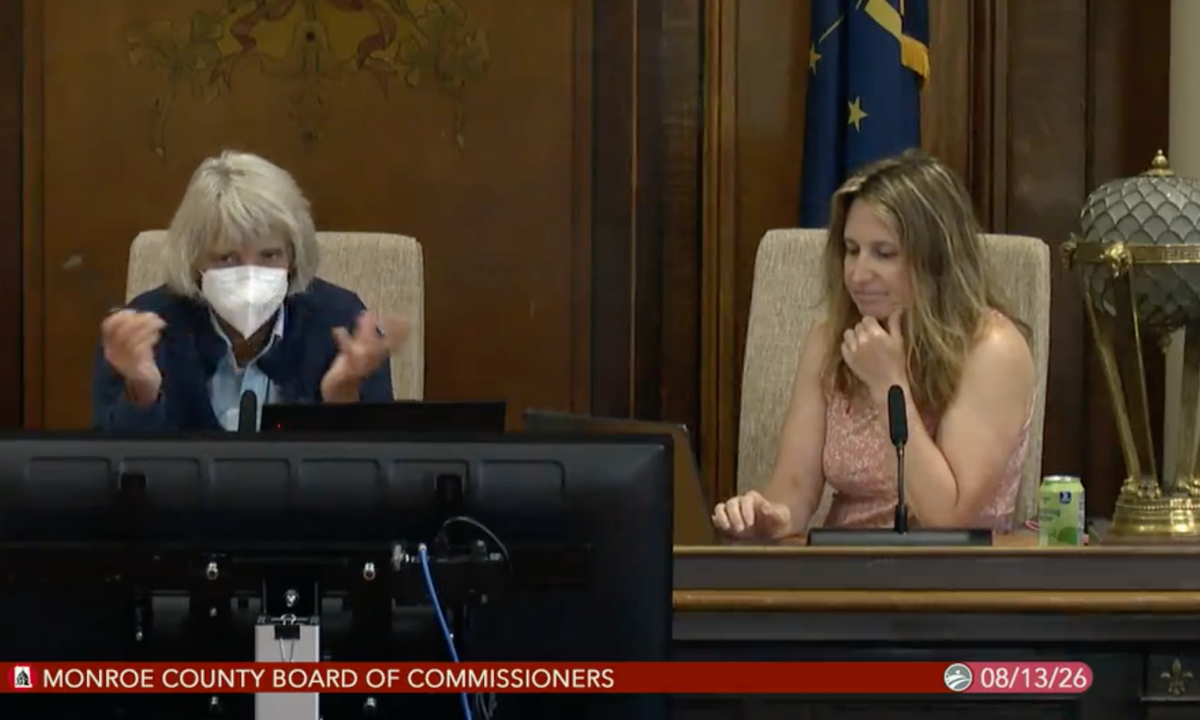
Monroe County commissioners on Thursday (Aug. 13) pushed back against county councilor David Henry’s criticism two days earlier of their handling of recent emergency conditions inside the Charlotte T. Zietlow Justice Center.
They rejected any implication that they had ignored unsafe or unsanitary conditions after a July 24 sewage backup.
The remarks came at the end of a meeting when commissioners Julie Thomas and Jody Madeira voted 2–0 to approve or ratify roughly $118,000 in carpet replacement and building-controls work at the justice building. Commissioner Lee Jones did not attend the meeting.
Henry, speaking at Tuesday’s (Aug. 11) county council meeting, had noted that responsibility for the building rests with the commissioners under Indiana state law.
Henry reported hearing from employees that conditions were still “not cleanly.” He warned commissioners that, if employees were still working in unsanitary conditions, “I hope you bring your body armor to budget season.” He qualified the warning by adding, “if it is true that that’s the case.”
Madeira said Thursday that Henry’s remarks rested on what she called “two unsupported leaps.” First, Madeira said Henry was treating employee allegations as if they were proof the building remained unsanitary. Second, Madeira said Henry was suggesting that if there was any remaining problem, that meant commissioners knew about it and deliberately failed to respond.
“Hearing an allegation isn’t the same as establishing that allegation is fact,” Madeira said. She noted that the IOSHA letters themselves were not citations and did not establish that the alleged hazards existed.
The letters each say “This letter is not an IOSHA citation or notification of proposed penalties or fines … ” [Complaint No. 2473934] [Complaint No. 2473949] The letters also note that citations can only come after an inspection. An unannounced inspection came this Tuesday, after last Friday’s letters said no inspection was planned at that time. [Added Aug. 13, 2026 4:42 p.m. There are two known response letters from IOSHA to Monroe County government in response to employee complaints. There are reportedly at least five additional employee complaints stemming from the incident, which could have factored into IOSHA’s decision to conduct an unannounced inspection.]
Madeira said professional remediation crews arrived about an hour after the July 24 sewage backup, and pointed out that the building was closed for four working days. Damaged carpet, drywall and other materials were removed while affected areas were cleaned, sanitized and dried, Madeira said.
The flooding began when a bag containing e-cigarettes was flushed down a jail toilet, blocking a sewer line and sending wastewater through ceilings into offices below.
Madeira acknowledged that commissioners have statutory responsibility for the justice building facilities. But she added that responsibility for responding to an incident is not the same as causing it or being indifferent to it. Alluding to Henry’s mention of “budget season,” Madeira said commissioners would come to September budget hearings with “facts, remediation records, project needs, and funding requests,” and said the process should not become “an occasion for threats or assumptions about one another's motives.”
Thomas said she agreed with Madeira. “I really wish people would not talk about things they don't know anything about,” Thomas said later in the discussion. She thanked county staff for their work responding to the building problems.
County attorney Jeff Cockerill, who was present for IOSHA’s unannounced Tuesday inspection, said inspectors toured the damaged areas and were shown where carpet, drywall and other materials had been replaced. Cockerill said the county would provide documentation of the work to IOSHA. Inspectors also interviewed employees without county officials present, he said.
At Thursday’s meeting, commissioners administrator Angie Purdie also pointed to a separate state health department air-quality assessment based on samples collected July 22, concluded that the building’s air quality was acceptable. Indoor fungal concentrations were lower than the outdoor concentration, and carbon-dioxide and humidity readings were within the benchmarks discussed in the report. Purdie said that assessment found acceptable mold-spore and carbon-dioxide levels.
Because that testing preceded the sewage incident, it did not address conditions resulting from the July 24 flooding.
Before the closing remarks Thursday, commissioners approved two Bounds Flooring agenda items stemming from the July 24 flooding. One ratified an emergency contract of about $23,683 to replace carpet in court offices. The other approved $35,362.63 to replace carpet tile throughout the clerk’s office.
Commissioners also ratified a separate $59,100 Harrell-Fish Inc. contract for Phase 4 of an ongoing building-controls project, including engineering and site work for three air-handling units.
Even as Thomas rejected criticism of the county government’s response to the recent incidents, she gave a stark assessment of the justice center itself. “This building is in terrible shape,” Thomas said, citing structural, HVAC and functional problems. She said the latest problems underscored the need to move forward with the county’s jail project.
Purdie likewise rejected assertions that the county had failed to maintain the building. She said county staff have kept it functioning despite a design that limits what improvements can be made while the jail remains a round-the-clock operation that cannot simply be emptied for a major renovation.
Part of the general backdrop of the justice building’s condition is the new lawsuit filed on July 10 by the ACLU on behalf of two prisoners, over conditions at the jail. [Monroe County Jail Timeline]



Comments ()