
Bloomington grows by a quarter-acre after 6–3 vote to OK owner-requested annexation
Bloomington’s city council voted 6–3 to approve a voluntary annexation of a wooded parcel on Cory Drive, adding about a quarter-acre to the city. Neighbors warned of drainage and karst risks. New R2 zoning was also approved which would allow a duplex as a conditional use.
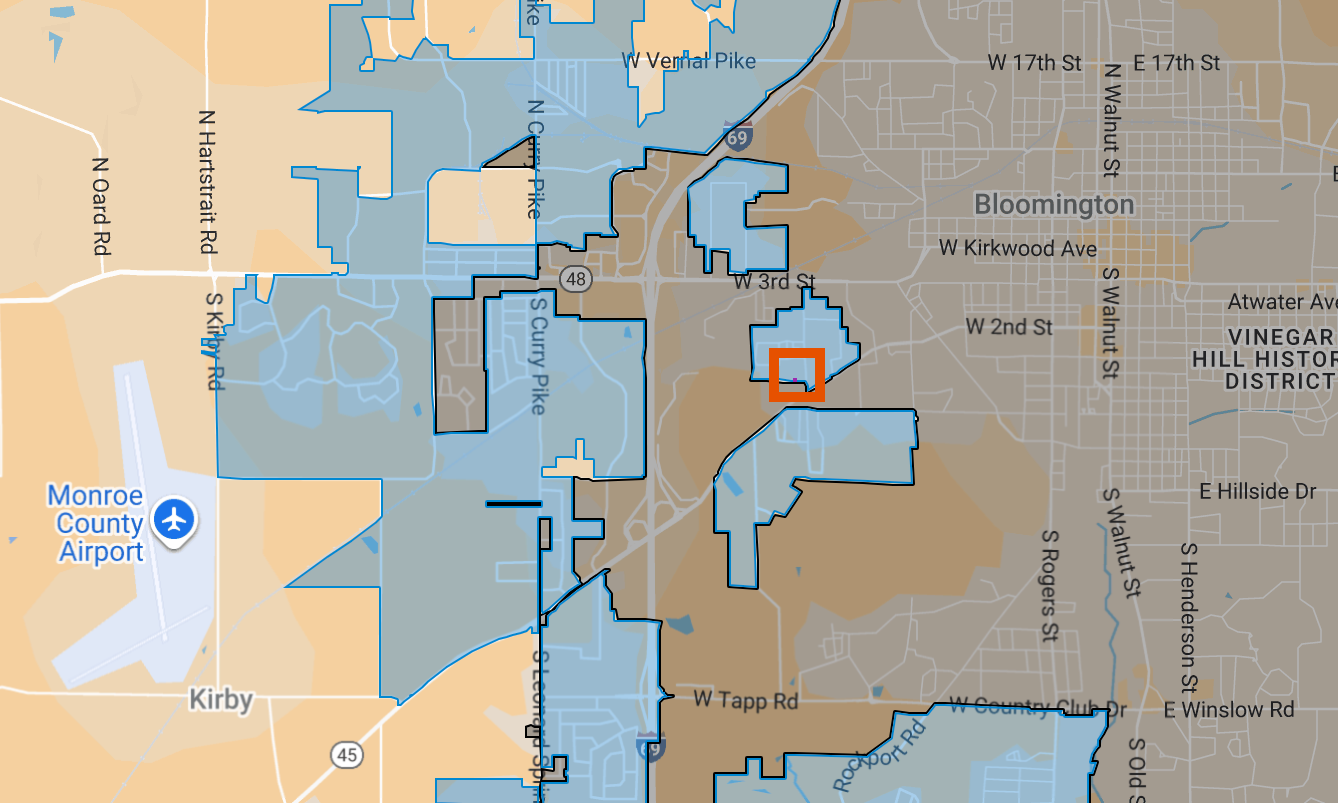
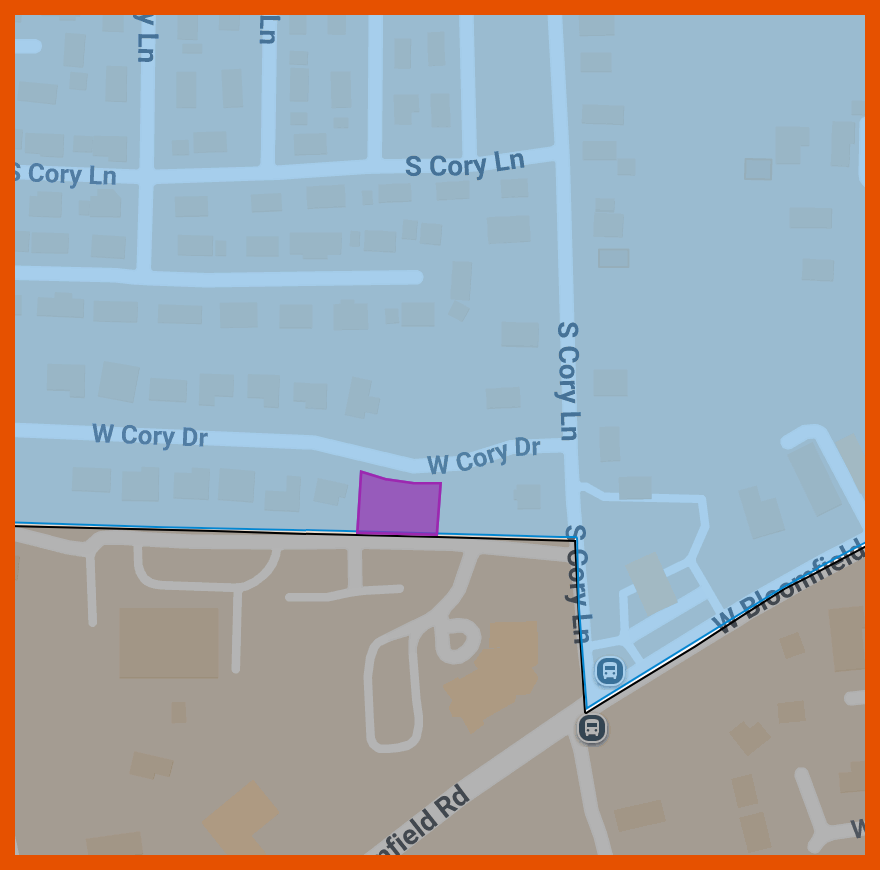
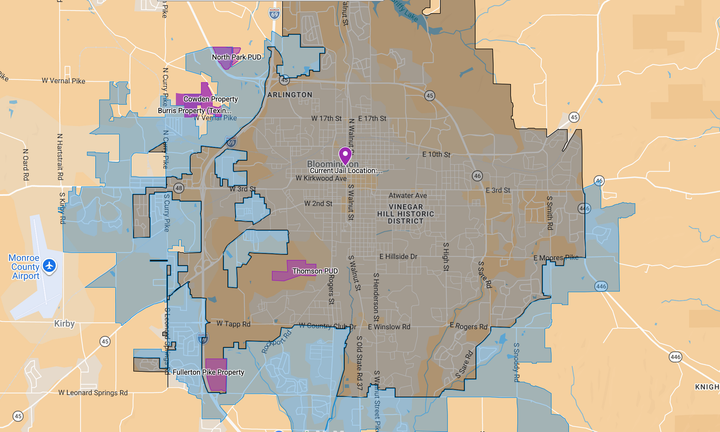
Maps by The B Square with information from city of Bloomington and Monroe County. The blue area is territory that the city of Bloomington tried to annex starting in 2017 and still the subject of litigation. [link to dynamic map]
The total area of Bloomington grew by a quarter of an acre after a vote by the city council on Wednesday night. The approval of a voluntary annexation for one wooded parcel at 2005 West Cory Drive came over objections from nearby residents.
The council was split 6–3 on the vote with Andy Ruff, Dave Rollo, and Courtney Daily voting no. A related ordinance to zone the newly annexed lot as R2 (residential medium lot) passed 7–2, with Ruff and Daily dissenting.
At its meeting in the first week of December, the council hand already approved the fiscal plan in connection with the proposed annexation. The city’s plan commission had recommended the R2 zoning for the parcel in mid-November.
The property sits on a short dead‑end street of single‑family homes just outside current city limits in one of the so-called “islands” that are included in the ongoing litigation between the city and property owners over the city’s attempt to annex territory into the city dating back to 2017. The annexation approved on Wednesday night was requested by the owner, not initiated by the city.
Assistant city attorney Chris Wheeler told councilmembers that under Indiana’s “super‑voluntary” annexation statute, the council’s role is narrow: the city must verify contiguity, a valid petition, and adoption of a fiscal plan.
Wheeler said the only way to legally oppose the annexation would be to challenge contiguity. But it is a geometric fact that the parcel exceeds the requirement that at least one-eighth of its perimeter is shared by the city border, which is the definition of contiguity.
Wheeler also said that neighbors’ concerns about drainage, karst and construction impacts are not part of the annexation test:
At least five residents of Cory Drive spoke against approval, warning that any development on the lot could exacerbate flooding and destabilize nearby homes, especially given the owner’s plans for building a duplex there.
Jay Nelson, whose grandmother lives next door, said the parcel practically functions as “a drainage system” tied to a single cross‑road pipe: “If this wooded lot is cleared and filled and paved for a duplex with parking, you’re concentrating more water into a very small basin tied to one cross road pipe.” Nelson added, “If that pipe ever plugs, fails or simply cannot handle extra volume, the city will own that problem once the land is annexed.”
Nelson also cited karst risks: “Cutting the trees, adding a structure, driveway, storm water facilities without a site‑specific geo‑technical and karst study is a serious risk for the future residents and for the city’s utilities.”
Neighbor Paul Post framed the whole effort as being driven by sewer access while broader annexation litigation is unresolved: “The only reason we’re here is because the owner just wanted to build on the property and couldn’t connect to the sewer lines.” Post said that it would make much more sense to let all of the currently pending annexation litigation get settled instead of annexing a single lot.
During city council deliberations, Matt Flaherty tied the case to the city’s broader annexation and sewer‑connection history, noting that current City of Bloomington Utilities policy bars new sewer hookups outside the city. Because of that, Flaherty said, the parcel will have to be annexed as part of a larger area or will need individual annexation in order to be developable. In either case, the annexation of the single parcel makes sense, Flaherty said
Isabel Piedmont‑Smith thanked residents for their remarks but said the focus of the council’s consideration was narrow: The council has to decide the question of annexation based just on the legal criteria in front of it.
The question of what is allowed to be built on the parcel can’t be considered by the council until the parcel is a part of the city of Bloomington, Piedmont-Smith said. Piedmont-Smith said annexation is the prerequisite for applying the city’s more stringent stormwater and environmental rules
Hopi Stosberg acknowledged the drainage concerns, but framed annexation and zoning as procedural steps, not a development approval: “I have a whole lot of faith that this isn’t just, like… if we annex it, then these people can do whatever they want … That’s just not the way it works.”
Ruff, who dissented on annexation, reported that he had visited the site, and called most of it “a literal water conveyance channel” that would require “a significant amount of modification of the grade” to build on it. Ruff said, “I don’t think it makes any sense… to annex this while we’re in the middle of this annexation fight… I don’t want to throw this little bit into the mix and confuse it even more.”
Rollo echoed the concern about acting while broader annexation litigation is unresolved: “The decision is pending, and I would prefer to wait to see how that manifests, rather than do this incrementally at this point.”
Daily said she was “not convinced that annexing this property is in the best interest of the city or the residents of Cory Drive,” saying that neighbor Paul Post’s phrase, “a headache of logistical problems,” was apt. urging delay until the larger annexation question is settled.
When the zoning ordinance came forward, Daily and Ruff also voted no on assigning the new R2 city zoning. Rollo supported the zoning once annexation had passed.
The city’s development services manager Eric Greulich explained that R2 mirrors the historic lot pattern in the subdivision: the parcel was originally platted in the 1990s under city zoning that allowed 7,200‑square‑foot lots, the same standard now mapped to R2.
Greulich told council the zoning does not guarantee any specific project will be approved. A single‑family home could be permitted by right, but a duplex would require a conditional use approval and neighborhood meeting before the board of zoning appeals. In either case, he said, the city would enforce its karst, sinkhole‑setback, tree‑canopy, and stormwater standards.
“Annexing it doesn’t guarantee that they can do everything that they want,” Greulich said. “The zoning code has a lot of layers to it that guide what can and can’t happen here—setbacks, environmental preservation features …”
Comments ()