
Bloomington plan commission gives nod to housing code changes, zoning for 2 voluntary annexations
On Monday (Oct. 12), Bloomington’s plan commission recommended the new zoning for two voluntary annexations. The commission also recommended UDO changes easing rules for duplexes, cottages and ADUs.
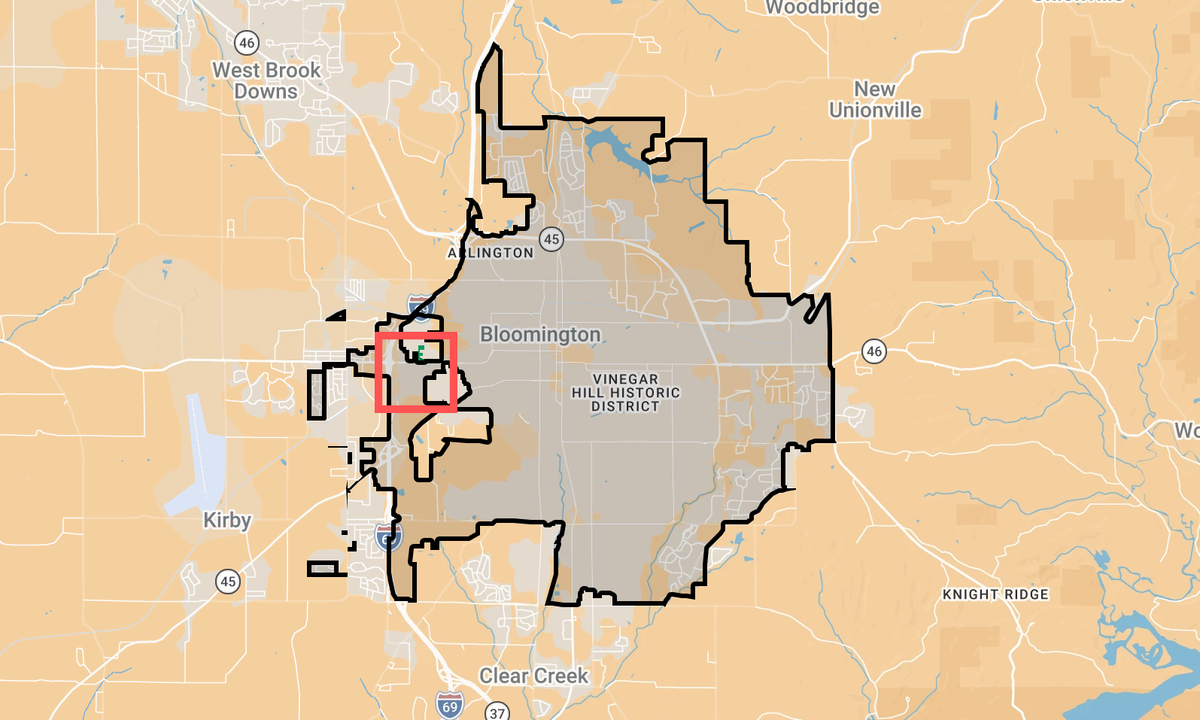
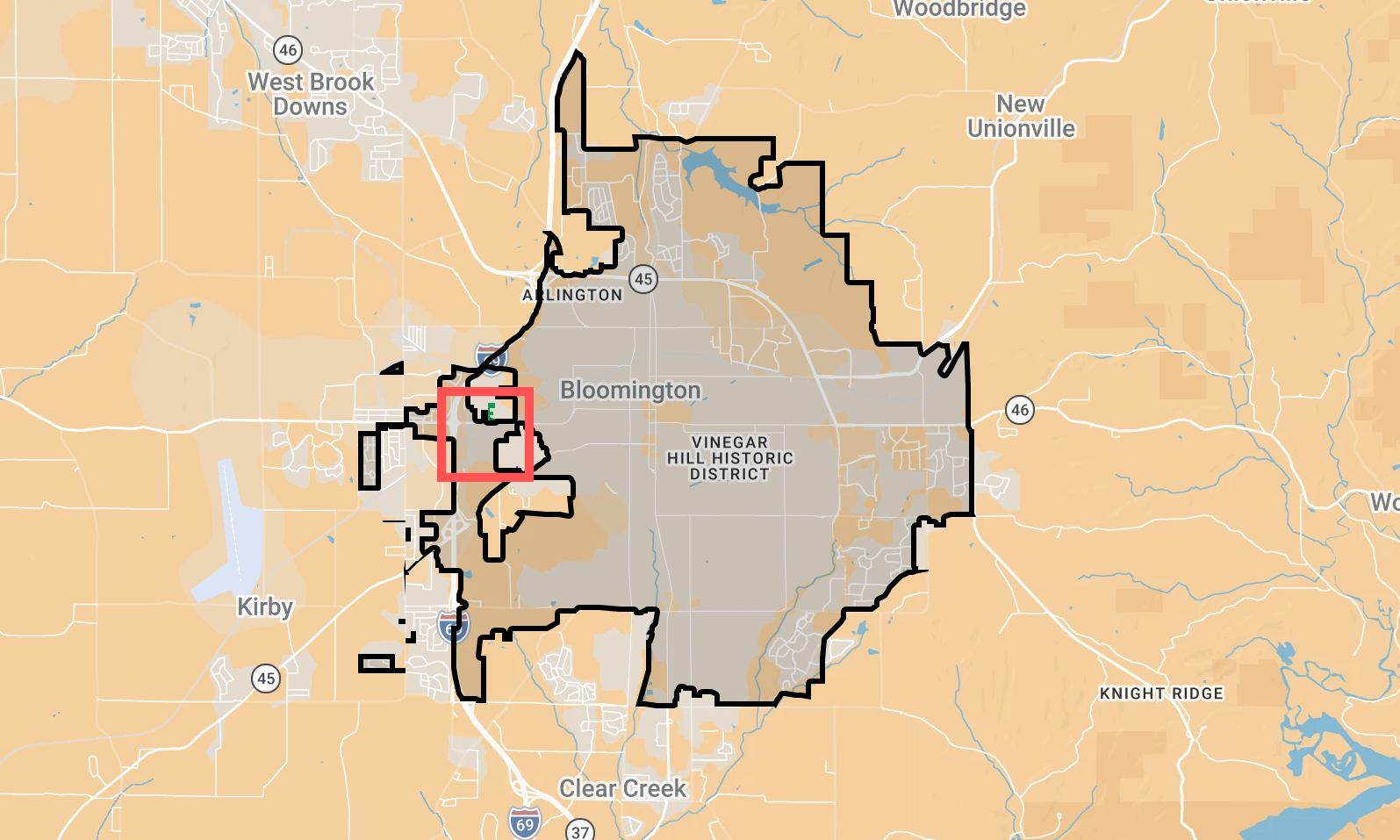
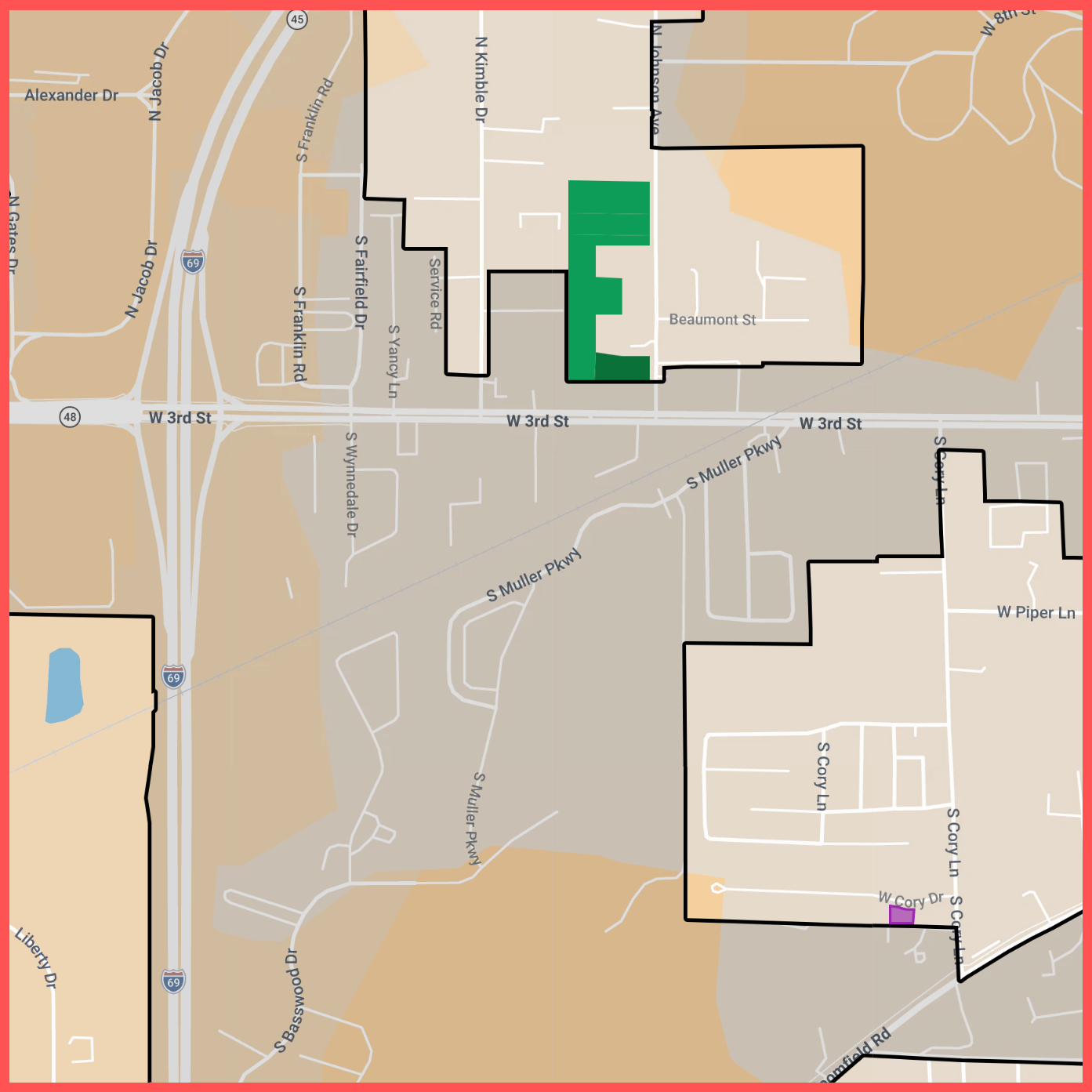
Zoning for areas shaded light and dark green were considered by Bloomington’s plan commission on Monday (OCt. 12). Dark versus light shading distinguishes the different ownership of the parcels. The area shaded purple was voluntarily annexed in late 2025. Maps by The B Square Bulletin with information provided by the city of Bloomington. [link to dynamic map]
Bloomington’s plan commission voted unanimously on Monday (Oct. 12) to recommend zoning for two voluntary annexations along Johnson Avenue, near West 3rd Street and I-69.
The commission also gave a favorable recommendation to changes in the city’s unified development ordinance (UDO) intended to make some housing types easier to build.
All three recommendations passed unanimously among the five members present, which was the minimum number needed on the nine-member commission.
Final decisions on annexation, zoning for the annexed territory, and UDO amendments will be made by the city council.
New zoning for area to be annexed
Even though the land in the unincorporated part of the county already has defined zoning under county government zoning code, any areas to be annexed into the city, have to get their zoning set under the city’s unified development ordinance (UDO). It’s the city council, not the plan commission that will eventually decide whether the territory is actually annexed into the city.
Monday’s first annexation zoning petition involved about 0.77 acres, where commissioners recommended mixed-use corridor (MC) zoning. That matches neighboring commercially zoned property owned by the petitioner.
The second involves a larger collection of long, narrow parcels, recommended for residential multifamily (RM) zoning. Commissioner Hopi Stosberg wondered whether less-intensive R4 zoning would provide a better transition to the surrounding neighborhood. In the end, she supported the RM recommendation.
Representing the owners, local realtor and former city plan commissioner Chris Cockerham said at Monday’s meeting that the owners hope to attract an affordable-housing developer, possibly Habitat for Humanity. Cockerham specifically mentioned access to city sewer service as a positive factor. Access to sewer service has been a key issue in the context of annexation. Bloomington’s basic policy is not to extend sewer service outside city limits.
The properties considered on Monday lie in an unincorporated “island” surrounded by city territory. They are another case of the kind of parcel-by-parcel annexation approved by the city council in December 2025, when a quarter-acre lot at 2005 W. Cory Drive was voluntarily annexed on a 6–3 vote.
Both “islands” have been part of Bloomington’s disputed, long-running effort to annex surrounding territory, which dates to 2017. That litigation is on two separate tracks, one of which has wrapped up February 2026, when the Indiana Supreme Court declined to review a ruling that blocked annexation of Areas 1A and 1B.
But in the other track, which affects the “islands,” the city’s separate constitutional challenge to a 2019 state law remains pending before the state’s high court. The 2019 law invalidated many agreements waiving the rights of property owners to oppose annexation.
The city contends that the 2019 law unconstitutionally impaired its contracts with property owners. An appeals court ruled against Bloomington in February 2025. The constitutional case is approaching the first anniversary of the Oct. 30, 2025, Supreme Court oral arguments.
Housing-related UDO amendments
The UDO amendments recommended Monday would eliminate the annual limit of 15 duplex approvals and the two-year, 150-foot separation requirement for certain duplexes. They would also increase permitted cottage-development densities, relax some related development standards, and allow individual exterior entrances for units in triplexes and fourplexes. Design comparisons for duplexes, triplexes, and fourplexes could take account of houses on both sides of a street.
Another change would align the city’s accessory dwelling unit (ADU) definition with the state’s limit of 75% of the primary dwelling’s habitable area or 1,000 square feet, whichever is less. That definition has been made a part of Indiana law, under IC 36-7-1-1.5. The current cap for ADU square footage in Bloomington’s UDO is 840 square feet. The recommended changes will be in front of the city council sometime in the coming weeks.
The recommendations come ahead of a special plan commission hearing on Wednesday, Oct. 28, at 5:30 p.m. in city hall, devoted to public input on housing and development regulations.
The hearing is required under House Enrolled Act 1001, enacted this year. Under IC 36-7-4.3, local governments must review development regulations for barriers to housing, including density limits, parking requirements, ADUs and permitting procedures, and report the results to the state by Jan. 1, 2027. The Oct. 28 meeting is for receiving public input, not voting on amendments.
In a planning staff memo written for some UDO amendments to be considered by the plan commission at its Aug. 10, 2026 meeting, the hearing on those amendments was described as fulfilling the HEA 1001 requirement: “[T]his hearing fulfills the public hearing requirements of IC 36-7-4.3 as added by HB 1001.” Those UDO changes were later enacted by the city council in mid-September.



Comments ()