
Bloomington plan commission wants answers on stormwater before subdivision vote
Bloomington’s plan commission put off action on a revised 14-lot North Dunn Street subdivision until July 13, citing unfinished CBU stormwater review. Neighbors opposed the plan over flooding, tree loss, and wetland questions.
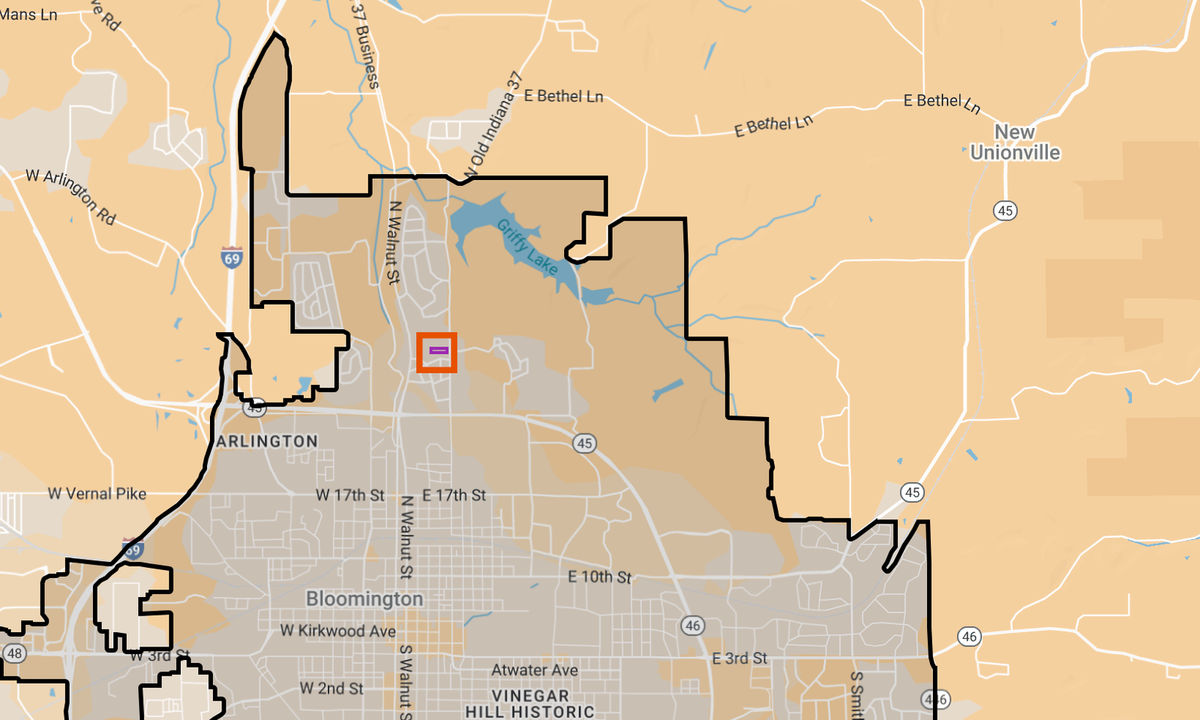
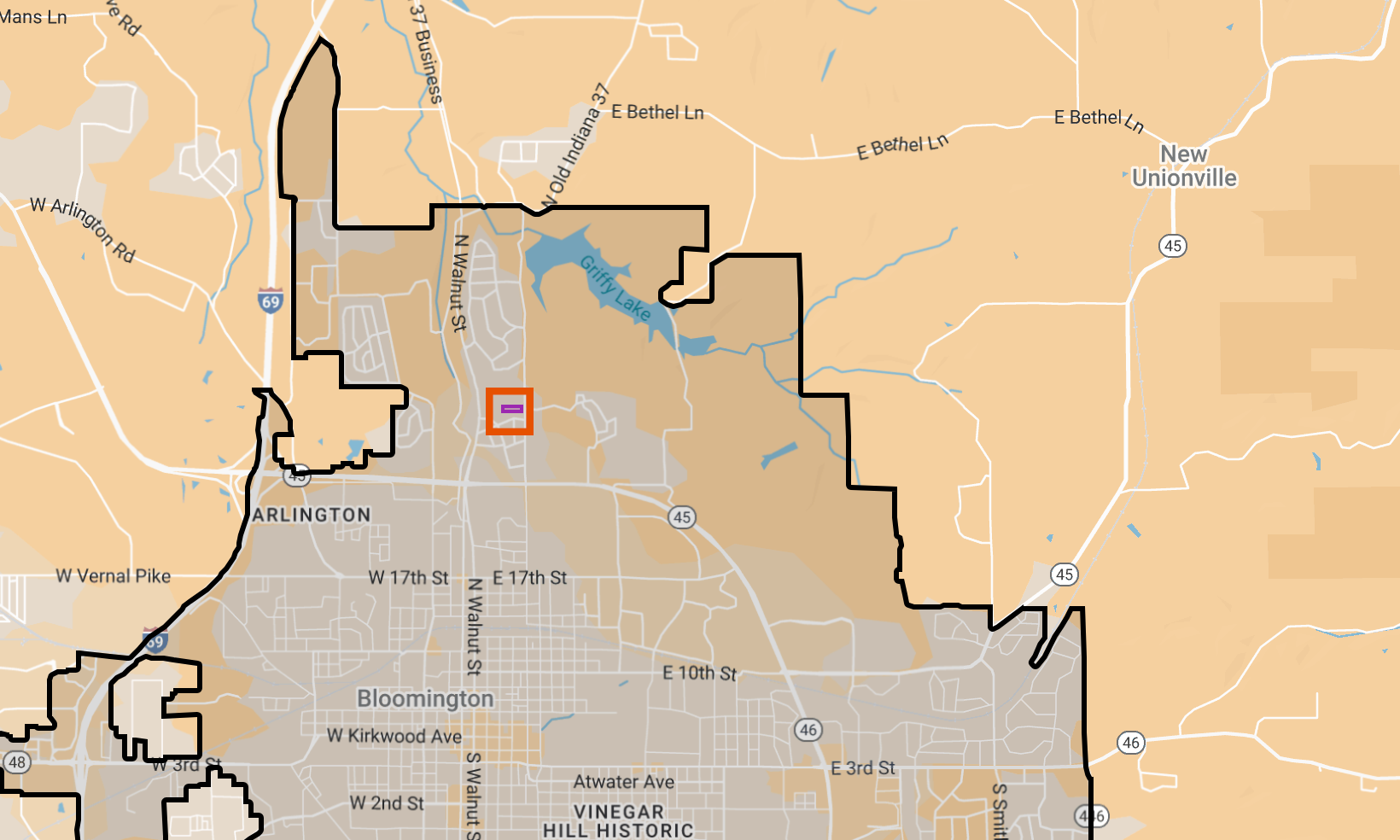
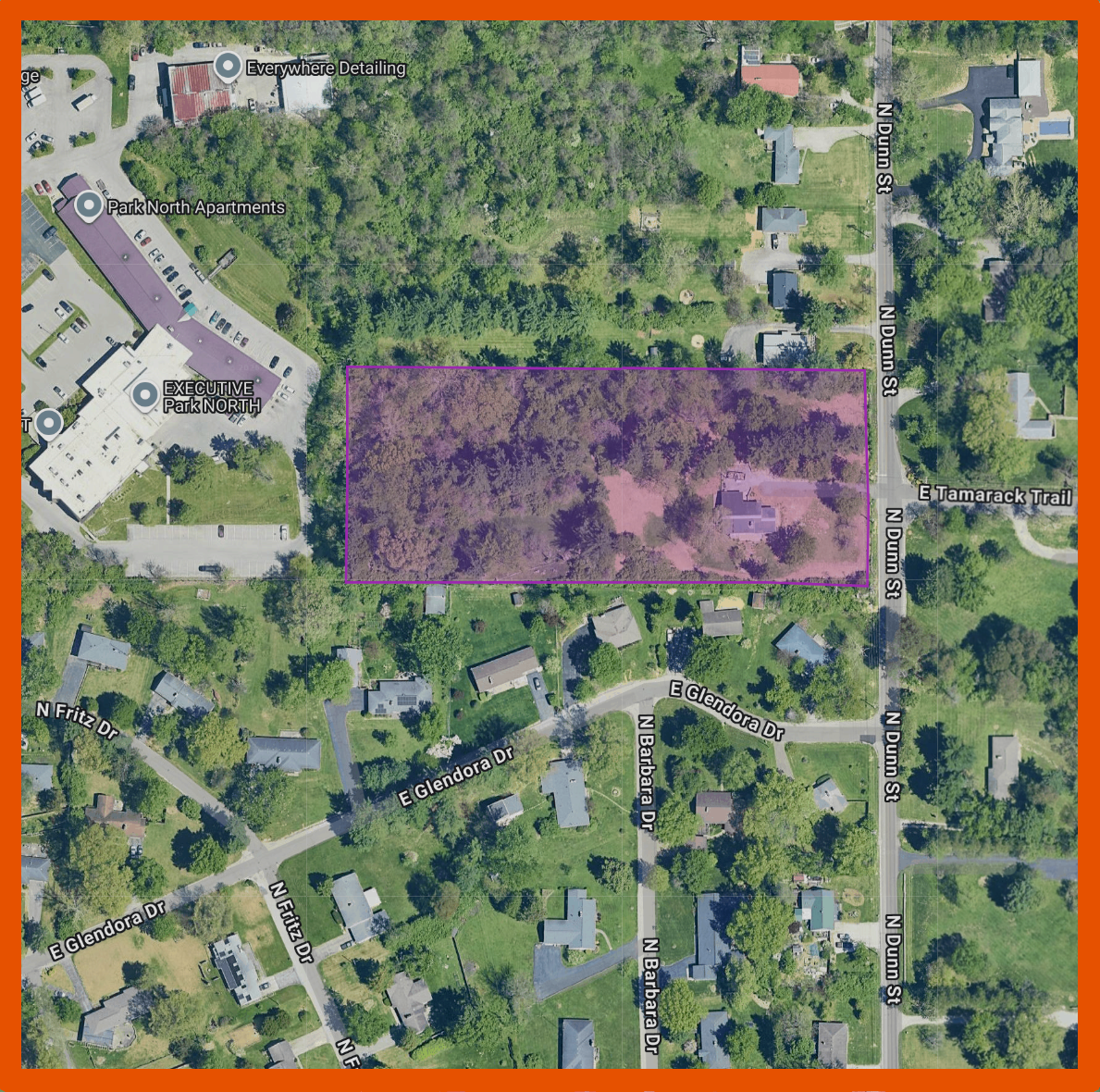
Maps by The B Square with information from the city of Bloomington. [link to dynamic map]
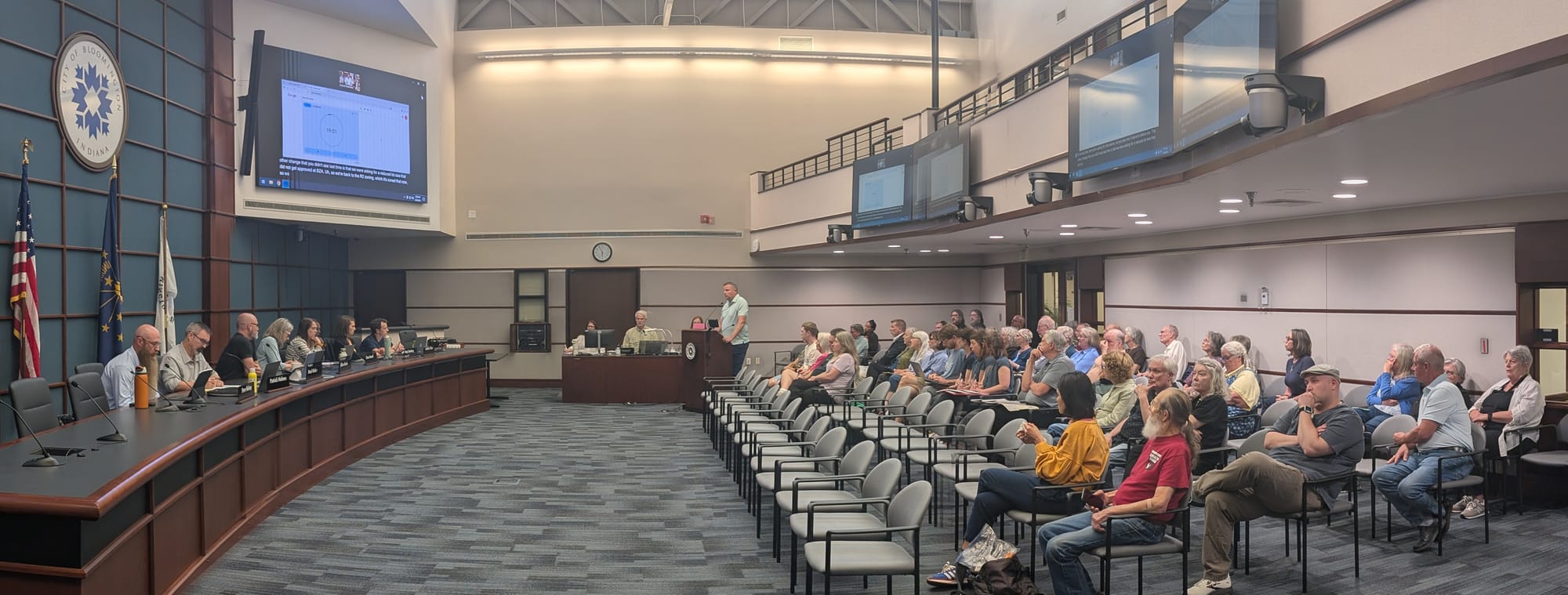
The Bloomington plan commission on Monday night (June 8) declined to take final action on a controversial subdivision proposed for North Dunn Street, instead voting unanimously to continue the case to a required second hearing, which will take place on July 13.
The plan commission had already considered a version of the petition in January.
In front of the plan commission on Monday was a revised proposal, this time for a 14-lot subdivision on 4 acres at 2511 N. Dunn St., where an existing single-family house would be demolished and replaced with 11 single-family residential lots and three common-area lots. The property is zoned R2 (residential medium lot) and the proposal calls for a new public street, stormwater detention, utility work, tree-preservation areas and drainage improvements.
The request was reduced from the earlier 18-lot version with 15 residential lots that was proposed in January. The petition, filed by Paul Pruitt and Keith Klein and represented by engineer Daniel Butler of Bynum Fanyo & Associates, is asking for a waiver to allow a cul-de-sac, another waiver to suspend a rule requiring 67% of lots to be served by alleys, and a revision to riparian-buffer easement wording that is tied to stormwater maintenance.
The proposal in front of the plan commission on Monday was different enough from the January version that it was treated as a fresh proposal, subject to the plan commission’s mandatory two-hearing requirement, unless waived by the commission. Continuing its consideration until July 13 meant the plan commission did not waive the second hearing.
Planning staff had recommended continuing the proposal, citing among other unresolved issues a stormwater review by City of Bloomington Utilities (CBU). Plan commissioners were clear about their expectation that a representative from CBU would be present for the July 13 plan commission hearing.
It was Bloomington’s senior zoning planner Jamie Kreindler and development services manager Eric Greulich who gave the staff report on the proposal to plan commissioners, which included some variances considered in February by Bloomington’s board of zoning appeals. The BZA denied some of the requested variances, which covered smaller lot areas, narrower lot widths and reduced side setbacks.
But the BZA also granted some variances related to the city’s tree and forest preservation standards and riparian buffer requirements. With those variances, the proposed road and stormwater facilities were allowed to proceed as designed.
But some residents have asked for a judicial review of the variances that were granted by the BZA. A hearing on the granted variances in front of circuit court judge Emily Salzmann is set for June 17. Greulich said the city’s legal department has advised that the pending court proceedings do not prevent the plan commission from acting on the petition, though it would limit the petitioner’s ability to proceed with construction.
The commentary from the public mic on Monday night was uniformly against the proposal. Much of the opposition was based on existing stormwater management and flooding issues in the nearby Matlock Heights neighborhood. The remarks from Fritz Drive resident Deirdre Sheets were typical:
The plan to significantly reduce permeable surfaces, remove trees that naturally prevent or mitigate erosion, and leave it up to the homeowners to manage a detention pond all upstream from an area without storm drains and with already existing drainage and flooding issues, to pretend that anything other than the obvious is going to happen, is to participate in a fiction, and it feels like—and I apologize for my language here—but and it feels like giving the homeowners and residents of Matlock Heights a really big middle finger.
City planning staff had recommended the continuance, saying the updated Northgrove plan is not yet ready for approval. That’s mainly because City of Bloomington Utilities (CBU) has not finished its stormwater review and several legal and technical questions remain unresolved.
Proposed subdivision: Changes since January review
Under the proposal heard by the plan commission on Monday, the subdivision would use conforming R2 lots, which means each is at least 60 feet wide and 7,200 square feet. That’s because Bloomington’s board of zoning appeals (BZA) denied requests for smaller lots and reduced side setbacks.
The current proposal includes three subdivision waiver requests. One is a waiver from the general ban on cul‑de‑sacs in the city’s Unified Development Ordinance (UDO). A waiver would allow the internal street to dead‑end in a hammerhead turnaround instead of extending as a “stub street” west to the adjoining large commercial tract. Another waiver is requested from the UDO requirement that at least 67% of lots in a traditional subdivision be served by an alley.
A third waiver would allow CBU to access and “disturb” riparian buffer areas as needed to maintain stormwater facilities
About the stormwater issue, Kreindler said CBU had given only conditional authorization to bring the plan to a first hearing. CBU has flagged conflicts among easements, tree plantings, and drainage paths and says there are “unacceptable outfall rates” that still need to be fixed.
Based on CBU’s feedback, Kreindler told commissioners, the planning department recommended that the plan commission continue the case to its required second hearing on July 13.
Commissioners on cul‑de‑sacs, connectivity, and flooding
Commissioners focused their questioning on three issues: street connectivity, the subdivision’s interaction with long‑standing flooding in Fritz Terrace and Matlock Heights, and the modified riparian buffer wording.
Bynum Fanyo’s Daniel Butler, speaking for the petitioner, told the commission that the new 11‑lot design reduces the amount of housing from the 15 lots proposed in January, eliminates an earlier sidewalk waiver request, and adds more common open space to preserve mature trees. The big change now on the table is a shorter street, ending in a hammerhead rather than being built all the way to the west property line.
Butler said fully extending the street west, as staff previously advocated, would require about 188 additional feet of road, disturb about 11,470 square feet now left in a common area, and remove roughly 24 large trees. He estimated the extra road would cost about $400,000, or roughly $38,000 per lot. He said that would be reflected in higher home prices. Butler said the development team is trying to keep homes under $500,000 for 1,500‑ to 2,000‑square‑foot houses.
From planning staff’s perspective, Greulich said, the larger issue is the city’s long‑term street network. “The installation and establishment of a road network is something that you’re dealing with for the next 100, 200 years,” he said. “We are paying the price for a lot of cul‑de‑sacs that have been done over the past 80 years.”
Greulich said that extending the street as a stub to the west property line would preserve the option of a future east‑west connection between Dunn and Walnut as the large, currently unplatted tract to the west redevelops. Without a stub, he said, traffic would be forced onto a few existing connections such as Glendora through Fritz Terrace.
Greulich discouraged a compromise where the right‑of‑way would be dedicated but the street not built, saying that would leave taxpayers on the hook eventually to construct and maintain a road that should be the developer’s responsibility.
The situation led plan commission president Brad Wisler to suggest that some kind of payment-in-lieu option should be developed for incorporation into the UDO. That way the developer would pay the cost, but the road would not be built until the connection was actually needed, leaving the stretch unpaved and pervious as long as possible.
On flooding, commissioners Jillian Kinzie and Hopi Stosberg asked whether the project would worsen conditions for properties downhill on Glendora and Fritz Drive, where residents say basements are already regularly flooding.
Greulich said that question is exactly why staff want more time for CBU’s review. The goal, he said, is that the plan either improves the current situation or at least does not make it worse. He also stressed that, unlike now, the developed site would have a formal stormwater collection system with basins and swales and that North Dunn Street currently has no storm sewers in this area.
Butler contended that no runoff from the new development would go south. Instead, he said, it would be directed to basins and then west through existing infrastructure. He noted that CBU has put his drainage report through three rounds of review by an outside firm.
On the riparian buffer waiver, Kreindler and Greulich explained that the standard easement wording—intended to prevent disturbance—conflicts with CBU’s need to mow, access, and excavate where necessary to maintain stormwater pipes and basins. The new wording, they said, was developed jointly by planning staff, CBU, and the city’s senior environmental planner to allow disturbance only as required by CBU and the operations manual.
Stosberg asked for a clearer, public explanation of how the city decided the on‑site seasonal pond is not a regulated wetland. Greulich said the city’s environmental planner visited the site and concluded it did not meet the criteria for a delineation as a wetland, but that the pond area is still being preserved in common open space and the riparian buffer. The planning department’s environmental planner is Rachael Johnson.
Kinzie and Stosberg both requested that a CBU representative attend the July hearing and that commissioners receive more direct documentation on the stormwater manual and the earlier wetland assessment.
Public mic: 10 speakers, all opposed
Ten people spoke at the public microphone. All ten opposed the subdivision as currently proposed and urged at least a delay, if not outright denial or major redesign.
Attorney Jason McAuley, representing several nearby owners, argued that the revised plan is “fundamentally different” from what neighbors had first seen and highlighted that CBU’s internal review still shows only 13 percent completion. He questioned the absence of a formal wetland delineation and pointed to an unresolved sanitary sewer easement across a lot to the south. With a court challenge to the BZA decision pending, he asked the commission to put off the decision until the second hearing is held.
Julie Williams showed video of water coursing across her yard and into her finished basement during what she described as a routine storm, not a rare event. Despite a French drain, sump pump, and landscaping work, she said she has suffered repeated uninsured losses.
Deirdre Sheets, speaking for a neighbor, described a May storm that completely flooded his recently purchased home’s finished basement, requiring removal of all flooring and significant drywall.
Longtime Fritz Drive resident Jeanne Ream traced her flooding problems to the 1970s when a development was constructed on North Walnut, which she said already channels water onto her backyard. She warned that removing trees and adding pavement on Dunn Street would only increase the volume of stormwater.
Julia Livingston brought photos of large pines, seasonal water, and wildlife in the back acres, saying that the area functions as a wetland and wildlife corridor between Griffy Lake and Cascades Park. She urged a conservation‑oriented approach and a formal wetland delineation.
Greg Grant criticized inserting what he termed “high‑density urban‑style housing” into a moderate‑density R2 area.
Jessica Will reported on a petition opposing the project, saying organizers had collected 291 signatures representing 253 households, including all adjacent households except one also owned by Pruitt.
Stephanie Dickinson and Susan Sandberg both stressed the status of Matlock Heights as a historic mid‑century neighborhood with no alleys and no sidewalks. Sandberg called the proposed subdivision “an insult, a violation of our trust in the UDO and in city planning.”
Robin Halpin Young accused the city of pursuing “density at any cost” and characterized the use of multiple waivers and variances as “pocket zoning.” She said the project should instead be treated as a conservation subdivision under the UDO, designed to cluster homes while protecting sensitive environmental features.
The plan commission voted unanimously to continue the Northgrove petition to July 13 for its required second hearing, with a clear expectation that CBU and staff will bring more complete answers on stormwater, riparian buffers, and the wetland determination.


Comments ()