
Bloomington proposes $6.87M bond issue for fire truck, street safety, plans for regular borrowing
Bloomington is considering about $6.87 million in bonds to replace its aging aerial fire truck and fund street safety projects. The borrowing would raise property taxes. A public hearing and possible final city council vote are scheduled for Nov. 4.
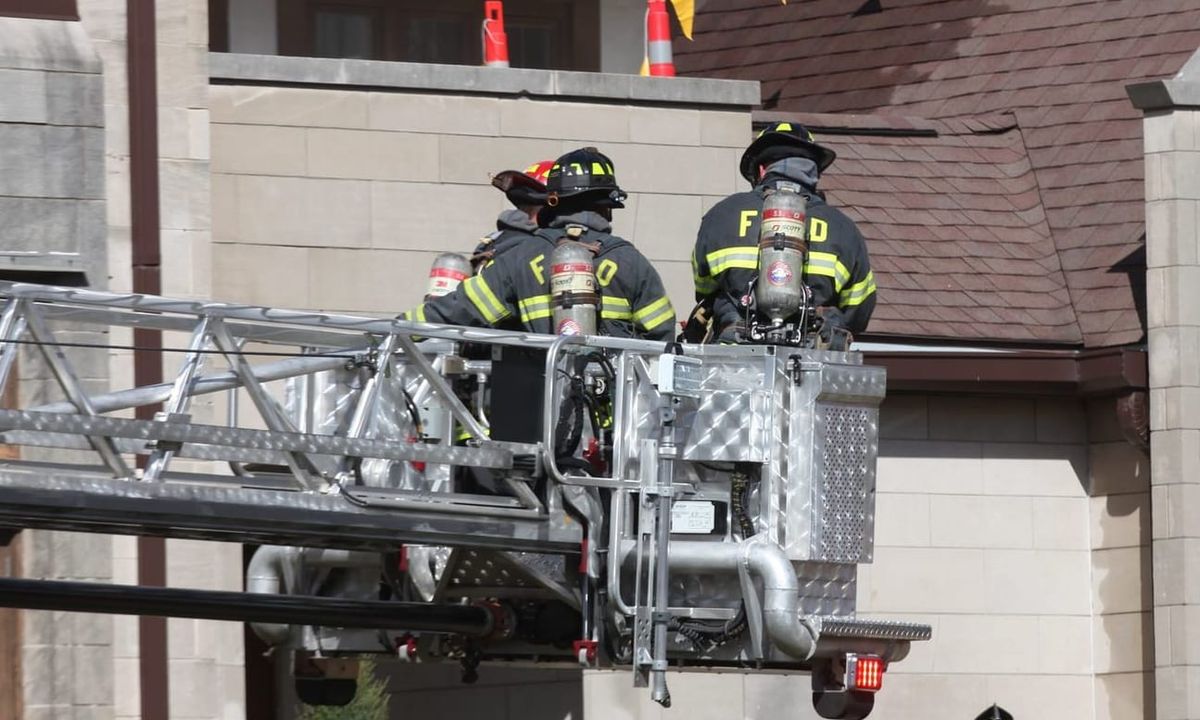
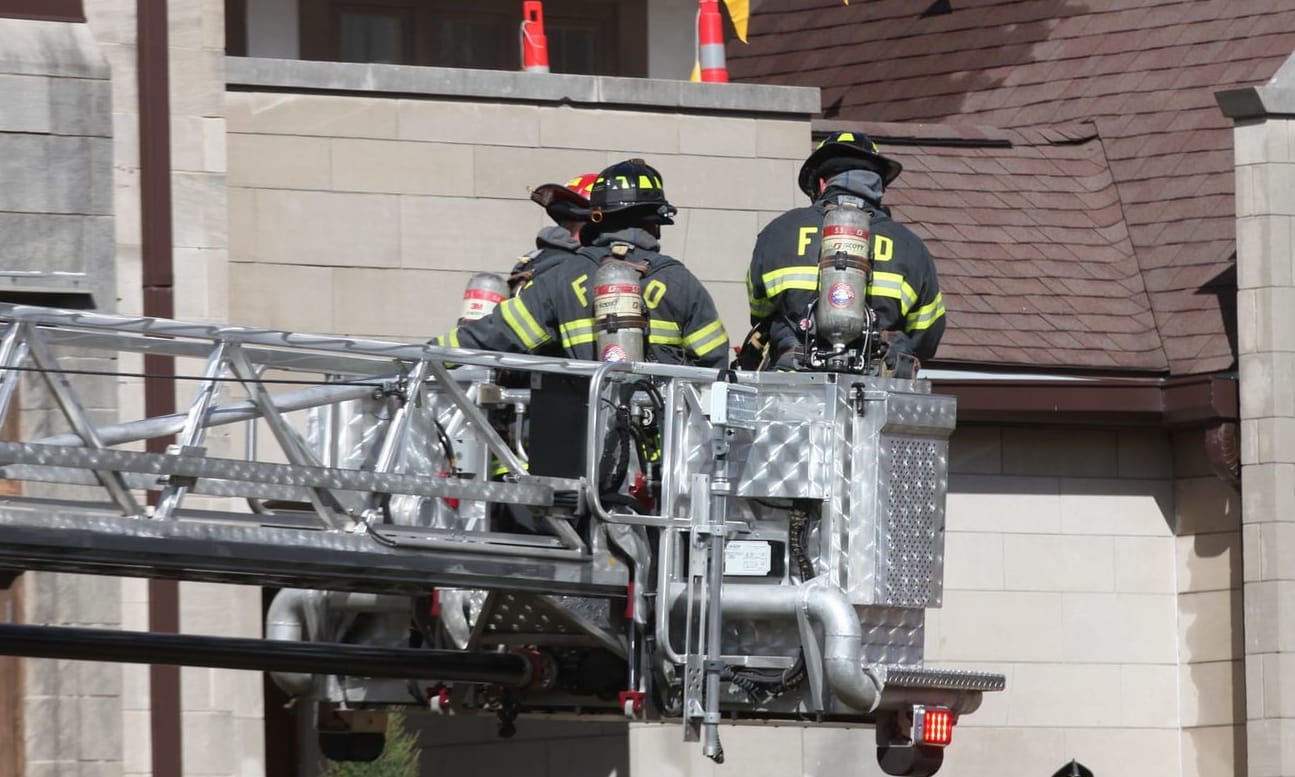
Bloomington could replace its only aerial platform fire truck, which has been out of service for more than four months, and pay for several street safety improvements, through a roughly $6.87 million bond issue that would be financed by additional property taxes.
The proposed general obligation (GO) bonds, introduced at Wednesday’s (Oct. 14) city council meeting, would provide $2.5 million for the fire truck and $4.23 million for transportation projects. The debt would be repaid over slightly more than six years.
The proposal is also the first installment of what city controller Geoff McKim described as a planned three-year cycle of borrowing for capital improvements.
Beyond the individual projects, the proposal highlights an important feature of Indiana’s property tax system: The city can impose additional property taxes to repay qualifying bonds without counting that revenue against its ordinary property tax levy limits. Its ability to raise additional taxes to save for future purchases is more restricted.
The ordinance is scheduled for a public hearing and possible final vote on Nov. 4.
Fire truck replacement: $2.5 million
The largest single expenditure to be funded by the GO bonds is $2.5 million to replace Bloomington’s only aerial platform fire truck.
Deputy fire chief Max Litwin told the council that the truck has been out of service for more than four months, with repairs estimated to exceed $100,000. It has seen downtime in each of the last three years, with the periods growing progressively longer.
The problems reflect both the aging equipment and the availability of replacement parts. Some components are no longer manufactured and have to be custom-fabricated, which adds expense and extends the time the truck remains out of service.
The big truck can do things that the department’s other vehicles can’t. Its 100-foot hydraulic ladder can reach people trapped on upper floors of burning buildings when firefighters can’t safely reach them from inside. It can also put huge amounts of water on a fire from above a building, which is key when flames have spread through the roof.
Litwin said the department hopes to purchase a stock model rather than commission a custom-built truck. A custom order could take three years or more to arrive; a stock model could substantially reduce the wait.
The department operates on a roughly seven-year replacement cycle for such equipment, which is comparable to the proposed bond repayment period.
The truck is a concrete example of the potential advantage of borrowing rather than waiting to save enough money for a purchase. Keeping deteriorating equipment in service can produce repair costs, downtime, and risks that might not be factored into a pure financial analysis.
Transportation projects: $4.23 million
Five categories of transportation improvements account for the remaining $4.23 million of the proposed bond issuance.
The largest allocation of the other allocations is $1.7 million, which would support improvements along 10th Street between College Avenue and Park Avenue, connecting Indiana University’s campus with the Trades District. Possible improvements include wider sidewalks, raised intersections, curb ramps, crosswalks and traffic calming. Design is underway, with construction targeted for 2028.
Another $1.5 million would go toward 3rd Street safety improvements, which could include modernization of the traffic signals at Rogers and Madison streets. City engineer Andrew Cibor told the council on Wednesday those are among Bloomington’s oldest signals and are in poor condition. The city’s goal of upgrading two signalized intersections annually amounts to replacing each intersection’s equipment approximately once every 40 years.
The remaining proposed expenditures are $500,000 for sidewalk and bikeway improvements, $280,000 for crosswalk safety projects, and $250,000 for street lighting improvements.
The crosswalk work includes a planned pedestrian refuge island at 17th Street and Willis Drive, near Tri-North Middle School, and improvements to the unusually wide intersection of Covenanter Drive and Auto Mall Road.
Some of the bond proceeds would pay for design and inspection services rather than immediate construction. One crosswalk project is not scheduled for construction until 2030.
Cibor said the proposed allocations are estimates and could shift as designs and costs become more definite. The bond proceeds would also be combined with other funding sources, including federal transportation grants.
Bond payments and property taxes
The proposed bonds would be backed by Bloomington’s full faith and credit, with the city pledging to levy sufficient property taxes to pay the principal and interest.
The ordinance authorizes borrowing up to $6.868 million, with an interest rate no higher than 5.5% and a repayment period no longer than seven years. The administration anticipates an interest rate around 5%.
The ordinance also requests a $7 million appropriation, which McKim said would accommodate investment earnings on bond proceeds before they are spent. The city’s proposed 2027 budget already includes a new bond fund with a property tax levy of $1,568,814, at a rate of $0.0337 per $100 of assessed value.
What is the impact on property owners? At the proposed rate, the annual additional tax would amount to $33.70 for each $100,000 of net taxable assessed value, before any circuit-breaker credits.
The amount that taxpayers ultimately pay would exceed the principal borrowed, because of interest and issuance expenses. The actual total will depend on interest rates at issuance and the final repayment schedule.
The property tax mechanism is an important part of the financing strategy.
Under state law, property taxes pledged to repay qualifying bonds are excluded from the state’s ordinary limits on local government tax levies. Bloomington’s proposed 2027 property levy is already at its maximum of $43.76 million.
So the city has authority to impose additional taxes for qualifying bond payments that it generally could not impose as an unrestricted increase in its ordinary levy, just to accumulate savings.
But debt-service taxes are still subject to Indiana’s constitutional property tax caps, which can reduce actual collections.
An alternative: The cumulative capital development fund
Borrowing is not the only way Indiana law allows cities to raise property taxes for capital improvements.
Bloomington already has a cumulative capital development (CCD) fund, which allows money from a dedicated property tax to be accumulated for future purchases. The fund can support specified capital investments without requiring the city to borrow.
The adopted 2027 budget includes $3.1 million in expenditures out of the cumulative capital fund. The fund balance for the cumulative capital fund at the end of 2025 was about $2.7 million. The proposed 2027 budget includes $2.74 million in CCD property tax collections at a rate of $0.05 per $100 of assessed value. That is the statutory maximum under state law.
The city only recently restored the rate to that maximum. State calculations tied to assessed property values had gradually reduced Bloomington’s CCD rate from $0.0493 in 2020 to $0.0477 by 2022. The lower rate remained in place through 2025.
The city could have restored the rate sooner, but doing so required a separate legal procedure. Under state law, a city that wants to increase an established cumulative fund’s rate must formally reestablish the fund. Bloomington’s council completed that process in March 2025, adopting an ordinance to restore the 5-cent rate for taxes payable beginning in 2026. Once the rate is established and certified, the city can continue imposing it annually.
The cumulative capital fund receives special treatment in calculations of the state’s property tax levy limits. But unlike a bond levy, the cumulative capital tax rate is capped by a separate statute. Bloomington’s 5-cent rate for the cumulative capital rate is at the maximum.
The difference matters when comparing financing strategies: Bonding can support additional property taxes to repay debt, while Bloomington’s existing capital savings tax is capped at 5 cents per $100 of assessed value.
The proposed $6,868,000 bond issue is just $664 below the state’s 2026 “controlled project” threshold of $6,868,664, which is established under state law Above the threshold, capital projects can become subject to taxpayer petition-and-remonstrance procedures or, for larger projects, a referendum.
Borrowing versus saving: Who pays, and who benefits?
In its memo, the Thomson administration offers another argument for borrowing: It allows the taxpayers who are to pay for it to benefit from the expenditure as soon as they start paying for it.
Councilmember Hopi Stosberg said Wednesday that the argument helped persuade her to support it. Stosberg said her instinct had been that governments should approach expensive purchases as households ideally would: Save the money first, then buy what is needed.
On Wednesday night, McKim used the fire truck to explain why borrowing could be preferable. “If we saved up for seven years for that fire truck, you’d have seven years of taxpayers paying and not benefiting, and seven years of taxpayers benefiting but not paying,” he told the council.
That argument is especially persuasive for a specific purchase when money has not already been accumulated. But the distinction becomes less clear when borrowing and saving are considered as permanent financing strategies.
Under a routine savings plan, current taxpayers contribute to future purchases while benefiting from equipment and infrastructure purchased with money accumulated by earlier taxpayers. Under routine borrowing, current taxpayers make debt payments on earlier purchases while benefiting from those assets.
The more consequential differences involve financing costs, the investment earnings that savings could generate, the consequences of delaying improvements, and the availability of tax revenue under Indiana law.
The fire truck example illustrates why waiting to accumulate cash can be costly in ways that a purely financial analysis might overlook.
Borrowing every three years
McKim said the administration envisions issuing capital bonds every three years, combining debt with grants and existing resources to pay for major improvements.
With the bonds scheduled to be repaid over about six years, new issues would overlap with older ones. The city could maintain a relatively stable level of debt, if new borrowing and repayments were balanced, but it would also establish an ongoing stream of property tax revenue dedicated to debt service.
The strategy is intended to be guided by a five- to 10-year capital improvement plan. However, McKim said the city has not completed that plan. Department heads have submitted their needs, and financial adviser Reedy Financial Group has assembled an initial draft. A more developed version is expected by year’s end.
A companion parks bond issue has been deferred until 2028 at the earliest because of grant opportunities the parks department is pursuing.
Bloomington also has recent experience with more frequent short-term borrowing. In 2024, the council approved $4.3 million in GO bonds , primarily for engineering projects, with repayment over approximately two years. The borrowing increased the city’s property tax rate.
Indiana subsequently enacted SEA 1 , which imposed a waiting period after certain short-term bond issues. Bloomington’s now proposed six-plus-year bonds would fall outside the statute’s definition of short-term GO bonds.
Under the new state law, “short-term” GO bonds are defined as having terms of five years or less. Such bonds now trigger a one-year cooling-off period before another such bond can be issued.
Monroe County government, which had routinely issued about $3 million in one-year GO bonds annually, responded to the change in state law by shifting to a $6 million bond issue with a six-year term, approved in late October 2025. An initial GO bond proposal for this year was formally introduced to the Monroe County council at its meeting this past Tuesday (Oct. 13).
Bloomington’s 2024 bonds had a two-year term, but its currently proposed six-plus-year bonds, like Monroe County’s, fall outside the new law’s definition of short-term GO bonds.
As for borrowing capacity, Justin Chang of Reedy Financial Group told the council on Wednesday that Bloomington has a constitutional debt limit of about $36.55 million. Existing GO bonds account for approximately $8.39 million, leaving about $21.29 million in capacity after the proposed issuance.
That establishes how much the city can legally borrow, not whether borrowing is its least expensive financing option.
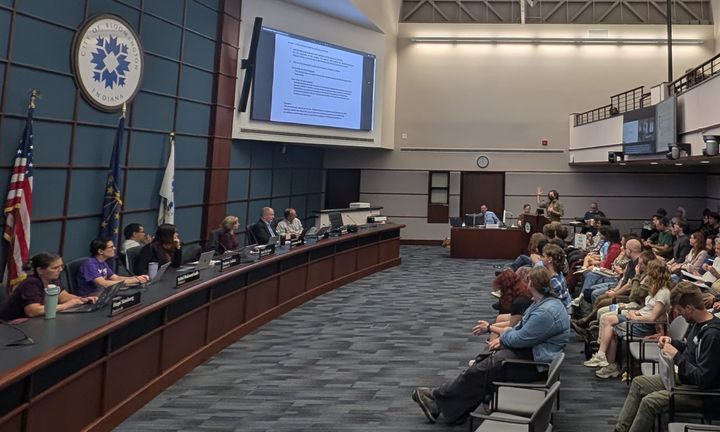
On Wednesday, councilmember Andy Ruff raised a question about the council’s control over the eventual expenditures. Ruff said the fire truck purchase was clear and specific, but some of the transportation projects were not yet fully defined.
Ruff asked the administration to explain what opportunities the council and public would have to influence the projects funded by the bonds, particularly transportation improvements whose designs have not been finalized. He requested more information before the Nov. 4 hearing. The administration did not answer the question during Wednesday’s meeting.
From the public mic came a question about whether the borrowing would divert resources from addressing poverty and homelessness. Councilmember Isabel Piedmont-Smith responded that bond proceeds must be spent on capital projects, not social services.
Another kind of typical response that municipalities often give to the concern about social services funding is to point out that financing capital improvements through bonding helps to conserve existing city revenues, which can be spent on social services.
The council is expected to take up the ordinance again on Nov. 4 with a possible final vote on the bond issuance at that time.


Comments ()