
Bloomington RDC signs off on public offering for College Square, declines 30‑day pause for land‑swap talks
Bloomington’s redevelopment commission voted April 20 to proceed with a public offering for the 2-acre College Square site, declining a CIB request for a 30-day pause to explore a land swap tied to a convention center host hotel. Responses to the $7.59M minimum offering are due July 20.
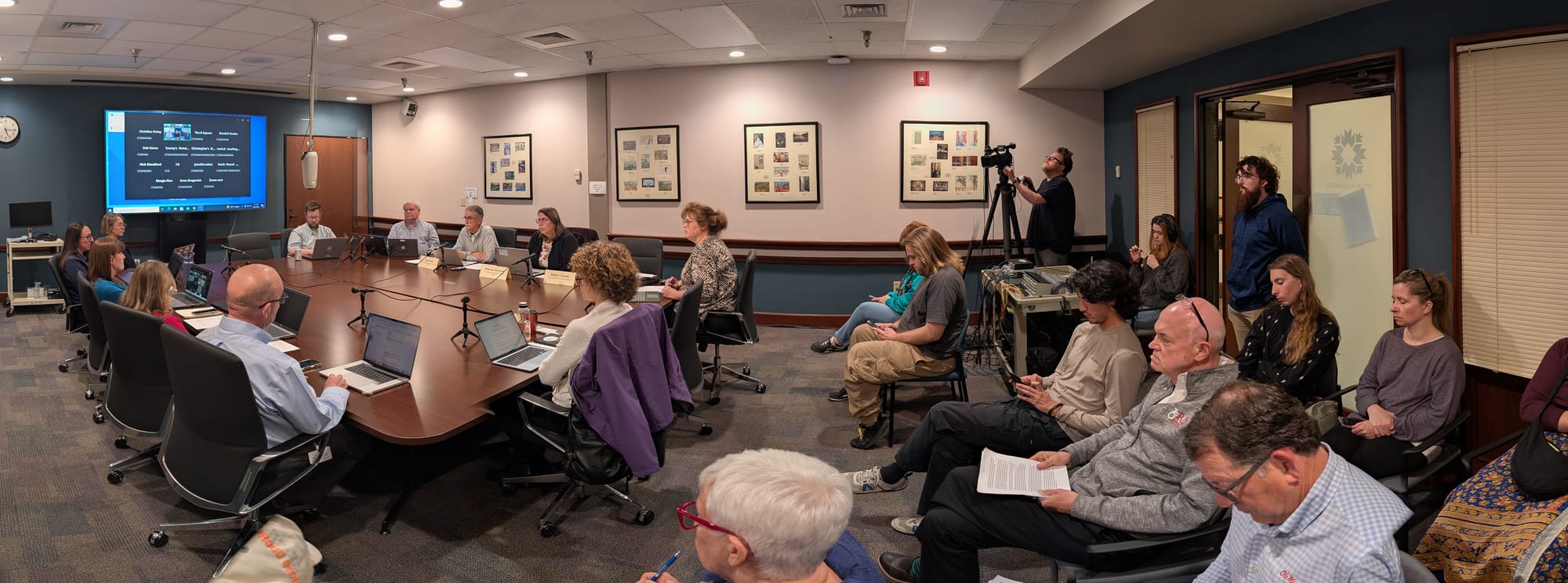
At its regular Monday meeting (April 20) Bloomington’s redevelopment commission (RDC) voted unanimously to move ahead with a public offering for the College Square property at 4th Street and College Avenue.
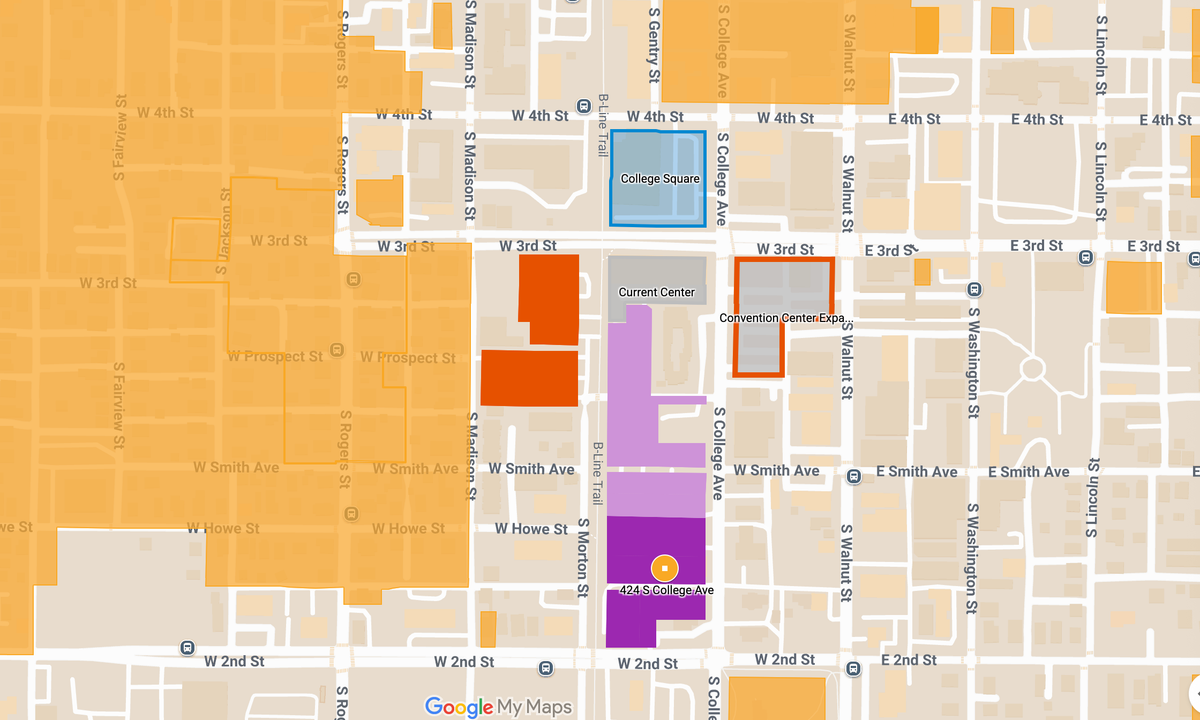
That meant the RDC declined a request from Monroe County’s capital improvement board (CIB) to delay action for 30 days to explore a possible land swap. The RDC wants to negotiate a swap that would trade the Seminary Pointe block, which was recently transferred by the county government to the CIB, for the College Square property, so that the CIB could offer it to a potential developer of a host hotel for the convention center.
The RDC’s resolution authorizes issuance of a notice of offering for the roughly 2‑acre College Square site, which is often called the former Bunger & Robertson lot.
The minimum offering price is set at $7.59 million, the average of two recent appraisals, according to RDC executive director Anna Killion‑Hanson. That figure is higher than the nearly $7 million the city’s RDC paid in 2019 to purchase the property in two transactions under then‑mayor John Hamilton.
The RDC meeting included public commentary from several housing advocates and tenants of the Seminary Pointe property, as well as a Bloomington city councilmember, Courtney Daily, who all spoke in favor of a 30-day delay to negotiate a land swap with the CIB.
In the end RDC members were not persuaded that 30 days was enough time to get information about appraisals and environmental conditions for the Seminary Pointe property in order to conduct a meaningful negotiation.
The time frame for the public offering would allow for the CIB to make a proposal with that kind of information. The idea is to publish the notice of offering on April 27, with responses due and opened at the RDC’s July 20 meeting. That’s an 84‑day window that RDC executive director Anna Killion-Hanson characterized as a realistic response period for serious developers.
RDC member John West pointed out that the RDC’s public offering allows for the possibility of a response from a host hotel developer. But based on his comments, the prospects of a host hotel getting developed at College Square as a result of a land swap with the CIB sound grim. The long-time commercial real estate broker said:
I just, I’ll rip the band aid off: I don’t think the land swap as proposed is a good opportunity or even a good deal for the city.
...
At the end of the day, it’s my opinion, never appraised it, but I don’t think you’re going to see equal value. So I don’t know how we get to $7.5 million.
The role of appraisals
One of the conditions given by the RDC to the CIB on the start of negotiations was a current appraisal for the Seminary Pointe property. That doesn’t exist, but the property was purchased in 2010 in two transactions totalling about $3.2 million, which is about half the RDC’s asking price.
During Tuesday’s meeting, RDC executive director Anna Killion-Hanson said the RDC does not yet have basic information about the Seminary Pointe property that it would ordinarily want before contemplating a land swap. There are no updated environmental reports, no current rent roll, no financials to help gauge the property’s value or the scope of any deferred maintenance.
“It’s hard to know if that particular property is also worth $7 million,” she said.
The Bloomington RDC bought the College Square real estate in two separate transactions—one in 2019 and the other in 2023.
Back then, the average of the two appraisals for the two parcels making up the property was $6,585,000.
Based on city of Bloomington financial records, two more recent appraisals were paid for by the RDC, one by First Appraisal which cost $5,000 (March 13, 2026), and the other by Michael C. Lady Advisors, which cost $3,950 (May 9, 2025).
Killion Hanson indicated that one of the two current appraisals was less than $7 million. Given the $7.59 million average, the basic arithmetic means one of the appraisals was more than $8 million. Killion-Hanson said about the higher appraisal, “I’m not sure that the appraisal that was over the $7 million mark fully considered the environmental conditions that were present.”
Environmental conditions
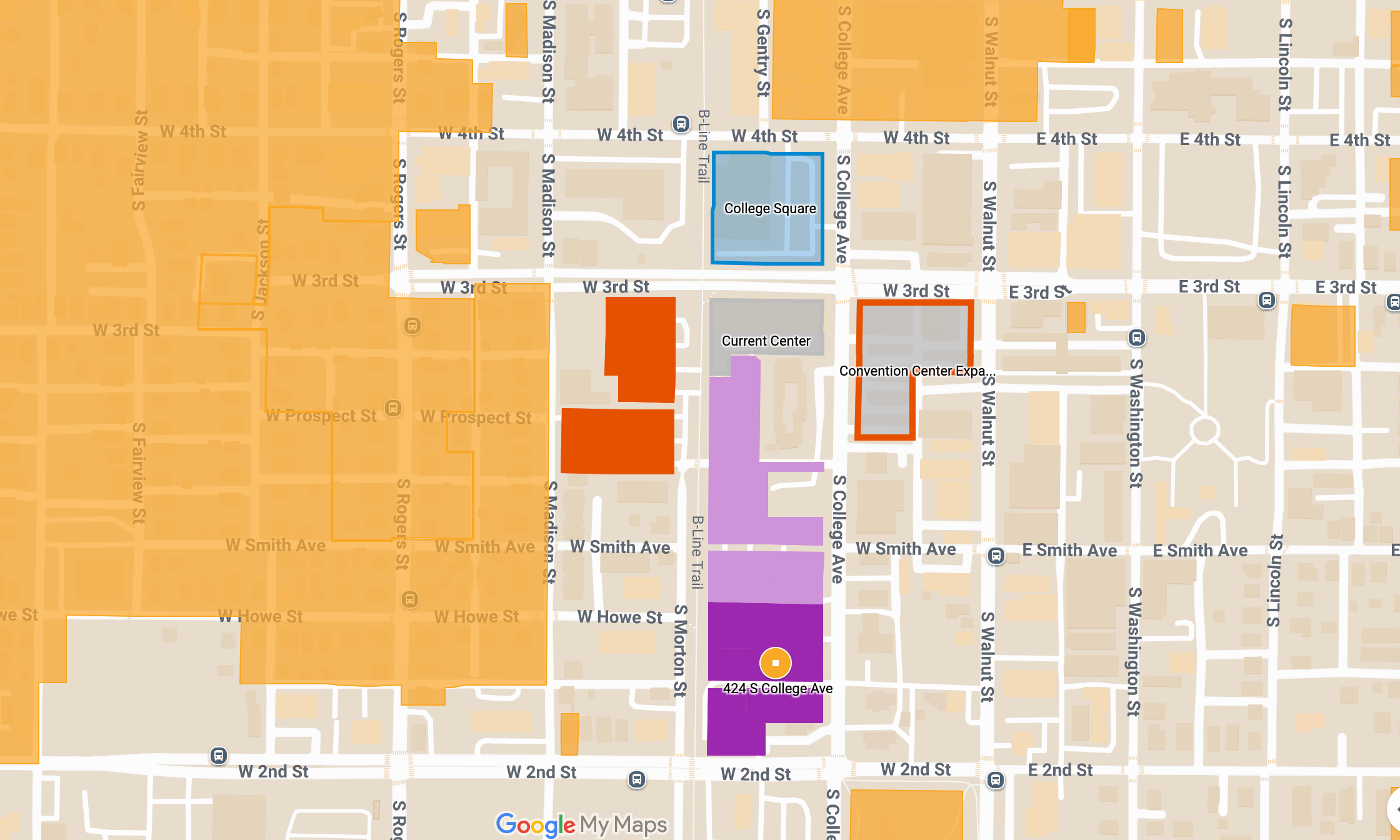
The College Square site consists of three tracts totaling about two acres between 3rd and 4th streets along College Avenue. The property currently includes a one- and two-story office and storage building with about 39,000 square feet of space and sits adjacent to the B-Line Trail and the convention center area.
The offering packet notes that environmental studies have found that “environmental conditions do exist” on the property based on earlier Phase I and Phase II environmental site assessments. The RDC says it is working with the Indiana Department of Environmental Management (IDEM) to further evaluate the site.
The IDEM virtual file cabinet on the College Square site includes a Phase 2 Environmental Site Assessment, a Supplemental Phase 2 Environmental Site Assessment, and internal IDEM review memos from late 2025 by the agency’s Geological Services, Chemistry Services, and Risk Services sections
The investigations found that soil on the site does not exceed standards for direct contact, meaning it is not considered a health risk under current state guidelines. But groundwater beneath the property contains petroleum-related compounds and metals above state screening levels, including benzene, arsenic and lead.
IDEM reviewers concluded that contamination in soil appears to be fully identified, but the extent of groundwater contamination has not yet been mapped. Additional sampling may be needed to determine how far the contamination extends and whether cleanup measures or land-use restrictions will be required as part of redevelopment.
According the supplemental Phase 2 ESA by BCA Environmental Consultants, the site’s history includes gasoline filling stations operating from the 1920s through the mid-20th century, as well as battery service and railroad-related activities.
Seminary Pointe: Historic buildings?
RDC executive director Anna Killion‑Hanson noted that Seminary Pointe has some buildings, and described two of them as “historic.” That could require the city, if it owned the site, to work with the historic preservation commission and possibly face a demolition delay for some redevelopment scenarios, she said.
Based on the city’s map of historic properties in the city, the status of the buildings on the Seminary Pointe block does not appear to be inside a historic district. However, the Jeff’s Warehouse and Bluetip Billiards building at 424 S. College Avenue is listed as “contributing” in the city’s 2018 survey of historic sites and structures.
And according to the city’s flowchart for demolition of buildings, if a building is listed as “contributing” in the survey, then it is potentially subject to the demolition delay process, even if it is not locally designated as historic.
Offering framework: Not just about the money
Killion‑Hanson walked commissioners through the structure of the offering, stressing that while the RDC is statutorily required to set the initial minimum price at the average of two appraisals, price alone will not determine the winning proposal.
Assistant city attorney Dana Kerr put it like this: “It is not based on money. It’s not like the highest bid for the property wins.” The RDC can select the project it believes is best for the site.
The draft offering describes the RDC’s goal as attracting a “transformative, mixed-use redevelopment project in the heart of downtown Bloomington.”
The offering makes clear that purpose‑built student housing rented by the bedroom will not be considered. It allows condominium housing that offers ownership options for residents. It states a preference for mixed‑use projects tied to Bloomington’s strengths in life sciences, technology and innovation, defense technology, destination tourism, and higher education.
It also acknowledges the possibility of a convention center host hotel on the site, but requires any such proposal to secure all necessary approvals from the CIB as a condition of award, negotiation, and closing. A hotelier, in other words, would have to respond directly to the RDC’s offering and separately obtain the CIB’s blessing.
CIB request: 30‑day pause to talk land swap
The central point of contention Monday night was not the wording of the offering itself, but its timing. During public comment, attorney Jim Whitlatch appeared on behalf of CIB president John Whikehart, to read aloud a prepared statement that echoed the CIB’s written request to RDC president Deborah Myerson for a 30‑day pause.
The statement recounted some of the backround: The CIB is now in control of the Seminary Pointe block south of the convention center, which is property with commercial and residential tenants, including some of the city’s lowest‑rent apartments. The CIB wants to explore swapping that block to the RDC in exchange for College Square, then offering College Square to a host hotel developer as part of the long‑planned convention center expansion.
Whikehart’s statement framed the question less as a straight real‑estate trade and more as an opportunity to jointly advance community goals. He said that if the CIB’s proposed land exchange is viewed simply through the lens of a cost‑benefit analysis of a transactional real estate swap for equal‑value properties, the CIB “does not have that to offer in a negotiation,” given that Seminary Pointe has no current appraisal supporting a value comparable to $7.59 million.
“What we propose is that prior to your public offering, you consider a different cost‑benefit analysis, one of opportunity for the public good, rather than simply a transactional one based on cash value. Perhaps there is a different return on investment to consider,” Whikehart’s statement said.
Advocates for 30-day pause for land swap
Several speakers during public commentary focused on the existing “super affordable” apartments at Seminary Pointe and the prospect of preserving or re‑imagining the site as permanently affordable, community‑oriented housing.
Barry Herbers, who lives down the street from Seminary Pointe, described the complex as “30‑odd units of super affordable housing” and said friends who live there rely on the low rents as a “ lifeline” in the face of job losses and growing families. Herbers pointed to Friendly Beasts, one of the commercial tenants, as a small anchor of the neighborhood community, and said a land swap could allow that sense of place to be strengthened rather than erased.
Bryce Greene, who told the RDC he has lived in Bloomington for about a decade, said that the city currently has people and organizations ready to step into a development role at Seminary Pointe, if the city were to acquire it. Green talked about local cooperative and land‑trust models that already support deeply affordable housing in Bloomington. With the right approach, Greene said, the Seminary Pointe block “can be one of those fixtures of Bloomington that makes it unique and a really lovely place to be.”
Also speaking in favor of a 30-day delay was Courtney Daily, who told the RDC she was the lone dissenter on the Bloomington city council’s letter of May 6, 2024, which called on the RDC to recoup the full purchase price of the College Square property. In that context, Daily said, “This is my moment to speak.” She said there is no better place for a host hotel than College Square, and it doesn’t make sense to put a host hotel for the convention center down on The Seminary Pointe property, because it is too far away.
Responding to John West’s characterization, Daily said, “I respectfully disagree that it’s not an opportunity. I think it is actually a great opportunity for the city.” She continued, “It is so close to Hopewell … We could do something wonderful with that land.” Daily wrapped up saying, “I think we can really revitalize that entire block area if we can pull off that land swap.”
RDC member sentiments
Significant for RDC member Sue Sgambelluri was the city council’s 2024 letter, on which Daily dissented, which called on the RDC not to undervalue the land: “I hear that, and I find that a compelling statement on behalf of our city council.”
Sgambelluri also said the 30-day time frame was not long enough: “I also find it compelling that 30 days is not a long time. … The notion that a great deal can change in 30 days isn’t compelling to me.”
RDC member Lauri McRobbie said she agreed with her fellow commissioners, that “30 days is not going to change anything.” So she felt like moving forward quickly might start to “open up some other possibilities and opportunities that may not be evident to us because we haven’t been clear about what our vision is for College Square.”
The CIB’s next step could be to issue its own RFP for hotel proposals, at the Seminary Pointe block.
Whikehart’s prepared statement ended by warning that if the RDC proceeded with its public offering and invited the CIB simply to “throw its hat in the ring with other potential suitors, ... then the CIB will meet to decide if instead we re-engage immediately in hotel development for the south and west properties we now have to offer.”
The next step for the CIB likely will become clear by the time of its next regular monthly meeting on May 20.


Comments ()