
Monroe County land transfer to CIB has final OK, with calls for land swap to preserve housing, put host hotel on north parcel
Monroe County councilors voted April 14 to transfer downtown property that includes Seminary Pointe apartments to the CIB, clearing the way for a potential convention center host hotel deal. The move could, but is not guaranteed, to allow a land swap involving the former Bunger & Robertson site.
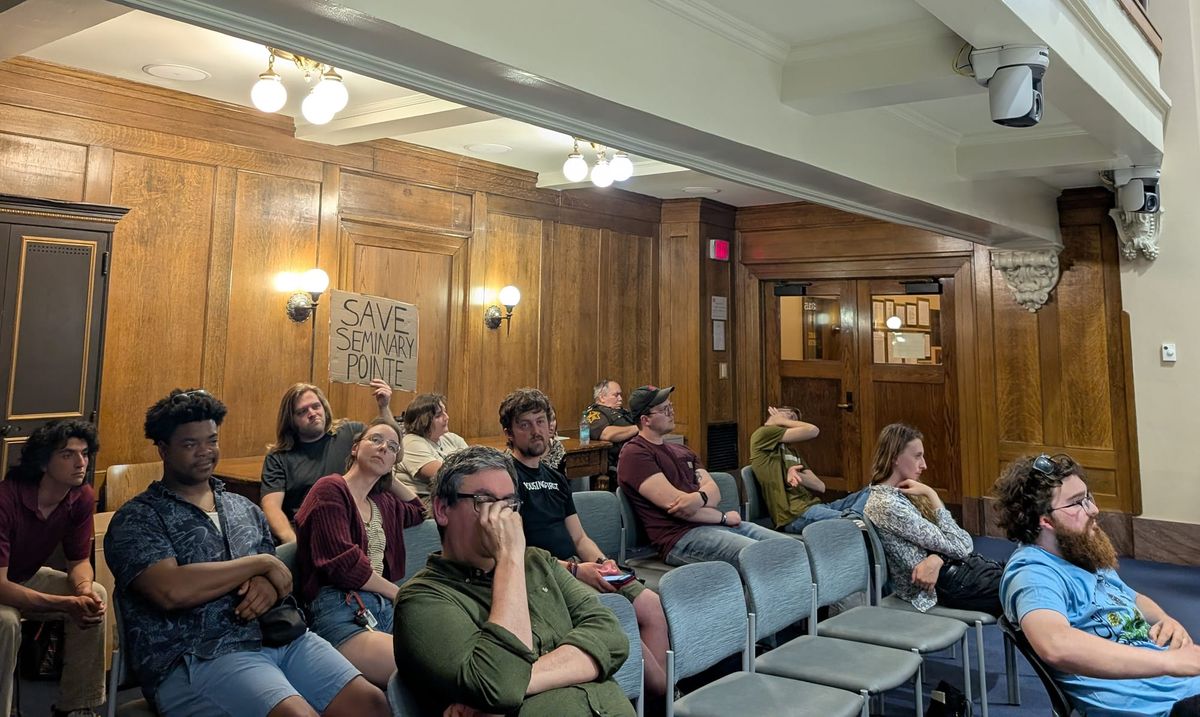
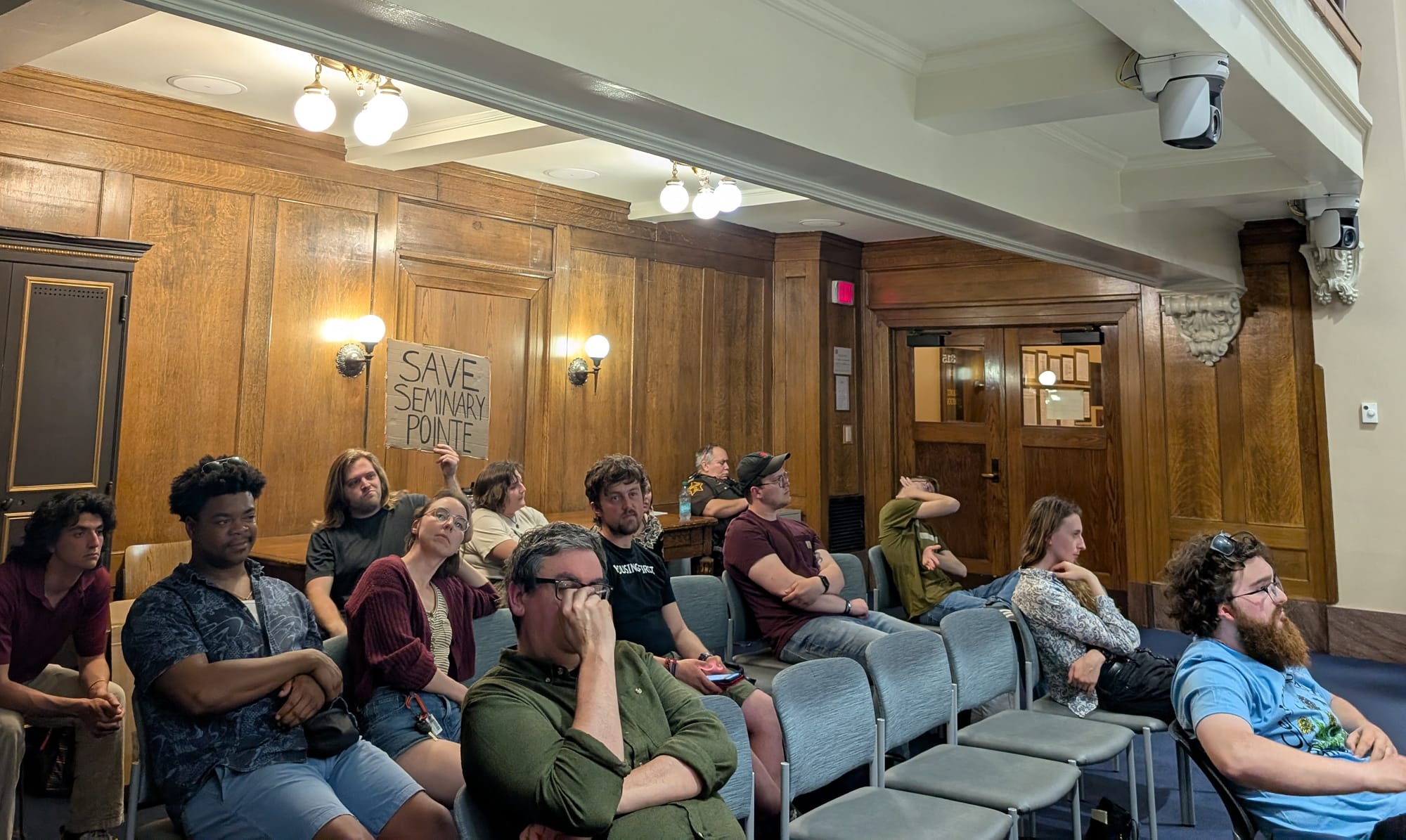
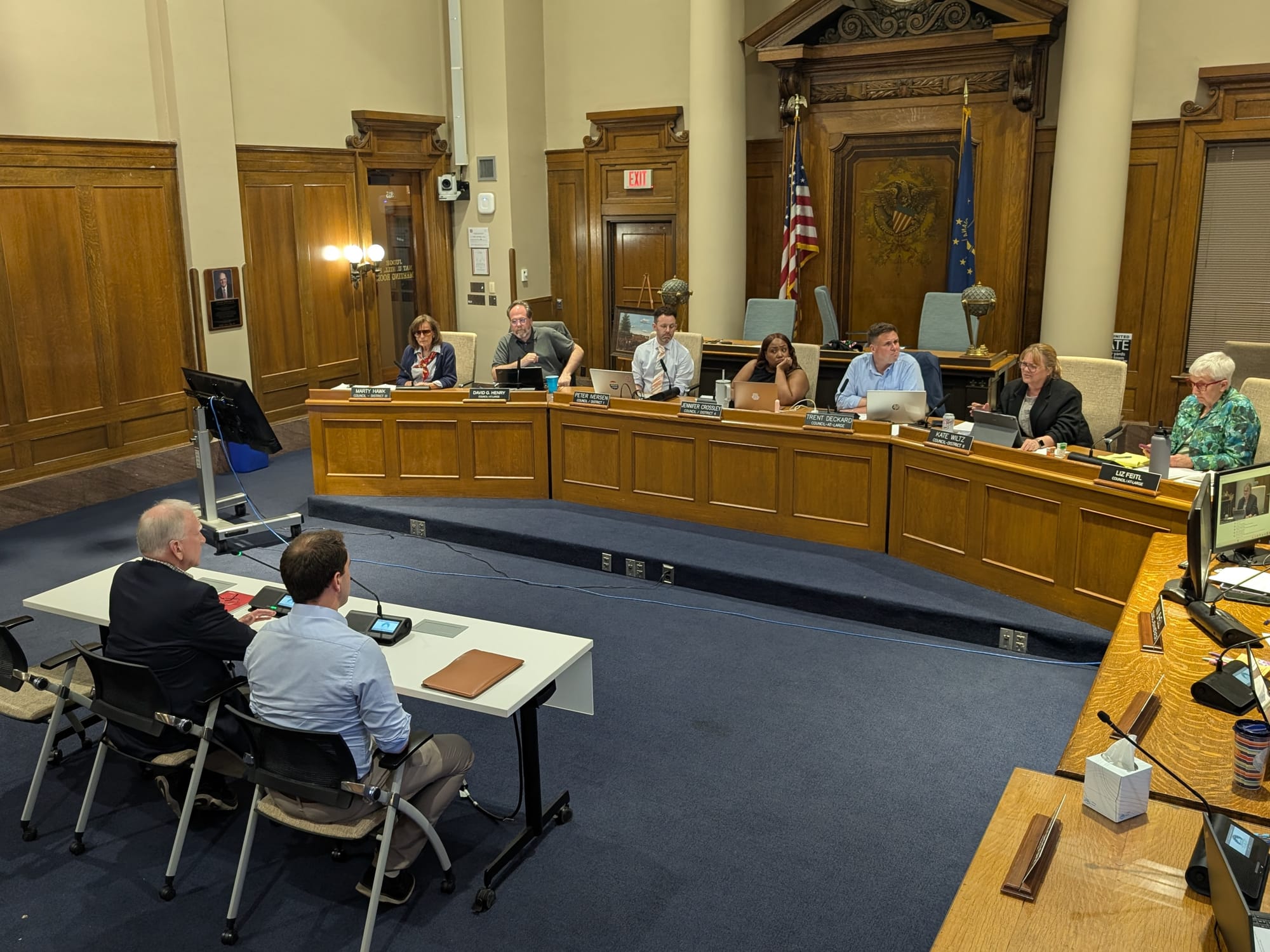
Left: Residents and advocates at the Tuesday (April 14) meeting of the county council. The sign reads: “Save Seminary Pointe.” Right: Seated at the table, CIB members John Whikehart and Galen Cassady field questions from the county council. (Dave Askins, April 14, 2026)
At their regular Tuesday night meeting (April 14), Monroe County councilors approved a resolution authorizing the transfer of key downtown real estate to the Monroe County capital improvement board (CIB), as part of a transaction that is meant to make a deal possible for a convention center host hotel.
The vote was supported by all councilors except for council president Jennifer Crossley, who abstained.
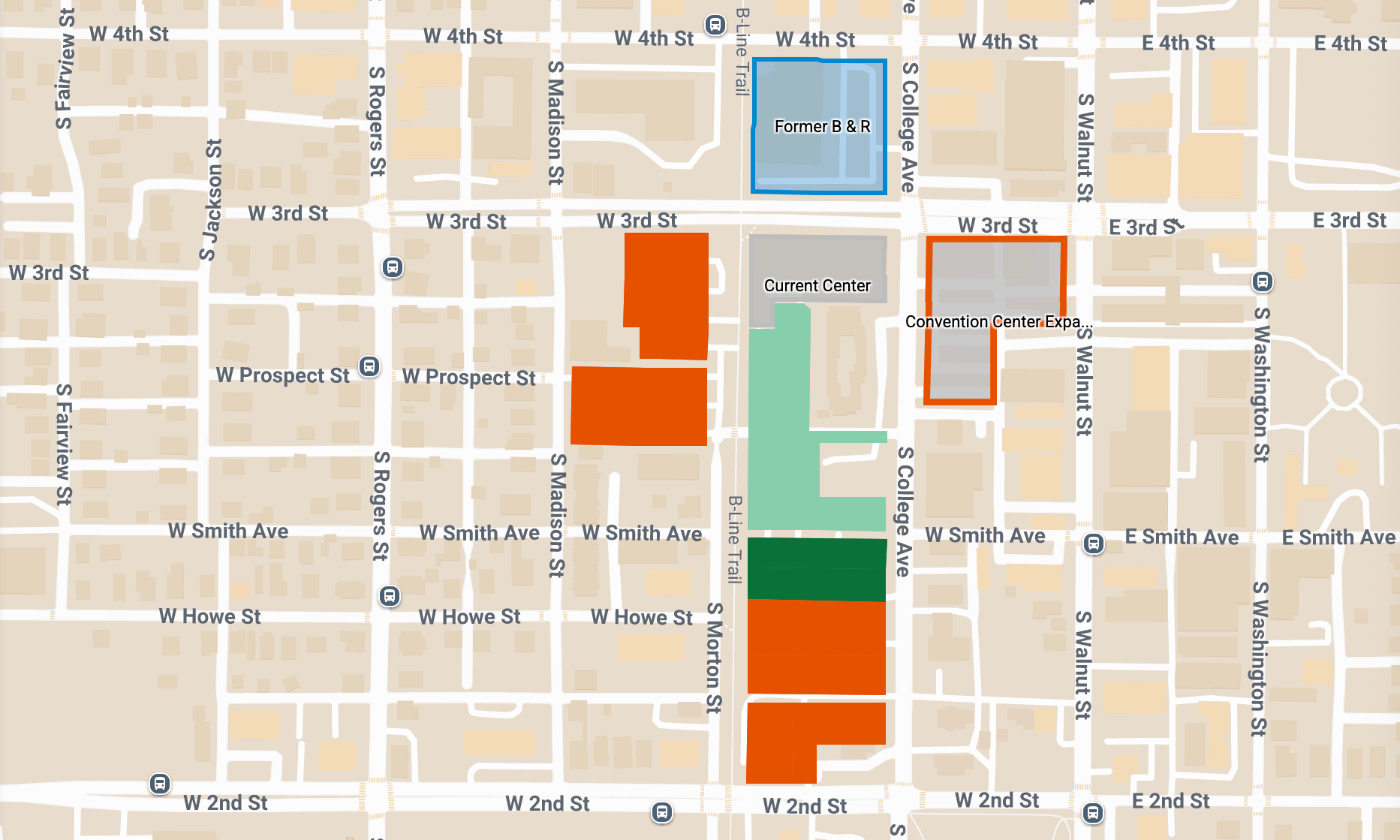
The land in question is south of the existing convention center, north of 2nd Street, on College Avenue. It’s home to buildings with 29 residential housing units, including Seminary Pointe. The rents there are reportedly in the range of $400 to $700 a month—what one speaker from the public mic on Tuesday called “super-affordable housing.” The property includes commercial tenants as well, like Friendly Beasts Cider Company, My Sister’s Closet, and Jeff’s Warehouse.
The county council’s vote came after more than a dozen speakers weighed in from the public mic, either in person at the Nat U. Hill Room in the historic county courthouse where the council meets, or through a Microsoft Teams interface.
At their regular meeting on March 26, Monroe County commissioners had already approved their own resolution approving the transfer. Both the council and the board of commissioners have to sign off on such a deal.
The land transfer is controversial, because it makes definite what had been expected to be a probable outcome at some point—that the real estate, purchased in 2010 with innkeeper’s tax, would be put towards a tourism-related purpose, displacing residential and commercial tenants there. Tenants have been notified their leases will not be renewed past July 7 this year.
But a point raised from the public mic on Tuesday by Barry was the wording of the state statute on the use of the innkeeper’s tax, which includes “promotion and encouragement in the county of conventions, trade shows, visitors, or special events, and for the financing of facilities to be used by the commission for those purposes.” Special events are happening “all the time” on the property to be transferred, Barry said, at places like Friendly Beasts Cider Company.
Land swap for former Bunger & Robertson property?
On Tuesday night, from the public mic, as well as from CIB president John Whikehart, came several mentions of a land swap. The idea of a land swap became a major theme of the night’s deliberations
The land that might be swapped to the CIB—for the real estate transferred to the CIB by the county government—is currently owned by the city of Bloomington. It’s the former Bunger & Robertson property (College Square) at Fourth Street and College Avenue. The parcel, which is just to the north of the existing convention center, across 3rd Street from it, is generally acknowledged as the best of the available locations for a host hotel serving the convention center.
The idea would be for the county government to transfer the Seminary Pointe block to the CIB, which would then exchange it with the city for the former Bunger & Robertson property. The requirement that innkeeper’s tax revenue support tourism would be met in the transfer to the CIB, likewise for the transfer from the CIB to the city, because it would be in exchange for a location where a host hotel could be built.
The idea of a land swap is not new—it was floated publicly by Bloomington city councilmember Kate Rosenbarger, at a Dec. 10, 2025 joint meeting of Bloomington’s redevelopment commission (RDC) and the city council. The RDC is the entity that legally owns the Bunger & Robertson property.
The failed year-long negotiations between Dora Hospitality and the city of Bloomington for the former Bunger & Robertson property foundered over compensation. Even if the land swap fell short of the roughly $7-million purchase price, the city would still recover at least some value for the property. And the end result would place the host hotel on the parcel widely viewed as the best site for it. The city would then have control over real estate that it could use to support affordable housing.
At Tuesday’s county council meeting, Whikehart stressed that the CIB would not be able to continue as landlord for the properties and to extend leases: “The CIB is not a property manager. The CIB has no budget to manage properties.” He added, “We have no ability to be a property manager.”
Instead, Whikehart said that if the land were transferred to the CIB, then it would be his intention the following day to talk about the possibility of a land exchange with the rest of the CIB during their scheduled executive session.
But Whikehart also portrayed the idea of a land exchange as one that Bloomington mayor Kerry Thomson had told him in conversation she’s not interested in. He said he wants to give it a try formally—something that would not be possible unless the CIB has the land to exchange, something to negotiate with. Whikehart put it like this:
The mayor has told me, informally—because we’ve made no formal proposal, we’ve had nothing to offer—that she’s not interested in a land exchange of any kind. … My point would be: I’m talking about a land exchange, and I don’t even have the authority on my own board to talk about a land exchange. We haven’t even talked about it as a board. I’m talking about: What’s John Whikehart think might be a path forward on this? And it seems to me, back to my ‘no horse is too dead not to keep beating,’ that we have not formally asked the question yet about a land exchange, and that formal question goes to the redevelopment commission.
From the public mic, Seaforth advocated for a land swap, pointing out how the political math could add up in the mayor’s favor, but also called on the county council to ensure that such a swap would take place:
I’m glad that there seems to be a lot of consideration on your part, but I think that approving the transfer, without guaranteeing that there will be the land swap, just guarantees that we lose affordable units in our community in a location that is essential… If there can be a conversation with the mayor about [a land swap], … providing a win for all the parties involved. … If the county successfully bridges this and allows this to happen, then they come out looking wonderful. And for the mayor, you know, she’s been receiving a lot of flak lately, rightfully so, I would say. But when it comes to Hopewell, for example, if she can tie that to maintaining and maybe even expanding Seminary Pointe as a land trust, then she gets to have the feather in her cap of saving affordable housing that existed, expanding it, and then providing multiple different options.
One reason there’s not a lot of optimism about the prospects of a land swap is not just the lack of enthusiasm on the mayor’s part, as relayed by Whikehart, but also the mayor’s own communications about the future of the former Bunger & Robertson property.
Thomson has indicated she has something else in mind besides a host hotel for a convention center. In a news release issued on Jan. 21, after the unsuccessful conclusion of the negotiations with Dora Hospitality for the former Bunger & Robertson property, Thomson talked about a “new direction” for the real estate.
The news release says: “The Mayor stated she will formally ask the Bloomington Redevelopment Commission (RDC) to place the [former Bunger & Robertson] property on the market for redevelopment focused on economic development uses and to pursue a new, narrower request for proposals that aligns with the City’s long-term downtown economic and convention center goals.”
Councilor comments
On Tuesday, councilors spent more than an hour on the question of whether to act that night or table the item to buy time for additional negotiations with the city of Bloomington and its redevelopment commission (RDC) over a possible land swap.
Councilor Peter Iversen framed the “optimal outcome” as one that many people in the room seemed to share. Iversen put it like this: “If we can get a host hotel and preserve super-affordable housing, that is the optimal outcome, and I think it’s within our reach”
But Iversen concluded that the best way to get there was to move the land out of county ownership and into the hands of the CIB: “The question then is, once we have shared goals, who can best get us there? … The reason why I will be voting affirmatively tonight on this [land transfer] is because I think the best way that we can get to that optimal outcome is by having someone who is not a county commissioner or a county council member working with the city and the county and being able to do that work tomorrow.”
Iversen added, “I think if you keep having politicians like us involved in this, we’re going to continue to make a mess of it.” As Iversen made his point about removing elected officials from the mix, came a call from the audience: “God forbid you represent people!”
County attorney Jeff Cockerill pointed to the CIB as a suitable agent for the negotiations about a land swap, pointing out that the seven-member group is an even mix of appointees from both county and city governments. The seventh member is chosen by the other six.
Councilor Marty Hawk questioned what the tenants would actually gain from a delay in the land transfer, given that it would not mean an extension of their leases.
At the same time, Crossley—who ultimately abstained—voiced skepticism that the county should simply trust that things will work out for tenants once the property leaves county hands.
“We do this, and then it fails, and then we’re back at square one, where [tenants are] stuck with trying to find housing, because they’re done as of July 7. That’s a big old gamble that we are taking right now,” Crossley said.
“If we fail in our efforts to do this, then we fail with trying to make sure that folks have affordable housing. And I don’t know if I want that on my conscience,” Crossley said. She was echoing comments from the public mic from Noah, who said, “I want to be clear, if people lose their homes, this is a scandal. This will follow you. It will remain your fault. I urge you to actually do something for people who live here and aren’t just a big business trying to bring whatever commerce to this town that doesn’t help anyone.”
County commissioner Jody Madeira, speaking from a remote connection during the council debate, cautioned that further delay “risks undermining a project” that has already required “substantial planning, substantial negotiation, and substantial investment” across several governmental bodies. Madeira also highlighted efforts that have been made to help current tenants find other affordable places to live. From the public mic, one speaker said only three apartments had actually been found.
Madeira said, “Moving the property out of the county now would provide certainty to project partners. It would protect the county’s credibility, and it would help avoid added costs that often accompany postponement, including the chance that we would miss an opportunity.” She said that sticking to a plan “also increases certainty for residents,” but also acknowledged that Seminary Pointe tenants face “very real hardship.”
Councilor David Henry pointed out that it’s the county commissioners who have the executive authority to sign leases and contracts, and they’re not interested in doing that. That means in a scenario where the county council does not approve the land transfer, there will be empty buildings with no tenants because the board of commissioners will not extend the leases. That scenario would not serve the CIB, or the county government or the tenants, Henry said.
Councilor Trent Deckard said that for people who are concerned about maintaining the property as residential or commercial properties as they currently exist, “the best hope they almost have is us to send this out of here with an exchange.”
The CIB has a regular meeting scheduled for 3 p.m. on Wednesday (April 15). The topic of the county council’s action on Tuesday night could get some airtime at the CIB’s Wednesday meeting.


Comments ()