
Business community raises concerns over proposed Bloomington water rate increases
At a Bloomington field hearing in a drinking water rate case, business customers warned that the city’s proposed rate increases could strain local employers. The plan would help fund an $84 million infrastructure program, with a final decision expected later this summer.
Drinking water rates for City of Bloomington Utilities (CBU) customers will be going up for all classes of customers, with an order expected later this summer.
That’s been known since late June last year, when CBU was holding discussions with Indiana University and Washington Township to develop the proposal. IU and the township had formally opposed CBU’s rate increase four years ago, which is why CBU had to have meetings with those two big customers this time around. IU and IU Health are also formally opposing the current increase.
After Bloomington’s utilities service board adopted the proposed rate increase in early September, it was submitted to the Indiana Utility Regulatory Commission (IURC) for review. The IRUC docket for the case is a convenient online repository for all the filings as well as a schedule of important events, like the evidentiary hearing, to be held on April 30.
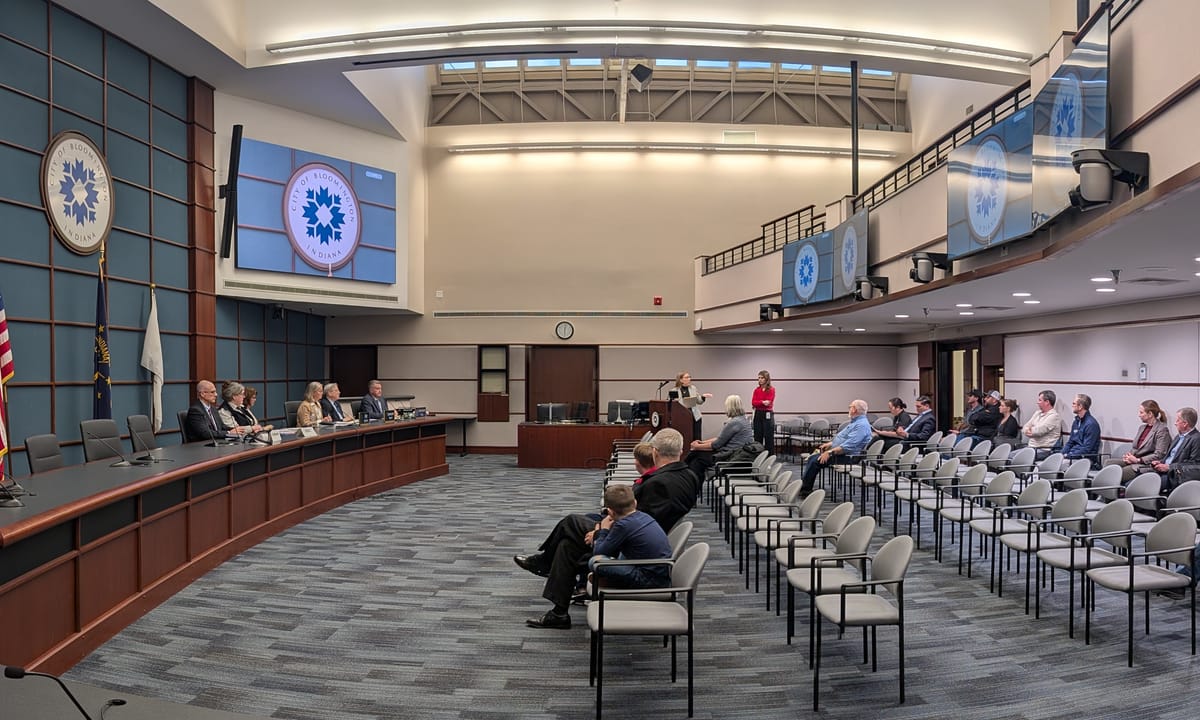
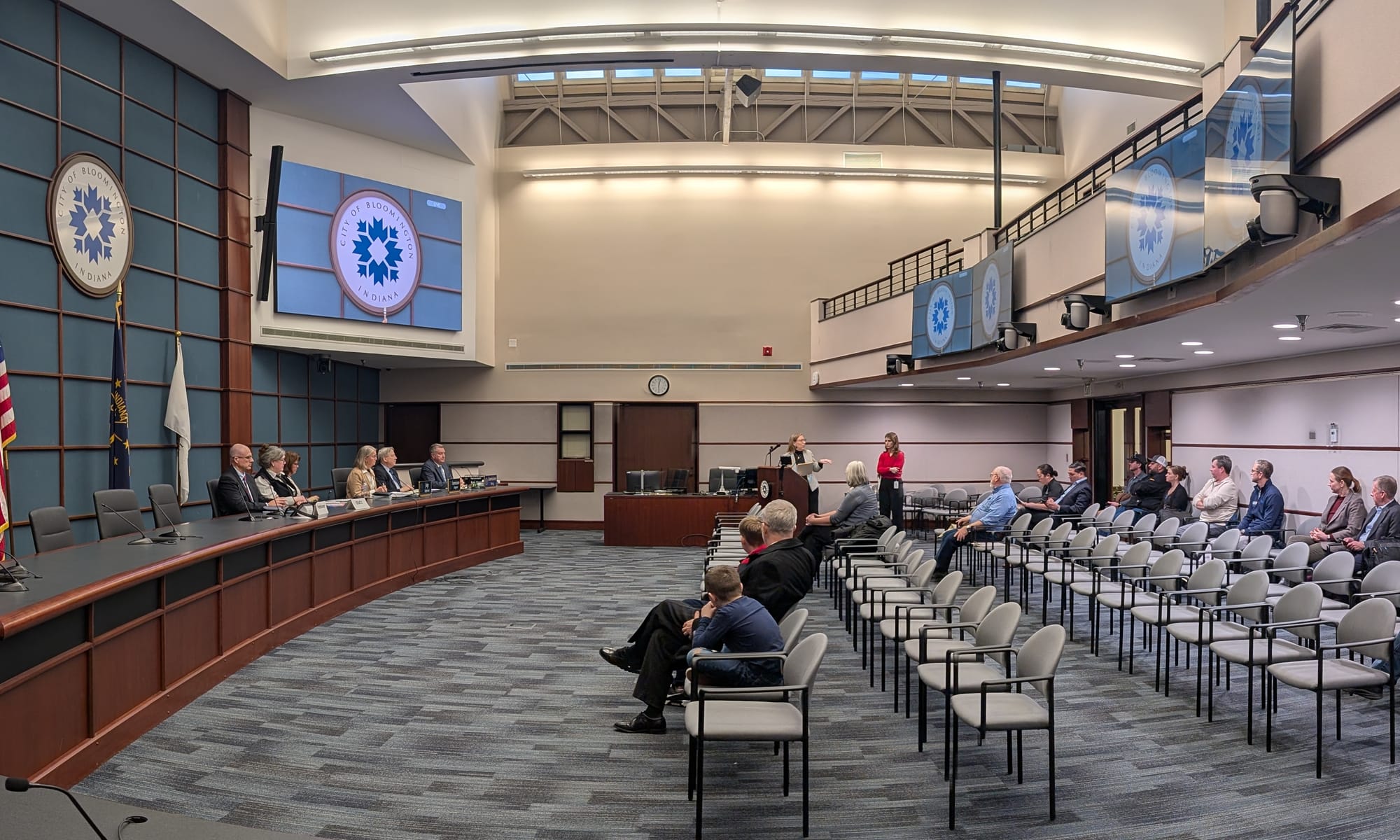
Last week, the IURC held a field hearing in the Bloomington City Council chambers, when three people spoke. Comments came from a board member of a neighboring water utility that is a CBU wholesale customer, and two representatives of the business community.
Rodney Lee Ira, a board member of Southern Monroe Water Authority, said his utility purchases water wholesale from CBU and currently has some of the lowest rates in the area. While acknowledging that increases are expected, as systems invest in infrastructure, he urged the IURC to ensure parity and fairness between rates paid by big users such as Indiana University and wholesale customers like Southern Monroe.
Aubrey Williams, co-founder of Heartwork Brewing, warned that steep increases for commercial customers would hit small, locally owned businesses hardest. Water is the main ingredient for beer, she said, and higher utility bills could mean delayed equipment purchases, reduced staff hours, or higher prices in a market where customers are already cutting back.
Eric Spoonmore, president and CEO of the Greater Bloomington Chamber of Commerce, framed the proposal against what he described as a broader affordability crisis in Monroe County, citing rising costs for both households and employers. He said significant, one-time jumps in water rates risk undermining Bloomington’s economic competitiveness and urged a more gradual, incremental approach to any necessary increases.
CBU has for several years tried to implement regular increases for all of its utilities—drinking water, sewer, and stormwater—about every four years, to avoid dramatic increases at any one time.
Still, the currently proposed percentage increase for business customers means an increase to the rate charged per 1,000 gallons of about 47%. In the documentation for CBU’s rate case, business customers are a part of a customer class called “general services.” The increase in the rate for business customers is more than twice the roughly 21% increase proposed for the residential class.
The different customer classes are key to the logic behind CBU’s rate case.
In addition to paying for delivering drinking water, the rate increase is supposed to pay for a five-year capital improvement plan totaling $84 million. The five-year plan is supposed to replace and upgrade aging pipes, pumps, and treatment facilities. The plan depends on issuance of $71 million in long-term debt.
The idea is to calculate how much total revenue is needed to pay for the cost of delivering drinking water to all customers, add the revenue required to pay for capital improvements, and then come up with a reasonable way to distribute the cost across customer classes.
The idea is to analyze the cost of delivering water to each customer class separately, and to tie the cost of delivering water to that class of customer to the rate for that customer class. If the true cost of delivering water were the same for all types of customers, then CBU would not have a basis for charging different rates for different classes.
But CBU analyzes the cost of delivering water to different customer classes as different. One part of that cost-of-service analysis, but not the only part, involves the peak-demand ratio—that is, the ratio of a customer class’s highest day of water use to its average daily use over a period of time. It’s also called the max-day factor.
Peak-demand ratios show how much each customer class contributes to the system’s maximum day of water use—that’s the scenario CBU must design and size its treatment plants, pumps, and pipes to handle. Because those peak-capacity requirements drive a big part of the system’s costs, the ratios help determine how those costs should be allocated across customer classes.
From CBU’s rate case, here’s a breakdown of the max-day factors for different customer classes:
Peak Service
Class
(kgal)
(kgal)
max day
factor
The 1.43 ratio for general services (business) customers is bigger than the 1.31 ratio for residential customers. So the cost of service for business customers gets analyzed as bigger than the cost of service for residential customers.
An initial step in calculating rates per 1,000 gallons for each class is to figure out how much revenue is needed from each customer class, to cover the future cost of service to that class. It’s not as simple as looking at the amount of revenue currently collected from that class, comparing it to the future amount needed, and applying that percentage increase to the rate per 1,000 gallons. That’s because costs charged to customers are divided between fixed costs and volumetric costs. Fixed costs are the flat charges customers pay just for being connected to the system.
On CBU’s analysis, the total amount of revenue from residential customers needs to increase by 18.9% and the total amount of revenue from business customers needs to increase by 33.4%.
Cost of Service
But those percentages don’t apply to the rate per 1,000 gallons. For both customer classes, the proposed volumetric rate increase is bigger than the percentage of total revenue increase. Residential customers are proposed to pay 21.3% more in their rate, while business customers are proposed to pay 46.4% more.
Volumetric Rate
That means a larger share of the increased revenue is proposed to be tied to how much water a customer within a class uses, rather than the flat amount paid simply for being connected to the system.
Four years ago, the IURC decided to reduce CBU’s requested rate increase by 16 cents a gallon for residential customers and by 32 cents a gallon for Indiana University.
The IURC docket for the current rate case calls for an April 30 evidentiary hearing, with closing briefs expected in May.

Comments ()