
CBU fills in some details behind countywide boil-water advisory, including 1.06 NTU reading
A power outage and equipment failures at Bloomington’s water plant led to a brief turbidity violation and countywide boil-water advisory. The measurement showing levels too high came about 5 p.m. Saturday, and fell below the limit by 6 p.m. It was not announced to the public until 12:04 a.m. Sunday.
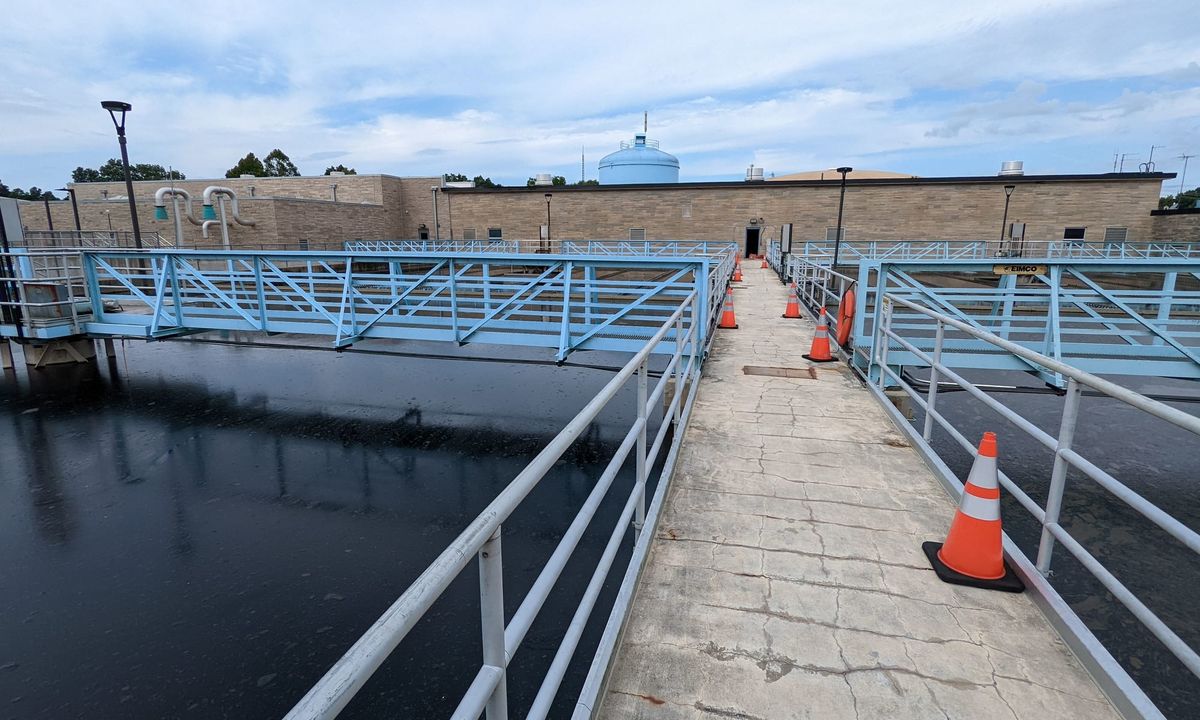
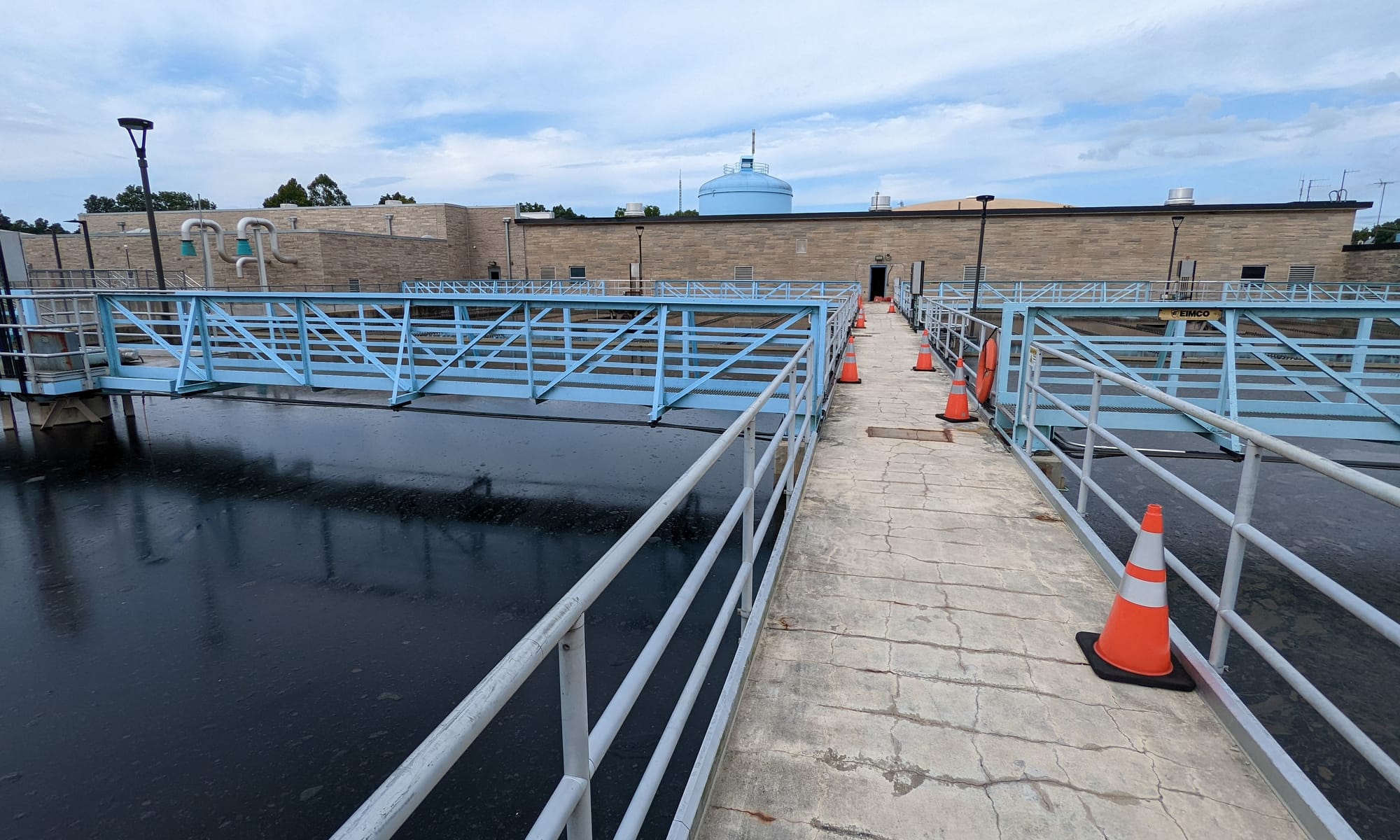
Between a news release Monday morning (Sept. 21) announcing the end of Monroe County’s boil-water advisory, and a Monday night briefing given to the city’s utilities service board, many of the questions related to the weekend advisory got answers.
The original advisory was issued based on a turbidity level that was measured at a level higher than state standards. Turbidity is a measure of cloudiness, which in itself is not a health risk, but can be an indicator of improper filtration, might interfere with disinfection, and can provide a medium for microbial growth.
Among the details released on Monday was the peak measurement for turbidity, which was 1.06 nephelometric turbidity units (NTU) at about 5 p.m. on Saturday. That’s just over the regulatory ceiling of 1.00, and was back below the limit by 6 p.m. Turbidity is measured hourly. The public notification went out around midnight, roughly seven hours after the standard was exceeded.
Another detail released Monday was that the water treatment plant had gone about 10 and a half hours without treating and pumping water normally, after a storm-related power failure that began around 6 p.m. on Friday (Sept. 18).
The advisory itself was lifted Monday morning after samples collected at locations throughout the water distribution system came back clear. CBU director Katherine Zaiger told the USB at its regular Monday meeting that the samples require 24 hours to run and that CBU allowed about 26 hours before relying on the results.
Zaiger praised the work of the CBU staff: “I want to give a lot of kudos to our staff, our operators, and our maintenance staff who are on site, who are incredible, quick thinking, calm problem solvers who were able to get it done very quickly.”
Power outage followed by equipment trouble
The chain of events started around 6 p.m. Friday, Sept. 18, when a storm knocked out power at the Monroe water treatment plant.
CBU’s existing backup generators can operate the plant at about 50% capacity, according to Monday’s news release. But additional electrical problems at the intake tower meant the plant could not treat and pump water normally for about 10 and a half hours. The release identified problems involving raw-water pumps, alum pumps, the plant’s supervisory control and data acquisition system (SCADA), and communications equipment.
At Monday’s USB meeting, assistant utilities director Hector Ortiz Sanchez said Duke Energy power was unavailable for roughly four hours. The other six hours when the plant wasn’t treating water were spent troubleshooting CBU’s own systems after utility power was restored. One issue involved a depleted battery backup and the controls governing the transition between generator power and utility power.
Once the intake was operating again, the plant still was not at full capacity. Zaiger said an alum feed pump was damaged when the power came back on. A replacement alum pump was also damaged, before staff established a temporary alum-feed arrangement. By Monday evening, the plant was producing at a rate of 22 million gallons per day, which is toward the high end of its normal production capacity, while storage tanks continued to refill, Zaiger said.
The alum pump failure connects the electrical problems directly to the high turbidity level. Alum is an aluminum sulfate-based coagulant. It causes very small particles that would otherwise remain suspended in the water to join together into larger clumps, called floc, which can then settle out or be caught by filters.
Losing the alum feed interfered with formation of floc and removal of suspended particles, causing turbidity in the water to increase. Low levels in the Monroe distribution tank also contributed to the high turbidity, according to CBU.
Turbidity is a measure of how much light is scattered by suspended material when it passes through the water. It does not by itself identify what those suspended particles are or show that bacteria or other pathogens are present. But high turbidity can indicate that treatment and filtration are not working as intended.
Exceedance lasted less than an hour
The specific reading that triggered the regulatory issue was 1.06 NTU at approximately 5 p.m. Saturday, Sept. 19. That reading was 0.06 NTU over the 1.0-NTU maximum. CBU says readings were back below 1.0 NTU by 6 p.m. and remained below the limit after that. The B Square has made a records request for a dataset of the turbidity levels from the start of the year to now.
The federal drinking-water rules require turbidity to be 0.3 NTU or lower in at least 95% of measurements during a month, with no measurement allowed to exceed 1 NTU.
After the USB meeting, Zaiger told The B Square the plant has two instruments that produce hourly readings for turbidity. At 5 p.m. on Saturday, one was below the limit and the other reading was over it. Staff initially considered whether the instruments were clean and whether the measurements triggered the advisory, she said. The outcome of that conversation was to proceed with the advisory.
Zaiger said that the basic question of the triggering threshold was resolved within the first hour. So that doesn’t explain the whole time lag before the public notification. The rest of the time was spent on internal coordination and preparing a news release that could be linked from the customer notification, Zaiger said. Zaiger alluded to IDEM’s (Indiana Department of Environmental Management’s) 24-hour requirement for notification.
The original release was sent at 12:04 a.m. Sunday, putting roughly seven hours between the 5 p.m. measurement and the announcement.
“I wish we could have got it out sooner,” Zaiger told The B Square after the meeting.
The timing of the release meant that restaurants serving dinner on Saturday night were not affected, but those offering breakfast Sunday morning had to tweak their operations. Village Deli on Kirkwood was like many, who posted a sign on their door reading: “We are not serving water or soda due to the Bloomington water advisory. We will be selling bottled water. Thanks for your understanding.”
IDEM’s 24-hour rule
After the USB meeting, Zaiger referred in her comments to The B Square to an IDEM 24-hour requirement.
For a violation caused by a single exceedance of the maximum turbidity limit, Indiana’s Administrative Code (IAC) says the water system has to consult with the IDEM commissioner “as soon as practical,” but no later than 24 hours after learning of the violation, to determine whether a Tier 1 public notice is required to protect public health.
If IDEM determines that Tier 1 notice is required, IAC requires the notice as soon as practical, and no later than 24 hours after the system learns of the violation. If the required consultation does not take place within the first 24 hours, the rules call for a Tier 1 notice within the following 24 hours, which means no later than 48 hours after the utility learns of the violation. That put CBU’s notification well within the required time frame.
A Tier 1 notice is Indiana’s most urgent category of drinking-water public notice. It applies to violations or situations with a significant potential for serious adverse health effects from short-term exposure. IAC says a Tier 1 notice has to be “reasonably calculated to reach all persons served” by the utility.
Although turbidity at the plant dropped below the 1.00 limit just hour after the 1.06 measurement, that did not establish the condition of water already moving through storage tanks and distribution mains.
Zaiger told the USB that CBU sampled at locations throughout the distribution system. After running the samples through tests that take 24 hours, those samples came back clear, providing the basis for lifting the advisory Monday morning.
The announcement lifting the advisory also warned that some customers could continue to see lower-than-normal water pressure because storage tanks were still recovering from the period of reduced production.
2023 outage, lessons learned, preparation for future
Monday’s USB discussion at times returned to another prolonged power interruption at the Monroe plant in June 2023.
USB president Kirk White described that episode as a “close call” in which CBU “dodged a bullet.” He said the experience had already demonstrated that the utility cannot operate the plant indefinitely at full production on its existing generator capacity.
The July 3, 2023 meeting minutes for the USB describe a roughly 10- to 12-hour interruption after storms, with a failed electrical relay preventing the intake from receiving power from either the grid or the generator. A temporary intake that was already in place for construction work helped keep storage levels from falling farther during that episode.
White said Monday that the latest incident should be viewed as a failure of interconnected systems rather than of one employee or one piece of machinery.
“It’s a failure of systems,” he said, naming the Duke Energy connection, electrical equipment, generators, SCADA and other controls. He called for a comprehensive after-action review. White said the system has roughly 10 to 12 hours of water in its tanks if production stops, which puts a practical limit on how long CBU has to resolve an outage before conditions become much more serious.
Some of the equipment White was talking about is already scheduled for investment.
On Sept. 9, the city announced a $2.375 million EPA grant for resilience improvements at the its water treatment plant, including backup generators and improvements to its control systems. The city’s announcement noted that the plant sits in a rural, heavily wooded area near Lake Monroe, where high winds and fallen trees make electrical outages a recurring concern.
Zaiger told the USB that the grant will supplement projects funded through CBU’s recently implemented drinking-water rate increase. She said CBU has four planned projects involving electrical or control-panel work, along with broader modernization of the SCADA system.
White said the review should also cover public communication. When a water plant has stopped producing water and storage levels are falling, he said, CBU should have more aggressive communications ready to deploy, including simple instructions and graphics.
Zaiger said CBU initially used its Everbridge notification system, drawing on contact information associated with customer accounts. But many county residents either had outdated information or were not CBU account holders. Bloomington sells water wholesale to other utilities around Monroe County, which means customers of other utilities would not have received the initial notification.
CBU later sent notice through the county emergency-management system, which Zaiger said accounted for some of the differences in when people were notified.
From the public mic, former USB member Julie Roberts told the board she received an automated phone call around midnight but did not receive the text notification until much later, at 9:19 a.m. She urged CBU to coordinate more closely with Monroe County and to use simpler instructions. For example, she said news releases should talk about “brushing your teeth” instead of “oral hygiene.” She also suggested telling residents to conserve water when tank levels are critically low.
Information still to come
Monday’s release and briefing USB meeting filled in many of the major blanks left by the original advisory.
Questions about routine turbidity levels, the water levels in storage tanks, and more chronological details about the turbidity episode could get answers when the city responds to a records request filed by The B Square over the weekend.
Under the Indiana Access to Public Records Act, I request electronic copies of the following records concerning the turbidity event at the Monroe Water Treatment Plant that resulted in the countywide boil-water advisory issued around midnight on Sept. 20, 2026:
1. Records showing all turbidity measurements at the plant from Jan. 1, 2026 through Sept. 21, 2026 including the time the measurement was taken and the NTU measurement.
2. Records showing all water level measurement in the plant’s primary storage tank during that same period, from Jan. 1, 2026 through Sept. 20, 2026.
3. SCADA logs, trend data, alarm histories, event logs, or other records generated by the plant’s SCADA system that document the turbidity incident from Sept. 18 to Sept. 20, 2026.
4. Records sufficient to show when electrical power was lost and restored. Records sufficient to show which plant equipment lost power. Records sufficient to show whether backup or emergency power was available or used. Records that document any equipment or process that did not operate normally because of the outage.
5. Records showing plant water-production rates from Jan. 1, 2026 through Sept. 21, 2026 preferably at the smallest time interval maintained by CBU.
6. Communications starting Sept. 18, 2026 through Sept. 21, 2026 between CBU and the Indiana Department of Environmental Management concerning the turbidity exceedance, boil-water advisory, required sampling or testing, and the conditions that must be met before the advisory can be lifted.
7. Records showing any bacteriological, microbial or other water-quality testing conducted in response to the turbidity event, including sampling times, locations and results.
8. Any written incident review, preliminary assessment, chronology or other record describing the cause of the elevated turbidity and the operational steps taken in response.
For database, SCADA, spreadsheet or other structured electronic records, please provide the records in their existing native electronic format, such as CSV or XLSX, where reasonably available. If any portion of a responsive record is withheld or redacted, please identify the specific statutory basis for the withholding and disclose the reasonably segregable remainder. To the extent that a faster response could be possible if this request were modified or narrowed, please don’t hesitate to let me know so that I can consider such modification. Thank you!


Comments ()