
Bloomington transportation commission puts off College–Walnut two-way question
Bloomington’s transportation commission made no recommendation on two-way traffic for College and Walnut. A 3–2 vote, with two abstentions, fell short of the five votes needed. None of the 12 public speakers were in favor of the two-way design. The proposal returns on Dec. 7 amid cost questions.
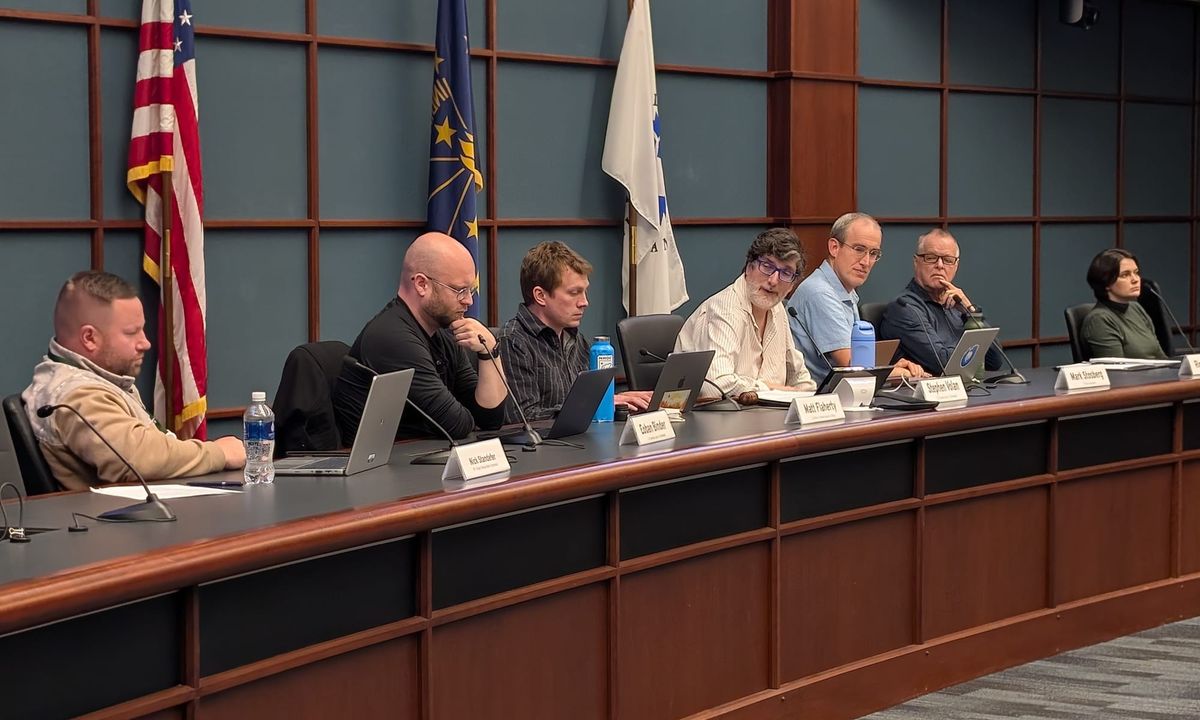
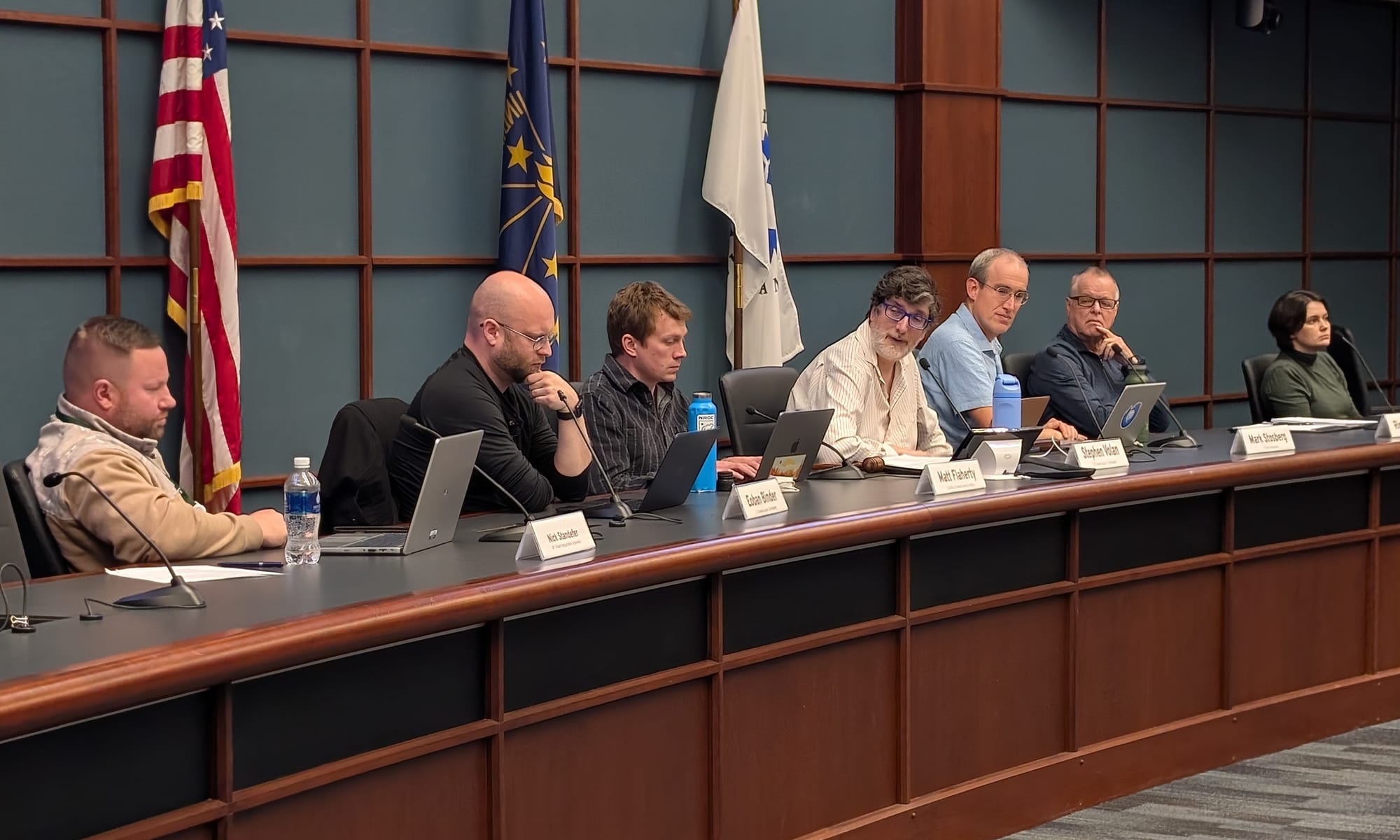
At a special meeting on Monday (Nov. 16), Bloomington’s transportation commission did not manage to make a recommendation one way or another on the two-way traffic proposal for College Avenue and Walnut Street in the city’s long-range plan for the corridor.
Instead, the seven commission commissioners who were present put off until their Dec. 7 meeting the question of amending the city’s transportation plan.
A motion to send the transportation plan amendments forward to the plan commission with a positive recommendation received just three votes in favor, two against and two abstentions. On the nine-member commission, any motion needs five votes in favor to pass, no matter how many members attend.
Voting yes were Matt Flaherty, Eoban Binder and Mark Stosberg. Voting no were Nick Standefer and Rick Coppock. Standhefer was attending his first meeting of the commission after taking over as general manager of Bloomington Transit.
Abstaining were Steve Volan, who is chair of the commission, and Sasha Sukhoruchko. Brian Drummy and Lesley Davis were absent. The members present then voted 7–0 to continue the item to the Dec. 7 meeting so staff could provide more information.
Even a positive recommendation would not authorize construction or commit money. The amendments to the city’s transportation plan would still go to the plan commission, then to the city council, which has the final say. The transportation plan is a component of the city’s comprehensive plan.
Bloomington mayor Kerry Thomson has said College and Walnut will not be converted to two-way traffic during her administration.
What was actually proposed
The proposal in front of the transportation commission was to amend the city’s transportation plan in two ways.
First, the plan’s description of the “Main Street” street classification would be revised to specify that future designs for College and Walnut should be based on two-way traffic. The new wording calls for one vehicle travel lane in each direction, with center turn lanes where appropriate.
It also calls for reallocating street space to accommodate protected urban trails, wider sidewalks, shorter pedestrian crossings, on-street parking and dedicated commercial loading zones.
Second, a new section titled “College and Walnut Corridor Study” would be added to the plan’s chapter on next steps for key recommendations.
The backdrop to the hearing was a report from consultant Toole Design, which recommends a conversion to two-way traffic.
Public: 12 speakers, none in favor
None of the 12 people who spoke during public comment supported the proposed two-way conversion. Ten opposed the conversion outright. Of the other two, one objected to the proposed two-way bicycle facilities, citing conflicts at intersections. The other urged the commission to proceed cautiously, release all crash and traffic data, and rely more on enforcement.
Speakers raised concerns about cost, congestion, ambulance response times, construction disruption and lax enforcement of existing speed limits.
Christopher Emge spoke for the Greater Bloomington Chamber of Commerce. He said 84% of businesses responding to a recent chamber survey opposed the conversion, including 65% who strongly opposed it. He asked the commission to consider safety and streetscape improvements separately from the proposal to make the streets two-way.
Economics
Planning services manager Ryan Robling gave three main reasons for the redesign. The first was safety. The second was environmental, including more room for trees, improved stormwater management and less urban heat. The third was economic development.
Robling cited three projects in other cities.
In South Bend, assessed property values downtown increased 21% between 2013 and 2018, according to a South Bend Tribune analysis of county tax records. During that period, the city converted major downtown streets from one-way to two-way traffic as part of its Smart Streets initiative. The increase in assessed values was not limited to properties along the converted streets.
In Louisville, property values along Brook Street increased 39% over three years after its conversion to two-way traffic. Over the same period, values along nearby one-way streets declined by about 0.4% each year.
In Indianapolis, a 2015 Indiana University study found that assessed property values within 500 feet of the Cultural Trail increased 148%, or just over $1 billion, from 2008 to 2014. The trail primarily involved pedestrian and bicycle improvements, not converting one-way streets to two-way traffic. The study did not establish how much of the increase was attributable to the trail.
Robling also noted that two-way streets make storefronts easier to see. On multi-lane one-way streets, he said, sightlines for drivers are obscured for about a quarter of the storefronts on the near side of an intersection. Two-way traffic would expose storefronts to drivers approaching from both directions. At speeds of 20 to 25 mph, he said, motorists would have more time to read signs and decide to stop and shop.
On parking, Robling said Bloomington’s downtown core between 3rd and 7th streets would increase by one, from 143 metered spaces to 144, along with new loading zones for delivery trucks. Along the whole corridor, metered spaces would decrease from 404 to 253. Most of that loss would come outside downtown, where metered parking spaces see comparatively little use, Roblin said.
Volan asked how much property values had increased on streets in South Bend that were not converted to two-way traffic. Without that comparison, he said, it was difficult to evaluate the reported 21% increase. Robling said he did not have those figures and that the 21% figure came from a press conference given by Pete Buttigieg when he was South Bend’s mayor.
Coppock, as well as some speakers from the public mic, questioned whether the economic results from South Bend and Louisville were comparable to Bloomington, because those cities had substantial redevelopment in areas that had previously been underused.
Robling acknowledged that South Bend and Louisville had economically depressed areas, but pushed back on the comparison. He said that while downtown Bloomington is well established, the southern stretch of the College–Walnut corridor has relatively few buildings, and the northern stretch has longstanding vacancies. He also noted that the Louisville area included an active convention center.
Safety
From 2018 through 2022, according to city crash records cited in the corridor study, College and Walnut had three fatal crashes and 34 serious-injury crashes.
Robling said speed measurements showed that the 85th-percentile speed reached 42 mph at some locations. That means 15% of measured vehicles were traveling faster than 42 mph. He noted a pedestrian struck by a vehicle traveling 40 mph has about an 80% chance of dying, compared with a 90% chance of surviving a collision at 20 mph.
Robling said vehicle traffic along College and Walnut has fallen 31% since the 1970s, while Bloomington’s population has grown 44%. At the busiest location during its busiest hour, the study recorded 931 vehicles on College south of Kirkwood, fewer than the roughly 1,050 vehicles per hour Robling said a single one-way lane could accommodate.
Robling said that the proposed two-way design would put southbound traffic on College about 70 vehicles over the capacity of a single lane during the peak hour. But he said converting Walnut to two-way traffic would provide another southbound lane to accommodate traffic.
The consultant’s traffic model indicates that, with two-way traffic, every signalized intersection could still operate at level of service A, B or C, which are considered acceptable operating conditions.
From the public mic, some speakers argued that the fatal crashes were not caused by speeding or by the one-way configuration. Robling said excessive speed was a factor in one of the three fatal crashes, but emphasized that the city’s approach is to reduce the severity of crashes through street design, rather than focus exclusively on the causes of individual collisions.
Responding to the call for more enforcement, Robling said drivers often slow down when they see police, then speed up again after they’re past the enforcement area. Effective enforcement would require officers to monitor speeds continuously, he said, which would strain limited police resources. Indiana law also does not allow the city to use automated speed cameras on ordinary streets, although a state pilot program permits them in certain highway construction zones.
Cost
Rebuilding both streets with safety improvements would cost an estimated $109.4 million with two-way traffic and $103.1 million if they remain one-way, in 2026 dollars. Both figures include design, infrastructure reconstruction and bridge work. Neither amount has been approved at any level. And the transportation commission’s vote will not approve any funding.
Robling described the proposal as a vision for 20 years or more. Most improvements could be built in stages while the streets remain one-way, he said, with conversion to two-way traffic coming last.
He said a city of Bloomington’s size could pursue federal grants of $20 million to $25 million at a time, with a typical local match of 20%. But that funding is not guaranteed, and the city would likely not receive the entire $100 million-plus in one grant.
Separate improvements to College and Walnut are already included in the city’s adopted 2026–2030 Transportation Improvement Program, administered through the Bloomington-Monroe County Metropolitan Planning Organization. The two phases have a combined estimated cost of $14.4 million. They include safety and infrastructure improvements, but not conversion to two-way traffic.
Volan questioned how much of the estimated reconstruction cost would represent ordinary replacement of infrastructure that would need work regardless of the traffic configuration. He asked staff for comparison costs from previous Bloomington road projects: East Third Street east of College Mall, the State Road 45/46 Bypass, South Walnut Street and West Third Street west of Patterson Drive.
Other commissioners asked how the work could be divided into phases and what alternatives would improve safety without converting the streets to two-way traffic.
Documents showing the redesigned one-way alternative, along with additional cost information, were added to the meeting packet during the meeting itself. Commissioners said they had not had time to review them.
Flaherty made a low-key bid for consideration of the proposal without the additional information, noting that cost is not central to the commission’s assigned task. Under Bloomington’s city code that task is to evaluate the proposal against criteria covering safety, city goals, public engagement and sustainability.
But Flaherty did not say that cost should be ignored, saying comparisons with previous projects could provide useful context, while broader decisions about spending priorities would fall to the city council. Flaherty is the city council’s representative to the transportation commission.
Robling said additional information would be provided before Dec. 7.
Will the public get to speak on Dec. 7?
It remains unclear if the public will be given another opportunity to speak in person to the transportation commission on the topic of the two-way conversion.
Before the vote to put off the matter until Dec. 7, Robling asked the commission to clarify whether public comment would reopen in December. He noted that the agenda for that meeting is expected to be packed and that the College–Walnut item would likely come late in the meeting. He said people should know whether they would be allowed to speak before deciding to attend and wait.
Volan said he regarded the December session as a continuation of Monday’s hearing, during which public comment had already been taken. He suggested limiting the December discussion to the additional information commissioners had requested, followed by a vote.
But the eventual motion on postponing the question until Dec. 7 did not specify how public comment would be handled. And the commission did not settle the question before adjourning. After the meeting, Robling told The B Square he would ask the commission to take a vote at the start of their Dec. 7 meeting on the question of public comment.
Even if the commission votes not to allow additional in-person commentary, the commission typically provides an online form for the public to submit written commentary.

Comments ()