
Cottage Grove conservation district OK’d by Bloomington city council on 7–1 vote
Bloomington’s city council voted 7–1 to establish the Cottage Grove conservation district, adding historic protections the central Bloomington area. Supporters said it could slow teardowns and preserve neighborhood character. Opponents warned it would constrain housing supply and raise costs.

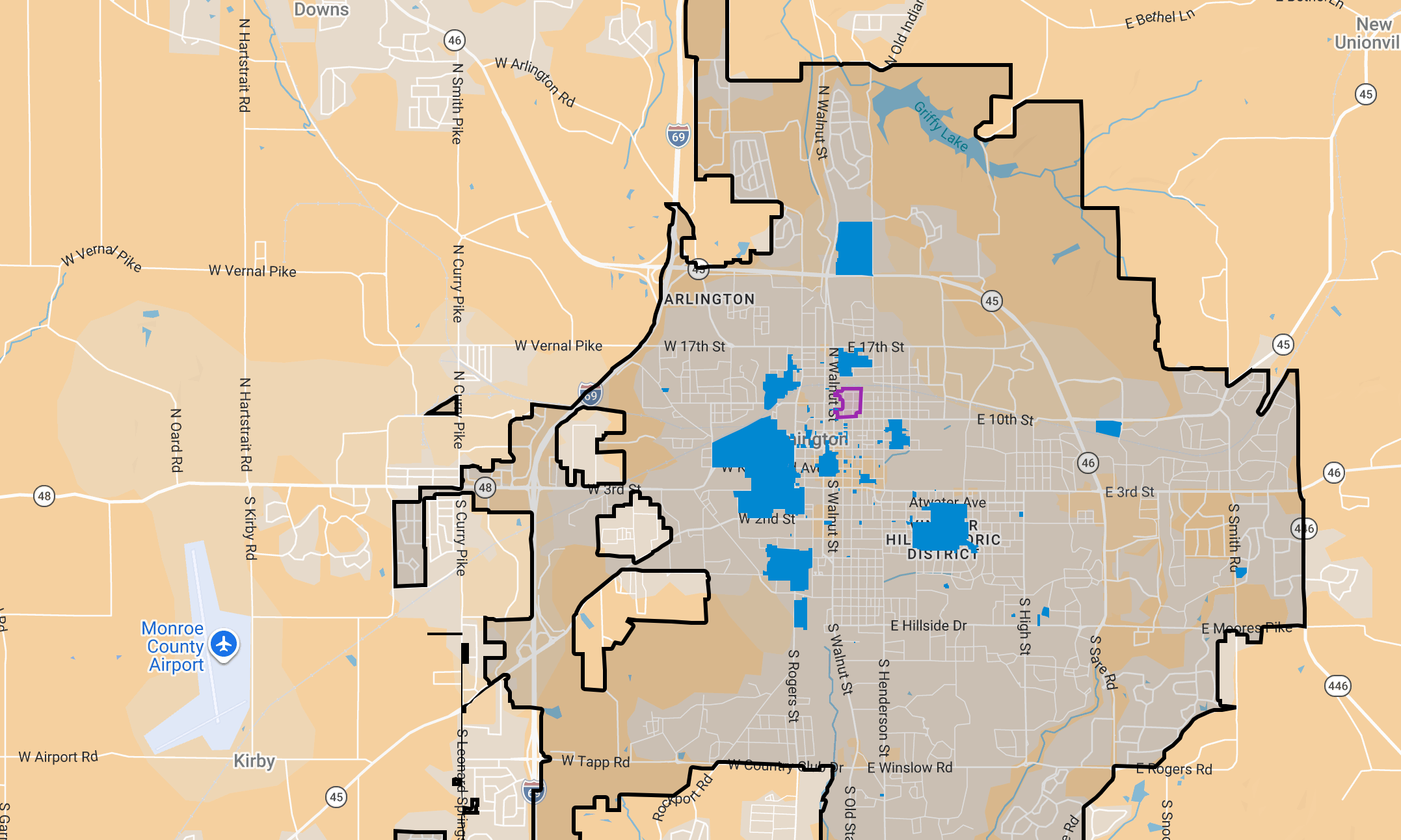
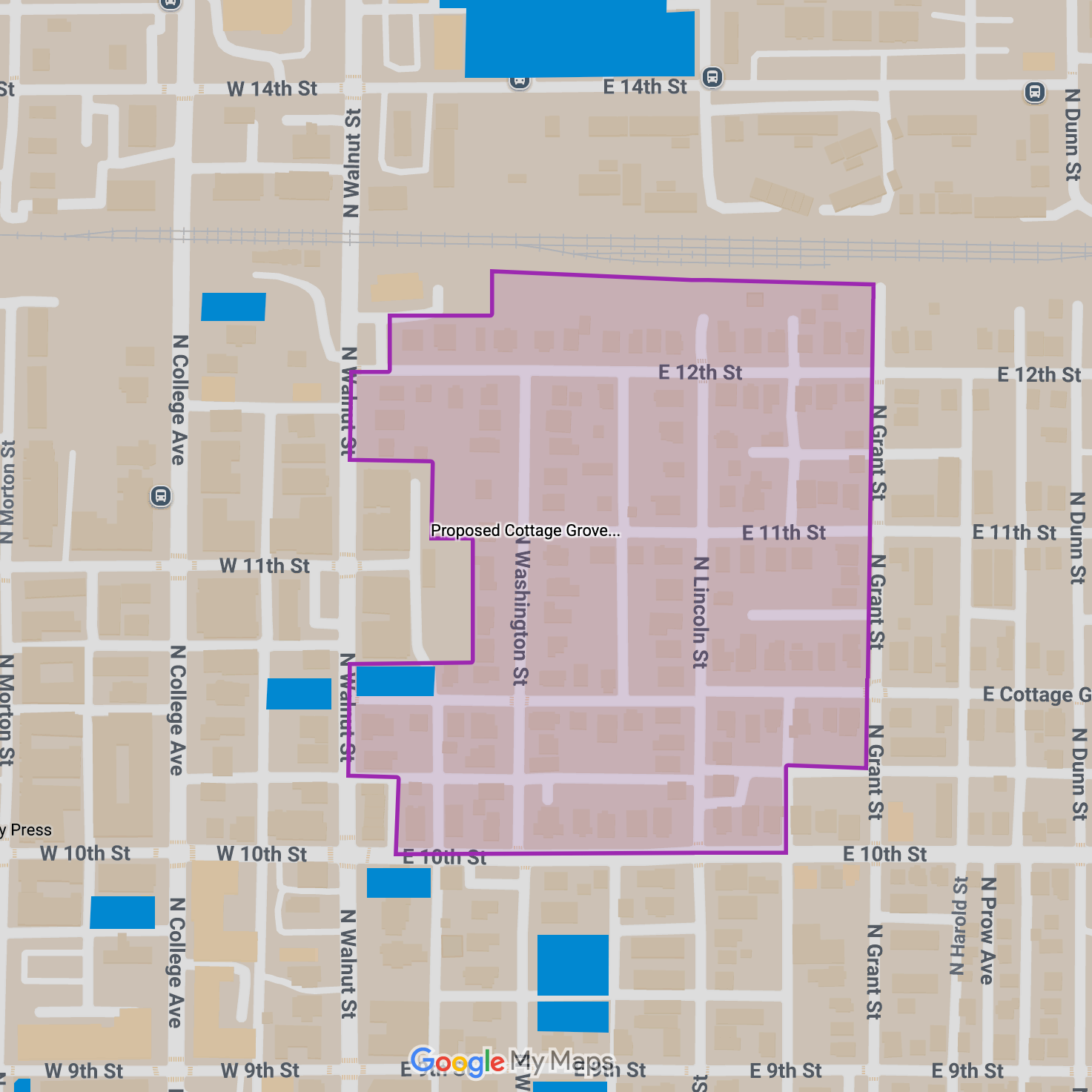
The area in purple is the Cottage Grove conservation district, approved by the city council on Wednesday night. The areas shaded blue are other areas in the city that have historic designation. Maps by The B Square with daa from the city of Bloomington. [dynamic map]
An area that includes over 120 properties in central Bloomington has been added to the city’s inventory of districts that enjoy some kind of historic protection.
By a 7–1 vote on Wednesday night (May 20), the city council established the Cottage Grove conservation district. It’s an area bounded generally by 10th Street on the south, the Indiana Railroad on the north, Walnut Street on the west, and Grant Street on the east.
The council heard the proposal for the first time at its previous meeting, on May 6, when a majority of councilmembers seemed ready to approve it that same night. But to enact an ordinance on the same day at the same meeting when it’s introduced requires a unanimous vote, which it seemed unlikely to get that night.
In a historic district, any exterior alterations are subject to review by the city’s historic preservation commission (HPC). In a conservation district, it’s just moving or demolishing buildings, or constructing new buildings that are subject to HPC review.
A future vote among property owners, to be taken three years after the conservation district is approved, will determine whether the district remains a conservation district or is elevated to a historic district. But unless a majority of property owners object, the conservation district automatically converts to a historic district. It’s not enough that a majority of those who participate in the vote object.
It is that “stacked deck” in favor of transitioning a conservation district to a historic district that counted among the reasons why Kate Rosenbarger voted no. Matt Flaherty left the meeting before the vote was taken, which left the final tally at 7–1.
At Wednesday’s meeting, the city’s historic preservation manager, Noah Sandweiss, didn’t present the detailed proposal for establishing the Cottage Grove conservation district, but was available to answer questions. Two weeks ago, on May 6, Sandweiss told the council the neighborhood had been identified decades ago by state preservation surveys as a potential historic district, and that it now meets the statutory criteria for local designation based on both architecture and history.
It’s a mostly intact early‑20th‑century working‑ and middle‑class neighborhood with a high ratio of “notable” and “contributing” structures, including multiple Craftsman, folk Victorian, Queen Anne and limestone Tudor houses associated with Showers Brothers workers and the city’s limestone industry.
According to the staff report, the push for designation came from neighborhood residents concerned about recent demolitions and redevelopment pressure near downtown and the Indiana University campus, including the proposed demolition of the house at 115 E. 12th St. The house on 12th Street was designated by the city council in mid-December last year as an individual local historic district because of its association with sculptor Ivan Adams.
The neighborhood also has original brick sidewalks, WPA-era cut limestone walks, limestone retaining walls, historic streetlights and a mature tree canopy visible in satellite imagery, which are absent from redeveloped blocks nearby, according to the staff report.
Letters from residents included in the meeting information packet ran heavily in favor of the designation as a conservation district. Long-term residents and property owners described watching surrounding blocks lose their historic houses to large-scale student apartment construction and said the district would preserve the neighborhood’s walkable scale and architectural character.
In one letter included in the packet, a property owner objected, writing that he had purchased his house in 1991 as an income property. Williams said the restrictions with historic district designation could diminish its resale value and rental potential, undermining the generational wealth he intended to pass to his children.
Supporters from the public mic
The overwhelming majority of voices from the public mic and in written feedback were in support of the Cottage Grove conservation district.
Supporters framed it as a way to keep “naturally occurring” affordable housing in place, in the form of smaller, older houses. It would also slow the pace of teardowns that have already transformed nearby blocks into high‑rent student apartments and vacant lots, they said.
“This neighborhood is a small collection of 100‑year‑old or older homes that represent diverse architectural styles that are core to Bloomington,” Amy Butler told the council. “They cannot be duplicated. Once they are lost, we are not getting them back.”
Her husband, John Butler, said the choice is not between preservation and cheap housing, but between rehabilitating modest houses and replacing them with high‑end projects. “It’s sort of an option between the home being historically preserved and maybe the home is fixed up and there’s some investment, so the price would go up slightly, or the home is torn down and it’s replaced by a million‑dollar investment property,” he said. “That million‑dollar investment property is absolutely out of my reach.”
Other preservation advocates stressed embodied energy, walkability, and long‑term affordability. Residents who helped lead the effort to establish the McDoel Gardens historic district, Paul and Elizabeth Ash, described their own neighborhood’s experience. McDoel Gardens became Bloomington’s first conservation district, then historic district. They said teardowns slowed, renovation increased, and over time the share of owner‑occupied homes climbed while older houses remained in reach for buyers compared to new construction elsewhere.
Opponents from the public mic
Opponents did not dispute the historic fabric of Cottage Grove, but they questioned the policy tool and the boundaries.
Jordan Evans, president of the Old Northeast Neighborhood Association, said his group was not opposed to preservation in principle, but objected to the map extending into Old Northeast without its support. “We want to also be clear that this is the last neighborhood with zoned density near campus,” he said, arguing that placing it in a conservation district “eliminat[es] the ability for any further density to be built close to campus, which in turn will affect affordability across Bloomington.” He urged the council to scale the district back to the smaller High Point area.
Doug Horn, with Horn Properties, which owns several buildings in the area and elsewhere in the core, warned that the layering of historic rules on top of the new Unified Development Ordinance (UDO) would undercut city housing goals. Local historic designation, he said, “will significantly impair, if not completely stop, a property owner’s ability to increase area density, as encouraged by our current UDO and its associated zoning designations.” He noted that demolition delay and preservation review already apply to individual buildings and asked the council to vote no, even while describing the petitioners as “wonderful people, and with heartfelt intentions.”
Greg Alexander, described the district as a de facto homeowners association that will raise costs and reduce supply near campus. “Another thing is, it will make development just more expensive. Those costs will be passed on to tenants,” he said. “If we can’t build housing near campus, we’ll build it somewhere else.”
City council perspective
Councilmembers who backed the ordinance leaned on the idea that preservation, in this particular geography and market, will do more for affordability than continued speculative redevelopment.
Andy Ruff challenged the notion that replacing small houses with new multi‑unit buildings lowers rents. He cited nearby redevelopments where older homes were torn down and replaced with dense student‑oriented apartments. The going rate, he said, is $1,400 per bedroom per month, compared to significantly lower rents in existing houses. Letting “development just follow the market,” he said, has already produced “a much less dense, less diverse, less community‑oriented” environment than the one he biked through as a child.
Isabel Piedmont‑Smith said she has watched similar teardown pressures in her own district and sees establishment of historic districts as one of the few tools available to slow that trend. At the same time, she flagged a structural concern that ran through much of the council’s deliberation. Namely, it is a relatively small group of district residents that often ends up writing binding design guidelines for everyone else. “We really should do everything we can to try to involve as many people as we can when those guidelines are written,” she said, so that homeowners can agree to and live with the rules.
Hopi Stosberg, who said she has been skeptical of historic designations, said she’d had a lot of internal conflict about the Cottage Grove proposal. She criticized the statutory framework that almost automatically converts conservation districts into full historic districts and worried about the costs and delays imposed by the historic preservation commission.
Stosberg also pushed back against the idea that the existing houses are affordable stock in any simple sense. “Where this location is right now, I mean, these are not affordable houses,” she said. “Like just FYI, these are not affordable houses. They are too close to campus to be affordable.” She added, “The land value underneath them ... it just kind of dictates like that.”
But teardowns, Stosberg said, would almost certainly produce even more expensive buildings than the current houses. She said she is likely to pursue changes to city code to require broader owner buy‑in and periodic review of district guidelines citywide, but ultimately voted yes on the Cottage Grove ordinance.
Kate Rosenbarger cast the lone no vote, saying that historic districts make housing more expensive and constrain needed supply close to jobs and campus. “High level here,” she told colleagues, “I am not supporting this until the state of Indiana changes the way it works with historic districts and conservation districts. I don’t like that there’s not one conservation district that is known to have survived as a conservation district, and everything is forced into a historic district.”
Rosenbarger, who lives in Prospect Hill, said her own experience in a district shaped her view. She described “ups and downs” trying to renovate some things in her “that were rotting” that the historic preservation commission did not allow her to change.
Rosenbarger said, “For me it is Econ 101: The more supply we have, the more competition we have, the more we can stop prices from rising as fast as they are.” She said that historic districts increase renovation costs, increase maintenance costs, increase red tape and process. All of that, she said, increases rents, and exacerbates the shortage of homes.” Rosenbarger said she appreciates the neighborhood’s character and the work of the petitioners, but could not support the conservation district.
Sydney Zulich, who represents the district and described herself as speaking “for the renters,” tied the vote to the city’s larger struggle to retain working‑class residents. New downtown luxury apartments, she said, are not where “people who grew up like me” can live.
“If we want to bring the working class back to Bloomington, we have to start providing real housing for them, and it’s not new apartment sky rises,” Zulich said. She called Cottage Grove’s small houses “one of the only opportunities to preserve some of the housing opportunities for people who look like me.”



Comments ()