
Ellettsville, Richland Township OK fiscal impact for merger; police coverage issue gets sharpened
Ellettsville and Richland Township officials separately approved a fiscal impact analysis for a proposed merger, sending it to the state for review. Questions about police service in rural areas surfaced before two hearings in June and a possible Nov. 3 vote.
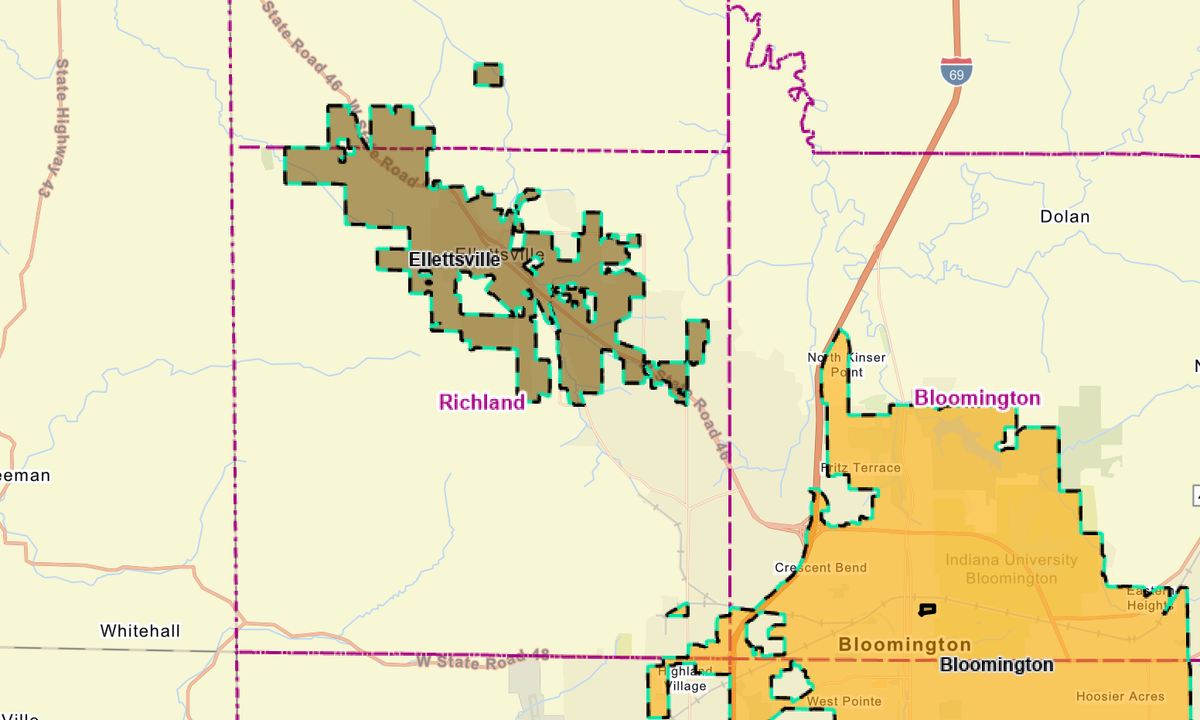
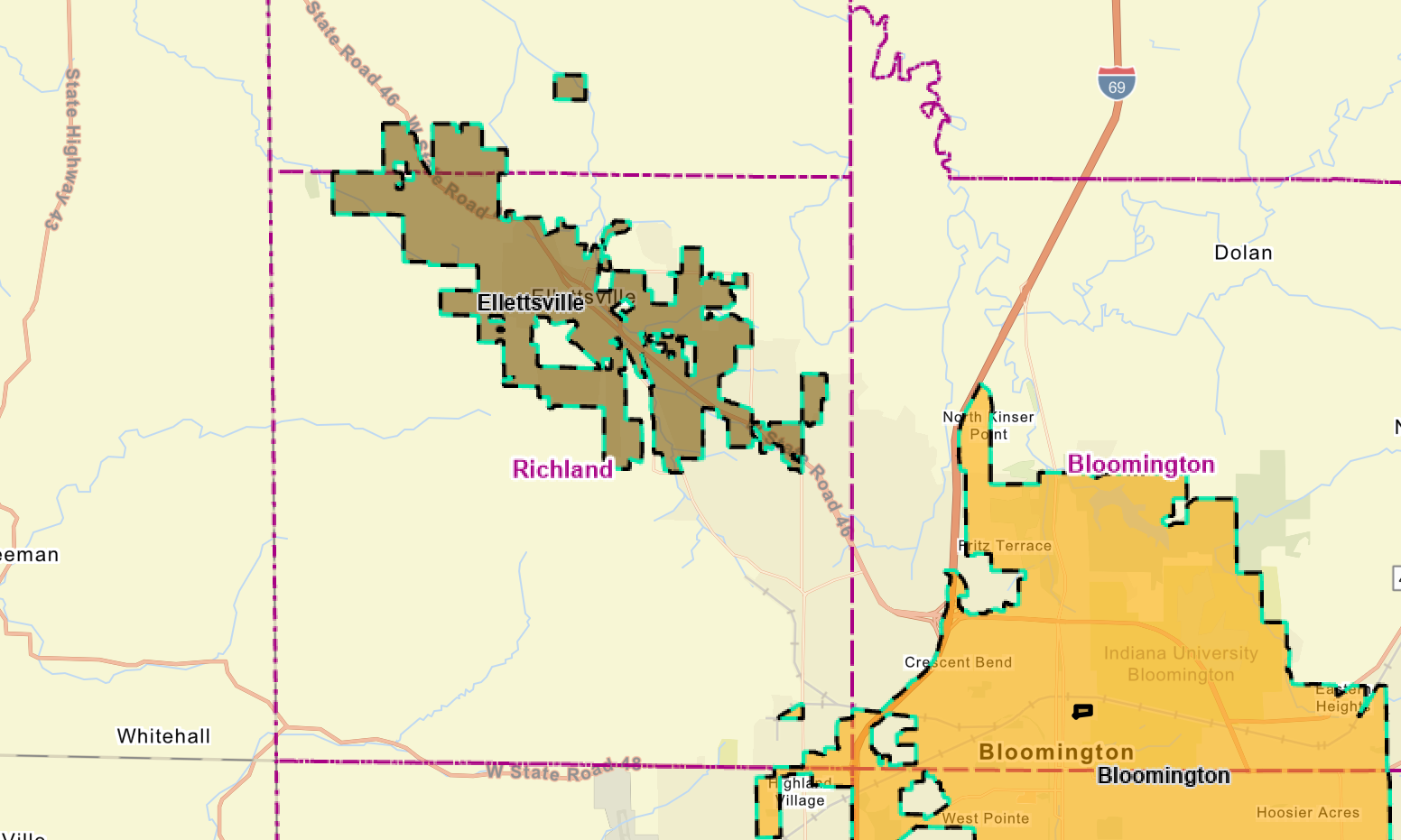
The Richland Township board and the Ellettsville town council both voted separately Wednesday night (May 27) to advance a proposed township–town reorganization. Each gave their approval to a fiscal impact analysis, which will now go to the state’s department of local government finance (DLGF) for review.
The joint meeting on May 27 is one of the last few meetings related to a possible reorganization, under state law. The fiscal plan underpins a reorganization proposal to consolidate Richland Township and the Town of Ellettsville into a single unit of government.
Next up will be two public hearings held by the board and the council on the proposed reorganization plan, after which the two governing bodies will vote on the question of whether to put the proposal to voters on the Nov. 3 ballot.
Those two hearings are set for June 10 at 6:30 p.m June 22, 2026, at 6:45 p.m.
Present on Wednesday for the Richland Township board were: Jay Thrasher; David Willibey; and Dawn Durnil. Present for the Ellettsville town council were: Scott Oldham; Trevor Sager; William Ellis; and Dan Swafford.
There was one vote of dissent for each of the governing bodies for their separate votes: Willibey Thrasher on the township board, and Swafford on the town council.
Town council president Scott Oldham was keen to make clear what was, and was not happening at Wednesday’s meeting.
He stressed that the day’s two separate actions by the board and the council did not put the question on the ballot yet: “This is a preliminary approval of a fiscal impact analysis to move forward.” He added that if either board ultimately votes the plan down after the two public hearings, “then the motion essentially is over, and it will not move forward to the taxpayers.”
Police, roads in rural vs. urban area of new reorganized town
It was also Oldham who raised a firm objection to the way law enforcement services under the reorganization were described by the financial consultant from Baker Tilly, Paige Sansone. During Sansone’s presentation, she said, “We fully anticipate that the sheriff's department will continue to respond to the rural areas as well.” But Oldham interjected mid-sentence: “No, they will not—so let’s reorganize that.”
The source of the friction over law enforcement services stems from the proposal to maintain a distinction between two areas within the newly reorganized town of Ellettsville. There will be an urban area, defined by the current town boundaries, and a rural area defined by the part of Richland Township that is not in the current town of Ellettsville. Property tax rates will be different in the urban and rural areas.
The funding for law enforcement in the newly organized town of Ellettsville will come just from the urban area. But that does not mean, Oldham was keen to stress, that the rural areas will be left to rely on the Monroe County sheriff for law enforcement. For the new, reorganized town of Ellettsville, which will be a municipality, the town police will serve the entire town, Oldham said. “[The] sheriff's department doesn’t respond to a municipality, so we need to do some refiguring,” Oldham, said.
Oldham called it “disingenuous” to say that the sheriff would be treating the rural part of the newly reorganized town of Ellettsville, which will be a municipality, the same way it had treated Richland Township minus the town of Ellettsville.
Oldham also clarified that there’s already a multi-jurisdictional mutual aid approach to law enforcement, where Ellettsville, Bloomington, Monroe County, and DNR all respond across their respective boundaries. It’s a matter of which agency is the point of first contact from the point of view of 911 dispatch. For the new reorganized town of Ellettsville, it will be Ellettsville police that will be the point of first contact for the whole new town, not just the urban part of it.
It’s roughly the same situation for maintenance of streets and roads. Township board member Jay Thrasher raised the question of county-versus-town responsibility for plowing roads in the rural part of the new reorganized town of Ellettsville. Oldham responded, “The town would have to take on that responsibility, because it would be one town—it will not be town and township.”
Background on reorganization process
Darla Brown, who is legal counsel for the town of Ellettsville, opened her remarks on the fiscal impact analysis with a recap of the process since last fall. On Nov. 10, 2025, the Richland Township board approved a resolution “indicating a willingness to explore a reorganization with the town of Ellettsville” under the modernization statute. The town council followed with its own resolution on Nov. 24.
Each governing body then appointed representatives to a seven-member reorganization committee, which met through the winter and spring. The committee created a series of subcommittees made up of “a cross section of citizens, township employees, and town employees” to look at specific functions: finance, local government, public safety, planning and zoning, parks and cemeteries, streets and road maintenance, water, sewer and stormwater, and former township services.
The reorganization committee approved a draft plan on April 9. That draft, along with supporting subcommittee materials, has been posted on the website that has been set up for the proposed consolidation, Brown said. Baker Tilly, the town’s financial consultant, was retained to produce the required fiscal impact analysis.
Baker Tilly fiscal plan: two districts, tax increases
Paige Sansone of Baker Tilly walked the board and the council through a PowerPoint presentation summarizing the fiscal impact analysis. At a conceptual level, she said, the reorganization is intended “to improve government efficiency, enhance the coordination of services, increase flexibility and local control, and improve planning and transparency,” while supporting long-term growth.
The proposal would dissolve the township government and fold its functions into a reorganized town government administered through Ellettsville. The new governing body would be a seven-member town council with five district seats and two at-large seats.
The plan creates two primary service districts: an urban district, roughly matching the current town boundaries; and a rural district, covering the current unincorporated township areas.
“This framework is intended to align taxes more closely with the services that are currently provided,” Sansone said, adding that the two-district structure “matches the taxes with the service levels, allows phased growth and expansion, preserves the rural character and expectations, and supports long-term infrastructure planning.”
Sansone said the town levies a property tax rate of $0.6160, generating about $3.3 million, while Richland Township levies a rate of $0.1644, generating about $1.3 million. The township has no property-tax-backed debt; the town has two existing debt issues, which Sansone stressed would “remain with the current town taxpayers,” with township residents not assuming that existing debt.
Projected property tax rates under reorganization would be $0.7028 in the urban district and $0.2776 in the rural district, generating a total of $6.1 million in property tax revenue. In raw dollar amounts, for a typical Richland Township homestead between $150,000 and $300,000, Sansone said, the property tax increase is expected in the range of $5–$12 per month. Sansone broke down the percentagewise increases like this:
- 6.9% increase for properties in Richland Township;
- 4.1% increase for the part of Ellettsville currently in Richland Township; and
- 3.5% increase for the part of Ellettsville in Bean Blossom Township.
Baker Tilly estimated average tax impacts as a percentage of the property owner’s total tax bill, not just the portion they pay for just the most local of the units, which are town and township.
That’s why, for example, Baker Tilly says the increase would be 6.9% [=(0.2776-0.1644)/1.6407] for Richland Township, instead of 69% [=(0.2776-0.1644)/0.1644].
The following tables are based on the 2026 budget order for Monroe County.
On Wednesday, Sansone reminded the boards that the law requires “a separate majority approval … for both town voters and township voters. In other words, both groups must independently approve the proposal for it to move forward."
If the proposal is put in front of voters and they approve it, the effective date for the new unified government would be Jan. 1, 2027.

Comments ()