
MCCSC board takes first step toward limiting bargaining for non-teaching staff
MCCSC trustees narrowly backed a first step toward limiting bargaining topics for non-teaching staff, while hearing support for Templeton’s multi-age program, reviewing federal funding changes and approving staffing moves. Redistricting discussion was delayed until Aug. 25.
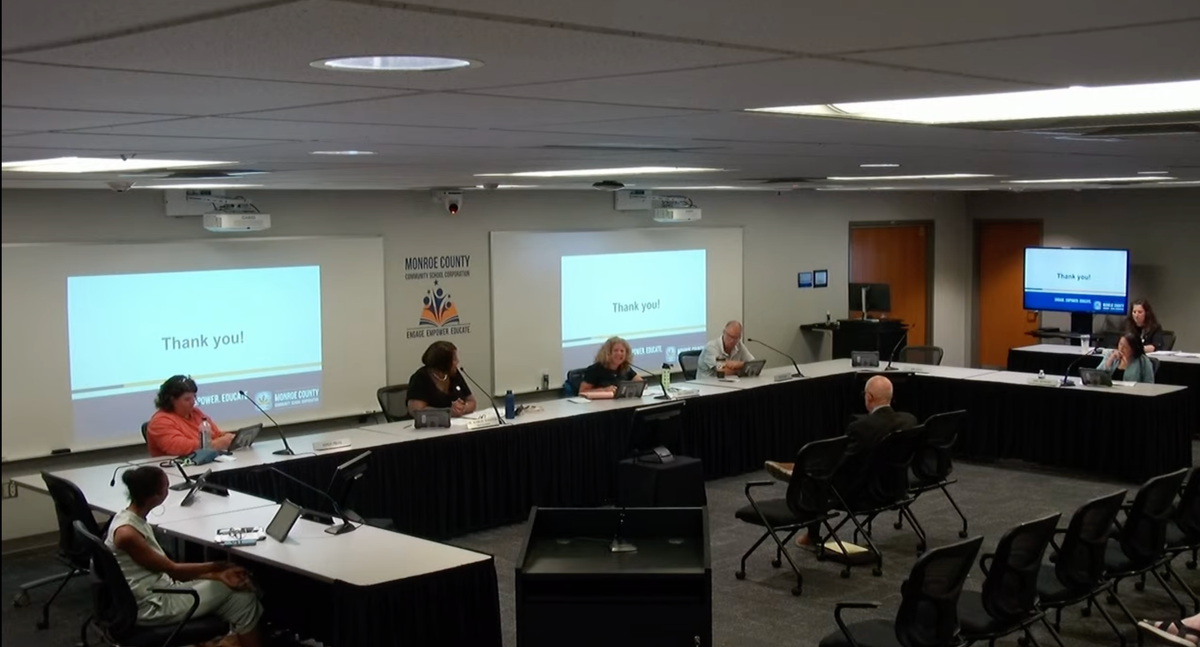
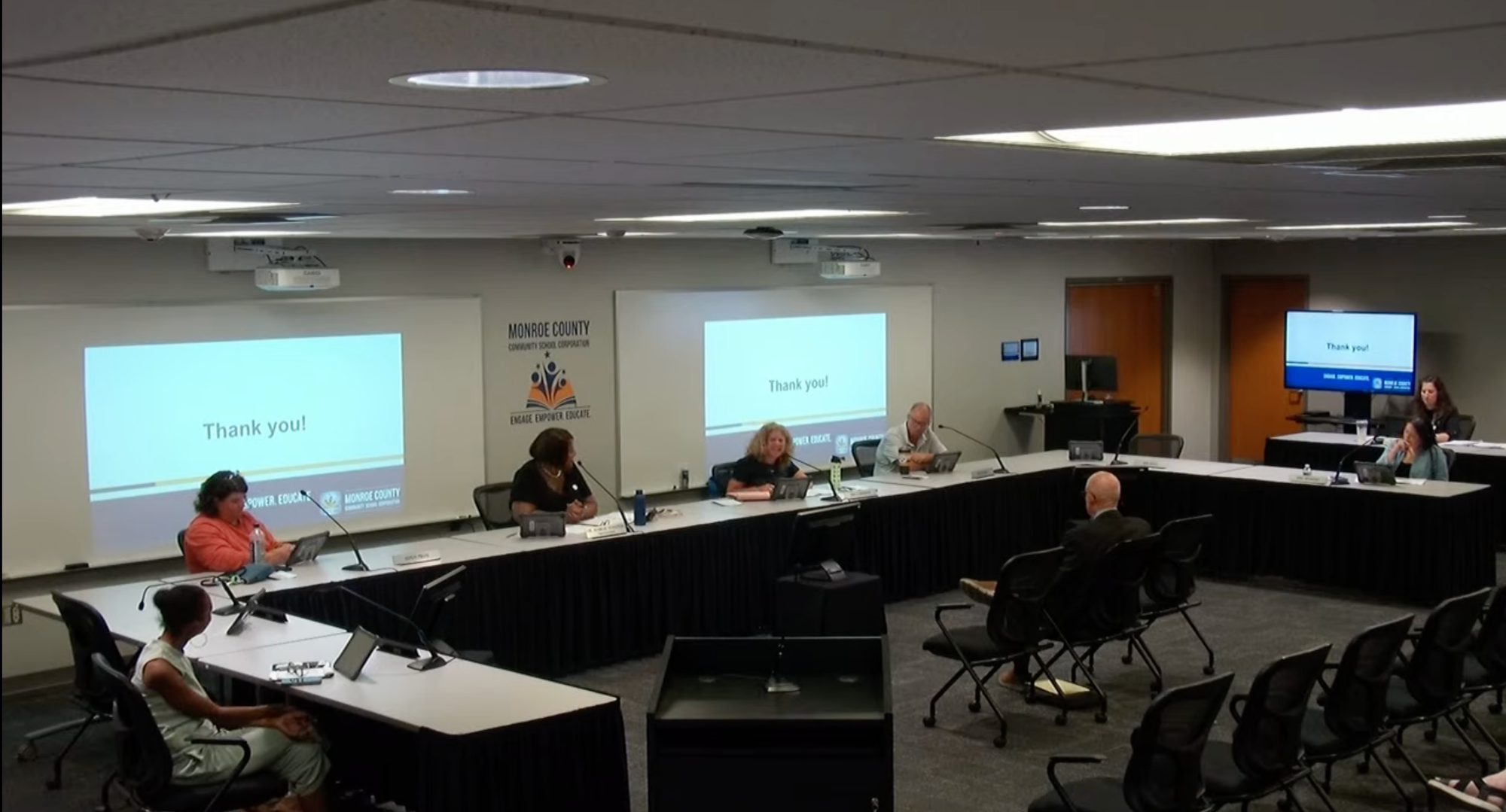
At their regular meeting last week (July 25), Monroe County Community School Corporation (MCCSC) trustees made changes to collective bargaining for non-teaching staff, heard concerns about a multi-age classroom program, heard district financial updates, and approved staffing changes.
An expected discussion about elementary school redistricting has been pushed to the August board meeting.
The first day of school for MCCSC students is Wednesday (Aug. 5). Teachers started work on Monday (Aug. 3).
Possible changes to bargaining for non-teaching staff
On the board’s agenda was a resolution that updates a district policy on bargaining rights for non-teaching staff.
The new policy is much shorter—one page instead of eight. The resolution cites Indiana Public Law 217, passed in 2017, which modified Indiana Code 20-29-6-4, as the reason for the new policy. But the law changed bargainable items for certified teaching staff, not operational staff.
The board’s proposal set up a conflict between uniformity and bargaining rights. District officials said narrowing the subjects open to bargaining would put non-teaching employees on the same footing as teachers and simplify negotiations. Union representatives, and board member April Hennessey, countered that the district would be voluntarily eliminating rights that non-teaching employees now have. What’s more, they said, no change in state law requires the district to do so.
American Federation of State, County, and Municipal Employees (AFSCME) Local 3995 is the bargaining unit for non-teaching staff at MCCSC. AFSCME Council 962 of Indiana and Kentucky executive director Ron Richmond opposed the resolution at the public mic. This is how he characterized it: “The board has intentions to change our bargaining status to change us from a full-range of bargaining to just doing wages and wage-related benefits like the teachers have.”
“That is not necessary,” he said. “The resolution being presented tonight reduces the workers’ voice instead of strengthening the partnership we have with the district.” Richmond also said that even if the resolution is “couched in terms of legislative action taken towards teachers, the reality is this is still a local choice. This is not a legislative certainty.”
“We urge the district and the board to reject Resolution 26-07,” he said. “This resolution does nothing to improve the product of teaching.”
Later during board discussion, member April Hennessey also raised a procedural issue. She said it’s confusing that the resolution contains a policy adoption before there have been two readings of it, which is required. Board president Erin Cooperman said that the resolution “doesn’t bind us to vote yes or no” on the policy.
Hennessey continued, “Can I ask why we would have a resolution ahead of a policy reading? … Why not just the policy change?”
MCCSC superintendent Markay Winston responded, “I think the policy just speaks to the fact that we continue, although there are no requirements or obligations for us to engage in bargaining, it just speaks to the fact that we have a continued and ongoing commitment to continue to support our bargaining groups and ensuring [their rights] are upheld. … This resolution asserts that.”
Hennessey said, “I am pretty staunchly and strongly pro-union. I actually do believe in … empowering people to bargain wherever there is space and room to do so, and I do also know that the teachers’ bargaining has been … stripped, truncated in many ways as a result of the legislature of the state.”
Hennessey said she understands the desire to align the bargaining ability of operations staff with that of teaching staff, to work towards “fairness or equitable policies and processes.” She also allowed that bargaining will probably be easier this way.
Hennessey said, “From my perspective, at this moment, I don’t know that I fully agree with the desire or the decision to remove bargaining rights that are available to people as there are no laws stripping or governing what can or cannot be bargained. … I am not totally sure how I feel about this.”
Hennessey asked if the Monroe County Education Association, the district’s teachers union, has had any input regarding the policy. Superintendent Winston said, “This resolution does not impact MCEA in one way, or any other way.”
Board member Ross Grimes clarified that if the resolution were to pass, the second reading of the policy at the board’s meeting did not pass, “the resolution basically goes away.”
“That’s my understanding,” Cooperman responded.
Cooperman said she shared her support for unions in general and some of Hennessey’s concerns about the resolution. “One of the most important factors to me is that it does align the collective bargaining rights of our teachers and our other staff. That feels equitable to me, and I think that, as you noted, without those two things being aligned, there are extra complications and extra time in bargaining with one union over the other union.”
Cooperman said she was leaning in favor of the policy change to bring the two bargaining units into alignment, though she wasn’t committing to a certain vote on the policy in August.
The resolution narrowly passed 3–1–1, with an abstention from Aja Jester, and the no vote from Hennessey. The updated policy will be on next month’s meeting agenda for a second and final reading. The tally did not add to seven, because board members Erin Wyatt and Tiana Iruoje were absent from the July meeting.
“I may very well be swayed, by the end of this process,” Hennessey said after voting.
Public comments: Multi-age program at Templeton
Eight community members spoke at the public mic during last week’s meeting; seven brought concerns to the board about the multi-age program at Templeton. Three people who spoke were students at MCCSC.
While traditional elementary school classes are grade-specific, Templeton Elementary also offers a multi-age program, where students of more than one grade level are in a classroom together. The seven people who addressed the board on the topic were unanimous in their support for the program.
Frank Brown Cloud is a Templeton parent who has two children who went through the multi-age program. “At a time when the school board has really been working on issues related to school equity, … it would be tragic to let this program lapse in the way that it has been for the past year,” he said to the board. “The multi-age program is one of the defining characteristics of Templeton Elementary School.”
Namora Cloud, a former Templeton student who is going into middle school, said at the public mic, “Multi-age has brought me so much in my education and in my social skills.” She said it allowed her to become friends with students both older and younger, and now, going into middle school, she can lean on those older classmates; “they have been able to show me around and told me what is expected of me,” she said. “I feel like that will make me a better student.”
Alan Pemberton, another multi-age parent, said he wished the program’s existence was better communicated to families. “My hope is that multi-age will not be a secret anymore,” he told the board. He said he felt frustrated when he first discovered the program.
He said his daughter joined a multi-age open Girl Scouts troop. “I started seeing benefits I hadn’t expected,” he said, “like positive peer mentorship, peer teaching, and learning from each other given the range of experiences of a great group of kids with diverse backgrounds and ages.” He was happy to learn of Templeton’s multi-age classroom and wished he knew about it sooner. “I’m sure multi-age is not a good fit for everyone, but it shouldn’t be a secret, because it’s been wonderful in my experience.”
Pemberton’s daughter, Addison, also spoke to the board. “Multi-age helps us with stronger friendships with younger and older ages and grades,” she said. “Older kids can model younger kids’ behavior better than adults can. … Without multi-age, it’d be hard for younger and older kids to get those skills.
Debbie Fish previously served as the principal of Gosport Elementary School, which is about 15 miles northwest of Bloomington. In the 1990s, she told the board, the school introduced a multi-age program. “Once implemented, their successful approach attracted attention statewide and nationally; they won a … national award. I was the principal of that school for three years and managed not to mess it up.”
Fish said, “The fractured society we live in does little to nurture families and children. So this type of schooling is needed more than ever. Please don’t let administrative expediency rule.”
Sarah Kopper said at the public mic, “My hope in speaking to you tonight is that the program will get the administrative support it needs to be fully implemented so MCCSC students can continue to benefit for years to come.”
An MCCSC spokesperson wrote in an email to The B Square: “Currently, the multi-age program is only offered at Templeton and this programming is planned to continue.” According to the district, about 100 students are currently enrolled in the program. Templeton’s total enrollment was about 430 students last school year, according to Indiana Department of Education data.
Changes to funding: Extended Day, EdVenture Camp, Title I
During MCCSC chief financial officer Matt Irwin’s report to the board, he noted changes to two federal grants.
MCCSC received a federal 21st Century Community Learning Centers (21st CLCC) grant for out-of-school time programs totaling $300,000 beginning in 2021 and ending in July 2026. The 21st CLCC grant funded the district’s Extended Day program, which provides elementary school students with supervision before and after school, and its summer EdVenture Camps. A new cohort application is available; schools have until Sept. 4 to apply. Irwin said MCCSC will apply, but “it’s not guaranteed.”
Another federal revenue source is Title I funding, which helps schools with high rates of students from low-income families. Irwin said funding is reduced by $362,490 for the 2026-27 school year. MCCSC has seven elementary schools considered Title I priority schools: Arlington Heights, Clear Creek, Fairview, Grandview, Highland Park, Summit, and Templeton. Irwin said the federal grant supported student intervention staffing at those schools.
Costs previously covered by these grants, Irwin said, will have to come out of the district’s operations fund.
Not mentioned at last week’s meeting was a decision the board made last year that has an impact on Title I schools this coming year: trustees unanimously voted in favor of a resolution that cut supplemental stipends that teachers at Title I schools received. Each Title I teacher received an extra $1,000 during the 2023-24 school year and $2,000 in 2024-25. The resolution reduced the 2025-26 amount back to $1,000 and provides no supplemental payments in 2026-27 and beyond.
School administration changes
At its meeting the board also approved a personnel report, which included: the hiring of new assistant athletic director, physical education teacher, and head boys basketball coach Matthew Britton at Bloomington High School North; the hiring of assistant principals Tyler Kelp at Summit Elementary, Kimberly Osborn at Fairview Elementary, and Sally Spice at Binford Elementary.
Administrative reassignments included Aaron Ritter from principal at Marlin Elementary to Childs, Steven Marshall from principal at Childs Elementary to principal at Summit Elementary, and Tyler Abel from principal at Summit Elementary to assistant principal at Tri-North Middle School. Additionally, Tim Dowling, director of early learning and enrollment for the district, is adding “interim principal” to his title as he splits his time between the administration building and Marlin Elementary.
Including Britton, the board approved the hiring of 19 new teachers, two of whom were promoted from MCCSC aide positions. The remaining 17 are outside hires. Also approved were nine teacher position transfers between MCCSC schools, 15 teacher resignations, and two teacher retirements.
Redistricting discussion pushed to August meeting
In March, the school board received a presentation of six “findings” from the redistricting study commission that was formed in April 2025. The board gave the commission the job of studying redistricting options with two goals: balancing student socio-economic status (SES) among the schools; and ensuring cost-effectiveness. The commission identified factors for evaluating new catchment areas and evaluated potential map scenarios, wrapping up its work in December 2025.
In June, Cooperman said, “We need to discuss [the report] this summer and I’d like to discuss [it] at the July board meeting.” Redistricting wasn’t on the agenda or discussed last week.
Responding to a B Square question, Cooperman wrote, “I removed the redistricting discussion from this month’s agenda prior to posting because two board members were not going to be in attendance and I want to make sure everyone is able to participate. Barring any other obstacles, the discussion will be on the August agenda.”
The 28-page report is publicly available on the redistricting page of MCCSC’s website. The next school board meeting is set for Aug. 25.



Comments ()