
Hopewell South PUD wins unanimous OK from Bloomington city council
Bloomington’s city council unanimously approved the Hopewell South PUD after months of debate over issues like how much of the project should remain permanently affordable. A compromise set a 35% affordability minimum with a 50% target, while preserving flexibility for financing tools.
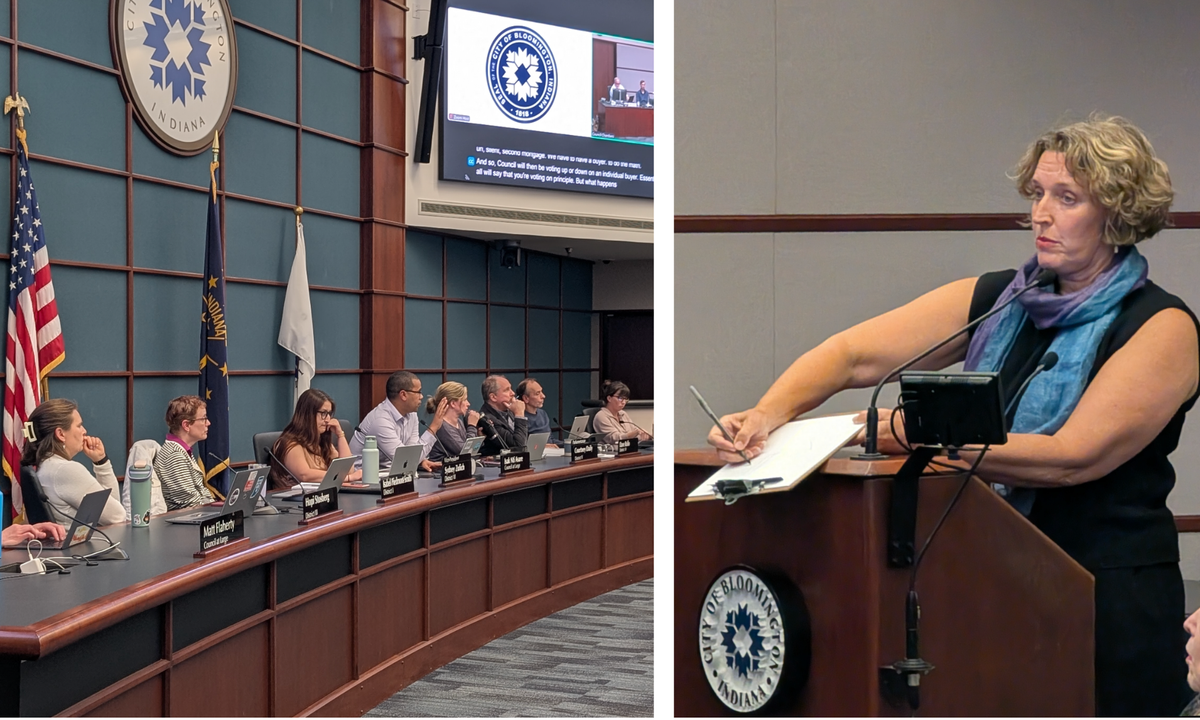
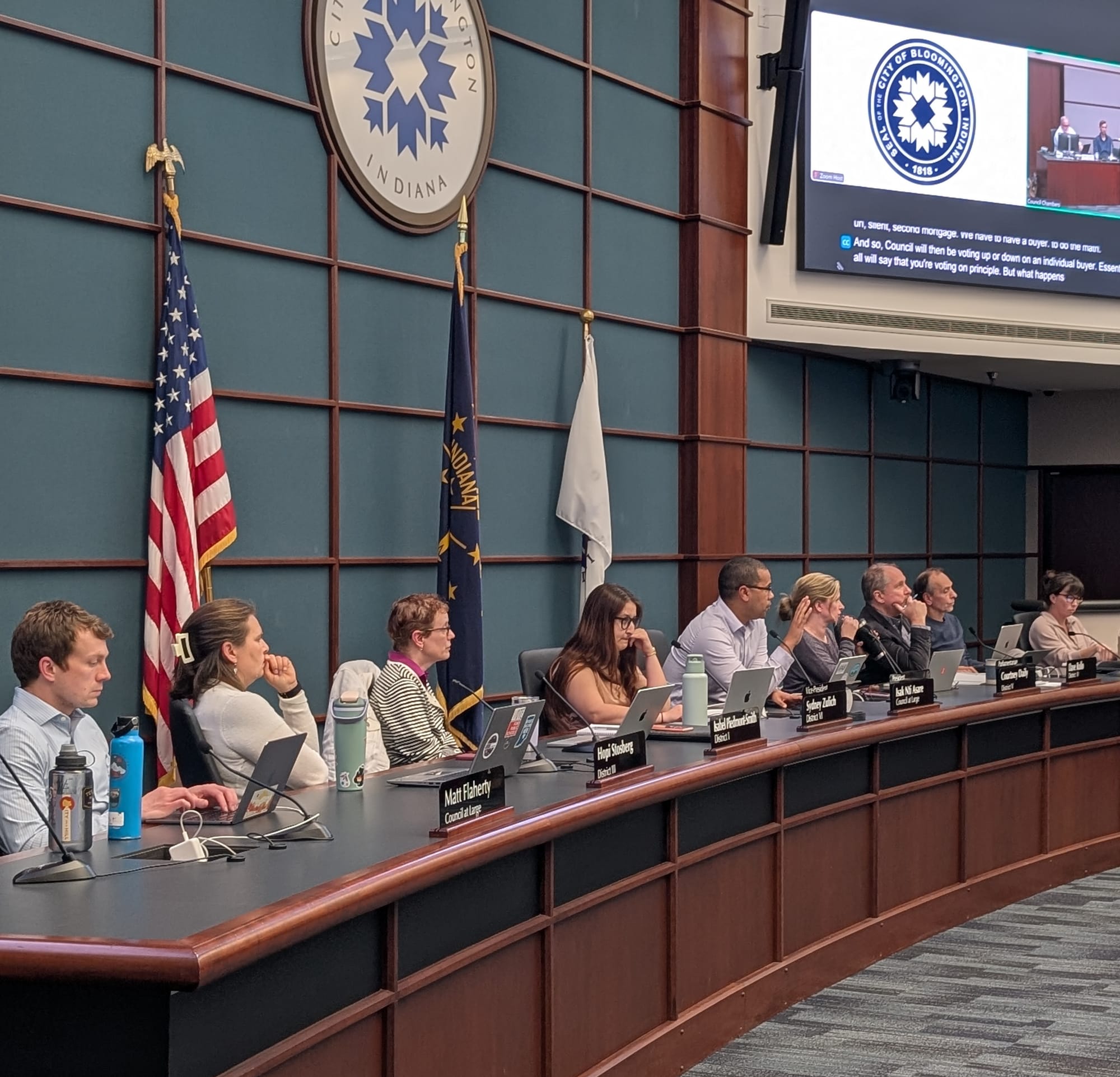
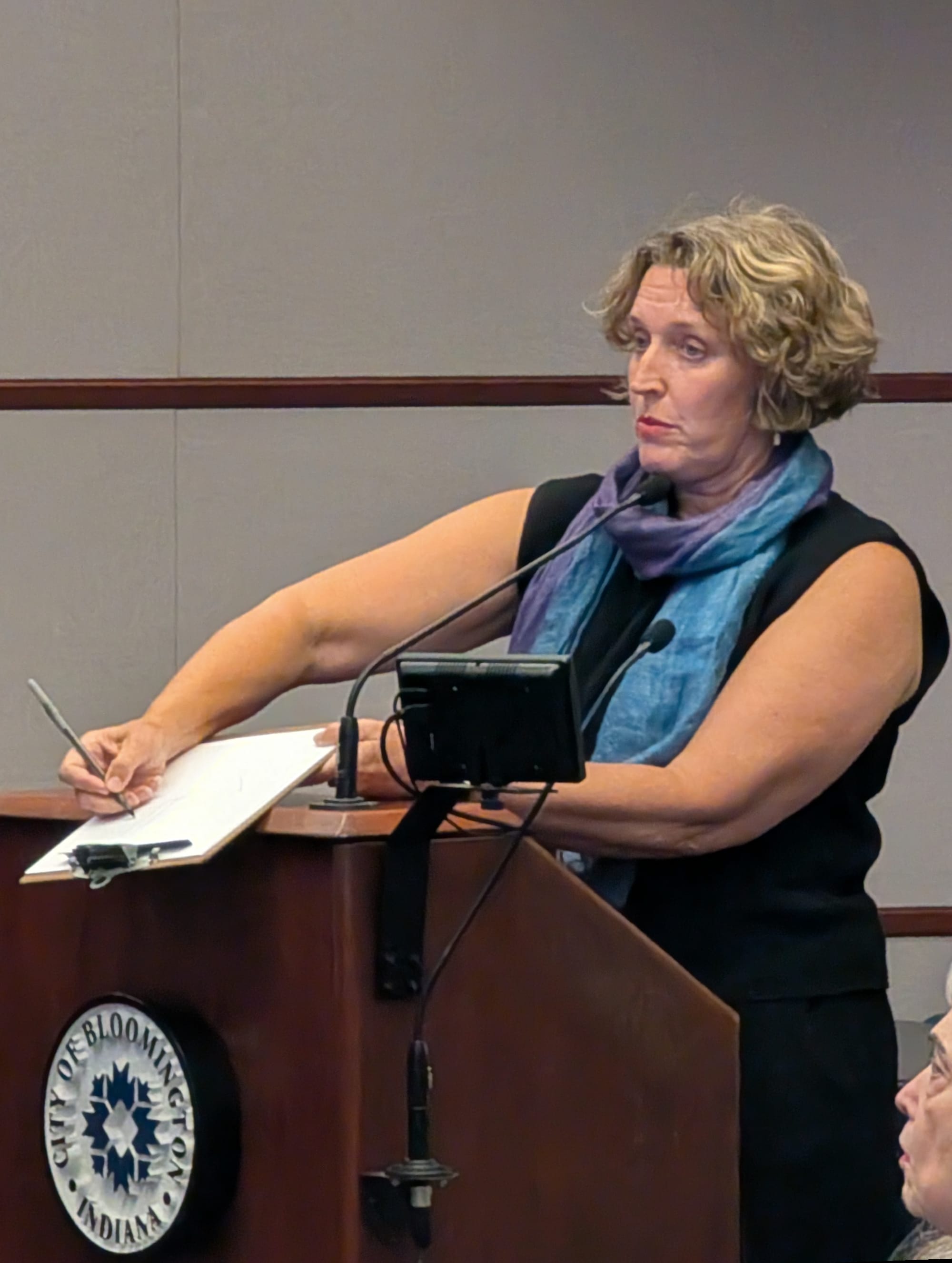
Left: Bloomington's city council. Right: Bloomington mayor Kerry Thomson sketches out how a second soft mortgage works. (Dave Askins, May 7, 2026)
Bloomington’s plan to turn the former IU Health hospital site at 2nd and Rogers streets into a new neighborhood finally passed a big milestone Wednesday night (May 6). The city council approved the Hopewell South planned unit development (PUD).
The decision came after a couple of months of granular debate over several issues, including what “permanent affordability” should mean for the 6-acre development, south of 1st Street. The council adopted the new zoning in the PUD on a 9–0 vote, but only after just a 6–3 majority settled on a new affordability condition.
The real estate is owned by Bloomington’s redevelopment commission (RDC). That means Hopewell South, and eventually the rest of the Hopewell development, is seen as a chance to set a high affordability standard for development in the rest of the city.
The PUD rezone was meant to allow up to 98 homes, most of them single-family dwellings, which is more than the 28 that the city’s zoning consultant said could be constructed by satisfying only objective criteria without any additional discretionary approvals.
The new affordability condition (Reasonable Condition #17) sets a floor of 35% permanently affordable units in the first phase, with an explicit goal of reaching 50%.
Only after Section 4 of the condition was struck was Bloomington mayor Kerry Thomson’s administration agreeable to the condition’s approval. Section 4 said the administration would have to bring a detailed permanent-affordability enforcement and monitoring plan to the city council for approval, before any new affordability instrument is recorded or any dwelling unit in the PUD is sold.
Anna Killion-Hanson, who is Bloomington’s housing and neighborhood development (HAND) director, and the executive director of Bloomington’s RDC warned that locking in a hard 50% requirement now, before infrastructure and construction costs are fully known, could jeopardize the project’s feasibility.
Under Reasonable Condition 17, at least 35% of the roughly 98 dwellings planned for Hopewell South have to be kept permanently affordable. Within that set, at least 15% of all units have to be affordable to households earning at or below 90% of area median income (AMI), and at least 20% must be affordable to households at or below 120% of AMI.
Even though Wednesday’s meeting itself was comparatively non-confrontational, an exchange of memos between staff and a councilmember leading up to the meeting was fairly sharp. It started with Killion-Hanson’s briefing on affordability for the initial meeting information packet, followed by a response memo from councilmember Hopi Stosberg, which got a pointed reply from Killion-Hanson. Killion-Hanson’s reply wrapped up with this:
Disagreement is expected. Dismissiveness, condescension, and repeated mischaracterization of clearly stated information are not constructive policymaking. If Council genuinely wants affordable homeownership delivered, it must begin by listening to the practitioners who are actually responsible for making these projects function in the real world.
At Wednesday’s meeting, Thomson took a turn at the public mic to respond to complaints about the amount of information and the lack of specificity in the plan for ensuring permanent affordability: “So I hear that you’re frustrated, and that the bulk of information that has been passed along may not be understood. But there has been quite extensive documentation.”
In her remarks at the meeting, Killion‑Hanson indicated her commitment to ensuring affordability of housing: “I know what the goal is, and it’s admirable, and it’s the mission that I live every single day here, while I work for this community, to deliver affordable housing, and to think otherwise is really offensive, to be perfectly honest with you.”
Much of the night’s deliberations turned on how far the city council could push affordability requirements without sinking the project. Stosberg and Kate Rosenbarger had advocated for a requirement that at least half the units be permanently affordable, while Isabel Piedmont‑Smith and others floated language that preserved the 50% target.
The council eventually recessed to allow city staff and council sponsors of competing reasonable conditions to re‑draft the affordability condition. They returned with the wording that became Reasonable Condition 17, lowering the guaranteed minimum to 35%, writing 50% in as a goal, and loosening earlier constraints on exactly how affordability had to be delivered.
Part of the context of the meeting included a resolution approved by Bloomington’s RDC at its regular Monday meeting this week, which includes the statement:
The RDC would willingly commit to increase the percentage of affordable dwelling units and make more units permanently affordable at a lower AMI if it were possible. But given the current economic market and the unknown future, the RDC cannot rightfully commit to something that may well be unattainable under current and/or future circumstances.
Underlying the friction about percentages of units was a more basic dispute about the financing structure. Some councilmembers and public commenters cast community land‑trust models and other forms of shared equity as the only way to make sure homes remain affordable for the life of the building without repeated infusions of public money.
Thomson indicated her administration does not intend to rely on a community land trust at Hopewell, because by adding more community land-trust houses, it could flood the market and make already-existing community land trust real estate harder to build on. That’s the view of Nathan Ferreira, who is executive director of the Summit Hill Community Development Corporation.
Instead, Thomson and Killion‑Hanson emphasized silent second mortgages and similar tools that can be tailored deal‑by‑deal, arguing that a rigid preference for any one mechanism could backfire in a changing lending environment.
At one point, Thomson literally sketched out for councilmembers the idea of a second soft mortgage, which are deferred loans that help cover the gap between what buyers can afford and a home’s actual cost. The idea is to keep units permanently affordable and prevent quick resale windfalls. Thomson said the exact mix of subsidies and restrictions would vary, based on buyer income and financing needs.
The final version of Reasonable Condition 17 gives the administration flexibility on financing tools, but requires regular reporting back to the city council on how the tools are being used in practice. The RDC has to provide updates every six months for five years on the methods being deployed and the project’s progress toward meeting the affordability minimum of 35% and its goal of 50%.
The vote on the affordability condition itself was 6–3. Andy Ruff opposed lowering the floor below 50%, saying, “One thing that I feel like can be set clear is a high bar on the amount of affordability we’re going to have in the project,” Stosberg voted no out of concern that complex affordability instruments will require staff capacity and long‑term subsidy commitments that have not yet been clearly mapped out. Rollo also voted against the affordability condition because it did not set the bar at 50%. Rollo also floated the idea of reducing the 120% AMI requirement to 110%, but that idea did not get any traction.
After getting a show of hands from those in the room who don’t own property, councilmember Sydney Zulich made the pitch for adopting the affordability condition and taking a vote on the PUD that same night:
Just to be clear, there are about five people in this room of 60 who do not own property. I’ve heard a lot of people who own property say that there is no urgency. There is urgency for those of us who do not own. There is urgency. You might not see it, but it’s there. It’s across our community. It’s the 850 people who pick up their mail at the Shalom Center. It’s the people who sleep outside at night. It’s the people who are nervous, because they don’t know if they have any resources to protect them when they’re renting an apartment. Like, this is urgent. We need to vote on this tonight.
With the vote on Reasonable Condition #17 done, which followed several other conditions put on the PUD at previous meetings, the PUD itself drew unanimous support.


Comments ()