
Indiana police agencies have signed dozens of ICE agreements. Did local governments authorize them?
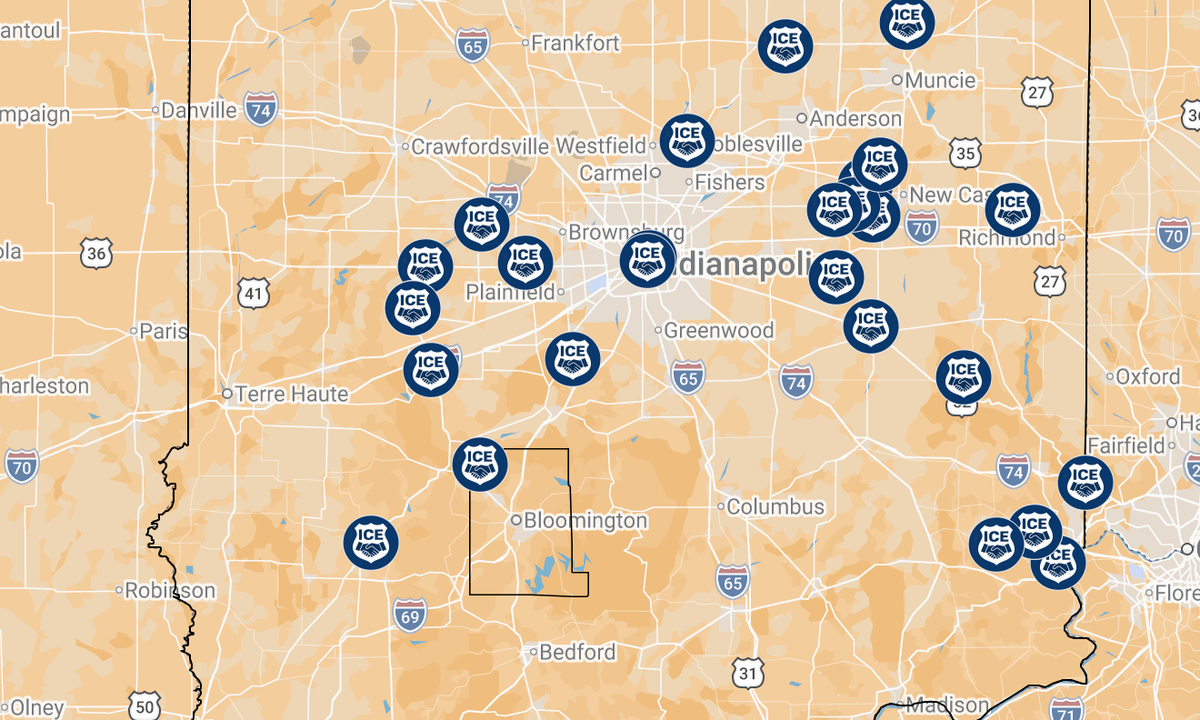
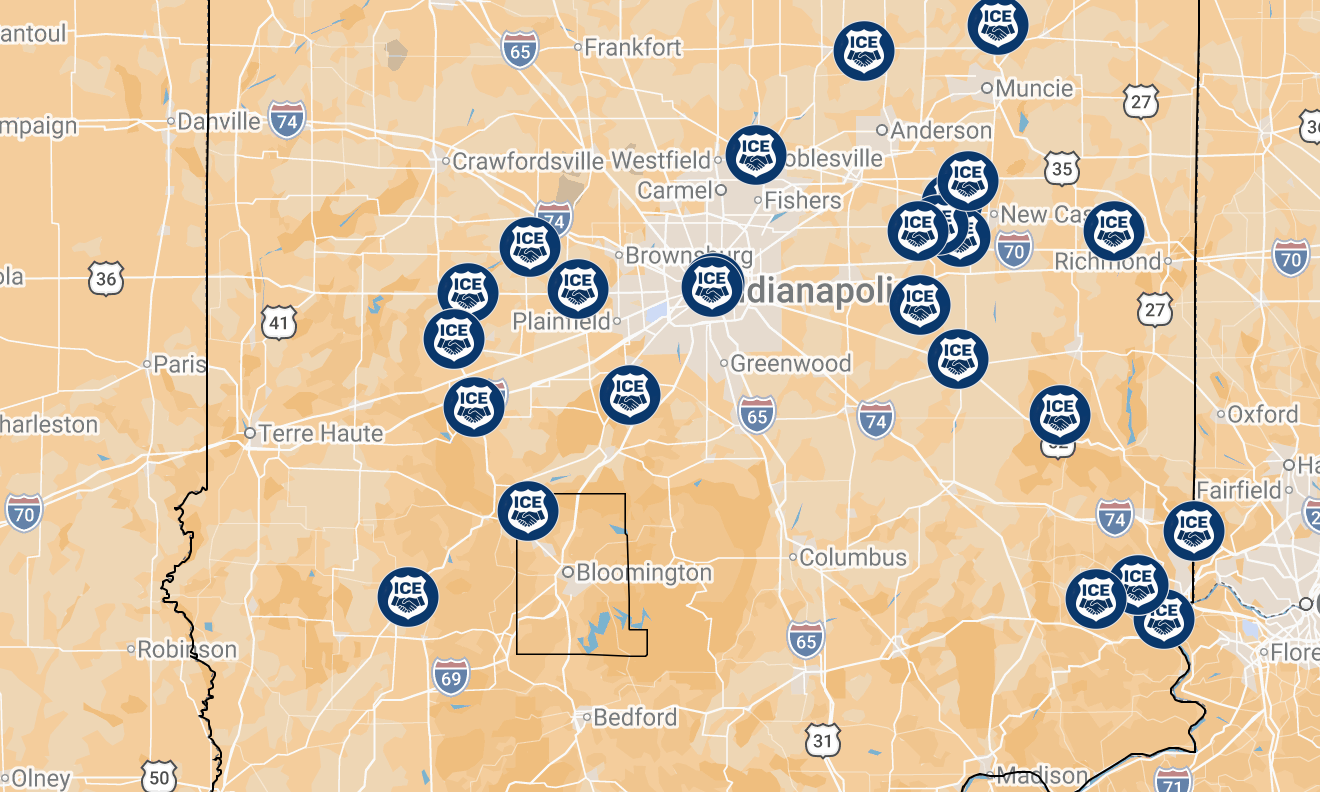
ICE now has 45 immigration-enforcement agreements with 42 Indiana agencies, including tiny Stinesville. But a B Square review found the public record does not always show whether local elected bodies properly authorized the deals before they got signed.
U.S. Immigration and Customs Enforcement (ICE) made 49,571 arrests nationwide in July, the highest monthly total of President Donald Trump’s second term and a 70% increase from February, according to an Associated Press analysis of ICE data.
Nearly 20,000 of those July arrests took place in Texas and Florida, where state and local law enforcement have become important partners in federal immigration enforcement. The AP reported that ICE has increasingly relied on state and local agencies operating through agreements made under Section 287(g) of federal immigration law.
The stepped-up activity has reached Indiana.
In Bloomington on Tuesday (Sept. 1), ICE agents arrested two Venezuelan men outside the Walmart on Bloomington’s west side. Indiana Public Media reported that both men had federal work permits and pending asylum matters. Bloomington police spokesperson Ryan Pedigo told IPM that city officers had not assisted in the detentions. Monroe County sheriff’s deputy Jeff Brown likewise said ICE had not contacted his department and that he was unaware of any assistance give by sheriff’s deputies.
Those two arrests coincided with reports of widespread ICE activity around Indianapolis. But across Indiana, figuring out when federal immigration officers are acting alone, and when local police are participating, is getting harder.
That’s because dozens of Indiana law enforcement agencies now have formal agreements with ICE that can give specially trained local officers some federal immigration-enforcement authority.
A Sept. 5 download of ICE’s Indiana data reviewed by The B Square contained 45 separate 287(g) agreements involving 42 state or local agencies. Of the 45 agreements, 36 use ICE’s Task Force Model, six use its Warrant Service Officer model, and three use its Jail Enforcement Model.
The agreements cover state agencies such as the Indiana State Police and Indiana Department of Correction as well as police departments serving some of Indiana’s smallest towns.
One of them is the Stinesville Police Department in northwestern Monroe County. Stinesville had just 203 residents according to the 2020 census.
ICE links to a Task Force Model agreement signed by Stinesville on Feb. 10. But whether that agreement was properly authorized by the town is not clear.
Bloomington immigration attorney Christie Popp told The B Square that the question matters for reasons that go beyond whether a town followed a paperwork procedure. A 287(g) agreement delegates powers that an ordinary Indiana police officer does not otherwise have, namely the authority to carry out specified functions of a federal immigration officer.
That’s why Popp said local residents should know when their government is considering accepting that authority, what resources it will consume, and who made the decision.
At the very least, she said, scrutiny of the agreements could force agencies “to go through the democratic process rather than just the sheriff’s or police department or whoever it is signing them.”
[Updated Oct. 7, 2026. In a letter sent to the Stinesville town board, dated Oct. 6, 2026, Indiana attorney general Todd Rokita gives his opinion that no authorization from the township board is required for signing of such agreements.]
Three kinds of 287(g)
Section 287(g) has been around for decades, but not every 287(g) agreement gives local officers the same authority. ICE currently offers three models.
The Jail Enforcement Model is aimed at people already being held in a jail or detention facility. It lets designated local officers identify and process people ICE considers removable who have pending or active criminal charges.
The Warrant Service Officer program is narrower. It allows designated officers to serve and execute ICE administrative warrants on people who are already in the local agency’s custody.
The Task Force Model is fundamentally different. It allows designated local officers to exercise limited federal immigration authority while carrying out ordinary police duties outside the jail. ICE gives as an example an officer identifying a potentially removable person during a DUI checkpoint and communicating directly with ICE. Task Force officers can also participate in ICE-led enforcement operations.
That third model accounts for 36 of Indiana’s 45 agreements in The B Square’s Sept. 5 tally. Only nine Indiana agreements use either of the two custody-based models.
The Task Force Model is also the most controversial of the three. It is not new. An earlier version allowed local officers to investigate immigration status during their routine police work. But the Obama administration discontinued the Task Force Model in 2012 amid criticism over racial profiling and inadequate federal oversight, according to the Associated Press. The Trump administration revived the model in 2025 as part of its expansion of immigration enforcement through state and local police.
Under the revived program, a Task Force officer completes a 40-hour online course covering subjects that include immigration law, civil-rights law, the officer’s scope of authority, cross-cultural issues, liability and complaint procedures. ICE says participating officers remain subject to its direction and supervision when exercising the delegated federal authority.
Popp sees the combination of broad field authority and comparatively short training as a problem.
Immigration law is complicated even for attorneys and federal officers who work with it every day, she told The B Square. Giving local officers 40 hours of online instruction and then allowing them to inquire about immigration status during ordinary policing creates a particular risk, in Popp’s view, that judgments about who warrants immigration scrutiny will be influenced by race or ethnicity.
For its part, ICE says 287(g) provides local departments with training and federal resources, improves information sharing and helps remove people subject to immigration enforcement who have been involved in crimes. ICE’s curriculum specifically includes instruction on avoiding racial profiling.
Now, there is also substantial federal money attached to Task Force participation.
Starting Oct. 1, 2025, DHS offered to reimburse participating agencies for the annual salaries and benefits of eligible trained Task Force officers, plus overtime coverage of up to 25% of an officer’s annual salary. DHS also established quarterly performance payments for participating agencies.
So participation can bring money into a local police department. But Popp said that reinforces rather than eliminates the need for a public decision. She points out that accepting federal reimbursement, assigning officers, deciding how they spend their working hours and assuming responsibility for the program are still governmental choices. Her reading of Indiana law is that those choices cannot be made solely by a police chief.
Popp points to Indiana’s interlocal cooperation law, which she says means that an agreement between an Indiana local government and a federal agency has to go through the local legislative body “either [by] an ordinance or a resolution,” with staffing and budget questions accounted for.
That is where the 287(g) question transcends the substance of federal immigration policy and becomes a local-government procedural issue.
Some town councils: Decision on 287(g) is on the record
At least two Indiana towns provide clear examples of elected councils taking a public vote right before their police agencies appeared on ICE’s 287(g) list.
The town of Waterloo, in DeKalb County, is the clearest. At its May 12 meeting earlier this year, the Waterloo town council considered an agenda item called “Law Enforcement Agreement.” According to the approved minutes, town marshal Tim Oberholtzer presented “an agreement to participate with US Immigration and Customs Enforcement.”
The minutes say the program would allow officers to report people believed to be unlawfully present and could provide funding for salaries, vehicles and equipment. Town councilor Michael Caudill raised concerns about training. Council member Dave Hobbs noted that immigration was a “hot topic” and said he wanted to make sure participation would not have a negative impact.
The Waterloo town council then voted to approve the agreement. ICE’s dataset links to an agreement signed by the Waterloo marshal’s office the next day, on May 13.
Andrews, a town in Huntington County, has a similar legislative trail even if its minutes do not explicitly mention the words “ICE” or “287(g).”
According to Andrews town council meeting minutes, at a public meeting on June 22, town marshal Josh Platt reported on police training, and the minutes state that “the town council approved Platt’s request to enroll in a US DHS partnership program offering financial incentives.”
Three days later, ICE’s data shows the Andrews police department signing a Task Force Model 287(g) agreement on June 25, even if the link to the signed document is indicated as “pending.”
Those records don’t establish that Waterloo or Andrews completed every step that Indiana’s interlocal law requires. They do establish the part that is plainly visible, which is that elected town council members considered the issue and acted on it in public.
When IC 36-1-7 is applied to 287(g) agreements, there are additional required steps under the statute. The agreement has to be recorded with the county recorder. And within 60 days after taking effect, it has to be filed with the State Board of Accounts for audit purposes.
The B Square has not investigated whether Andrews and Waterloo completed those additional filing steps.
Other towns: Harder to evaluate
It’s harder to evaluate a town like Silver Lake, in Kosciusko County. ICE’s dataset says its police department signed a Task Force agreement on May 21 and links to a copy of the agreement.
Silver Lake has a relatively detailed online archive of town council records. Eight days before the date that ICE says the agreement was signed, the town council held a meeting. The May 13 meeting minutes include a marshal’s report covering calls for service, K-9 training and overtime, mowing and the purchase of a used cage for a patrol car. There is no reference in those minutes to ICE, immigration enforcement or a 287(g) agreement.
That doesn’t mean the town council failed to take up the matter. In fact, the council did vote two and a half months later, at its Aug. 12 meeting, to “ratify” the 287(g) agreement, according to the Aug. 12 meeting minutes. But that puts it outside the 60-day time windows for filing with the recorder’s office and with the State Board of Accounts.
The town of Stinesville, in northwest Monroe County, makes recordings of its town council meetings available beginning in November 2024 and links to a separate collection of meeting minutes and agendas.
The B Square was not able to find meeting minutes or recordings that show the Stinesville town council authorizing Stinesville’s 287(g) agreement ahead of the Jan. 30, 2026 date on ICE’s copy of the agreement.
Stinesville police chief Shane Pittman has given an account of the approval process that itself raises questions. In a Sept. 3 email responding to an inquiry from a news organization in the Indianapolis market, Pittman wrote that the 287(g) agreement “was signed by me at the direction of the previous chief.” The Indy news outlet is not pursuing the story at this time.
Pittman added: “The Town Board has been briefed individually, along with the Town Attorney, and they have expressed support for the program.” What Pittman did not point to in that email was an ordinance, resolution or public vote authorizing Stinesville to enter the agreement.
Who has to sign the agreement?
Support by individual council members is not the same thing as formal action by the town’s legislative body. That distinction is important under a plain reading of the federal statute.
The question of who signs is answered by the wording of Section 287(g) of the Immigration and Nationality Act, which authorizes a written agreement “with a State, or any political subdivision of a State” under which qualified officers or employees of that state or subdivision can be trained and authorized to perform specified functions of an immigration officer. The same section says the delegated functions are to be performed “to the extent consistent with State and local law.”
In other words, the federal statute separates the governmental entity that signs the agreement from the individual officer who later exercises authority under it. ICE’s own standard Task Force agreement uses the same kind of wording: “Section 287(g) of the Immigration and Nationality Act (INA) authorizes the Secretary of Homeland Security, or her designee, to enter into written agreements with a State or any political subdivision of a State …”
For an Indiana town, state law adds another wrinkle. IC 36-5-2-2 says the town council is the town’s legislative body, while the president of the council is the town executive. It does not give similar status to the police chief.
Stinesville’s current staff directory lists Scott McGlocklin as town board president and Pittman as police chief. Even if the town board president had the authority as executive to authorize the police chief to sign a 287(g) agreement, it’s not clear how that could satisfy the requirement that intergovernmental agreements be enacted through an ordinance or resolution.
Popp told The B Square that if an officer makes an immigration arrest while relying on a 287(g) agreement that was not valid, a lawyer representing the arrested person could have grounds to challenge the detention.
She said that an invalid delegation could raise Fourth Amendment questions and, depending on the facts, create arguments over detention or the use of evidence obtained in the encounter. As one example, she pointed to the prospect of litigation, if an unlawfully authorized officer stopped and arrested a U.S. citizen and put them into removal proceedings.
What difference does a public vote make?
There is a big difference between putting a potential 287(g) agreement in front of a town council or county board for a vote and having individuals sign agreements out of public view.
Indiana’s Open Door Law generally requires meetings of governing bodies to be open so members of the public can observe and record them. Final action has to occur at an open meeting, and minutes documenting the meeting and votes become public records.
The case of Waterloo’s 287(g) agreement illustrates why that’s important. Councilors heard the proposal, discussed potential funding, raised concerns about training and possible negative effects, and voted. The resulting minutes tell residents not just that town officials knew about the ICE partnership, but that the elected body made a decision about it.
Pittman’s description of Stinesville is different. Board members were “briefed individually.” And it’s not clear if those individual briefings were ever followed by the formal action needed to commit the town to the agreement.
A public meeting would also give residents a chance at least to watch the deliberation. If the local governing body accepts public comment at ordinary meetings, residents could voice support for or opposition to joining ICE’s program.
The jail option, different approach in Monroe County
ICE’s Jail Enforcement Model allows trained local officers to identify and process people for immigration enforcement while they are already held on pending or active criminal charges. The Warrant Service Officer model lets designated officers execute ICE administrative warrants on people who are already in their agency’s custody.
Those arrangements are distinct from an ICE detainer, which is a request asking another law enforcement agency to continue holding someone so ICE can assume custody.
That distinction has become central to a two-year legal fight between Indiana attorney general Todd Rokita and Monroe County sheriff Ruben Marté.
Marté has taken an approach almost opposite to signing 287(g) agreements. His policy says the Monroe County Sheriff’s Office will not keep someone jailed past the point when the ordinary criminal-law basis for detention has ended solely because ICE has sent an administrative immigration detainer that is not accompanied by the kind of criminal judicial warrant required by his policy.
Marté argues that continued detention in that circumstance amounts to a new seizure under the Fourth Amendment. Rokita contends Indiana law requires the sheriff to comply with ICE detainer requests. That litigation remains pending.
A consent decree approved in August settled other portions of Rokita’s case but deliberately left the detainer dispute unresolved.
One of those settled issues involved 287(g). An earlier version of Marté’s policy declared that the sheriff would not enter a 287(g) agreement. Under the consent decree, the sheriff’s office cannot maintain a blanket policy prohibiting itself from ever entering such an arrangement. But the decree expressly says Marté or a future sheriff can decide not to enter a particular 287(g) agreement and that decision, by itself, does not violate the settlement.
That means two law enforcement agencies in the same county are really far apart on the spectrum of local cooperation with federal immigration enforcement.
Stinesville’s police department signed onto the Task Force Model, which is the 287(g) version that moves federal immigration authority out of the jail overlapping with ordinary police work. The Monroe County sheriff, meanwhile, has gone to court over whether state law can force his jail to extend a person’s detention solely so ICE can take custody.
Work left to do: Who made the decisions?
For 42 Indiana agencies or governmental entities now represented in ICE’s data, sorting out who made a decision on the 287(g) agreements means looking jurisdiction by jurisdiction for the ordinance, resolution, public vote or other legal authority behind each agreement.
It also means tracking down a county-recorder filing and a State Board of Accounts filing that should follow, under Indiana’s interlocal cooperation law.
Waterloo and Andrews have meeting minutes showing their elected councils considered participation before the agreement was signed, which is the start of a trail to follow. For other jurisdictions, the path is not clearly marked.
[Added Sept. 18, 2026. At its Sept. 17, 2026 meeting, Monroe County commissioners passed a resolution that expresses disappointment about the way the Stinesville 287(g) agreement was approved.]


Comments ()