
Partial settlement of Rokita-Marté immigration fight, but main ICE-detainer dispute remains
A consent decree narrows Indiana AG Todd Rokita’s two-year legal fight with Monroe County sheriff Ruben Marté, but leaves the central ICE-detainer dispute unresolved. A hearing on competing summary-judgment motions is set for Oct. 27.
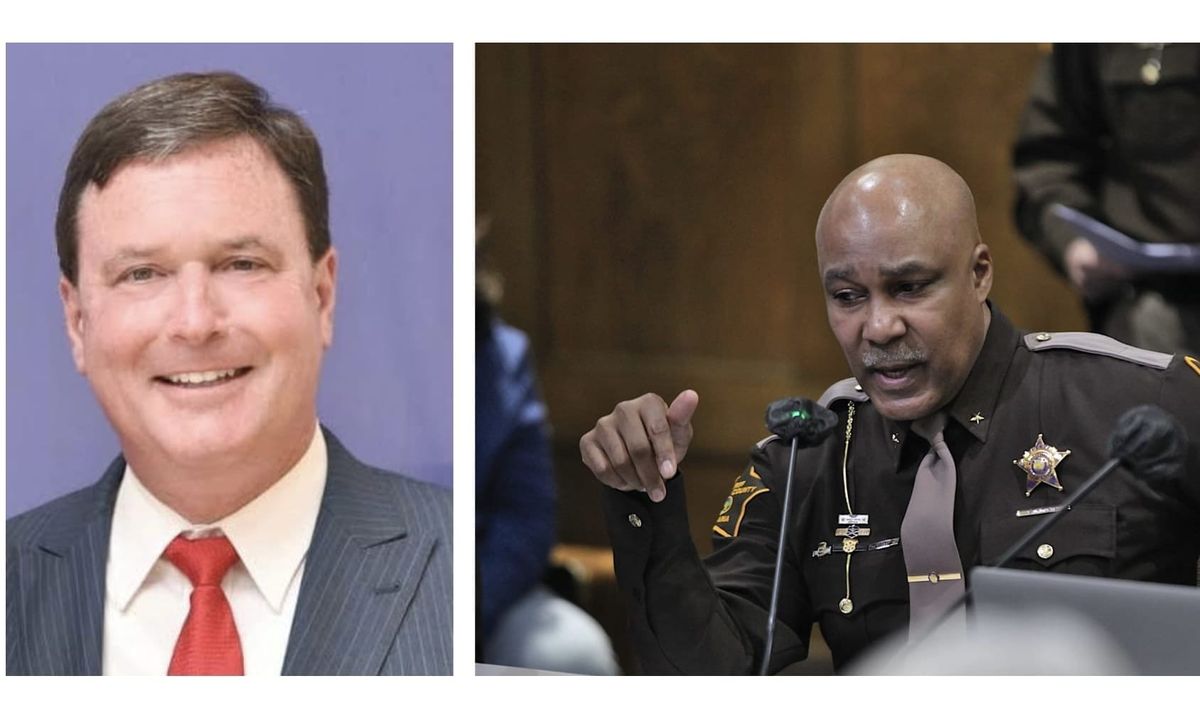
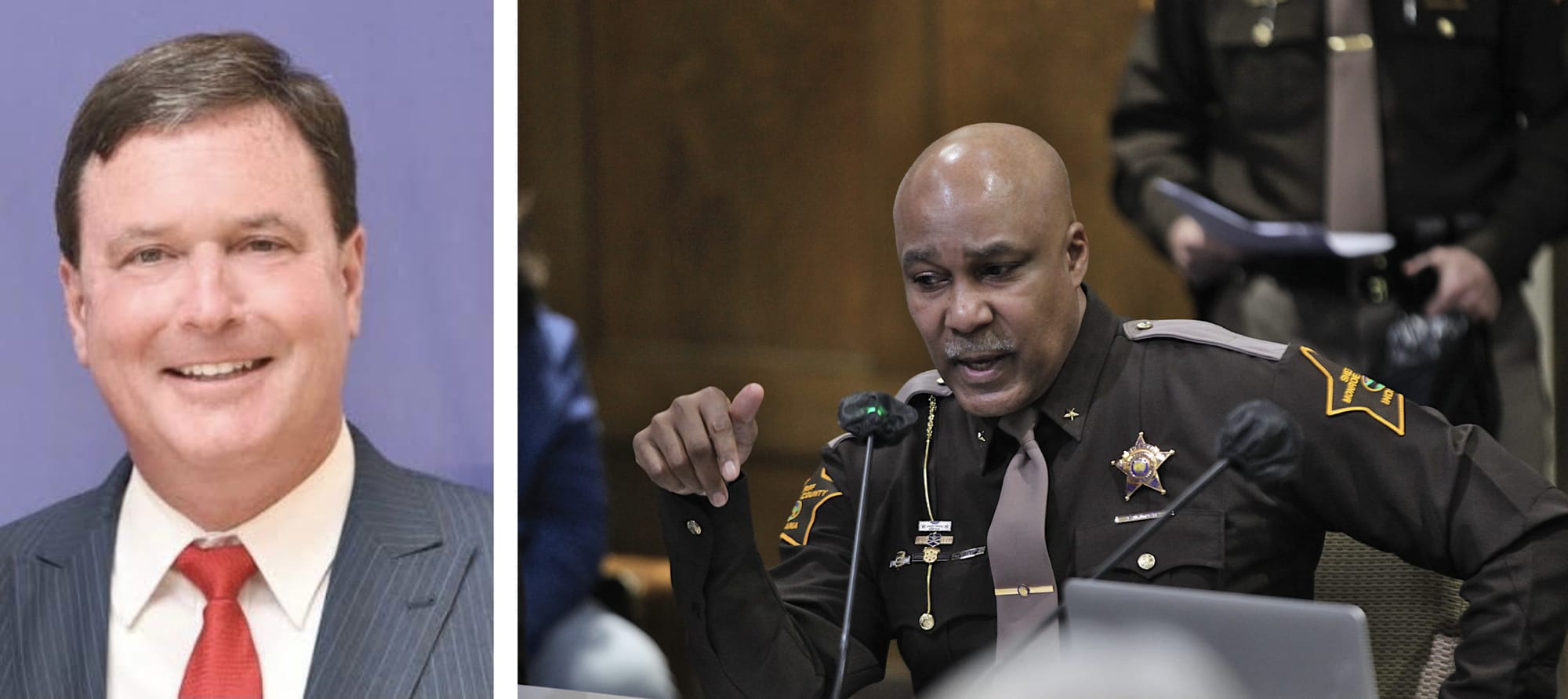
Some of a two-year legal fight between Indiana attorney general Todd Rokita and Monroe County sheriff Ruben Marté is headed toward settlement.
But the issue at the heart of the dispute remains unresolved: Whether the sheriff can refuse to keep someone in jail past the time they otherwise would be released, based solely on an ICE (U.S. Immigration and Customs Enforcement) detainer request that is not backed by a criminal judicial warrant.
That remaining question is now still the focus of litigation in both local and federal courts. In the Monroe County circuit court case, a hearing on competing motions for summary judgment is now set for Oct. 27.
The latest narrowing of the dispute came from a consent decree signed by Rokita and Marté and filed on Aug. 26 and approved by Monroe County circuit court special judge Luke Rudisill the following day. The decree would settle Rokita’s challenges to several parts of the sheriff’s immigration policy, known as MCSO-012.
But the decree explicitly says it does not resolve the dispute over immigration detainer requests. It does not require Marté to change his policy of refusing to honor those requests when they are not made together with the kind of warrant his policy requires.
An ICE detainer is a request from U.S. Immigration and Customs Enforcement asking a jail to continue holding someone so that federal immigration authorities can take custody. Such requests generally ask for someone to be held for as long as 48 hours after the person otherwise would have been released.
Marté’s position is that once the criminal-law basis for holding someone has ended, keeping the person locked up solely on an administrative immigration detainer amounts to a new seizure under the Fourth Amendment.
So Marté’s policy says his office will not extend someone’s detention solely on a non-criminal or administrative immigration detainer that is not accompanied by a criminal judicial warrant.
The initial local lawsuit was filed by Rokita against Marté two years go, in July 2024. But this year Indiana lawmakers sharpened up state law with Senate Enrolled Act 76. Among other provisions, the law says a governmental body holding someone named in an immigration detainer request has to “comply with all requests made in the immigration detainer request.” The law also gave Rokita authority to seek civil penalties of up to $10,000 for knowing or intentional violations.
On June 30, Rudisill gave Marté temporary protection from that provision. The judge barred the state from imposing penalties on Marté under the new detainer-compliance mandate while the case proceeds. The ruling was narrow. It applies only to Marté and the Monroe County sheriff’s office, and it was not a final declaration that the statute is unconstitutional.
But Rudisill found that Marté had shown a reasonable likelihood of succeeding on his Fourth Amendment argument. Among the considerations cited by the judge was that an ICE officer, rather than a neutral judge, makes the probable-cause determination behind an immigration detainer, and that the determination concerns removability under civil immigration law rather than probable cause that the person has committed a crime.
Rokita appealed that preliminary injunction to the Indiana Court of Appeals. It is what’s known as an interlocutory appeal, which is one filed about a ruling in a case while it is in progress, before a final ruling is issued. On Friday (Aug. 28) a ruling was made on the interlocutory appeal, denying Rokita’s appeal of the preliminary injunction.
After the interlocutory appeal was filed, Marté asked Rudisill to put the remaining circuit court dispute on hold until the appeals court had ruled. Rudisill rejected that request. In his order, the judge said the underlying issues already had been extensively briefed and were ready for a decision on the merits. He also reasoned that the appeals court might decide the preliminary-injunction appeal on grounds that would shed little light on the ultimate constitutional question.
At that point, Rudisill had set for Sept. 18 the oral arguments on the cross-motions by the parties for summary judgment. But then came a mundane scheduling issue.
On Aug. 21, Marté’s attorneys asked Rudisill either to skip the oral argument and decide the motions based on the written submissions, or move the hearing until sometime after Oct. 12. That request was based on the availability of Marté’s attorneys.
Rokita’s office did not oppose postponing the hearing, but did oppose deciding the case without oral argument. So the hearing is now set for Oct. 27.
What the consent decree settles
While the detainer question continues, the Aug. 26 consent decree would resolve the rest of Rokita’s challenge to MCSO-012.
Earlier versions of the sheriff’s policy restricted deputies from checking immigration status except when required in carrying out their duties. The policy also said the sheriff would not enter a 287(g) immigration-enforcement agreement with the federal government, and contained other limits that Rokita contended violated state law. A 287(g) agreement deputizes trained local officers to carry out some immigration-enforcement duties for ICE.
After SEA 76 was enacted, Marté revised his policy. The version effective July 1 now says deputies may communicate and cooperate with federal immigration officials, exchange information, check immigration status and otherwise assist federal immigration enforcement when state and federal law allow it. Under the policy, the sheriff’s assistance generally remains a matter of the individual officer’s discretion rather than a requirement.
Under the consent decree, the sheriff could not return to a policy that prohibits or restricts deputies from cooperating with federal immigration authorities. It also could not adopt a blanket prohibition against entering a 287(g) agreement with ICE, even if Marté could still decide not to enter such an agreement in some specific situation.
The settlement would last more than a decade. For 12 years, the sheriff’s office would have to give the attorney general advance notice of substantive changes to MCSO-012 and notify the AG office about complaints from sheriff’s employees alleging violations of the policy or the state-law provisions addressed by the decree. The sheriff also would have to post a notice for employees explaining their ability to cooperate with federal immigration authorities. The decree says Marté and the sheriff’s office admit no liability.
Federal court case
Running alongside Rokita’s state lawsuit is a federal case in which the positions are reversed: Marté is the plaintiff and Rokita is the defendant.
Marté filed that case in April, asking the U.S. District Court for the Southern District of Indiana to find that SEA 76’s detainer requirements violate the Fourth Amendment and to block their enforcement.
On June 18, U.S. District Court judge James Patrick Hanlon denied Marté’s request for a preliminary injunction. But Hanlon did not decide whether holding someone on an ICE detainer violates the Fourth Amendment. Instead, he concluded that the federal court appeared to lack jurisdiction under the “political subdivision doctrine.” That’s the principle that generally prevents a local arm of state government from invoking the U.S. Constitution in a lawsuit against its own state.
That federal lawsuit itself has not yet been dismissed. Rokita’s May 26 motion asking Hanlon to dismiss it is still pending. Rokita argues, among other things, that the political-subdivision doctrine bars Marté’s suit, that Marté lacks standing, that the federal court should defer to the older state-court proceeding, and that honoring an ICE detainer does not necessarily violate the Fourth Amendment.
So the rulings from the two different courts issued in June point favor different sides in the dispute, but don’t contradict each other. The federal judge said Marté probably cannot use federal court to litigate his dispute against the state. The local judge, meanwhile, concluded that Marté had made a strong enough Fourth Amendment showing to receive temporary protection from state penalties while the merits are decided.
Bloomington vigil focuses on ICE detention
The latest court activity came in the same week when immigration detention drew protests locally and across the state.
Just after sunset Friday (Aug. 28) more than 70 people gathered on the Monroe County courthouse lawn for a candlelight vigil calling for an end to ICE detention at the state-run Miami Correctional Facility in Bunker Hill, north of Kokomo.
The gathering was part of a statewide weekend of events coordinated by the Indiana Organizing Project. Organizers had initially hoped for at least 50 events around Indiana. More than 60 demonstrations, marches, and vigils reportedly took place.
At the Bloomington event, participants sang, prayed and listened to readings and reflections about immigration detention. Near the end of the roughly hour-long gathering, attendees read aloud names of people detained at Miami Correctional Facility.
It was in 2025 when the Indiana Department of Correction entered an agreement with the federal government to make as many as 1,000 beds at Miami Correctional Facility available for ICE detainees. IDOC’s annual report says the federal government reimburses the state $291 per detainee per day and that about 550 immigration detainees were housed there at the end of 2025, with the state expecting the ICE portion of the facility eventually to reach its 1,000-bed capacity.
The ACLU of Indiana reported that two ICE detainees have died at Miami Correctional Facility this year and has cited reports of medical neglect.
The campaign against use of the Miami Correctional Facility for ICE detention and the Marté-Rokita litigation involve different stages of immigration-enforcement. Friday’s vigil was about people already in federal immigration custody. The lawsuit involving Marté concerns the earlier question of when a county jail can or must keep someone in custody long enough for ICE to take over.
For the Monroe County lawsuit, that narrower question is the one that remains even after the proposed consent decree: Once Monroe County otherwise has no legal basis to keep someone jailed, can the state of Indiana require the sheriff to continue holding that person just because ICE has asked him to?



Comments ()