
Jail update: Monroe County elected officials working on ‘clear movement’ plan as April 15 ACLU deadline nears
Monroe County councilors and commissioners agreed the downtown jail fails constitutional care, conflicts with community values, and can’t be renovated. With an April 15 ACLU “clear movement” deadline looming, officials debated cost, sites (including North Park), and next steps.
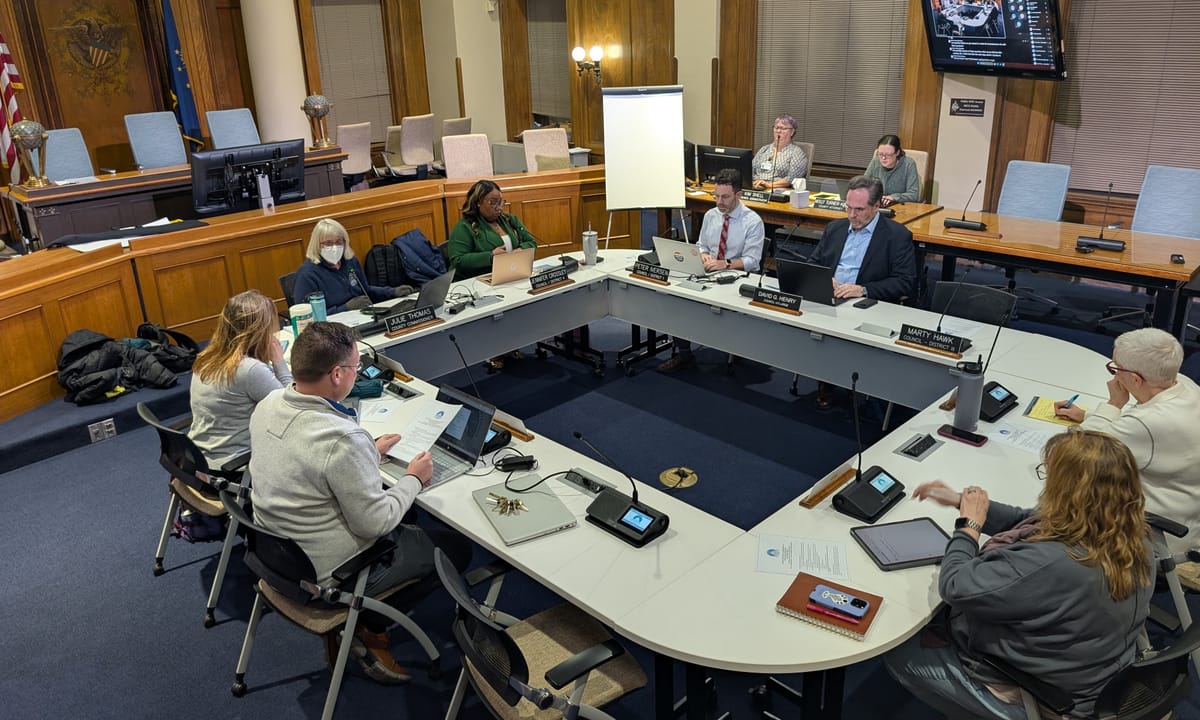
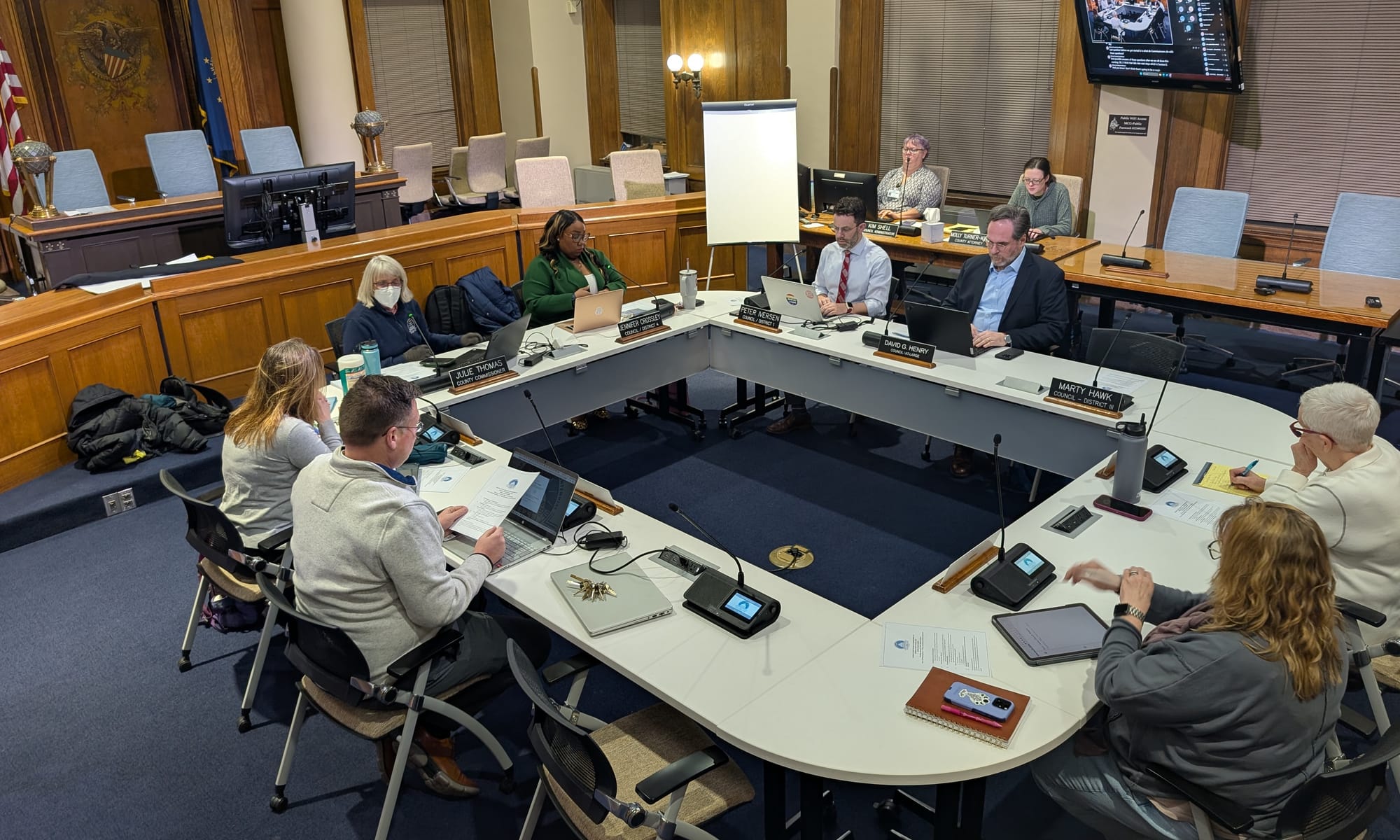
Monroe County elected officials reached consensus Thursday night (Jan. 23) on some core questions about the county jail: It is not providing constitutional levels of care, it does not reflect community values, and it cannot realistically be renovated to meet either standard.
Meeting jointly for two hours in the Nat U. Hill Room of the historic county courthouse, the board of commissioners and county council walked through a six‑point agenda meant to reset the county’s approach to a new jail and possibly a new justice facility. The resetting comes after the county council in late October last year rejected the appropriation needed to purchase North Park, which had up to then been the planned location of a new facility.
Thursday’s discussion unfolded under the shadow of an ACLU lawsuit dating back to 2008, and a 90‑day “clear movement” expectation from ACLU of Indiana legal director Ken Falk.
The 90-day window for “clear movement” ends on April 15 and would mean the expiration of the settlement agreement from the 2008 lawsuit, which could open the door to fresh litigation.
County elected officials are concerned that control over the future of a new jail would be determined not by locals, but rather by a federal judge. But on Thursday county councilor David Henry asked that council legal staff provide “some sort of opinion or document” explains the applicable U.S. Code on the federal judiciary’s authority about prescribing cures for unconstitutional jail facilities. Henry also wanted clarity on Falk’s phrase “clear movement.”
Consensus on core questions
On the first agenda item, constitutional care, there was no dissent. Council president Jennifer Crossley framed her answer in blunt terms: “We wouldn’t be in the lawsuit if we were meeting our constitutional care.” She praised sheriff Ruben Marté and staff for doing “a tremendous job,” but said they are “bursting at the seams” and worried about new state legislation that could increase the jail population.
One bill [SB 285] would make camping on public property a misdemeanor . Another bill [SB 3] would put a constitutional amendment on the November ballot that would make certain crimes ineligible for bail.
Later in the meeting, commissioner Jody Madeira highlighted the pending legislation that would potentially increase the number of people who are ineligible for bail, and thereby increase local jail populations. Madeira was also clear about whether she thinks the current jail is meeting constitutional levels of care: “I would say absolutely not.” Every official who spoke on the question of constitutional care answered no.
The meeting’s second agenda question asked whether the jail’s accommodations are consistent with Monroe County’s values regarding humane treatment and rehabilitation. Again, officials agreed the answer was no, but some argued that the failure extends beyond bricks and mortar to the structure of the local criminal justice system.
Councilor David Henry called it “more than a building issue,” adding that “it’s a systems issue.” Henry said that any capital project with a construction cost $225–$250 million range—like the planned new justice facility—should also fund alternatives such as diversion and treatment programs that might not be physically located in the jail. The term Henry applied to mental health and other diversion activities, which don’t need to be in the same facility as a jail, was other “classifications.”
Crossley recalled earlier work by the Justice Fiscal Advisory Committee and its recommendations to reduce recidivism, and urged colleagues to “think outside the box” about what else the county can do to align the system with community values.
In the context of pending legislation about to denying bail to individuals deemed “dangerous,” Madeira said, “While our hands are sort of tied at the local level, it is really imperative that we do what we can at the local level to reduce recidivism and also get people out of these carceral facilities,” she said.
No one at the table argued that current conditions match community standards for humane treatment or meaningful rehabilitation opportunities.
The third question on the agenda asked whether, given existing studies, RQAW Corporation, a separate study by RJS Justice Services, and Falk’s most recent letter, officials think the current downtown facility could be renovated to be larger or to meet constitutional requirements. On that question, commissioners and councilors also lined up on the same side: No.
Councilor Kate Wiltz’s remarks reflected the consensus: “I agree that the current facility cannot be renovated to serve as a jail,” saying, “that ship has sailed.” Factors mentioned by Wiltz and others included: cramped space, structural problems, design flaws, and decades of piecemeal alterations that have left the building fundamentally constrained.
Commissioner Julie Thomas traced the problem back to the jail’s original concept: a stacked facility on top of the justice building that may have looked innovative when it opened but has since proved unworkable. She described it as a design “that was cool in the ’80s.”
Madeira added that the building was “hastily constructed to begin with” and repeatedly reworked to accommodate a growing incarcerated population, with renovations that “have not always been skillfully done.”
Pending items for discussion
On the remaining agenda items—what the council is willing to fund, whether to co‑locate courts and jail, which property might be suitable, and what the precise next steps should be—differences emerged over money, location, process, and legal risk.
Crossley drew one clear fiscal line, saying she will not support a $250 million project. Henry said that it is the budget that must “drive the blueprint,” but said county councilors need solid operating‑cost data from the county’s consultant, DLZ Corporation, before taking firm positions on a single‑story versus multi‑story design or co‑location versus a stand‑alone jail.
Property questions led to one of the evening’s tenser exchanges—whether the council’s October 2025 vote on the North Park purchase agreement took that site permanently off the table.
Councilors stressed that, from their perspective, the answer was yes. Crossley said she believed the council had made it “as clear as day” that the council was “done” with North Park, explaining that there was not only a failed appropriation but also a follow‑up vote “to make sure that we say that this does not come back again.” She characterized the council’s position as rejection of North Park itself, not just on that particular deal structure.
Councilor Trent Deckard noted that he had made a motion at the late October meeting to postpone the vote, in order “to preserve every option,” but his vote was the only one in favor of that approach. “My conclusion at the end of that effort was that there was not an appetite for that location to even be preserved as a further discussion,” he said.
Commissioner Madeira, however, said she had understood the October 2025 decision differently. She took the council’s vote to mean “no to that building” but “not necessarily no to North Park,” she said. “I didn’t hear anybody say that they wouldn’t come back to North Park. It’s not haunted.” She had understood the council’s actions to mean that a smaller or differently configured purchase “under different circumstances” could still be considered.
Henry underscored the fact that the purchase agreement for North Park has expired and is now “a dead document.” What troubled several councilors was learning during Thursday’s meeting that commissioners have recently spoken again with the North Park owner about a different arrangement—one that did not require co-location of a justice complex with the jail, which had been baked into the previous agreement.
Thomas described those contacts as part of broad “information gathering” on many sites, “not a commitment of any kind,” and later said, “We are looking at a number of things right now. … We are in information‑gathering overdrive.”
Crossley responded that, if commissioners are talking to North Park owners, she wants those discussions to be shared with the county council.
Sheriff Ruben Marté, was invited to the table late in the meeting, delivered a skeptical assessment: “I have to be truthful,” he said, adding, “I don’t know if we’re going to make this 90 days based on what I’m hearing right now. I just don’t see it.” He warned that if a federal judge steps in, “then we’re done,” and reminded councilors and commissioners that jail staff are “day in, day out” running a facility where the proper classification of the people in custody is not possible.
Next steps
As the meeting turned to “next steps,” Councilor Peter Iversen sketched out a framework he jokingly labeled “Operation Clear Movement”—a written plan with specific tasks and milestones with dates, between now and mid‑April, and then beyond.
The tasks included assembling data on jail population, incidents, staffing levels, and programming space. Thomas said that attaching dates to a timeline before the legislature finishes its current session and the county gets a clearer view of its bonding capacity is not feasible, but agreed that a priority list and benchmarks are necessary.
Henry said that the council needs to be more routinely involved in the project, saying council liaisons need to be in meetings with consultants and lawyers, and statehouse lobbyists.
Councilor Liz Feitl made a concrete request to improve transparency, asking for a weekly update from commissioners. She asked: “Is a weekly update reasonable to think we could expect that from the commissioners on what you’re doing, as far as looking at property?” She asked that whatever can legally be shared be posted online so the public can follow along. Thomas said weekly written updates are possible “not in a meeting form, but in written form,” with some limitations on what can be disclosed publicly while land negotiations are active.
By the time the meeting ended, the electeds had not settled on a site or a building program, but they did converge on some next steps. Councilors and commissioners agreed:
- to seek a joint meeting with the sheriff and the board of judges for discussing classification needs, bed counts, and site tradeoffs;
- to develop a written plan with milestones for the coming months that could be shared with Falk and the public;
- to re‑establish regular joint communication, including weekly written status reports;
- and to collect hard data, including operating‑cost comparisons from DLZ Corporation, the project’s design-build consultant, and lessons learned from Allen County’s experience under a court‑supervised jail settlement.
Madeira made a statement that seemed to resonate with others at the table, when she indicated that statutory division of responsibilities between commissioners and council should not be allowed to become a barrier to action. “We cannot meet the deadline by ourselves, and you guys cannot meet the deadline by yourselves,” she said. “It’s going to take all of us together, working together openly.”

Comments ()