
Kirkwood proposal, power struggle over Bloomington streets, cued up for June 3
Bloomington’s city council introduced an ordinance that would close five blocks of Kirkwood Avenue to vehicles each year from April through mid-November. The proposal revived disputes over accessibility, logistics, and which branch of city government controls Bloomington streets.
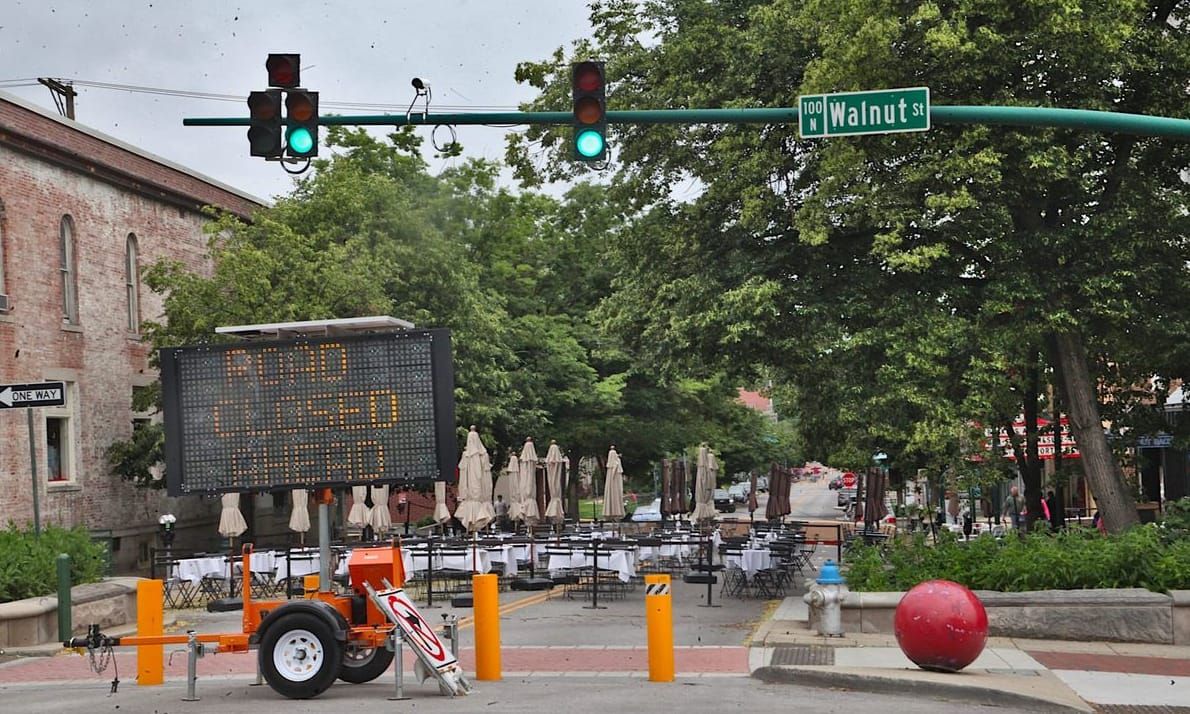
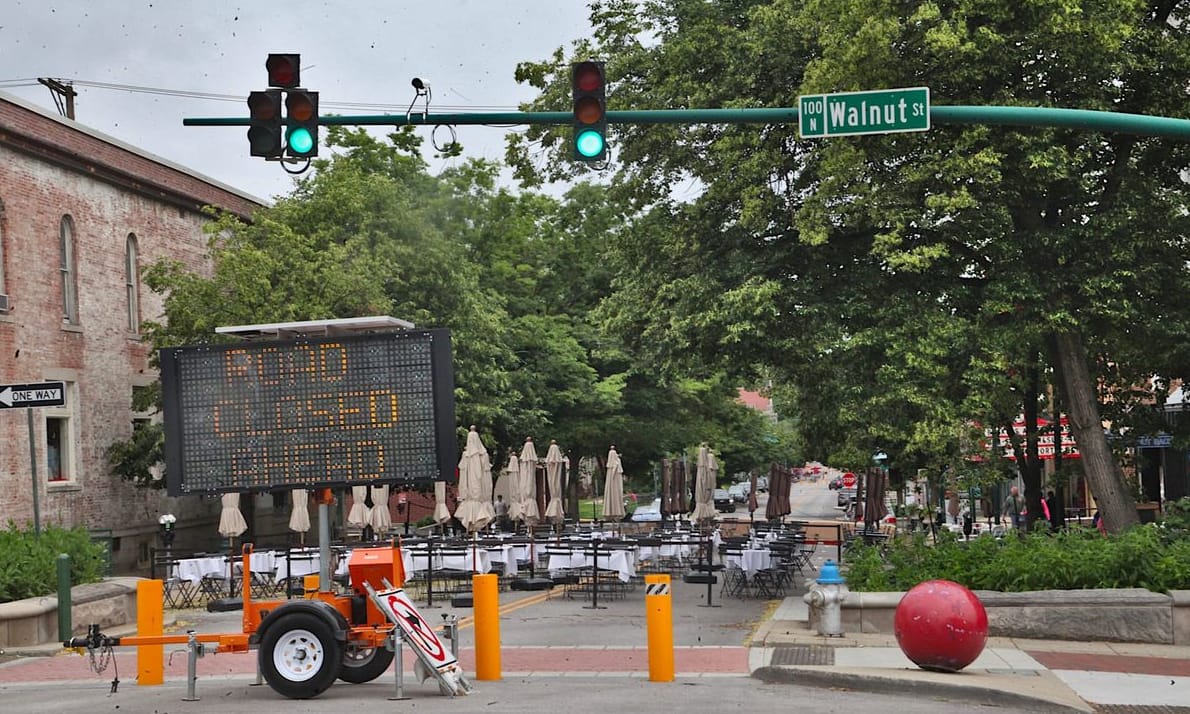
An ordinance that would prohibit vehicular traffic on five blocks of Kirkwood Avenue every year between April 1 and Nov. 15 got introduced, but no further action from Bloomington’s city council on Wednesday night (May 20).
The council will take up the proposal again, and could vote on it at its next meeting on June 3.
Strategies to activate the iconic downtown Kirkwood corridor have been a major point of contention between the council and city administration in recent months. Bloomington mayor Kerry Thomson’s administration recommended in late January that the seasonal Kirkwood closures seen in previous years be suspended for 2026. However, the plan drew sharp criticism from several city councilmembers and downtown business owners at the council’s Feb. 4 meeting.
On Feb. 12, city engineer Andrew Cibor issued an order reopening Kirkwood to vehicle traffic, citing “lack of participation and impracticality (budget)” under authority granted in the council’s 2025 outdoor dining ordinance. Later that month, the board of public works approved an outdoor dining plan that kept the street open except for one-off events.
The ordinance that was introduced on Wednesday aims to provide predictability by making a seasonal carless Kirkwood a permanent fixture on the calendar. If the ordinance is passed, Title 15 of the municipal code will be amended to specify five Kirkwood Avenue blocks, starting from Walnut Street to Indiana Avenue, closed between April 1 and Nov. 15 every year. The ordinance also proposes that an alleyway connecting 4th Street to Kirkwood, which is already closed for vehicular traffic, remain closed year-round.
Councilmember Courtney Daily presented the ordinance, giving reasons for its timing and what it aims to achieve. She alluded to the long history of the topic dating back to 2020: “If you feel like we've been talking about closing Kirkwood for years, you're absolutely right. It's because we have,” she said.
Daily pointed to the administration’s decision to not close the street in 2026, and the issues brought forth by city staff when the decision was made.
“We see codifying this closure now as a way to go ahead and start addressing all of those problems, rather than just hoping they'll get addressed down the road. So that's partially why we're introducing this ordinance right now, instead of looking at the technical worries as a reason to give up on pedestrian Kirkwood. We're introducing this ordinance to give the city the tools to actually fix those problems. Temporary year-to-year pilot programs naturally create temporary and incomplete solutions, that's why we see this as a strategic move,” she said.
Councilmembers Hopi Strosberg and Sydney Zulich brought up concerns over accessibility, specifically to the Monroe County Public Library, which has front doors facing Kirkwood along with alternative entrances at the back. Zulich also mentioned a church which uses an alleyway only accessible from Kirkwood for its members with disabilities.
Councilmember Dave Rollo voiced a concern that may ultimately decide whether this ordinance will end up having an actual impact. “This is a subject that’s been debated for the last few years, and that is: Who has authority over the streets in Bloomington? I guess it could be said multiple parties do, so I wondered about the interpretation of our code specific to Title 15 and any relevant state statute,” he said. Directing the question towards the council’s temporary legal counsel Larry Allen, he asked, “What's your interpretation? Is it within our purview?”
In response, Larry Allen said, “On my initial read, I believe it is [within the council’s purview], from the standpoint of: The city of Bloomington has regulated streets for a long time via Title 15. Generally, as a high-level principle, the regulation of streets and highways is designation of legislative authority from the state of Indiana via the police powers of the state, which are exercised by the city.”
But Allen acknowledged that the mayor’s administration takes a different view: “I know that right now the administration has a differing viewpoint on that, and I would be very interested in learning more about their viewpoint and seeing a little bit more about their arguments on that regard,” he said.
Allen served as city attorney for Bloomington from the start of the Thomson administration through the end of its first year, before joining Paganelli Law Group. He is serving as legal advisor to the city council on a temporary part-time basis, after the sudden and simultaneous resignations of the council’s two staff attorneys in February.
Councilmember Andy Ruff said the council needs a clear answer from the administration on whether it recognizes council’s authority over street closures before going further. Councilmembers seem to want the city’s legal department to produce a formal written position so that Allen can react to it.
On the timing of the effective date of the ordinance, Daily said that the idea was potentially to close Kirkwood to vehicle traffic as soon as this summer. Jane Kupersmith, who is director of the city’s economic and sustainability department, responded to the proposal after she was invited to comment. Kupersmith laid out three main concerns about immediately converting Kirkwood to a full seasonal pedestrian zone.
First, she said her department already has funding in place and a consultant under contract to activate the street under the current 2026 plan, which includes limited closures plus parklets. Kupersmith warned that trying to program a fully closed Kirkwood on top of that would likely exceed staff capacity, even though she thinks the city has a “killer plan” for the current model. Second, she noted there are existing maintenance-of-traffic plans tied to ongoing projects, including construction on the westernmost block, which would have to be reconciled with any new, broader closure.
Finally, Kupersmith pointed out that participating businesses have made “significant investments” in the new at‑grade parklet platforms, which finally resolve earlier ADA problems, and said she wants those accessible installations to be usable for some time rather than immediately displaced or made obsolete by a different configuration.
Another staff perspective on the proposal came indirectly from Bloomington’s director of public works, Adam Wason. Daily reported that she met with Wason the day before and that he “likes the idea” of the Kirkwood closure in concept but “wasn’t terribly supportive of it” as proposed, because of logistical issues. Daily said she and Wason didn’t settle anything as a result of it.
The proposed seasonal closure of Kirkwood Avenue got some discussion from the city’s transportation commission at its May 18 meeting. Steve Volan, a former city councilmember who is president of the transportation commission, attended Wednesday’s meeting to brief the council on the transportation commission plan for conserving the new ordinance. Volan alluded to the council’s annual calendar, which calls for two meetings in early June, but then no additional meetings until July 22 for a period of “recess.”
“We at least decided that we wanted to hold a special session [of the transportation commission] in order to be able to make a formal recommendation before the last meeting you have before recess, on June 10, so the meeting is scheduled for Monday, June 8 at 7 p.m.,” Volan said.
“I just want to remind council that this will be on our radar no matter what you decide, because it's part of our portfolio, and as you recall, the [transportation] commission has representatives from the council for community accessibility, board of public works, and Bloomington Transit,” Volan said.


Comments ()