
Land values in parts of downtown Bloomington rolled back to 2024 levels, based on appeals, economic distress
Land values for more than 100 downtown Bloomington commercial properties have been rolled back to 2024 levels, reversing steep increases. The move is supposed to provide targeted tax relief as longer-term fixes are weighed for the struggling corridor, plagued by boarded-up buildings and graffiti.
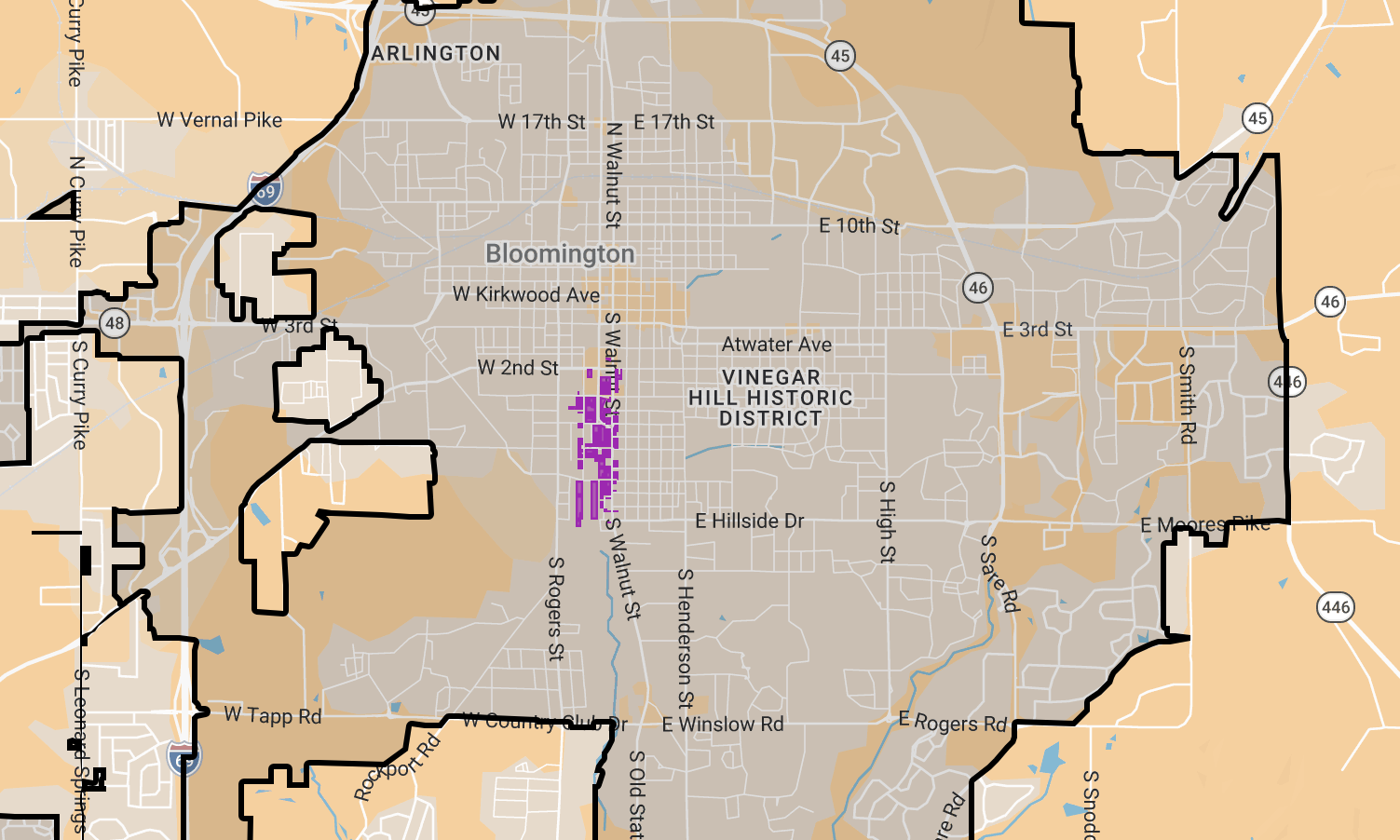
In a letter to the owners of more than 100 properties, dated Feb. 13, 2026, Monroe County assessor Judy Sharp relayed the news that assessments for the land value for certain downtown Bloomington commercial properties have been reduced to 2024 levels. That reverses recent increases, which had more than doubled some land values, according to the letter.
The change applies to 2025 assessments, payable in 2026, and will also carry forward into 2026 assessments, payable in 2027. Sharp’s letter says the rollback is intended to provide tax relief while officials continue to grapple with broader economic challenges affecting the area.
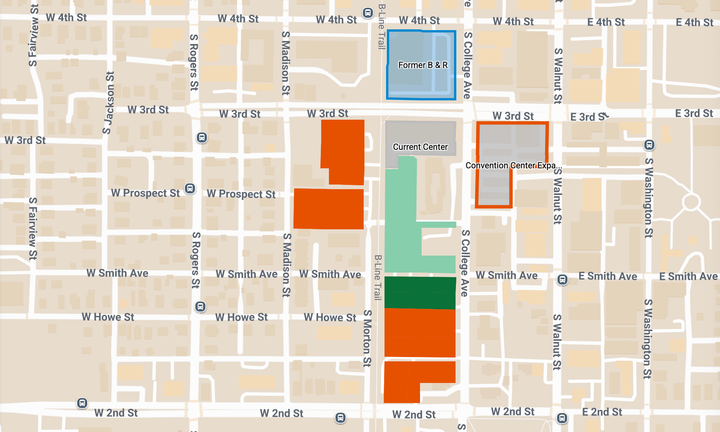
The general geographic area includes the College-Walnut corridor south of 2nd Street.
In her letter, Sharp says, “I drive through this area daily, and something is not working. There are boarded-up buildings, graffiti, trash everywhere, and empty lots where structures used to stand.”
One of the lots where a building previously stood is 424 S. Walnut, which was home to the Player’s Pub, until it was demolished to make way for a four-story 34-bed apartment building, which received site plan approval from Bloomington’s plan commission four years ago, in February 2022. That site plan approval has long since lapsed.
The opening line of Sharp’s letter frames conditions in the corridor as impacted by the homeless population: “In the last few years, my office has heard from taxpayers directly impacted by the unhoused, citing issues that they face each day.”
The area affected by the PTABOA’s decision includes properties that are all inside city limits, from Second Street south to Hillside Drive, between Walnut Street, College Avenue, and Madison Street—covering much of Bloomington’s traditional downtown commercial corridor.
The decision to reset land values in the area was made by the Property Tax Assessment Board of Appeals (PTABOA), which is a three member group currently consisting of Kurt Zorn, Vickey Reeves, and Patricia Bookwalter. Zorn was appointed to the PTABOA by county commissioners at their Feb. 5 meeting, to replace the retiring Jack Davis. Sharp serves as secretary of the PTABOA by virtue of her role as the elected county assessor.
The letters from Sharp come well ahead of the May 10 spring tax due date. Bills are expected to be sent in late April.
The adjustment comes after a period of rapidly rising land values. According to Sharp, land assessments in the area “more than doubled” in 2025, reflecting sales data used in the mass appraisal process. Sharp’s letter contrasts the county assessor as a “mass appraiser” with a “fee appraiser.” Fee appraisers are hired to value a specific property for a specific client.
Some business owners appealed the 2025 increases to the Property Tax Assessment Board of Appeals (PTABOA), which granted relief in certain cases, according to Sharp’s letter. Those appeals, Sharp said, provided insight into conditions affecting commercial viability that are not captured in mass appraisal models.
Sharp’s letter states that returning land values to 2024 levels would offer relief and that maintaining those lower values for an additional year should help the situation.
In the spreadsheet shared with The B Square by the assessor’s office, the total amount of reduced assessment across all the affected properties was around $16.9 million. That translates into a reduced tax burden for those property owners of around $347,131, according to the assessor’s numbers.
But that doesn’t mean $347,131 less will be collected in total taxes across all property owners. That’s because Indiana’s property tax system distributes the tax burden across all taxable property to meet the levy targets of local government units. So reductions for some taxpayers typically result in a shift of some tax burden to others within the same taxing districts. Monroe County auditor Brianne Gregory has indicated that the calculations will be done in the next few days and will be emailed to the county council, but that the amount is not substantial.
In contrast to levy-based funds, some rate-based funds will see a decline in revenue. The county has three rate-based funds: cumulative capital development, cumulative bridge and county major bridge.
Sharp’s letter says the rollback was developed “with the help of some of the owners in this area,” and invited property owners to provide feedback as officials continue evaluating longer-term solutions.
Sharp took office as Monroe County assessor in 1991. Since then, Sharp told The B Square, she recalled one previous occasion when a large number of properties in the same geographic vicinity had their assessments reduced—near the Lemon Lane Landfill, a federally designated hazardous-waste cleanup site on Bloomington’s northwest side, which was contaminated decades ago with PCBs.
Polychlorinated biphenyls (PCBs) are a class of man-made chemical compounds once widely used in electrical equipment because of their insulating properties, but later banned after they were found to persist in the environment and pose human health risks.
Comments ()