
MCCSC board advances staff reductions, cell phone ban, gets update about online school
The MCCSC board approved staffing changes tied to its 2-year fiscal recovery plan, including one reduction in force that prompted tense public comment from a student. Trustees also advanced a new cell phone policy, approved anti-harassment revisions, reviewed online school growth.

Last Tuesday (May 19), at its final regular meeting before the end of classes on Thursday, the Monroe County Community School Corporation board took several actions tied to staffing, finances, district policy, and facilities as administrators continued work on a two-year plan to stabilize the district’s budget.
Trustees approved a personnel report that included administrator departures, teacher transfers, and one reduction in force (RIF). The RIF provided one of the tenser exchanges of the night. The board also unanimously adopted a revised anti-harassment policy. The board also introduced new policies on student cell phone restrictions and school facility rentals, both of which are expected to return at June’s meeting for final approval.
District administrators presented updates on the district’s financial outlook, the first year of MCCSC Online virtual instruction program, and several ongoing construction projects, including athletics and parking improvements at Bloomington High School North.
Financial update, reductions in force, public comment
MCCSC is just over a year into a two-year plan to reach fiscal sustainability that began in February 2025. The district cites declining student enrollment, reduction in state funding, and increasing payroll expenses as primary causes for projected losses.
Since 2025, MCCSC says it has evaluated spending and staffing and has made staffing adjustments accordingly. The May personnel report approved by the board on Tuesday included the elimination of one administrator position, three administrator retirements or resignations, 76 teacher position transfers, 20 teacher retirements or resignations, one teacher termination, and one reduction in force (RIF).
Losing her position was Hongzhi Wang, who taught Chinese language full-time for MCCSC, splitting her effort between Bloomington High School North (BHSN) and Jackson Creek Middle School. According to the personnel report, William Sanders, who taught Chinese at Bloomington High School South (BHSS) and Batchelor Middle School, will instead teach at the two high schools.
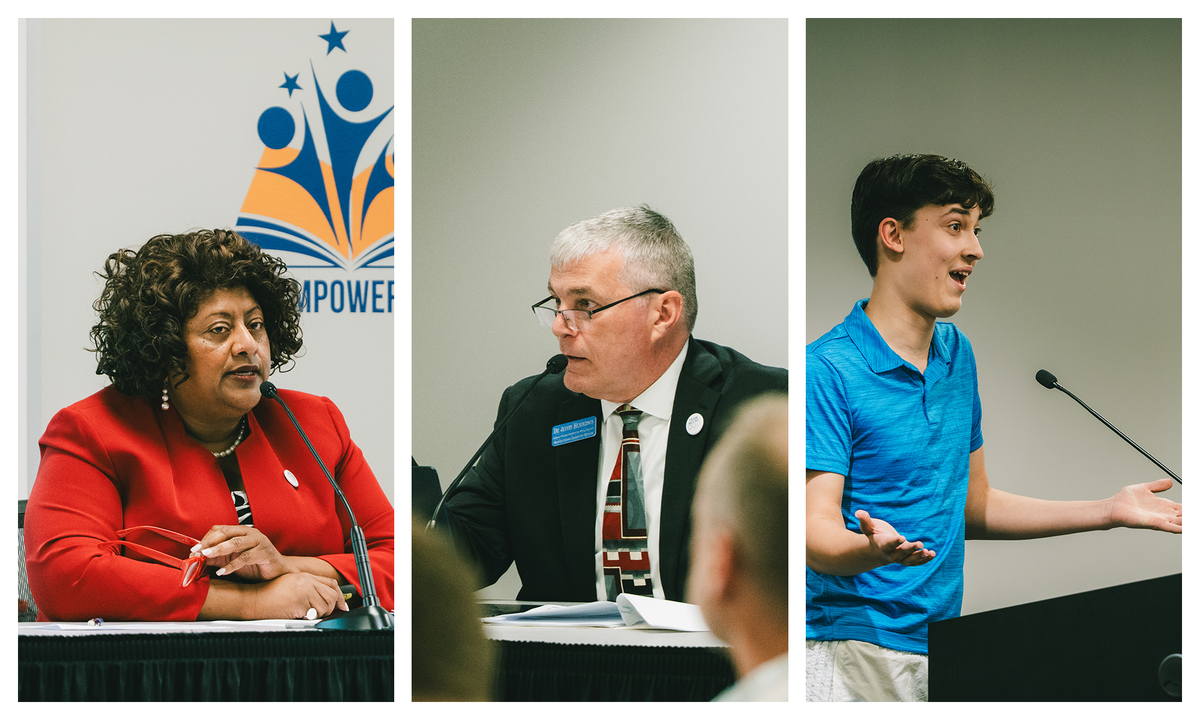
The meeting’s sole comment from the public mic came from BHSN junior Lyle Henry, who said, “I am here to speak out in support of my teacher, Mrs. Wang.” Board president Erin Cooperman cut him off.
Here is the full exchange, which begins at 11:23 in the meeting recording.
Henry: Good evening, my name is Lyle Henry and I am a junior at BHSN. I am here to speak out in support of my teacher, Mrs. Wang.
Cooperman: Lyle, I’m sorry. I’m going to have to interrupt you. We can’t use specific names of any personnel. We have—one of the guidelines is that we don’t talk about specific people at—
Henry: I am here to speak out in support of my teacher.
Cooperman: I hear that, and I appreciate that.
Henry: I just want to know answers. I’m not getting any clear answers.
Cooperman: So Lyle, I did email you today and I encouraged you to just speak generally. If you’d like to talk generally about ... what you appreciate about teachers in general, for example, you’re welcome to do that. But I can’t let you talk about specific personnel.
Henry: OK, I want to know why only one person is being RIFed and it’s her. [Henry gives an exasperated palms up gesture.] That’s all. I really want you guys to think about that. It’s an injustice. [Henry steps away from the lectern.]
The guideline Cooperman cited is included on the board’s online public comment form: “Please know, there is no commenting on personnel issues.” The MCCSC bylaw on the topic says that the presiding officer may “interrupt, warn, or terminate a person’s statement when the statement is too lengthy, personally directed, abusive, obscene, or irrelevant.”
After the meeting, Cooperman told The B Square: “In general, when I receive emails from people who say they are planning to come to public comment, I will, especially if there’s something in their email that would be against our guidelines in public comment, I will remind them of those guidelines and try to avoid a situation like what happened tonight. Because that speaker was a student, I tried to offer a little more guidance than I would a general speaker. ... Generally, we’re not supposed to have any kind of back-and-forth. And if it had been not a student, I might’ve been stricter.”
Cooperman said that she believes discussion of personnel matters during public comment can open the commenter or the board to liability, and that’s why it isn’t allowed. On the topic of not responding to speakers, she said, “I can imagine the philosophy behind not having us respond to public comment directly, that they want to minimize conflict, but that’s just my guess.” She said this isn’t a topic the board has discussed during her time on it, but she said it’s a “pretty common practice on boards. ... I can both understand the reasoning for it, and appreciate that it’s frustrating to the public to not see us respond. I’m sort of agnostic about whether it’s the right approach or not.”
Later during the meeting, MCCSC chief financial officer Matt Irwin presented a financial update. According to his presentation, “significant progress” has been made since December 2024 projections. “We have come a long way,” Irwin said, “and we are taking steps in the right direction.” He said that means the district is starting to look ahead, preparing for expected and unexpected increases in costs that may come in the future.
During the same presentation, MCCSC superintendent Markay Winston said the district has already conducted a thorough analysis of its fiscal situation, spending, and staffing levels, and is continuing to make staffing adjustments and increase efficiency.
Winston said MCCSC prioritizes natural attrition through retirements and resignations when reducing total workforce. The next strategy that’s used is position transfers, where staff are moved between departments and schools in MCCSC. “Where we could, we prioritized voluntary transfers, and then when necessary, involuntary transfers,” Winston said. After “operational efficiencies,” position reductions are a “last resort,” according to the presentation. She told the board, “I think it’s important for you to know that we had very limited position reductions. ... The majority of our position eliminations were achieved through voluntary retirements.”
According to the presentation, since 2024, there have been about 90 full-time-equivalent (FTE) voluntary resignations and retirements and about 70 FTE position transfers. The district also said that 79% of staffing cost savings were achieved through voluntary attrition and position transfers. The remaining savings can be attributed to position eliminations and terminations.
Winston also said that reductions were proportional across four employee groups: administrators, teachers, union support staff, and non-union support staff. Reductions were fewest for teachers, with 11% of teachers let go. The employee group with the most workforce reduction was union support staff at 15%. The next update on the two-year plan will be in August.
District policy changes: cell phone ban, anti-harassment, and school facilities
The board approved one district policy and gave initial consideration to two new ones on Tuesday (May 19).
After a second and final reading, the board voted unanimously to approve a new anti-harassment policy. Assistant superintendent for human resources and operations Jeffry Henderson told the board in April, when the policy was first read, that it has been “revised to reflect changes in current law.” It replaces Policy 3362 for professional staff, Policy 4362 support staff, and Policy 5517 for students.
Two policies were introduced for first reading on Tuesday (May 19). One was on cell phones: Policy 5136. During its 2026 session, Indiana legislators passed Senate Enrolled Act 78, which requires schools to ban “wireless communication devices,” which include cell phones, smartwatches, and non-school-issued laptops and tablets, from the start of the school day to the end. Schools are given two options for compliance: students can be prohibited from bringing devices to school; or schools can adopt a storage policy.
An acceptable storage policy is one where a cell phone “may be brought to school, but must be stored away, powered off, and inaccessible to a student throughout the school day.” MCCSC’s drafted policy says that devices “must be stored away in the administration identified and approved building location, powered off, and inaccessible to students.”
Alexis Harmon, MCCSC assistant superintendent of curriculum and instruction, who presented the policy to the board, said the location could be a locker or backpack, but the policy is intentionally vague so that each school can have flexibility as needed. For example, one school might use lockers as a storage location, while another school might not have lockers for every student.
During board discussion about the cell phone policy, board president Erin Cooperman asked Harmon about the first line of the policy: “A student may bring but is prohibited from possessing and/or using a personal, non-school issued/approved wireless communication device.”
Cooperman said, “Can you explain how they could bring but not possess a device?” She asked if the word “possess” could be replaced with another word “that makes it more clear that they can’t have it out.” Harmon said that the language was modeled on guidance from organizations that craft policies, but that the district can look at the specific wording.
SEA 78 also calls on the Indiana Department of Education to “publish model policy language and implementation guidance.” Harmon told The B Square that MCCSC has not yet received guidance from the department. The B Square has emailed a question to the department about the status of policy language and guidance. [Updated May 28, 2026: According to the secretary of education’s office the guidance is expected ahead of July 1, and will be provided in the secretary of education’s weekly update email.]
SEA 78 requires school corporations to pass policies in compliance with the bill by July 1, 2026. The board must adopt a policy after a second reading at its next regular meeting, on June 23, or else schedule a special meeting before July 1, to comply with state law.
The other district policy introduced for first reading at Tuesday’s (May 19) meeting was Policy 7510 on the use of school facilities, and associated facilities rental fee schedule. The new policy defines five tiers to categorize organizations that request facility space, with increasing hourly costs: Tier 1 is school and directly affiliated organizations, for whom all facilities are available at no cost; Tier 2 is youth and local nonprofit service organizations, Tier 3 is local government, Tier 4 is community and civic non-profit organizations, and Tier 5 is for-profit and commercial organizations.
Cooperman asked if the policy could include wording that would give the district “the option of declining the use of our facilities to organizations that might have values that are different from MCCSC.” Tom Bunger of Bunger & Robertson served as the district’s legal counsel at the meeting. Bunger said that could be explored, but warned that it could “put people in a difficult position trying to make executive calls” for individual organizations. He also said that the district would have to make sure the policy isn’t written in a way that is discriminatory. Cooperman responded by saying, “I think that’s just something I need to mull over a bit more.”
Cooperman told The B Square after the meeting that an example of an organization that the district may want to bar from using its facilities is a hate group. She summarized it like this: “Is there any room within constitutional requirements to allow us to be discerning?”
The use of school facilities policy and the cell phone policy, both of which could be revised, will be on the June 23 meeting agenda for second and final reading.
Online school update
MCCSC director of early learning and enrollment Tim Dowling gave the board an update on MCCSC Online, the district’s virtual school that just concluded its first school year in operation.
The virtual school is offered by the district as an alternative to in-person instruction for all grades, but is operating through one of MCCSC’s high schools, the Academy of Science and Entrepreneurship (ASE). It is open to all students in Indiana.
Offering over 300 courses taught by Indiana certified teachers, MCCSC Online runs on a platform called Edmentum EdOptions Academy. The same platform is used by other online schools in Indiana, including La Porte Online School, Franklin Community Virtual School, Cloverdale Distance Learning Academy, and Northwest Indiana Online School. Just like MCCSC’s offering, those online schools are available to all K-12 students in Indiana. There are also three online private schools in the state according to Private School Review.
Superintendent Winston said last year that the district received “numerous requests” to provide an online school after the 2020-2021 school year, which was impacted by the pandemic. The district launched MCCSC Online in the 2025-26 school year after its curriculum team researched options.
Dowling reported on Tuesday that MCCSC Online had 76 students enrolled as of May 8, 2026. Nine of those students participated in the hybrid learning model, which allows high school students to receive half of their instruction at a bricks-and-mortar MCCSC school and the other half online. According to an email from MCCSC director of communications Sarah DeWeese, the majority of the enrolled students are in middle or high school. “Most are from within MCCSC boundaries, although we have students from outside our settlement area as well,” she wrote.
Dowling said that there are 20 MCCSC Online students set to graduate in the Class of 2026. Six of them will participate in the ASE graduation ceremony, two of them will participate in the BHSN ceremony, and one at the BHSS ceremony. In her email, DeWeese said that graduating online students were invited to participate in ceremonies. “We worked with them to determine their preference on what school they wanted to attend for commencement,” she wrote. “All MCCSC Online students receive an MCCSC diploma from the Academy.”
According to Dowling’s presentation, 19 new students have already been admitted to MCCSC Online for the upcoming school year, and enrollment is ongoing. New students must apply; the application is on the MCCSC Online webpage.
According to DeWeese, ”many current MCCSC Online students are returning next year.” She said the district is still waiting for some responses from students about whether they are returning to MCCSC Online in the fall or if they are interested in returning to in-person instruction at MCCSC. She said that current students don’t need to re-apply.
The online school offering may also have an impact on the district’s financial health. In the budget adopted by the state legislature last year, the base number for the “foundation amount” of funding that goes to each school district is about $7,000 per student for the fiscal year beginning July 1, 2026.
The school board approved another contract with Edmentum for the 2026-27 school year in January. A full year costs MCCSC around $2,500-$3,000 per student, depending on grade level, or around $200-$325 per course.
That means any student not currently enrolled in person at MCCSC, who starts attending MCCSC Online, would be a financial net positive for MCCSC. But for just one student who is already enrolled at MCCSC at a bricks-and-mortar school, then switches to MCCSC Online, the immediate impact would be an additional cost to the district. Depending on how many current MCCSC students make the switch, and depending on where they currently attend, that could allow for some cost savings on the bricks-and-mortar side.
Construction updates
MCCSC assistant superintendent Henderson gave an update on MCCSC’s construction projects.
“I’m happy to report that the BHSN tennis and BHSS soccer projects that I reported on back in February are now at 100% completion,” he said. The project that remains ongoing is the BHSN athletics and parking improvement project. It will include new field throwing facilities, a new athletic facilities building, a new synthetic turf soccer field, batting cages, a concessions area, restrooms, and a new parking lot. The new parking lot will be south of the current football field, which is closer to the school building than the existing parking lot west of the field. The old parking lot will be the site of the new soccer field.
His presentation, which starts at 56:05 in the meeting recording, contains images of current progress. The project’s total cost is around $8 million and estimated completion is in fall 2026.
MCCSC’s construction projects are fully funded by bonds. According to the district, no money from the referendum, education, or operations funds is used for them.


Comments ()