
MCCSC policy banning cell phones OK’d despite board qualms
MCCSC trustees approved a state-mandated student cell phone storage policy despite board misgivings. They also adopted new facilities-use rules and rental fees. Jennifer Hester and Kelsey Pearson were appointed as principals. A July discussion of redistricting is planned.
As part of its main business on Tuesday (June 23), the Monroe County Community School Corporation (MCCSC) board approved two new policies. One restricts student use of cell phones and other wireless communication devices during the school day. The other governs use of school facilities and rental fees.
In other action the board approved the appointments of Jennifer Hester as principal of Jackson Creek Middle School and Kelsey Pearson as principal of Fairview Elementary School.
The board also established a task force to review district policies more broadly.
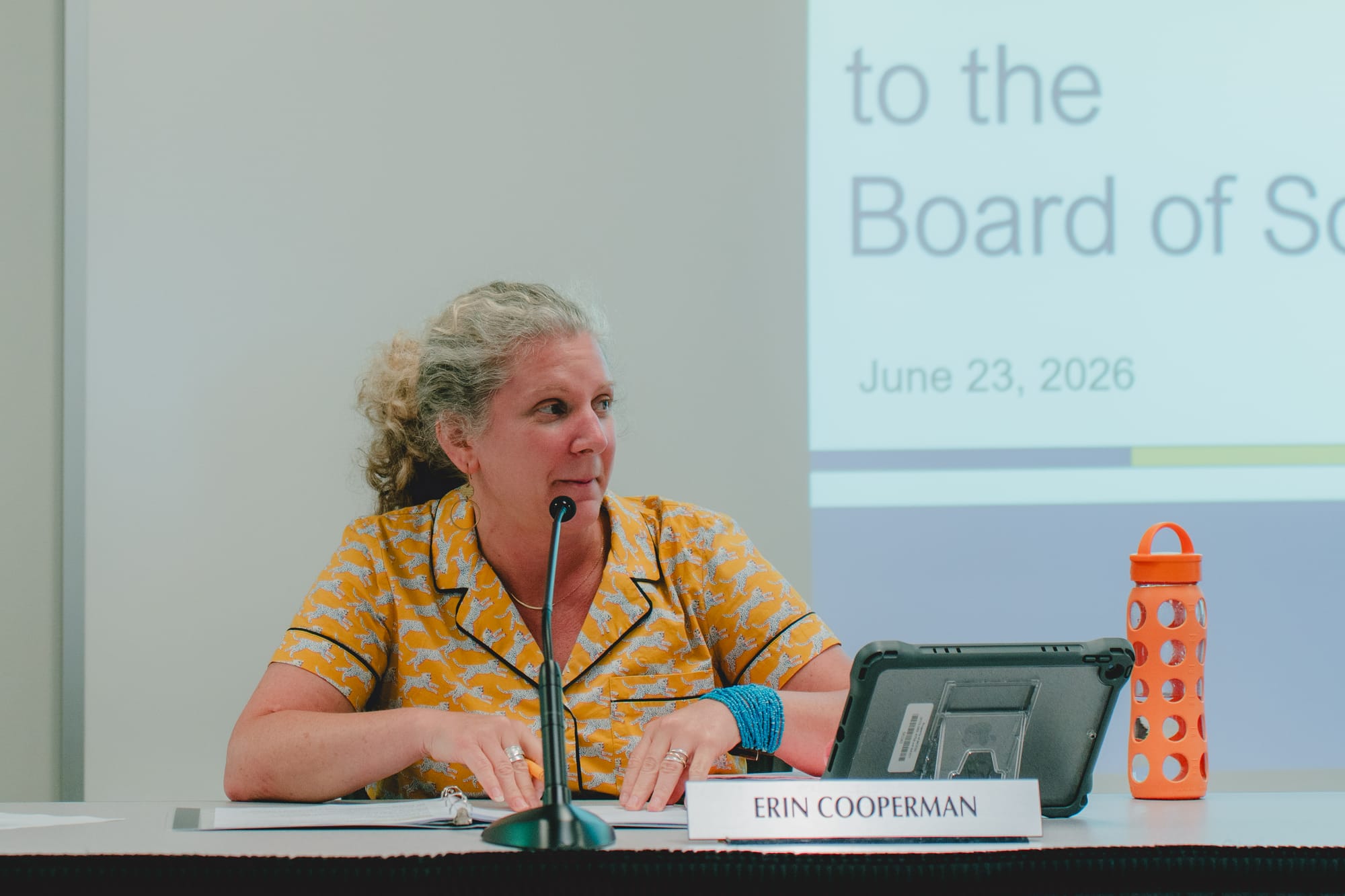
Board president Erin Cooperman also said trustees should be ready at their July meeting to discuss a redistricting study focused on balancing student socioeconomic status among schools and ensuring cost-effectiveness.
Cell phones reluctantly banned
After a first reading in May, the board approved updated Policy 5136 banning “wireless communication devices” during the school day. It passed 5–1 on the seven-member board. April Hennessey voted against adopting the policy. Ashley Pirani was absent.
The vote came after a six-minute presentation from MCCSC assistant superintendent for curriculum and instruction Alexis Harmon and nearly 15 minutes of board discussion. Even the motion to open the agenda item made by Ross Grimes, which was seconded by Hennessey, was made with evident reservations:
Cooperman: Next for our consideration is Policy 5136: Wireless Communication Devices. Do I have a motion to adopt Policy 5136: Wireless Communication Devices?
[Six-second pause]
Grimes: Unfortunately, I have to make a motion. Cooperman: Okay. Do I have a second?
[Another six-second pause]
Hennessy: For the sake of conversation, I second this motion. Cooperman: Thank you for your reluctant first and second.
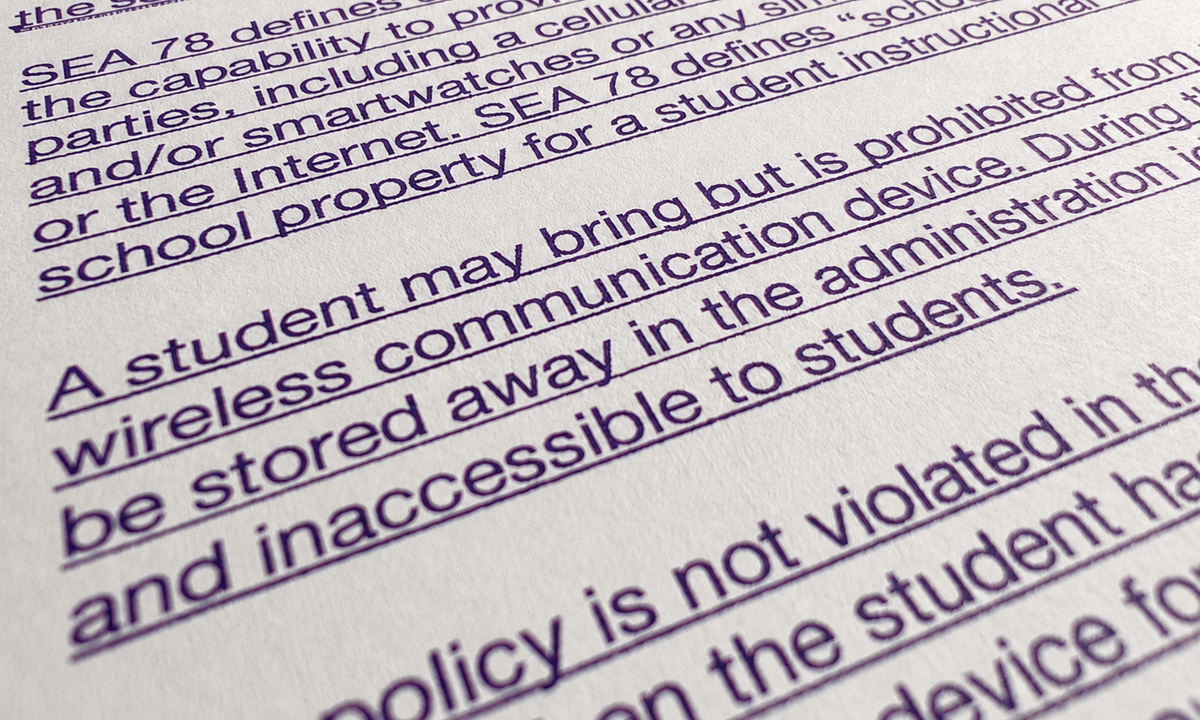
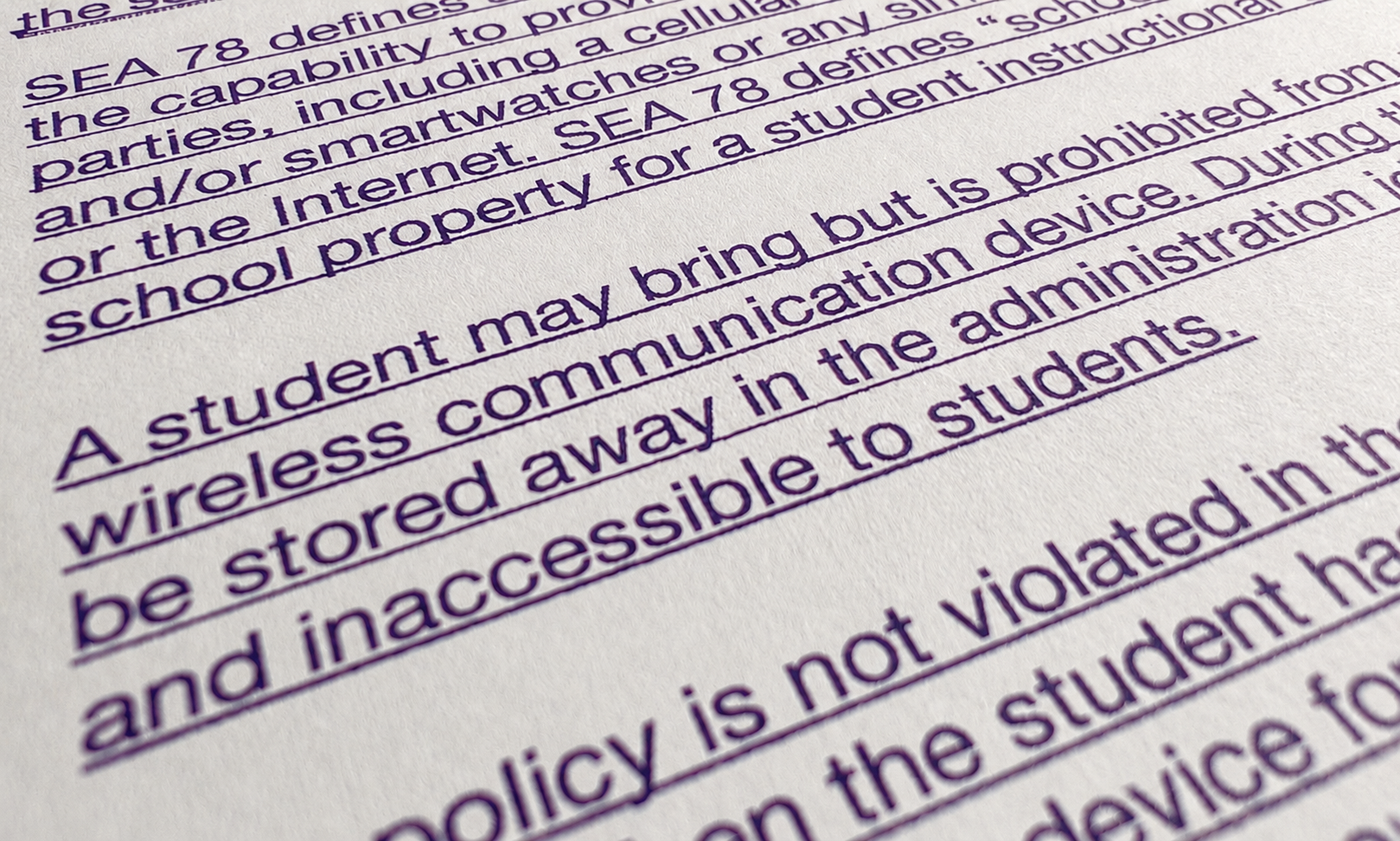
During its 2026 session, Indiana legislators passed Senate Enrolled Act 78, which requires schools to ban “wireless communication devices,” which include cell phones, smartwatches, and non-school-issued laptops and tablets, from the start of the school day to the end. Schools are given two options for compliance: students can be prohibited from bringing devices to school; or schools can adopt a storage policy.
According to Harmon’s presentation, MCCSC collected feedback, including 424 survey responses, asking families, staff, and students how MCCSC should comply with the state law. She said 82% of respondents preferred a storage method over a no-device policy, which is the approach MCCSC has taken. She also highlighted five “key themes” from responses: medical exemptions, administrator and teacher burden, safety and emergencies, storage logistics, and consistency across schools.
The new policy allows exemptions for students with documented medical need or accommodations such as Individual Education Plans (IEPs) or 504 Plans, and allows students to be authorized device use in an emergency situation.
An acceptable storage policy is one where a cell phone “may be brought to school, but must be stored away, powered off, and inaccessible to a student throughout the school day.” MCCSC’s new policy says that devices “must be stored away in the administration identified and approved building location, powered off, and inaccessible to students.” Harmon said the location could be a locker or backpack, but the policy is intentionally vague so that each school can have flexibility as needed.
Part of Harmon’s presentation also included three “administrative commitments” that are not included in the policy but will be, she said, in administrative guidelines. The first commitment was to establish clear storage locations at each school, which could be lockers, classroom pouches, or backpacks.
The second was consistent and equitable discipline, with outlined disciplinary response for each offense: a first offense would result in a warning and confiscation, while repeated offenses would result in “additional developmentally appropriate consequences,” including “potential loss of device privilege.”
The third commitment was teacher support. Harmon said teachers will not be required to confiscate devices; instead, school offices will manage device confiscations and parent contact. Harmon also said that all teachers and administrators will be trained on the policy.
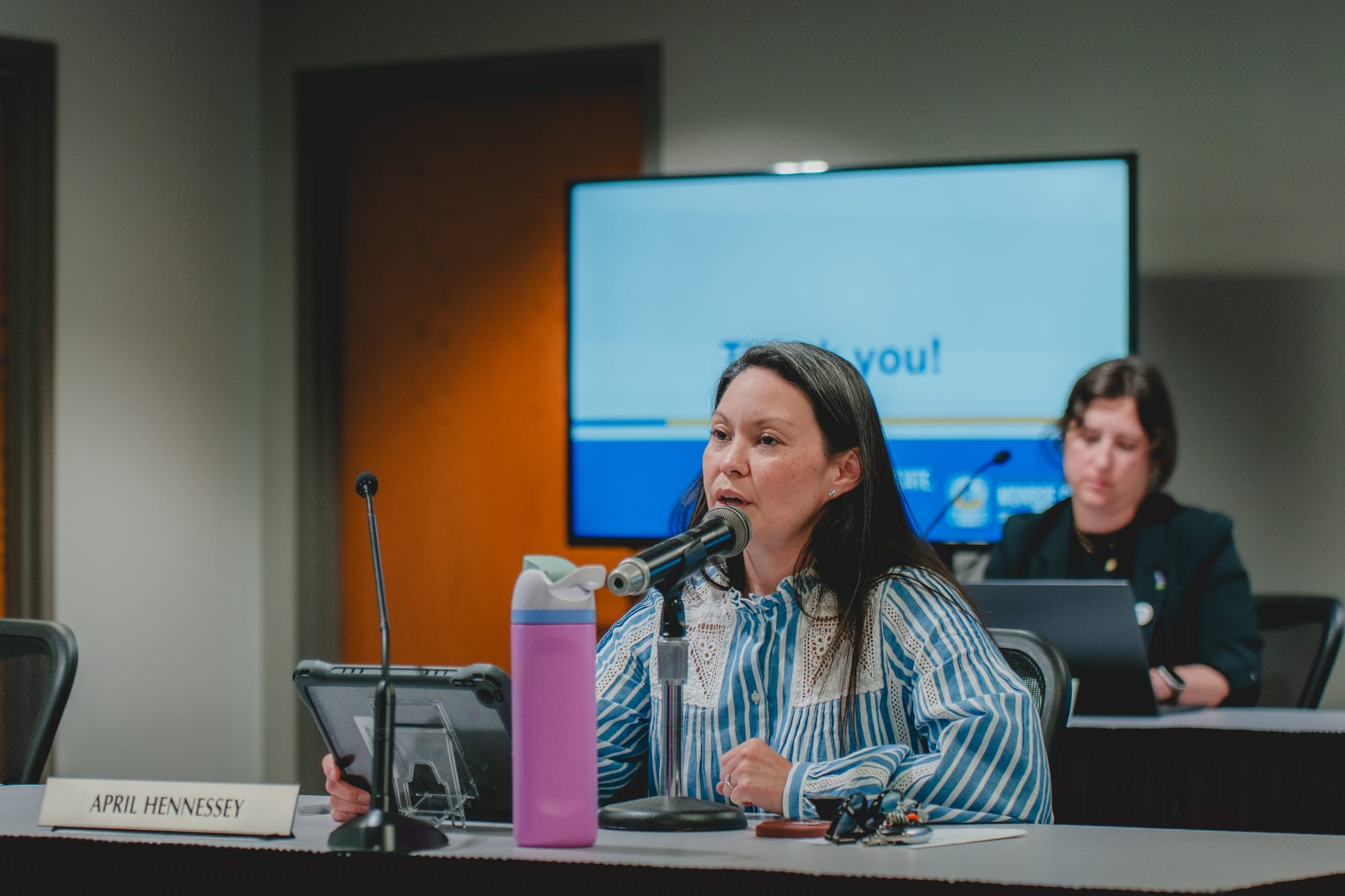
Hennessey began the discussion following Harmon’s presentation. “I really do not like this as a policy,” she said. “I think that this is an overreach of the state, to, sort of, mandate how we determine when and where devices get used in our buildings. I know that cell phones in classrooms are a problem; I have seen that in my own classrooms when I was teaching. But I think that we live in a different time, and I think that ... it’s problematic on many counts.”
One of Hennessey’s primary concerns about the MCCSC policy is inconsistent application, which, she said, “will stem from inconsistent policies of storage. ... And that will inevitably lead to different kinds of access, and then potentially, greater or less disciplinary action around those phones.” She said she’s worried this policy will “lead to inequitable disciplinary response.”
Harmon responded by saying that MCCSC is planning to implement the policy the same way within each school level: “We will see a consistent location for elementary schools, we will see a consistent location for middle schools, we’ll see a consistent location for high schools,” she said. “[We] don’t want to see increased discipline because of the policy.”
Hennessey asked the administration to track and report disciplinary data to the board related to cell phone infractions. She said, “I would actually like to see the data after we begin implementing this, to just ensure that we’re keeping our eyes on that, and that there is, in fact, not disparity.”
After the meeting Hennessey told The B Square that her goal is to see if there are discrepancies across the schools. She said that if one of the three middle schools had higher rates of disciplinary action than the other two, for example, that could indicate inequities in how devices are being stored or how staff is disciplining violations.
“We can absolutely do that,” superintendent Markay Winston said. “We share the exact same interest that you all are speaking about.” She said the district can provide quarterly updates to the board.
At the beginning of the meeting, one comment from the public mic on the cell phone policy came from Susan Ellenwood, a parent of two MCCSC students. She expressed concern about the policy, particularly in emergency situations. “As parents,” she said, “we find it crucial to be able to contact our children in the event of an emergency.”
Ellenwood said she’s heard from other parents, and that she’s seeing a pushback towards these bans nationwide. She said when parents hear that there may be a safety concern at their child’s school, “the first thing many of us do is contact our kids, check in, make sure they’re okay. And I would like to be able to continue doing that.”
Board vice president Grimes said he shared the same concerns as Ellenwood. He said he has a child going into eighth grade this fall, and he has relied on electronic devices. “This is a challenge and a frustration as parents. So, when I hesitantly made the motion, that’s why, because personally, I don’t like it either.”
During board discussion, Hennessey asked Tom Bunger, of Bunger & Robertson, who served as the district’s legal counsel at the meeting: “What happens if, like, we didn’t pass the policy?” Bunger raised the possibility that Indiana’s attorney general, Todd Rokita, would act:
Bunger: I’m sure Todd Rokita would take action.
Hennessey: And what would he do?
Bunger: He’d file suit for us for not following through with the statute and force our hand unless we can show that the statute’s not valid. He’d love that opportunity. ...
Hennessey: Well, no. I know. I know. I’m always just playing.
Hennessey said she takes issue with state mandates that require additional spending, such as trainings, labor, equipment, and communication. “I just think about the amount of time that will now be spent on something pretty frivolous and stupid, frankly. And that, of all the things that we have going on, the state, this is the thing that they, sort of, chose to take a stand on.”
She continued, “There’s no more dollars or resources for how we manage this in each of our 23 schools, right? ... It’s just another thing that needs to be folded in and encompassed by the ever-shrinking dollars that we’re given.” MCCSC is 16 months into a two-year plan to achieve financial sustainability.
She noted that the criticisms towards this policy will be directed at the schools and the district rather than the state legislators responsible for the mandate. Hennessey said this legislation is one of many examples of the state’s overreach towards schools. “Is this the thing I want to fight?” she said. She called the policy “fairly meaningless.” She said, “It doesn’t accomplish anything, really.”
Other board members agreed with Hennessey, but voted in favor of the policy. “I am voting mostly in favor of staying in compliance with the state legislature,” Cooperman said before voting.
Other business
In addition to adopting the cell phone policy, the board unanimously approved the adoption of Policy 7510 on the use of school facilities, and associated facilities rental fee schedule. The new policy defines five tiers to categorize organizations that request facility space, with increasing hourly costs: Tier 1 is school and directly affiliated organizations, for whom all facilities are available at no cost; Tier 2 is youth and local nonprofit service organizations, Tier 3 is local government, Tier 4 is community and civic non-profit organizations, and Tier 5 is for-profit and commercial organizations.
This agenda item’s only discussion before the vote was a question from Hennessey. She asked if there are any groups currently using MCCSC facilities that would be unable to under the new policy. Jeffry Henderson, assistant superintendent of human resources and operations, who presented the policy to the board, said there aren’t.
The board also approved the personnel report for the month, which included the appointments of two school principals: Jennifer Hester at Jackson Creek Middle School and Kelsey Pearson at Fairview Elementary School. Both appointees were at the meeting, and were invited to address the board.
According to the report, Hester comes from the Bartholomew Consolidated School Corporation where she was a teacher, dean of students, and assistant principal. Before that, she was at MCCSC, serving as a teacher, coach, and athletic director. “I’m excited to return to the school where I taught the year the building opened,” she said to the board. “My commitment is to listen, learn, and lead alongside the students, families, staff, and community partners to empower every Jaguar and continue the tradition of excellence.” (Jackson Creek’s mascot is a Jaguar.)
Pearson is being promoted to principal at Fairview, where she has served as assistant principal for the past four and a half years. She began her career at the school in 2013 as a special education teacher. Pearson was an MCCSC student herself—she attended Marlin Elementary School, Tri-North Middle School, and Bloomington High School North. “I am proud to give back to the community that helped shape me,” she said in her remarks to the board. She said she looks forward to expand on the strengths Fairview already has, including its arts program, accelerated learning program, and community partnerships, “while also ensuring a culture of academic excellence for all students in a safe and positive learning environment.”
In addition to the two principal appointments, the board approved the hiring of seven teachers new to MCCSC, along with six current district employees moving into teaching positions from roles such as substitute teacher and teacher aide.
Policy review task force
Near the end of the meeting, during the “Board Comments” portion of the agenda, Hennessey established a task force to do a formal policy review. “I think we have not reviewed our policies, not holistically, in a very long time.” She said that 2012 is when the board last adopted a lot of policies.
Board member Jester and assistant secretary Tiana Iruoje volunteered to join Hennessey on the task force. Iruoje said, “That’s one of the biggest reasons I joined the board, is to look at policies.” Jester said, “I would gladly accept joining that group.”
Board president Cooperman said a task force of no more than three board members is the procedure. “You can arrange to meet on your own, outside of meetings, and then bring your findings back to us at board meetings. ... We will look forward to your reports.”
Looking ahead at redistricting
Cooperman reminded her colleagues that in March, the board received a presentation of six “findings” from the redistricting study commission that was formed in April 2025. The board charged the commission to study redistricting options with two goals: balancing student socio-economic status (SES) among the schools; and ensuring cost-effectiveness. The commission identified factors for evaluating new catchment areas and evaluated potential map scenarios, wrapping up its work in December 2025.
Cooperman said, “We need to discuss [the report] this summer and I’d like to discuss at the July board meeting.” She asked board members to “refresh your memory” so they can “discuss that in detail.” She said, “I’d like us to be able to give some direction to our leadership team at the end of that meeting.”
A 28-page report is now publicly available on the redistricting page of MCCSC’s website. The next school board meeting is set for July 28.
Photos: MCCSC board meeting (June 23, 2026)




Comments ()