
Monroe County attorney gives update on activity related to choice of new jail site, financing, and ACLU feedback
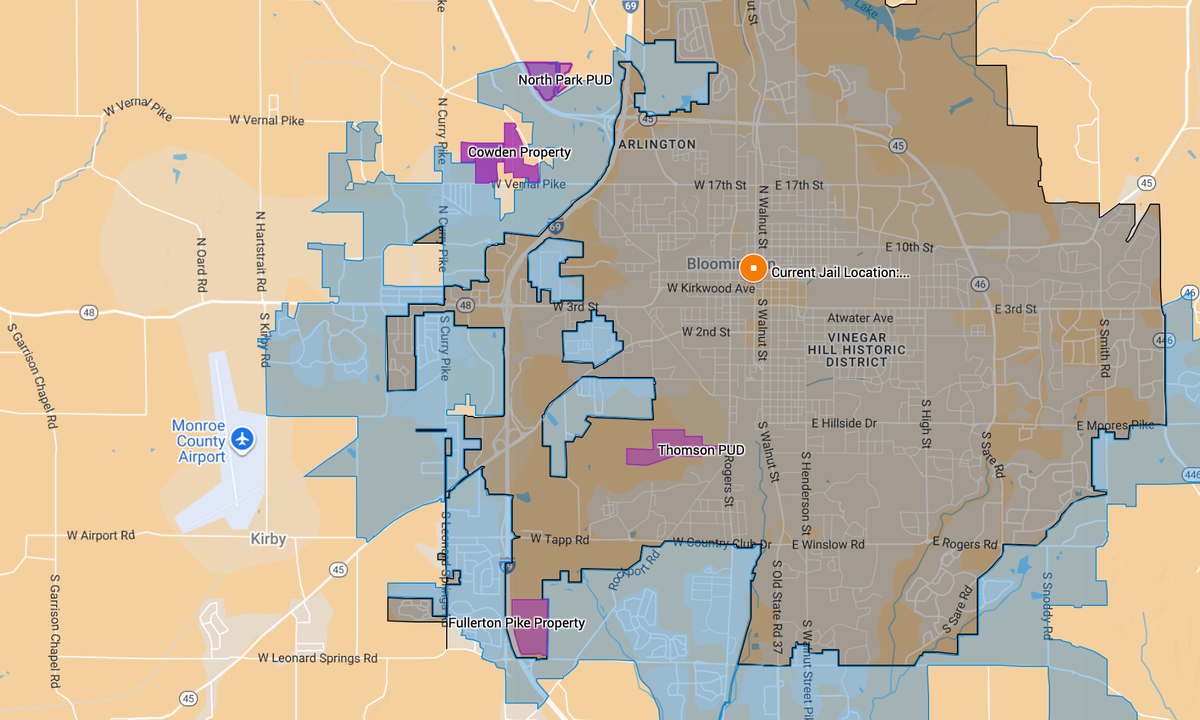
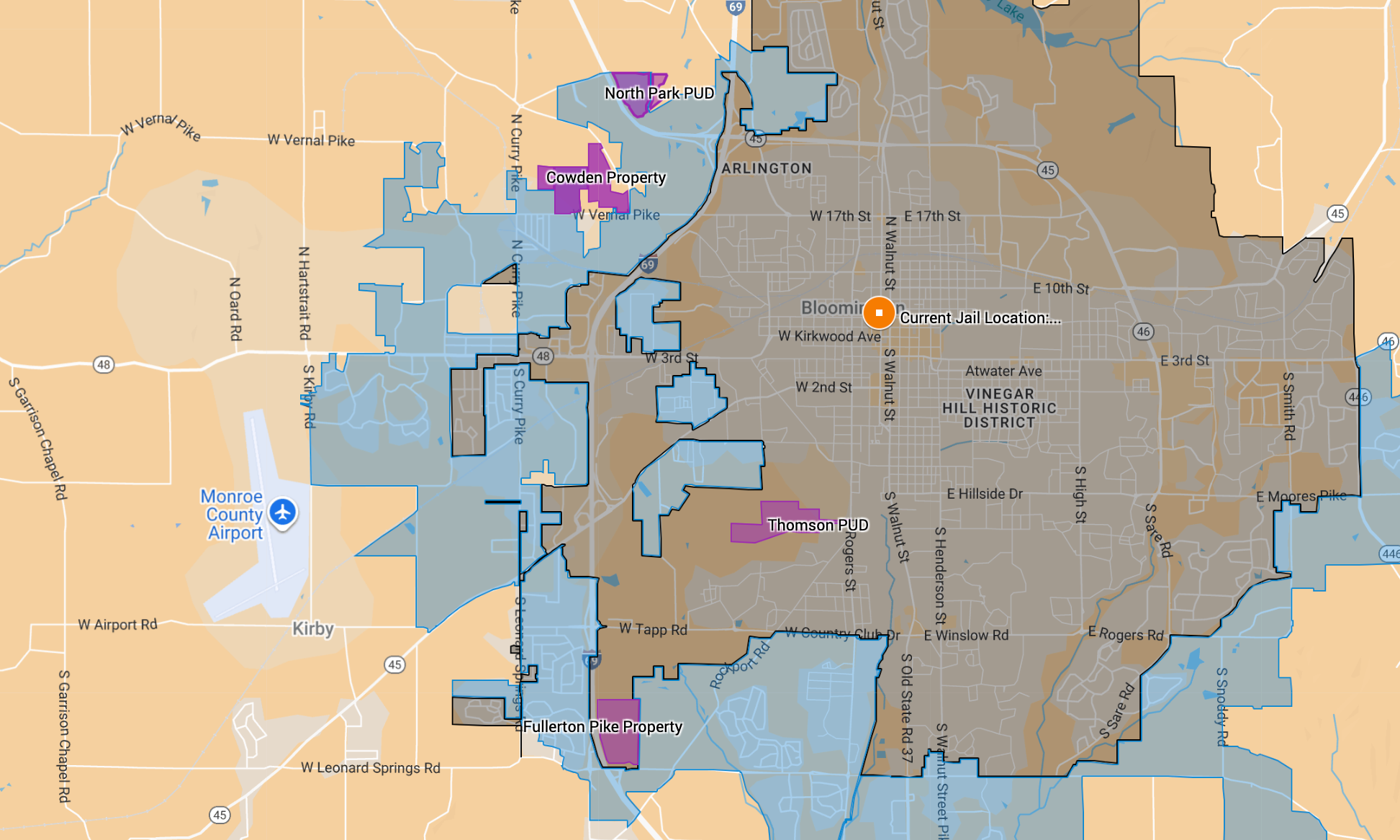
Monroe County appears to be treating the Thomson PUD as its current focus for a possible new jail site, even as financing questions and legal pressure from the ACLU keep the overall picture far from settled. A joint executive session of commissioners and councilors is set for March 30.
Monroe County’s long-running search for a site to build a new jail, and a way to pay for it, got some airtime at last Thursday’s (March 12) regular meeting of the county commissioners.
County attorney Jeff Cockerill laid out what he has been working on, and what comes next. One basic takeaway: The focus of Cockerill’s recent efforts has been the county-owned Thomson PUD, off South Rogers Street, near the RCA Community Park. The following day, Cockerill said he would be discussing with the county’s bond counsel the question of financing the project.
But a resolution by the commissioners—which board of commissioners president Julie Thomas said on Thursday she was hoping would be ready for a vote that day—is not expected to get consideration until the commissioners meet on March 26.
Based on Cockerill’s comments it was hard to pin down any likely outcome for the discussion on a new jail location—especially because the county council, the county’s fiscal body, will also have to be on board. The council approved a resolution on the topic in late February, explicitly ruling out the North Park Location and pointing to a bonding capacity of at most $135 million.
Cockerill’s briefing came in the context of a request for more frequent updates from the county council, which was made at the joint meeting held by commissioners and councilors in the last week of January.
A joint executive session for the two groups of elected officials, closed to the public, is set for March 30, based on pending litigation and real estate matters, either of which could serve as the basis for such a session.
The litigation forming the basis of the closed session, and the impetus for considering construction of a new jail, is the settlement agreement with the ACLU, related to a 2008 lawsuit filed against the county based on overcrowded conditions at the jail. Ken Falk, the lead ACLU attorney in the case, was unwilling this year to give the county a one-year extension to the agreement as he has in the past, instead giving the county just until April 15. After that, fresh litigation could come based on current conditions at the jail.
The takeaway from last Thursday's briefing is that Monroe County is now treating the Thomson property as its current focus while it re-examines the technical feasibility of that location, which was closely considered in 2023, before North Park was selected by commissioners as a preferable location. After approving the purchase agreement for North Park in late 2024, a year later the county council rejected the needed appropriation to closed the deal. That’s why the question of a location for a new jail is again up for consideration.
Speaking at Thursday’s (March 12) meeting of the county commissioners, Cockerill framed his update around three related questions: whether the county can still use its preferred bonding mechanism under recently changed state law; whether the Thomson property can credibly serve as the site for a new justice facility; and what the ACLU would require in order to extend the settlement agreement on the lawsuit. While the settlement agreement is in place, it keeps potential fresh litigation from being filed.
Cockerill framed his remarks in part with the county council’s recent resolution on jail financing, which assumed the county could use a particular bonding structure. That assumption has been thrown into doubt by changes made to state law in the 2026 session, Cockerill said. Cockerill indicated that he would be asking the county’s bond counsel at a March 13 meeting whether the county can still use the financing structure contemplated in the resolution, and, if not, what alternatives exist and on what timeline.
On the question of where to build the new facility, Cockerill said last Thursday, his most recent focus has been on the Thomson site, because it is the one “we can probably get the most answers about without expending money.”
From DLZ, the county’s design-build consultant on the new jail project, Cockerill is hoping to learn what might have changed about the Thomson site, since the last major round of site evaluation, when Thomson was considered.
“We’re trying to figure out what’s changed there that would make it more acceptable and able to be built upon,” Cockerill said. “I’m not going to say there’s nothing there, but we’re working on that.” When it was previously considered, the big challenges were the need for Duke Energy to relocate some power lines, and the need to move a substantial pile of debris.
Cockerill said he had sent some stormwater documents related to the Thomson property to county stormwater staff for review. And, taking a rough conceptual layout that had been considered for North Park, he sent that sketch to the Bloomington city planning department, Cockerill said. Cockerill said he’d asked city planners to flag any significant problems they see for that kind of footprint on the Thomson parcel, including slopes, conflicts with city policies or other constraints.
The Thomson location is not the only one still in the mix, though. Since the last public work session, Cockerill said, he has received additional information from a property owner connected to an unspecified site identified earlier, which he had forwarded to the county council, and the council’s staff, as well as the county’s design consultant DLZ, which is the county’s design-build consultant on the project.
About the ACLU’s attitude towards the county’s current activity, Cockerill said lead ACLU attorney Ken Falk is “looking for progress” and that timelines are “really important to him.” Cockerill asked Falk, for example, whether it would be problematic if the county had to wait two years before it could “move some stuff,” an apparent reference to the moving of power lines at the Thomson site. Falk’s response, Cockerill told the commissioners, was that such a two-year delay probably would be a problem.
Cockerill also floated with Falk the possibility that the county might not be able to use the bonding approach previously envisioned, depending on the impact of new state legislation. According to Cockerill, Falk said that the ACLU had worked through that kind of issue with a different county and offered to provide examples of how other counties have navigated similar financial constraints while still moving ahead on jail replacement.
“At the end of the day, what he said, and what he will continue to say, is, ‘You gotta show me, and then I’ll make a decision,’” Cockerill told commissioners.

Comments ()