
Monroe County commissioner candidates spar over jail, immigration, housing, listening
At a Bloomington DSA forum, Monroe County commissioner candidates Trent Deckard and David Henry traded sharp critiques over jail spending, ICE cooperation, housing policy, and homelessness. Henry urged decisive action, while Deckard stressed consensus and a “community of care.”


At a forum hosted on Thursday night (Feb. 26) by the Bloomington Democratic Socialists of America, Trent Deckard and David Henry fielded questions on topics ranging from housing affordability and the county jail, to ICE cooperation, surveillance cameras, and care for unhoused residents.
The two are candidates for the Democratic Party’s nomination for Monroe County commissioner, District 1.
The questions prompted some sharp exchanges between the two Democrats, who currently serve together on the seven-member county council, as at-large representatives.
The county council is the fiscal body of the county government, while the three commissioners make up a combined legislative and executive branch.
The two were most recently elected to serve on the county council in 2024. Henry’s election that year was his first. It was Deckard’s second, after winning election in 2020, having been selected in a Democratic Party caucus in 2019 to fill the vacancy left by Lee Jones, after she won election in 2018 to the District 1 county commissioner seat. That is now the seat that Deckard and Henry are looking to win. Jones is not seeking reelection.
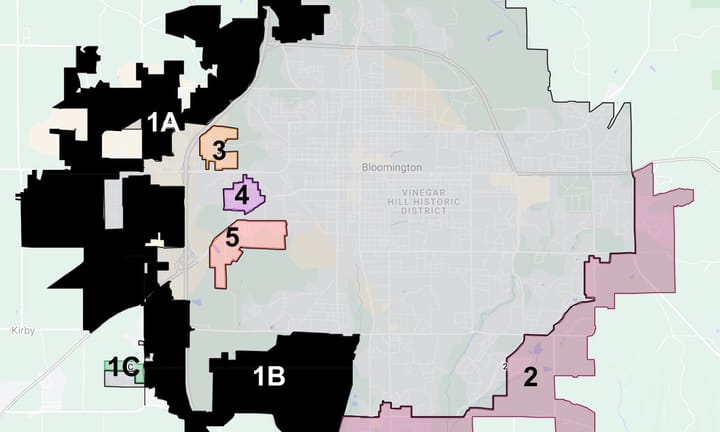
Even though candidates for the District 1 commissioner seat have to live in the geography of District 1, which is a western slice of Monroe County, all voters in the county will see Deckard and Henry on their ballots in the May 5 primary.
The forum was held at First United Church.
Affordable housing, semi-colons
Question: What actions would you take to ensure that new construction in Monroe County not only starts out meaningfully affordable but also stays meaningfully affordable for years to come?
Deckard responded to the question by pointing out that the county does not have a rental housing inspection program: “That means there is literally no requirement on what an apartment would look like, rental look like, etc.” Deckard continued, “We have to begin to take the steps … that begins with the commissioners creating a housing department.” [The city of Bloomington does have a rental housing inspection program.]
Deckard also called for a change from a “culture of bureaucracy” where people “worry about these three semicolons in an ordinance,” adding “We’ve got to make meaningful action that actually moves lives and welcomes people here.”
Henry picked up on Deckard’s swipe against semicolons by pointing to his role as the county council’s appointee to the county plan commission: “I sit on the plan commission now and the devil is in the details, in the colons and the commas of the County Development Ordinance,” adding, “It requires a curiosity to get under the hood of what we’ve built in the county and what we’re not building in the county.”
Henry then took up Deckard’s suggestion that the county needs a housing department with a rental inspection program, saying, “We have to find a way to fund that.”
Henry then followed up with an implicit criticism of Deckard’s role in the development of a plan for a new justice complex that at one point had a price tag of $225 million: “And one of the ways to fund [the rental inspection program] is to make sure we’re not overburdening this community by building a quarter billion dollar jail and putting that money to work [elsewhere] in the years to come.”
New jail construction
Question: Would you oppose the construction of a new jail as county commissioner?
Deckard cited the need to provide constitutional care for the prisoners that are held at the county jail, noting that improvements have been made to the basic condition of the facility, but that was not enough. He said, “Despite the efforts of our sheriff, despite the efforts of the jail commander, not everything that they’re doing can get that facility to constitutional care compliance.”
About the idea of the constitution, Deckard said, “I took an oath to it, both state and federal…” “It is a hard subject,” Deckard said, adding, “Ultimately, someone in [the jail] tonight needs to have constitutional care.”
Henry countered by talking about the overcrowded conditions that led to the 2008 lawsuit. “Let’s start with what constitutional care means in the lawsuit. It means having the space, because it’s overcrowded.” Henry pointed to the period of time since the settlement agreement was reached, saying “Trent’s been in office for about a third of that.”
Henry said, “I have long believed that the answer to the criminal justice system problem in our community is a system and not a building, and we should be working most certainly to make sure we’re not filling the jail—whatever it may be at the end.” He added, “We should be very much working hard not to fill that new facility.”
Deckard then responded to Henry’s point about how long Deckard has been in office on the county council. “Since 2019 I’ve been on a study commission attempting to figure out our next steps. We were stopped by a pandemic … by state law, state bonding changes, but yet we persevered.”
Deckard then responded to Henry directly: “The other thing I just want to say is sometimes when I hear folks like David in elected office talking about our judicial system and how judges do their job, and prosecutors do their job, and probation officers do their job under Indiana law, … it sounds like we’re doing the sentencing.” Deckard said, “Ultimately, our job is to collaborate with them in that system, to try to make change.”
ICE, Flock cameras, and surveillance
Question: Would you commit as commissioner to prevent ICE (U.S. Immigration and Customs Enforcement) from using county resources or removing county resources that could be used to aid ICE, like Flock cameras and other mass surveillance tools?
The question prompted both candidates to cite their affiliations with Indiana University—Deckard is a lecturer at Indiana University’s Kelley School of Business, and Henry teaches on the topic of homeland security at the Indiana University O’Neill School of Public and Environmental Affairs.
Deckard said, “One of the proudest things that I have done is to vote with the Bloomington Faculty Council … against ICE doing recruitment on campus,” adding, “We took a firm stand on that.” Deckard said, “I don’t want ICE doing anything here at all, and I don’t want ICE coming in here.”
He continued, “Occasionally an elected official like me has to stand at the door and use nine generations of being a Monroe Countian to stand for those who cannot stand for themselves.” He added, “If that means Flock cameras not being used until our nation gets back to the regular order of people being decent, kind, following and honoring a constitution, then that means we stand in the door.”
Henry led off by citing his credentials: “It’s no secret that I founded the homeland security program at IU. I’ve worked in and around that topic since September 11.” He continued, “I’ve seen the best of people that have been trying to protect our country and the absolute worst. I left federal contracting over it this past year.”
“Right now, our county government contracts on six [Flock] cameras. There are more cameras in the county, but there’s six that were signed in by commissioner [Julie] Thomas and the previous sheriff.” Henry said he’d talked with experts at CISA (Cybersecurity and Infrastructure Security Agency) and they’d told him,”There’s absolutely no way we can guarantee that that data is not used in the cloud in ways that you all do not want.”
Henry said, “I’m happy to walk with Trent to commissioner Thomas tomorrow and cut up the contract—it’s that simple.”
On the topic of ICE, Henry alluded to the lawsuit that Indiana’s attorney general Todd Rokita has filed against Monroe County sheriff Ruben Marté for not assisting with immigration enforcement. There’s a March 13 hearing on motions for summary judgement.
Related to the Marté case is SB 76, which has been passed during this year’s legislative session, and requires local units to cooperate with federal immigration enforcement and allows the attorney general to penalize noncompliant governments and employers. It expands the existing law under which the attorney general sued Marté.
Henry said, “We’re the only county in Indiana that has stood up against the cooperation with ICE, and that’s going to be put to the test in a matter of weeks.” Henry then invoked the “good trouble” tagline of John Lewis, the late civil rights leader and longtime U.S. congressman from Georgia. Henry said, “So it’s time for county legal to get ready for good trouble.”
Unhoused residents, Thomson encampment eviction
The backdrop to one question was a planned removal of a homeless encampment late last year on the county-owned Thomson PUD property.
Question: How will you prioritize caring for our unhoused neighbors, and what specific critiques do you have of existing county council policy or county commission policy?
Henry responded to the question by describing how he and county commissioner Jody Madeira visited the Thomson property to see for themselves what conditions were like. “These are people that were trying to survive the winter, we almost unhoused them with no plan whatsoever before Christmas.”
A task force that was supposed to be formed has yet to meet, Henry said. The commissioners approved a policy adopting a 30-day notice, with no notices to be posted until March 2, 2026. About the looming issue that is about to be repeated, Henry said, “We’re a month away from having this conversation like Groundhog Day all over again. I’m appalled by this.”
Deckard responded to the question with a slogan from his campaign: community of care. He said, “You can’t have a community of care if you don’t see the dignity of all people in the community.” Deckard continued, “When this issue developed … and the eviction began, I joined the chorus of individuals that said: Let’s not do this. We’re in the dead of winter. This is inhumane in every way that inhumanity exists.” Deckard said that he and county councilor Kate Wiltz met with some advocates at Bloomingfoods, and “we did this novel thing in government called listening.” Deckard said, “It’s our job to think about those things, treat people with dignity, and see all lives as they matter.”
Henry took up two points in Deckard’s response: “I appreciate Trent’s concept of the community of care. I just think we already have it.” He gave some examples: “When I see people in Seminary Square feeding our unhoused neighbors—that’s a community of care. When I see activists in this room on the county square protesting Washington and Indianapolis, we already have a community of care.”
Henry then declared: “County government’s job isn’t to be another non‑profit. It’s to set the standard in our community and meet it every day.” He picked up on Deckard’s phrasing, and said, “It’s one thing to join the chorus. It’s another thing to get in the front line of leadership and get involved in these issues up front.”
Deckard responded to Henry’s description of the already-existing community of care in the context of the following question, about public libraries and their evolving function as daytime spaces for people experiencing homelessness.
Libraries as day shelters
Question: Public libraries are increasingly serving as daytime spaces for people experiencing homelessness, mental health crises or housing instability. How do you see the county’s role in ensuring public libraries have the resources they need to serve the community, especially as demand for social service related support continues to grow?
Deckard pulled on the thread from the previous question, when Henry described some evidence that a community of care already exists in Monroe County. Deckard said, “Well, one thing I want to say just really, really quickly, David: The system we have currently is not working. Given this question, given what’s happening, the county’s got to step up.”
Deckard continued, saying, “If we don’t step up, places like the library continue to have to put themselves out doing things maybe beyond the capacity that they can fund … as the library becomes a treatment community.” Deckard called libraries the “original co‑working space.”
Deckard then elaborated on the idea of a community of care, calling the current approach that he is trying to get away from “legislative fiat, where elected officials say: Oh, here’s a problem. Let’s do this. Let’s do that.” Deckard said, “The community of care I’m talking about means getting people to the table, including the libraries, to say, let’s figure this out together. Let’s get our business community in here. Let’s get our residents in here. Let’s get all individuals affected, rather than telling them: Here’s what you’ll do, here’s how this will go.”
Henry first acknowledged Deckard’s description of the way the community of care would work by saying, “I appreciate that we’re getting into some details here about what it means to listen to the community.”
Henry then alluded to the county council’s action in 2024 before he was elected, to authorize the purchase agreement for North Park, for which the council in October last year, with Henry as a member, rejected the appropriation needed to close the real estate deal. At the time the reasons for councilors to reject the appropriation varied, but a big part of the context was SEA 1, the tax reform bill that the governor signed into law in 2025.
Henry put it like this: “I just want to know where that listening was in 2023 when the Monroe County Democratic Party and the NAACP and others went to the courthouse to say, ‘Do something differently with the jail!’ and we ended up with the plan that only Governor Braun disrupted, and prevented us from putting a quarter billion dollar facility on the north part of town.”
Henry said, “Our job in the county is to not consume every last tax dollar for programs like the very large justice center to make sure that we have the tax base to continue to support our libraries.”
County‑owned affordable housing on 2nd Street
Question: My neighbors and I lived in a county‑owned affordable housing unit at 2nd Street and College Avenue. All of us just received notices that we will be expelled from our apartments in July. What is your position on the county destroying affordable housing?”
Deckard started by saying, “Well, I think affordability begins with looking at every single thing that was just described in that question… where people live, where will they go if they’re not in the place they’re in?” As he had a few times before during the forum, Deckard called again for the creation of a county housing department.
He described how child care costs are a big challenge. He compared getting child care to “almost like a lottery.” Deckard said, “I want to make it so that when you come here for a home, for child care, to have quality of life, that it’s not this lottery ticket that says I got in the country club no one else does.”
Henry took an indirect swipe at Deckard’s answer, starting with, “Well, let me try to address your actual question there—for the people that are directly waiting on their fate as to whether or not they’re going to have housing due to the county’s choices.”
Henry called the situation with the apartments at 2nd Street and College Avenue an example of the kind of culture of the county commissioners that needed to be changed. “We have unelected people in our legal department that have basically come to a very conservative conclusion that we can’t be in the rental business as a county government.”
Henry continued: “You want to talk about a different approach? It would be saying: This a test case for what a housing authority could look like in Monroe County? But instead, we’ve been chasing people out of county‑owned properties that we’ve acquired over the past year.”
As another example of that pattern, Henry gave the eviction of some tenants on property that was donated to the county government as a nature preserve—because the use of the property as a rental was not consistent with the terms of the gift. Henry said, “We received a 400‑acre gift to add yet another nature preserve to the county… but we evicted people who were living on a farm before. We are now evicting people that are living near the construction of the convention center [2nd and College].” Henry said, “This is the wrong approach.”
Henry gave credit to the business sector for helping to transition the tenants of the rentals to other space. “I want to thank people in the community, and it’s the business community that have actually stepped up on this to help find housing for those apartment dwellers that are in the area just south of the new convention center.” He added, “But it shouldn’t be the responsibility of our private sector to clean up a mess made by our board of commissioners.”
Henry wrapped up his answer by saying, “It’s not my apology to give, but I’ll do it for our county government. We should be doing better.”
Closing thoughts
Question: Could you summarize your thoughts on solutions to the housing crisis, and especially in the context of Indiana state law—rent controls, subsidized housing, loosening zoning laws, or any other concrete solutions to this issue?
Henry said, “This is about the future of our community. It’s about where we’re taking our county, and whether or not we get there gently, or in a hurry. And I’m in a hurry.”
Commenting on the idea of home rule and the way the Republican-dominated state legislature had repeatedly taken it away from Monroe County, Henry said, “My argument and approach is very simple: We keep testing the edge. We pass the ordinance to try to make things happen, and we can make them take us to court over it.”
Henry said, “I was on the affordable housing commission in this county, where we declared, once upon a time in 2021 that housing is a human right in Monroe County. And we haven’t done anything since to move that needle.” He added, “We are well behind on [housing], and we have a lot of work to do. It’s going to take creativity, curiosity, conviction, and the courage to stand up to the State House and even people in our own community and in our own Democratic Party to finally get stuff done.”
Deckard picked up on Henry’s use of the phrase “in a hurry.” Deckard said, “I’ve watched commissioner races for a little over 20 years… about every four years on some of these seats, we see someone that comes forward as a candidate, and says: It’s going to be my way, my change, my way or the highway.”
Deckard said, “I would ask you to look at the results of that over the last 20 years, where we’ve put people in who rule by legislative fiat, and ‘We’ve got to move quick, and here we go. I figured this all out before I’ve even listened to everybody.’”
“Friends, we’ve got to try something different,” Deckard said. “To get a plan through, you have to sit at a table, persuade people, listen to people, alter plans and get it to move forward.”


Comments ()