
Monroe County council adopts jail resolution, reaffirms ‘no’ to North Park, confronts tighter financing limits
County councilors voted to adopt a resolution committing to a new jail that provides constitutional care, while reaffirming rejection of the North Park site. A consultant’s $135-million financing estimate has heightened concerns about the county's ability to pay for a bigger, co-located facility.
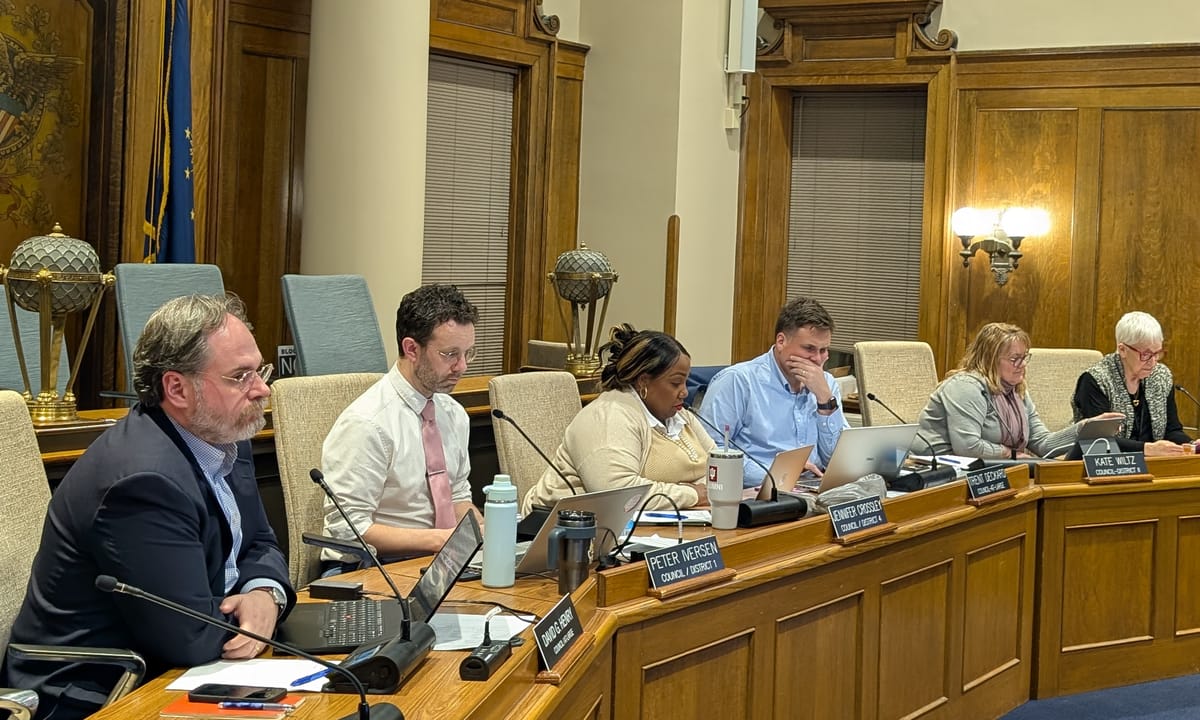
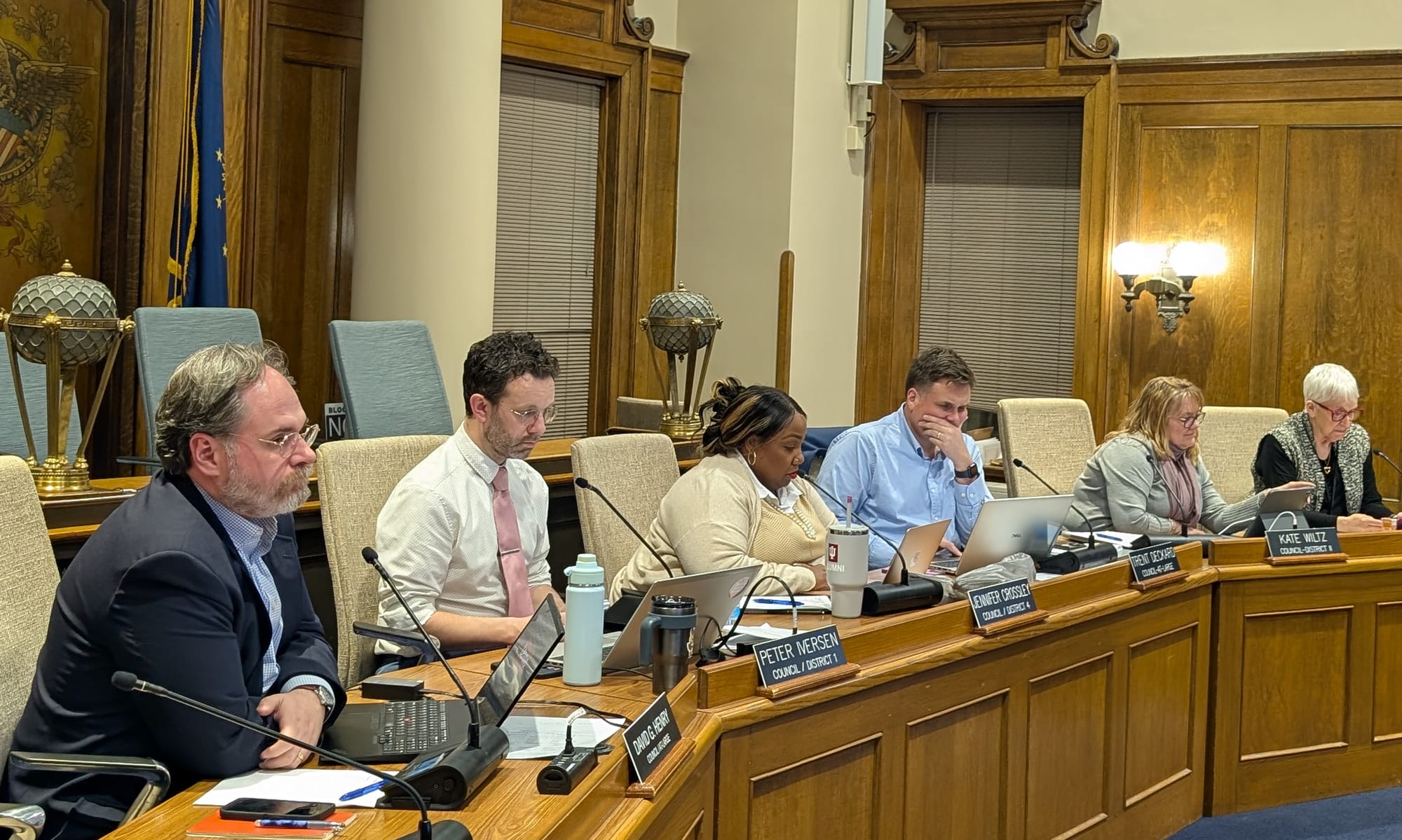
Monroe County councilors spent more than 90 minutes at the end of their Tuesday (Feb. 24) meeting on a line-by-line review of a resolution that restates their commitment to building a new jail, while acknowledging financial constraints, and reaffirming their opposition to the North Park site.
The resolution, adopted on a 6–0 vote, will be sent to ACLU of Indiana attorney Ken Falk, who represents plaintiffs in the long‑running Richardson v. Monroe County jail case. It’s also supposed to be forwarded to the three county commissioners.
The roll call vote totalled just six, because councilor Marty Hawk had left the meeting by the time the council took up consideration of the resolution, which had been added to the agenda the previous day.
A backdrop to the consideration of the resolution was the settlement agreement in the Richardson v. Monroe County lawsuit, filed in 2008, about overcrowding conditions. The ACLU is an audience for the resolution, because Falk this year has agreed to an extension of the settlement agreement only through April 15, which could open the door to fresh litigation, after a decade and a half of annaul extensions.
Jail financing
Another key backdrop to the resolution was a same‑night report from Financial Solutions Group (FSG), which councilors cited as validation for their concerns about the county’s financial capacity for a new jail. The presentation from FSG’s Greg Guerrettaz put the bonding capacity for a new jail at $135 million. But after applying a standard 1.25 debt-service coverage requirement to the available local income tax revenue, the amount that could actually be supported dropped to about $118 million.
That’s a much lower figure than the number presented recently by county attorney Jeff Cockerill, who based calculations for the county’s financial capacity for a $225-million facility on an increase to the local income tax of about 0.40 points, which is possible under the scheme enacted through SEA 1 last year.
Key to Guerrettaz’s lower figure is the 25% limit of LIT funds that can be pledged to a bond, but that limit expires in a few years. County attorney Molly Turner-King pointed out that the 25% cap is not permanent, and based on the most current legislative changes it will disappear in 2029.
But with the looming expiration of the lawsuit’s settlement agreement, councilors stressed the urgency of the current situation. Councilor Kate Wiltz responded to Turner-King: “We have to figure out stuff now is our problem.” She added, “ And I mean, now as in, like, this coming month would be ideal.”
She likened the situation to being “house poor”—where someone buys a house they can afford, but cannot afford to put curtains on the windows.
Councilor David Henry extended the “house poor” analogy to operating costs and non‑jail justice spending: “We could buy the ‘house,’ but in terms of prevention and restorative justice programs and diversion programs and things that keep it empty—we will not have the resources to do that.” About the idea of being able to afford the bigger facility, Henry said, “So we will build it and have a very ‘not justice center’ the way that we think about it.”
Councilor Trent Deckard added that operational costs across the entire justice system will compound the issue, especially if the jail is separated from courts and services. The county has, since about 1986, used a building at the corner of 7th Street and College Avenue that co-locates the jail, courts, clerk’s office, prosecutor and public defender. About any solution that does not co-locate those functions, Deckard said, “It’s going to have a cost.” He added that there needs to be some “wiggle room” in the budget to account for the additional costs that come from facilities that aren’t located in the same spot.
Councilors decided to incorporate FSG’s numbers into the resolution as Exhibit A rather than spelling out specific dollar figures in the text.
Sequence of resolved clauses: North Park
The first big decision of the night was to keep the content of what had been the first resolved clause, which read: “The Monroe County Council no longer wishes to consider the ‘North Park’ property for the location of the new facility.”
The significance of the council’s vote in late October 2025, to reject the appropriation needed to close the real estate deal on North Park, has been subsequently questioned—even though councilors themselves have indicated that their vote was meant to close the door on North Park as a possible site.
Still, on Tuesday night, councilor Peter Iversen proposed striking the clause. Iversen gave two reasons for striking it. He felt like the second resolved clause, which talks about the council’s consideration of possible sites for the new jail, contradicted it. The second reason Iversen gave was a concern that North Park might wind up being a last resort. He put it like this: “I’m also worried that we might need it, and if this [resolved clause] is in there, that might stymie efforts.”
There was a general consensus that the North Park issue should not be the first resolved clause, but councilors were a little bit split on whether to keep it.
Council president Jennifer Crossley argued for keeping the clause, framing it as a clear response to repeated signals from some county commissioners that North Park might still be viable: “I would like to express that I think we can look at other places, and our ‘no’ to North Park should be abundantly clear.”
Henry said ruling out North Park was already obvious, but he did not want to leave any ambiguity for the county commissioners: “One of the consumers of this resolution is the board of commissioners, who still, or at least some, have an impression or keep floating an idea that there’s viability in this location.” Henry added: “I don’t want to leave a door open on that space.”
When it came to a vote, Iversen’s motion to strike the North Park clause failed on a 2–4 roll call, with Iversen and Wiltz the only supporters. But the clause did wind up getting moved to the bottom and appended to the clause about the search for a site, instead of standing separately on the enumerated list.
Sequence of resolved clauses: Constitutional care
Instead of North Park, the topic of the first resolved clause in the resolution adopted by the county council leads with a statement about constitutional care within the jail facility—wording that councilors identified as the central message to Falk, the court, and the public.
1. The Monroe County Council recognizes that providing constitutional care within the jail facility is an utmost priority that must be met and that Monroe County is in need of a new jail facility to provide adequate medical care, mental health treatment, classification opportunities, humane living conditions and to ensure the safety of inmates and staff within the facility. The Monroe County Council commits to funding the construction of a new jail facility and funding the staffing thereof to ensure that inmates housed within the Monroe County Jail will receive said constitutional care.
Iversen was not just in favor of making it the first resolved clause—he said that by itself, it was the only one that was needed, because it captured what truly mattered: “This clause talks about needing the funding to build that new facility … I think this is the only clause we need in this section.”
Other resolved clauses
The resolution also incorporates benchmarks from two other federal cases that Falk provided as models. The council replaced a generic reference to those cases with an explicit list of milestones drawn from them.
The resolution also commits the council to working with the city of Bloomington, particularly on zoning and site‑selection issues, while stopping short of giving the city a role in helping to design the facility.
Crossley framed the collaboration clause as a test of whether city and county can actually live up to their frequent rhetoric about partnership: “We always talk in both city and county about how great we are at collaboration, and I, as the kids say, call cap on that.” She continued, “This is the moment right now that we can do this together.”
From the public mic: “Please build a constitutional jail.”
The only public comment on the resolution came from April Wilson, who spoke in her personal capacity, although she works in the prosecutor’s office. She underscored the urgency that remains even after the edits to the council’s resolution.
Wilson told councilors that the problem isn’t North Park, the problem is not funding, and the problem is not the pending lawsuit. She called the lawsuit a symptom of the problem, which she described as: “... about 230 souls in a building [the county jail] down the street from us, and they will continue to be in that building when all of us go home tonight.” The building, Wilson said, is not providing constitutional standards of care.
Wilson told councilors: “Respectfully, this problem is not going to be solved with resolutions at the end of the day. It’s going to be solved by county council and commissioners that are going to sit down and jointly work together to start making tough decisions”
She continued, “It’s not just identifying benchmarks. It’s about meeting them.” Wilson added, “I remain hopeful that the council will take concrete and meaningful steps to start addressing these dangerous and unacceptable conditions that are affecting members of our community.” She concluded her remarks by saying, “I respectfully request that you please move forward and please build a constitutional jail.”
Comments ()