
Monroe County council sticks with proposed 2027 salaries, keeps commissioners at 85%
The Monroe County Council adopted a $147 million budget for 2027, but rejected an appeal from county commissioner Julie Thomas to bring commissioner salaries in line with other elected officials. Councilor David Henry called for a broader review of county administration in January.
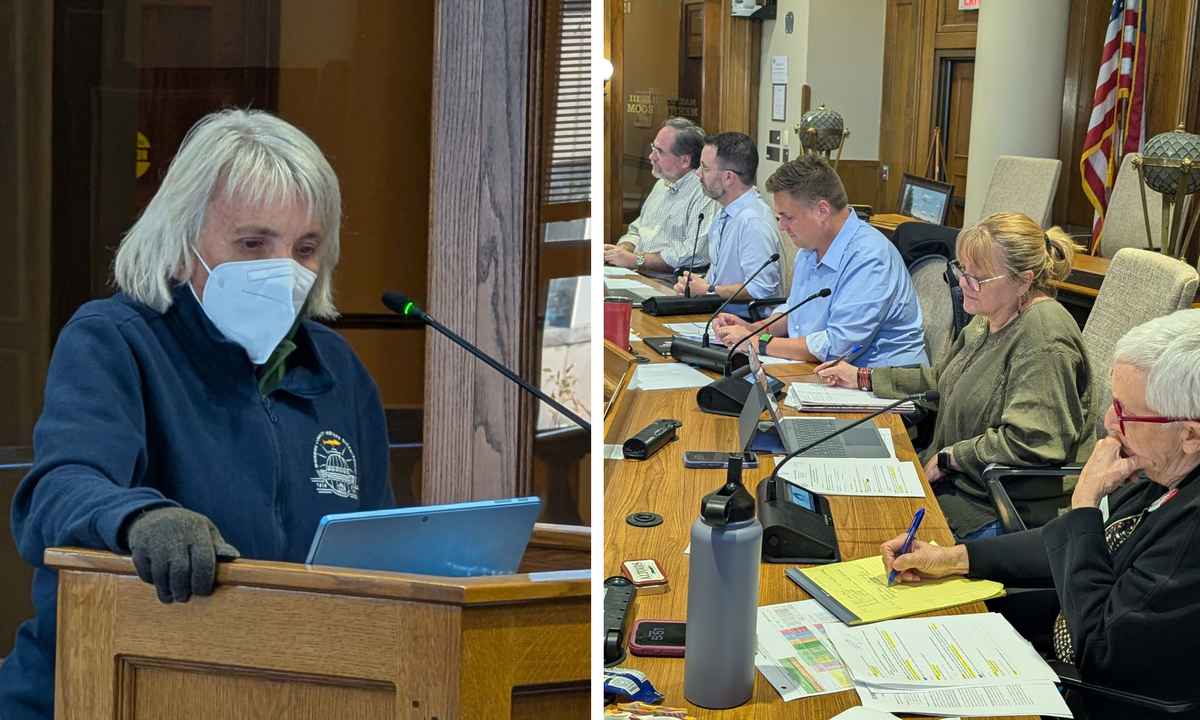
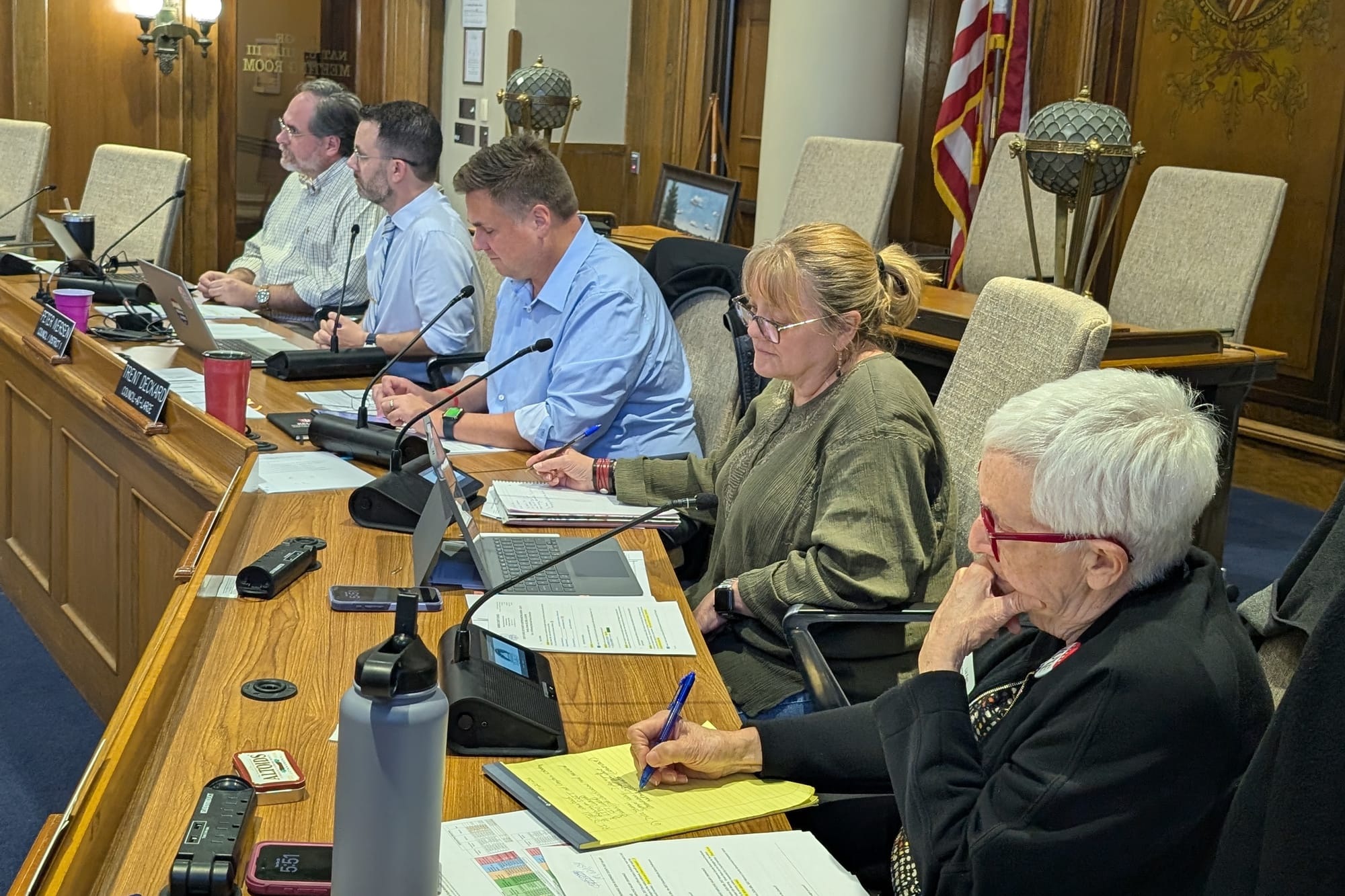
Left: County commissioner Julie Thomas. Right: County councilors from left to right are David Henry, Peter Iversen, Trent Deckard, Kate Wiltz, and Liz Feitl. (Dave Askins, Oct. 20, 2026)
The president of the board of Monroe County commissioners made another attempt Tuesday evening (Oct. 20) to convince county councilors to bring salaries for commissioners salaries into line with other full-time elected county officials.
But the county council adopted its proposed 2027 salary ordinance, as well as the whole 2027 budget, without making the requested change.
Without much fanfare, the Monroe County Council voted 5–0 on Tuesday to adopt a $147,020,534 budget for county government in 2027, an increase of 12.3% over the adopted 2026 budget. Councilors Marty Hawk and Jennifer Crossley were not able to attend Tuesday’s meeting.
This year’s total comes from $126,881,726 in funds listed on the state’s budget forms, including the $49,085,325 general fund, plus another $20,138,808 in home-rule funds that are not reviewed by the state Department of Local Government Finance. The council also unanimously adopted separate budgets for the Monroe County Public Library, Monroe Fire Protection District and Waste Reduction District.
Under the salary ordinance for elected officials, each of the three commissioners will receive $70,512 next year, or 85% of the $82,955 base salary paid to other elected officials, including the auditor, clerk, recorder and treasurer.
Monroe County board of commissioners president Julie Thomas urged the council to raise salaries of the three commissioners to the full base amount, citing both the demands of the job and the council’s recent decision to increase compensation for the elected county surveyor.
“Simply put, we are seeking pay equity,” Thomas said.
Thomas proposed using an additional $45,485.39 from the county’s stormwater fund to cover the difference for all three commissioners, which would include the cost of benefits. She said the money was available and the change could be made at the next meeting of the stormwater board, without affecting the county general fund.
The county council made no change to the proposed compensation and approved the elected-official salary ordinance on a unanimous 5–0 vote.
Councilor David Henry said the question of commissioners’ compensation should be considered as part of a broader examination of county government administration, including the full-time position of county administrator. That scrutiny, he said, would take more than a brief exchange during the final adoption of the budget.
“That’s a January conversation and not an October one,” Henry said.
A January discussion would take place with a board of commissioners that has a different composition. County councilor Trent Deckard is a Democrat who is unopposed on the Nov. 3 ballot for the District 1 commissioner seat currently held by Lee Jones. So Deckard is expected to join the three-member board in January. Thomas and commissioner Jody Madeira will continue in office.
Surveyor’s salary provides opening for argument
The immediate backdrop for Thomas’s renewed appeal is the county council’s treatment of the elected surveyor’s salary.
For several years, the county’s compensation formula assigned the surveyor 90% of the base salary paid to most other full-time elected department heads. County commissioners received 85%, and the coroner received 70%. County councilors were, and still are, slotted in at 30%.
But the salary ordinance adopted Tuesday for 2027 assigns an unregistered surveyor the full $82,955 base amount. It also establishes a $124,433 salary for a registered surveyor, or 150% of the base amount.
The difference between a registered and an unregistered surveyor is required by state law which says county councils have to set different salaries for registered and unregistered surveyors. State law specifically requires a registered surveyor to get one and a half times the salary of a surveyor who is not registered under state law.
The surveyor’s former 90% salary factor had a different rationale from the 85% factor for commissioners. The lower amount for the surveyor was not meant to represent a determination that the surveyor worked only 90% of a full-time job. It was meant to limit the county’s potential obligation, if the incumbent surveyor became professionally registered.
During deliberations in October 2023, then-county councilor Geoff McKim said the reduced percentage represented a compromise between fairly compensating the surveyor and limiting the county’s financial exposure to a substantially higher mandatory salary.
In her comments on Tuesday, Thomas grouped the surveyor and commissioners together under the principle that full-time elected officials should receive the same base compensation. Thomas also included the coroner in her characterization of the salary grid, calling the compensation for commissioners and the coroner unusual outliers. The 2027 salary grid, as in past years, puts the coroner at 70% of the base salary, which is $58,069 this year.
For the commissioners, Thomas’s justification rests on the duties of the office. “We are both the legislative and executive branch of county government,” she told councilors. The legislative work requires research and preparation, while the executive responsibilities make the position a “24/7 on-call position,” she said.
Thomas added that the commissioners operate with a small staff, which has been one position short for several years. The commissioners have left that vacancy unfilled and handle numerous administrative tasks themselves, she said.
Henry raises question of administrator’s role
Henry’s response focused less on whether commissioners work full time than on how their responsibilities fit with the county government’s existing administrative structure. He said the county should examine its overall executive compensation system before committing to paying all three commissioners at the full-time elected-official rate.
“I think we can count on one hand how many counties in the state of Indiana have a full-time county administrator position and a full-time executive-legislative county commission,” Henry said. He questioned the idea of paying all three commissioners as full-time executives and maintaining a fourth full-time administrative position with a salary, benefits and pension.
Monroe County’s staff directory lists the current position for Angie Purdie as the “commissioners’ administrator,” which is not the same position that is specified in state law.
State law authorizes a county executive to appoint a “county administrator” to serve as the county’s administrative head under the executive’s supervision. Under Indiana law, the board of commissioners itself is the county executive. The statute lists possible responsibilities for the county administrator as including supervising government operations, preparing reports, keeping the executive informed about county finances and preparing a budget.
Henry’s point was that compensation should be considered alongside the distribution of administrative responsibilities between the commissioners and the staff. He said that would require a more sustained discussion than could be accomplished at the end of the annual budget process.
There was no motion to amend the salaries for commissioners during Tuesday’s consideration of the elected-official salary ordinance.
A point of friction going back years
The limited airing of the topic on Tuesday evening came against a longer historical backdrop.
In September 2020, the commissioners requested an increase from $36,000 to approximately $60,000. The county council agreed instead to raise the amount to $46,000 for 2021.
At the time, councilor Geoff McKim described the $10,000 increase as a “downpayment” on a potentially larger future increase. He agreed that commissioners were underpaid, but the council was awaiting the findings of a comprehensive county salary study.
In November 2021, the council adopted a new job classification and compensation grid, increasing commissioner salaries to $48,886 for 2022.
Thomas objected at the time to treating commissioners like employees in the professional, administrative and technological classification, rather than in the executive classification. She said commissioners were doing full-time executive work and should be compensated accordingly.
In December 2021, the commissioners sought an increase, this time to $67,158, matching the salaries of other elected county officials. That effort failed. The county council voted 0–5–1 on the request, and a compromise amendment from McKim that would have set compensation at $58,000 failed for lack of a second.
At that meeting, councilor Peter Iversen said that concentrating resources on increasing the compensation of elected officials would divert attention from other public needs. McKim, meanwhile, said that comparisons with other Indiana counties continued to show that Monroe County commissioners were undercompensated.
In October 2023, the council again considered its elected-official salary grid. Councilors approved an 8.5% increase for elected officials, which was the same cost-of-living adjustment for other county employees. But they decided against changing the underlying percentage of a base salary for individual offices. At that time, councilors said the purpose of such a percentage was to avoid having to reconsider the relative compensation of individual elected officials every year.
The subsequent salary ordinances continued to reflect the same percentage structure. For 2025, the county’s published salary grid set the base for most elected department heads at $78,959, with commissioners receiving $67,116, surveyors $71,064 and the coroner $55,272.
The council kept a 3% cost-of-living increase for 2026, then approved a 2% adjustment for 2027.
For 2027, the compensation for commissioners increases to $70,512, but that remains at 85% of the base elected-official rate. The surveyor’s unregistered rate, by contrast, is now set at 100%. That difference is the basis for Thomas’s latest appeal.
Whether the compensation for Monroe County commissioners is reconsidered in January will depend in part on the willingness of the new configuration of commissioners to pursue the question, and the county council’s interest in having the conversation.
2027 budget reflections
Although the budget passed without controversy Tuesday evening, councilors offered some reflections on the spending plan and the work ahead.
For Trent Deckard, it’s his last budget. He is leaving the council at the end of the year, as he is unopposed in the Nov. 3 election for county commissioner. So the occasion prompted a look back to 2019, when he first joined the council. He recalled more predictable state funding and lower inflation, but said the fundamental challenges of providing public services had not changed. He also warned that no adopted budget remains accurate for long. “The minute it is passed, it will be wrong in some way,” he said, noting that revisions are inevitable as circumstances change.
David Henry compared the budget to a meal that was satisfying without being particularly exciting. “It would be a ham sandwich,” he said. He credited the budget with getting the job done, but urged councilors to start earlier next year in identifying resources for emerging community needs, including homelessness, substance abuse and assistance for refugees and asylum seekers.
Peter Iversen, who presided over Tuesday’s meeting in Crossley’s absence, highlighted the 2% cost-of-living adjustment for employees, the county’s financial reserves and $1,162,000 appropriated for direct relief of residents experiencing homelessness. But he also pointed to challenges ahead, including the jail, employee compensation and changes in state tax law. He cautioned that continued reliance on economic development income tax revenue was not a viable long-term fiscal strategy.
Council president Jennifer Crossley, who offered comment remotely from the public mic, but could not vote, thanked department heads for holding their budget requests largely flat. She also urged an early start on discussions of employee pay, longevity and benefits for 2028. Referring to the uncertainty surrounding state legislation and property taxes, Crossley observed that the county was entering “spooky season.” She urged her colleagues to approve the budget, saying the work on the next one would begin almost immediately.
Monroe County elected official salaries: 2027
Assessor, Level 3
$81,328
$82,955
+2.0%
Auditor
$81,328
$82,955
+2.0%
Clerk
$81,328
$82,955
+2.0%
Commissioner
$69,129
$70,512
+2.0%
Coroner
$56,930
$58,069
+2.0%
County council
$24,399
$24,887
+2.0%
Recorder
$81,328
$82,955
+2.0%
Surveyor, not registered
$73,196
$82,955
+13.3%
Treasurer
$81,328
$82,955
+2.0%

Comments ()