
Monroe County eyes Thomson encampment closure; resident describes barriers to housing
Monroe County has authorized a step toward closing the Thomson encampment, though no date is set and a new state law could shorten the planned 30-day notice. Stephanie, a resident there, describes how rental history, lack of credit, and a criminal record have kept housing out of reach.

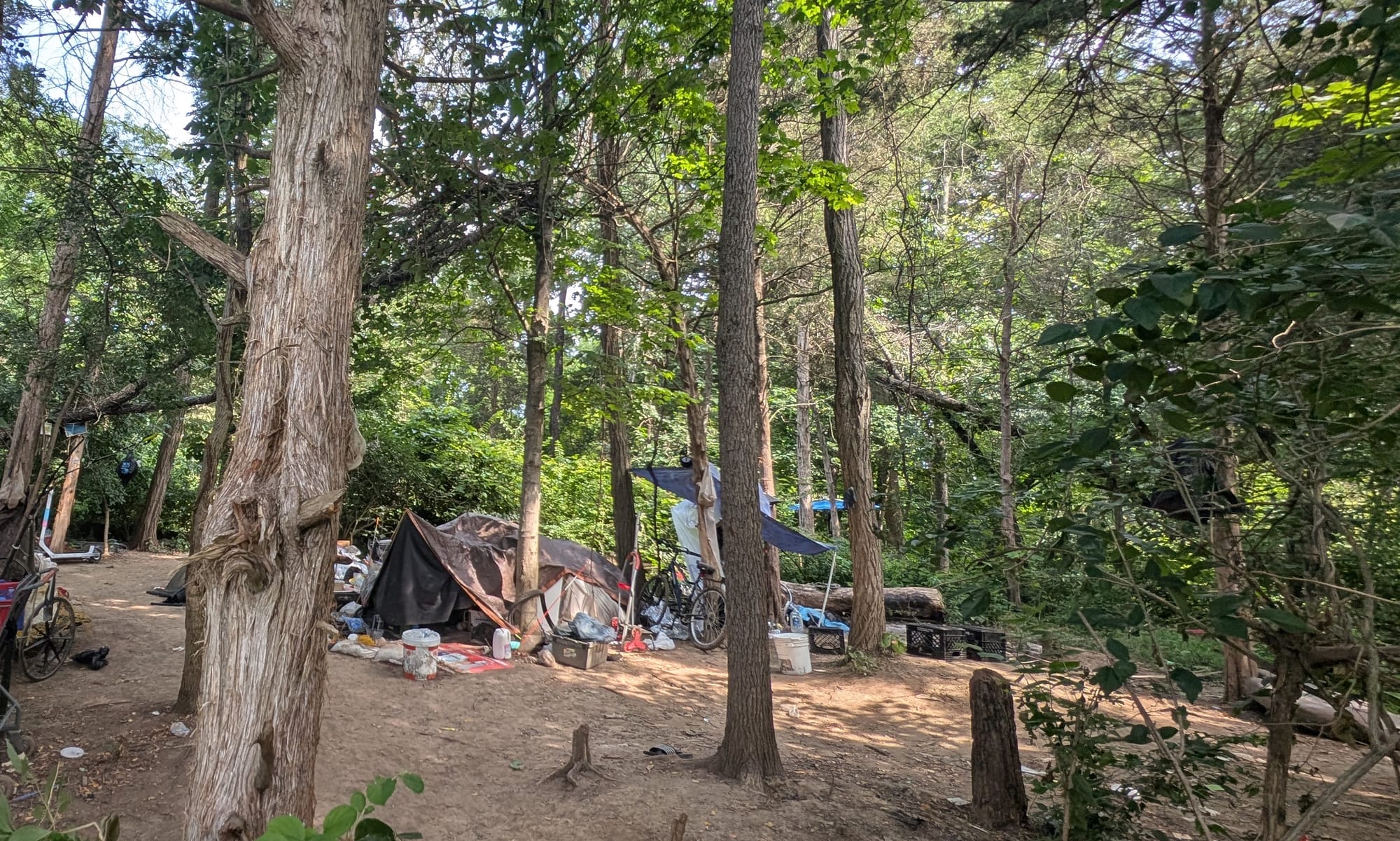
Last Thursday (July 23), Monroe County commissioners authorized their attorney to begin formal steps toward closing the encampment on the county-owned Thomson “power line” property off Rogers Street, after reports of a sharp increase in calls about the site.
No closure date has been set, and the interaction between the county’s planned 30-day notice and a new state law leaves it unclear how much time they would actually have to clear out.
For Stephanie, who is a Bloomington native living at the encampment with her adult son and two dogs, the prospect of closure means preparing to move. From her perspective, she is stalled in a housing system that has placed one barrier after another in her path.
County commissioners: Authorization for notice
County attorney Jeff Cockerill told commissioners Julie Thomas and Jody Madeira at their regular meeting Thursday morning (July 23) that the sheriff’s office now believes the encampment at the Thomson site is “becoming more dangerous and more of a cause of a public safety concern.”
As the commissioners were looking at an upcoming two-week stretch without another full regular meeting, Cockerill asked for permission to act before their next meeting, if the situation requires it.
“We don’t have a plan yet,” Cockerill said. “But I think, given the fact that you’re not having a meeting the next two weeks, we may need to act and begin the process formally prior to your next meeting.”
Madeira and Thomas agreed. Madeira said commissioners had been kept informed about the increased calls and noted that any response would also have to account for a new state law governing encampments on public property.
The commissioners did not vote to close the site on a specific date. But Cockerill said the authorization could allow the county to post a closure notice before the board meets again.
If the county closes the encampment, Cockerill said, commissioners still intend to give residents a 30-day notice. That timeline, however, is no longer guaranteed by formal county policy.
Earlier this year, commissioners removed a 30-day notice requirement because of concerns that it could conflict with a new state law, which went into effect on July 1.
The new law says a law enforcement officer has to issue a warning to anyone who is camping on, sleeping on, or using land for long-term shelter, if the land is owned by a political subdivision (like the Monroe County government). The law continues by saying the person sleeping on the property is guilty of a Class C misdemeanor, if forty-eight (48) hours go by after the warning was issued and they have not moved.
Cockerill told The B Square after the meeting, said the commissioners, acting as property owners, can choose to provide more time. But they cannot prevent sheriff Ruben Marté from acting sooner, if he determines that the state law applies and that he has to act.
Cockerill drew a distinction between the state law, which governs the activities of law enforcement officers, and the commissioners, who are acting as property owners. Cockerill said that any notice that might be posted at the Thomson property will say that a planned 30-day period does not restrict law enforcement from acting under state law. In practical terms, residents would be told they have 30 days to leave while also being warned that the encampment could be cleared sooner.
The commissioners want to make sure they have current and accurate information about the number of people living in the woods on the Thomson property.
Part of the annual general obligation bond request from commissioners this year is a $150,000 purchase of drones with cameras, which would be used in part to monitor the Thomson property. All of the projects in the draft proposal from commissioners will be presented to the county council at its regular 5 p.m. meeting on Tuesday (July 28).
Interview with Stephanie
At the Thomson property encampment on Friday (July 24), Stephanie told The B Square she’s been living there for around a year. She was born at the old Bloomington hospital, which has now been torn down to make way for the new Hopewell neighborhood to be redeveloped by the city. “I had my kids there. I was born there,” she said.
She grew up in Bloomington, attending North High School school and briefly moved to Aurora.
From Stephanie’s point of view, being “from here” has not translated into the kind of support that local officials often say should be reserved for Bloomington’s, or the region’s own, instead of people who arrive from outside.
“I was born and raised here. ... It’s a lot harder for me to get help, because I’m from here. They look at me like: ‘You’re from here. Why don’t you have anybody?’ I don’t have any family. My family’s gone. I have one living brother, but both of my parents are gone. All my friends are out here with me.”
She didn’t graduate from the high schools she attended in Bloomington and Aurora. “I got my GED in county jail,” she says. Broadview Learning Center instructors came into the jail to run the program. “Chris Harmon. He’s a really good guy,” she adds.
Harmon is director of the Broadview program. The connection to local institutions has given her some tools, but it hasn’t overcome the structural barriers she faces now: credit rating, rental history, and a criminal record that follows her. She describes herself as a “recovering alcoholic.”
Stephanie says she has been at the encampment since last September, “minus a month and a half” when she left to care for a sick friend at “the flats.” That’s short for Kinser Flats, which is a 50-unit permanent supportive housing project for people experiencing homelessness who also have substance-use disorders or co-occurring mental health conditions. Kinser Flats is on Kinser Pike, a block south of SR 45/46.
Stephanie returned to the Thomas encampment in February, when it was still cold, and has been there since. As Monroe County commissioners prepare the legal groundwork to post notices and clear the site, she has already begun to plan for another move.
The next spot won’t be a matter of guesswork about who owns the property. She has an app that allows her to look up the property lines, she says.
One of the county’s stated justifications for empowering its attorney to post eviction notices is an increase in dispatch calls and activity near the camp. Stephanie says what she sees on the ground does not necessarily match that story.
“I mean, there hasn’t been an increase in traffic or anything up here. It’s been a decrease, actually. I believe a very huge decrease,” she says.
If she had to estimate now, she puts the population at around 15, compared to around 30 earlier in the year. She thinks at least some of what the county is calling “increased activity” may trace back to a single neighbor, who calls about everything.
The encampment is next to a Habitat for Humanity subdivision. At least some friction between the new Osage Place neighborhood and the encampment population was evident last Friday. A woman came rushing up to Stephanie’s campsite, yelling that a truck was about to be towed from one of the neighborhood’s streets.
Day-to-day, one of the most visible conflicts at the camp is over trash. County officials and neighbors point to piles of debris as evidence of nuisance conditions. Stephanie says the reality is more complicated.
“The problem we have is getting rid of that stuff that’s been here for years … That pile—that’s been building for a couple years.”
She continues, “I’ve made a lot of these piles—just random trash laying around, [rake it] up in one spot.” Some of what people see as a new mess, she says, is actually an effort to consolidate what has been scattered through the woods “for years of generations gone by.”
For her, trash is a problem that needs a practical solution, like legal, accessible disposal: “That’s been one of the big fights. It’s the trash. If we had a way to get rid of it legally… because it’s really hard to dump it places.” She says she has cleaned up the area near her campsite in part to protect her dogs: “I’ve got dogs and they run around, and I don’t want them to get hurt. So that’s why a lot of it’s been cleaned up.”
Stephanie is officially in “the system” for housing, but the mechanics of that system mean that it’s not a smooth path. “I’m on the list, I guess, for housing,” she says. She scores a 17 on the CHAT housing assessment, which she’s been told is “pretty high.” On Indiana’s Collaborative Housing Assessment Tool (CHAT), a score of 17 is well above the 12-point threshold that generally points to recommendation for permanent supportive housing.
In the meantime, she says, her past counts against her. “My rental history is not the greatest because of my husband, and we’re not together anymore. But they still look at that.” She has evictions on her record, she says. While she was living at Crawford Apartments, Danielle Sorden told her it was “really hard … to find a place to send me outside of Crawford because of my rental history,” according to Stephanie. Sorden is director of supportive housing for Beacon, Inc.
“I don’t have any credit. I’m a ghost. So… that’s worse than having good or bad credit, not having any credit,” Stephanie says.
Her criminal record is also a red flag for landlords. “I have one felony on my record. It was a Level 6 [the lowest level of felony] from a few years ago … Other than that, I had misdemeanors.” It’s still something that counts against her, she says.
Stephanie says one charge grew out of a brief stay in an apartment that had been flagged for drug activity. She says she had only been there once before, but stayed there, because she needed somewhere to go. Police “kicked the door open” at the place, and she ended up charged with “visiting a common nuisance.”
Under Indiana law, a “common nuisance” generally refers to a place associated with repeated illegal activity, including drug use or dealing. Visiting such a place can itself be a charge. For Stephanie, the practical effect is that another line appears on the same background checks that landlords and housing programs use to evaluate a housing application.
Asked what she wants, Stephanie’s answer: “Someplace to live.”



Comments ()