
Monroe County revises 30-day notice policy ahead of July 1 ‘street camping’ law
Monroe County commissioners removed a 30-day notice clause from their encampment removal policy ahead of Indiana’s July 1 “street camping” law. Commissioners criticized SB 285 as criminalizing poverty, while Sheriff Ruben Marté said deputies will continue assessing things case by case.

A new Indiana law (SB 285) that takes effect July 1, will make it illegal to camp, sleep or live for an extended time on land owned by the state or a local government, unless the land has been set aside for that purpose.
With a month to go before the law takes effect, Monroe County commissioners last Thursday (June 4) took formal action to strike a clause from their existing policy on responding to homeless encampments, which says they’ll give 30 days notice to residents before removing them. The resolution enacting the new policy says the 30-day prior notice has been made “irrelevant” by SB 285.
The law does not require police to arrest someone the first time they are found sleeping or camping on public land. First, an officer has to decide whether the person should be taken for emergency mental health care under Indiana law. If that applies, the officer is supposed to use that process instead.
If emergency detention does not apply, the officer is supposed to give the person a warning and information about places where shelter or services are available.
A person can be charged with a crime only after that warning has been given, at least 48 hours have passed, and the person is still camping, sleeping or living on public land within 300 feet of the place where the warning was issued. The offense is called “street camping” and is a Class C misdemeanor.
The law also limits what local governments can do. Cities, towns and counties may not adopt policies that bar or discourage enforcement of laws against public camping, sleeping or blocking sidewalks.
Last Thursday, county attorney Jeff Cockerill told commissioners the new state statute requires local law enforcement to act when people are sleeping on public property without authorization, and bars local policies that could be interpreted as limiting that authority. The 30-day notice had to be eliminated, because of that, according to Cockerill.
Cockerill contended that the county’s policy has not changed: When a camp removal is initiated by county government, commissioners intend to give as much notice as possible and still views 30 days as the goal. But he said they can no longer guarantee that in writing without risking conflict with state law.
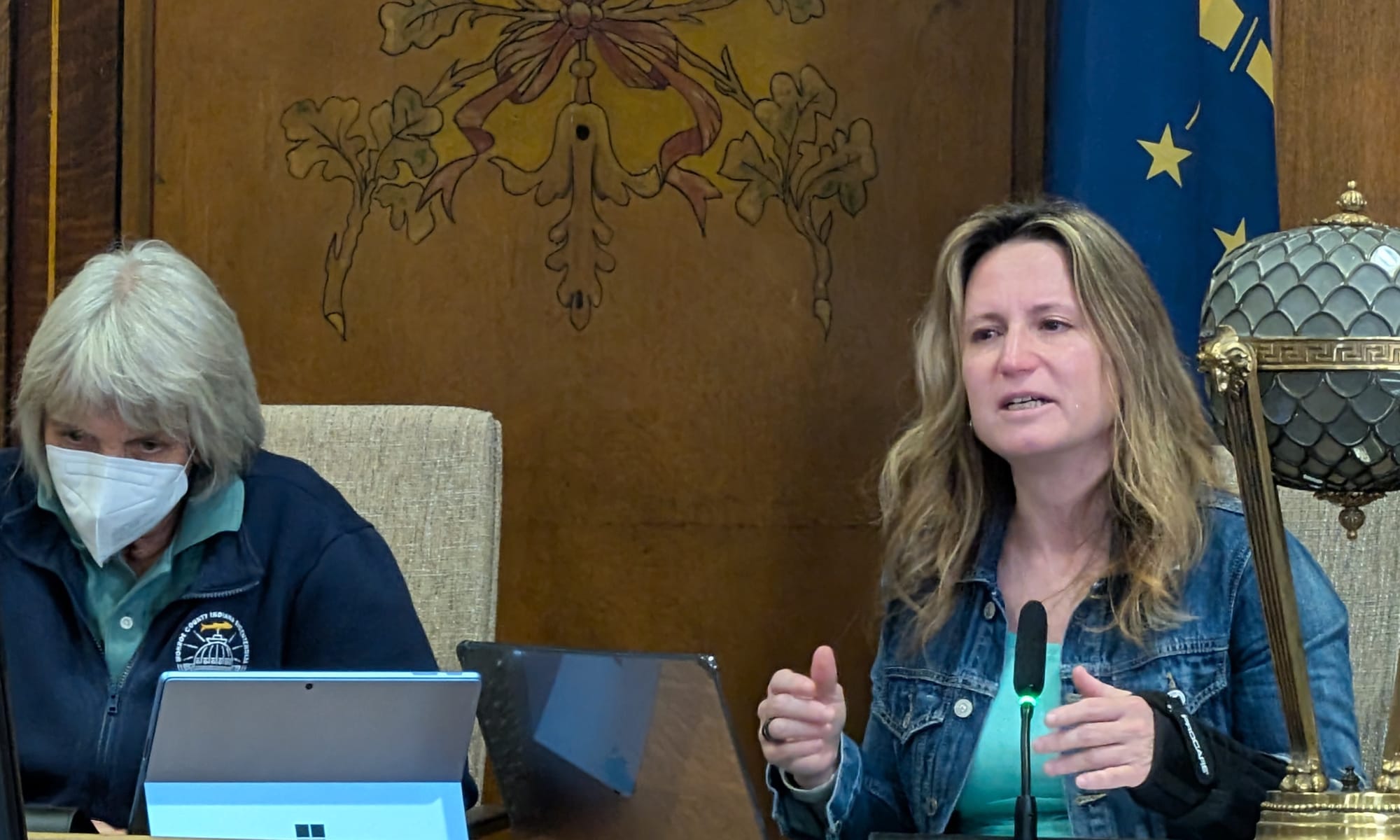
Commissioner Jody Madeira used the vote to deliver a blunt critique of the statute, fighting back tears to frame it as criminalizing poverty and shifting costs onto local governments without new resources for housing or services:
I think we have an obligation to protect public spaces and the quality of life for all residents. We also have an obligation to say really clearly that homelessness isn’t solved by pushing people from one place to another, and poverty shouldn’t become a pathway into the criminal legal system. People don’t have to sleep outside because it’s easy, they sleep outside because they run out of options, because housing is too expensive, shelter is unavailable and unsuitable, and treatment is hard to access, and the safety net has failed them.
Madeira called the state’s approach “horrible” and “a double cruelty,” adding that “criminal penalties are not housing policy.” That was an allusion to the title of SB 285, which was “Housing Matters.”
Commissioner Julie Thomas echoed the criticism, describing the statute as “another unfunded mandate from the state of Indiana” that doesn’t solve anything. Thomas said the county will continue to work with the city of Bloomington, Heading Home of South Central Indiana, and service providers on a coordinated response. She said it remains county policy to seek shelter and services for encampment residents when removals are contemplated.
Responding to an emailed question early last Thursday, Monroe County sheriff Ruben Marté sent The B Square a statement. The statement indicates that the new state law does not mean there will be a significant change to the day-to-day approach taken by sheriff’s deputies: “Operationally, complaints involving individuals sleeping on public property will continue to be assessed on a case-by-case basis.”
Marté’s statement continues, “Deputies will first evaluate the circumstances, ensure public safety, and seek voluntary compliance whenever possible. We will continue working with community partners and service providers when appropriate to connect individuals with available resources and assistance.”
As of midday Monday, city of Bloomington officials had not responded to emailed questions from The B Square sent Thursday morning.
There are a handful of known local encampments to which state officials will likely expect a response, probably the highest profile one being the county-owned Thomson property off South Rogers Street. The site is also considered by some to be a possible site for a new jail.
After Thursday’s meeting, Madeira and Thomas told The B Square that because it’s a county-owned property, situated inside the Bloomington city limits, the city and the county will be taking a joint approach to it.
[Note: The reporter’s wife, Mary Morgan, is executive director of Heading Home of South Central Indiana, the nonprofit mentioned by county commissioner Julie Thomas as involved in the effort to address the Thomson encampment.]


Comments ()