
Monroe County Food and beverage tax panel reviews spending plans
Monroe County’s food and beverage tax advisory panel reviewed 2027 spending plans Friday, including $300K for a convention center hotel and $12.3M for convention center expenses. Some members questioned whether the county was leaving enough cash on hand.

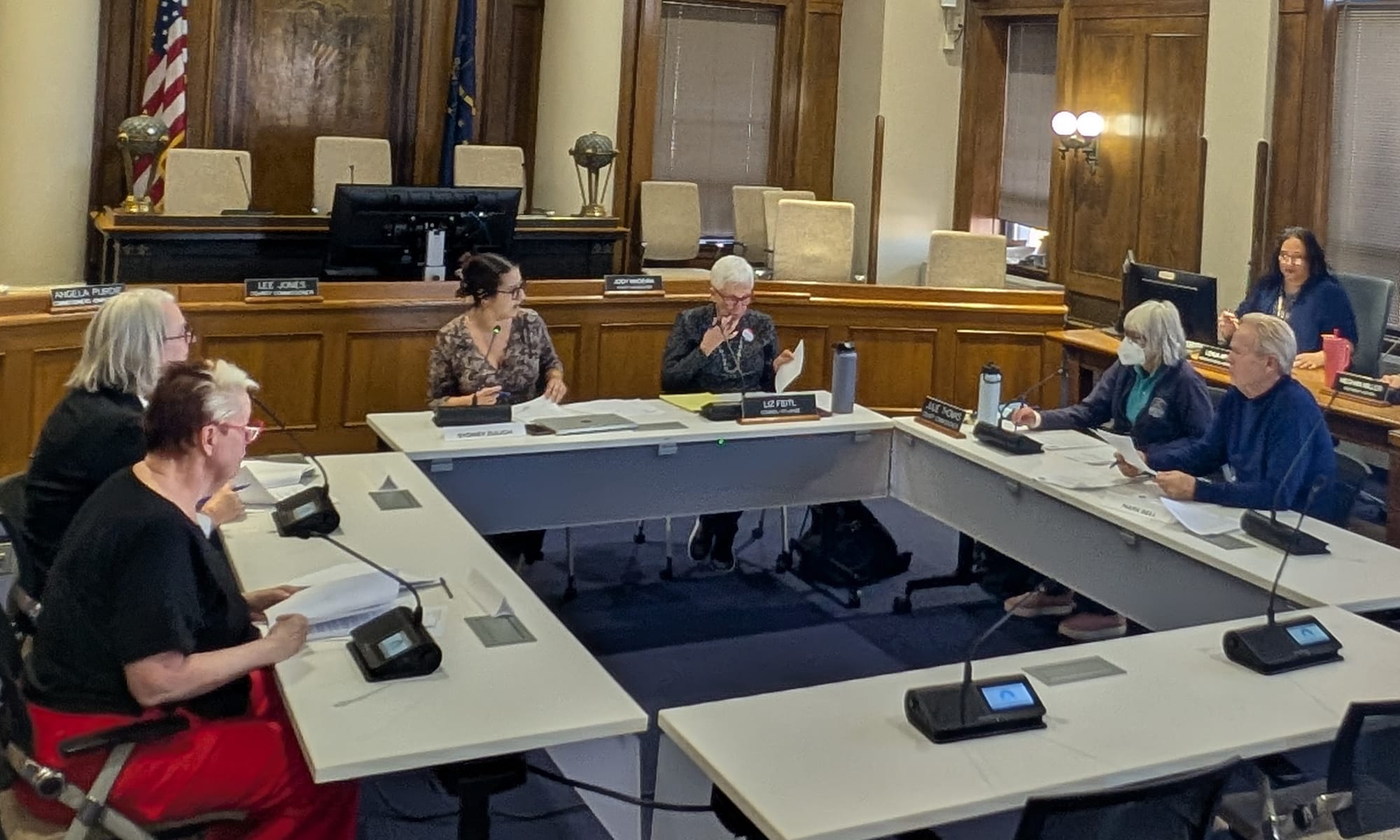
Monroe County’s food and beverage tax advisory commission (FABTAC) met Friday (Oct. 30) for its legally required review of spending plans for a tax that brings in nearly $5 million a year.
The city Bloomington and the county government share the revenue from the tax based on where the taxable sales occur. That works out to a roughly 90-10 split.
The county government’s plan for 2027 includes $300,000 from the county government’s share to help move forward a hotel for the expanded convention center, among other projects.
The city’s plan for 2027 is focused on the convention center expansion project with about $12.3 million in spending, $7.78 of it million going toward convention center bond-related lease payments and a reserve fund to ensure those payments can be made even if tax revenue drops. Another $4.51 million is set aside for the Monroe County capital improvement board (CIB), primarily to cover the final stages of the convention center project.
Friday afternoon’s meeting also surfaced some questions about committing nearly all of the available balance for the county government, instead of allocating some of the revenue instead of helping the restaurants and other businesses that collect the tax.
Monroe County’s spending plan
County commissioner Julie Thomas first revealed the proposed hotel assistance earlier in the week on Tuesday, during a county council discussion of general obligation bonds. “We’d hate to see that project linger unnecessarily for want of $300,000,” she said.
The following day, on Thursday (Oct. 29), county commissioners approved the food and beverage tax plan 3–0, before its presentation to the advisory commission on Friday.
Besides the hotel money, the county’s plan includes $905,000 for development of a 409-acre nature preserve and more than $1.5 million for Quarry in the Uplands, a proposed limestone history and tourism attraction. The county acquired the roughly 99 acres for the quarry project in two transactions, paying $370,000 for about 29 acres in 2021 and $640,000 for another 70 acres in 2022. To purchase the real estate, the county used proceeds from its 2019 general obligation (GO) bonds.
John Whikehart, president of the Monroe County capital improvement board (CIB), said the CIB was concluding productive negotiations with the selected hotel developer, which is Dora Hospitality. The $300,000 could pay for utility relocations or other site work, Whikehart said. A newly identified need is an owner’s representative to monitor hotel design and construction on behalf of the public agencies, he said.
Commission member Lennie Busch said she was uncomfortable with a plan that would commit almost all the county’s available funds, leaving little cushion for unexpected expenses. Busch serves as on of the commission’s community representatives. She is co-owner of One World Enterprises.
Liz Feitl, the county council’s representative, also pressed for an accounting of the balance. County officials reported about $2.7 million in available food and beverage tax revenue. The projects identified in the county's spending plan total about $2.75 million, but that amount includes money already spent on the nature preserve.
Commission members questioned how much would remain available for other projects after accounting for the planned expenditures. Thomas said some figures needed to be reconciled, but stressed that the tax collections will continue to generate revenue.
Revenue stream, restrictions on use
That revenue stream began in February 2018, after the county council voted in December 2017 to impose a 1% tax on qualifying prepared food and drinks.
The tax generated $4.81 million in 2025 and $3.59 million during the first nine months of 2026. Total collections since 2018 have reached about $34.26 million.
Under state law, the tax is scheduled to end after 2044.
At Friday’s meeting FABTAC member Mark Bell suggested another kind of use: small grants to hospitality businesses outside Bloomington for improvements such as lighting that would help customers find them. He said investments of $5,000 to $15,000 could make a difference for establishments away from heavily traveled roads. Bell serves as the commission’s other community representatives. He owns Trailhead Pizzeria on State Road 446 south of Bloomington.
The tension between convention center spending and broader economic development is not new. The wording of the state law governing the city and the county’s use of the food and beverage tax allows the revenue to be used only to “finance, refinance, construct, operate, or maintain a convention center, a conference center, or related tourism or economic development projects.”
Over the years, the question of how broadly to interpret “related tourism or economic development projects” has been part of the local debate of the use of the tax revenue.
In 2024, Bloomington city councilmembers Kate Rosenbarger and Matt Flaherty questioned the commitment of food and beverage tax money to the convention center expansion. Rosenbarger cited an extension of the Monon South Trail as a possible alternative. Flaherty suggested investments in pedestrian infrastructure near the convention center expansion.
Flaherty had also said in March 2024 that he did not support public subsidies for a hotel.
Earlier in the week, on Tuesday, during the county’s general obligation bond discussion, councilor Trent Deckard suggested food and beverage tax revenue could cover some county parks improvements. Councilor David Henry expressed reservations about using the tax for projects unrelated to the convention center, which he regarded as its intended purpose.
The county council nevertheless approved some wording identifying the food and beverage tax revenue as a possible funding source, without appropriating any of it.
Bloomington’s 2027 plan calls for about $12.3 million, including $7.78 million for convention center lease payments and a bond-payment reserve, plus $4.51 million for CIB expenses.
At Friday’s meeting, Whikehart said the convention center expansion will be dedicated Jan. 12 and renovations to the existing building should finish June 16, in time for a booked sporting event with 900 participants and an estimated $500,000 economic impact.
Deputy mayor Gretchen Knapp urged more public discussion of how future tax collections should be spent, whether on major projects or smaller investments benefiting local businesses.
Under state law, Bloomington and Monroe County have to prepare annual spending plans and seek the advisory commission’s recommendations. But the commission does not have veto power over spending decisions, a requirement the state legislature removed in 2023.


Comments ()