
Monroe County halts Thomson encampment eviction, no new date set; 30-day notice mulled
Monroe County commissioners say there is now no specific timeline to clear the homeless encampment on the county-owned Thomson property, indefinitely postponing a previously scheduled Dec. 15 removal. Commissioners signaled support for longer notice periods, potentially 30 days
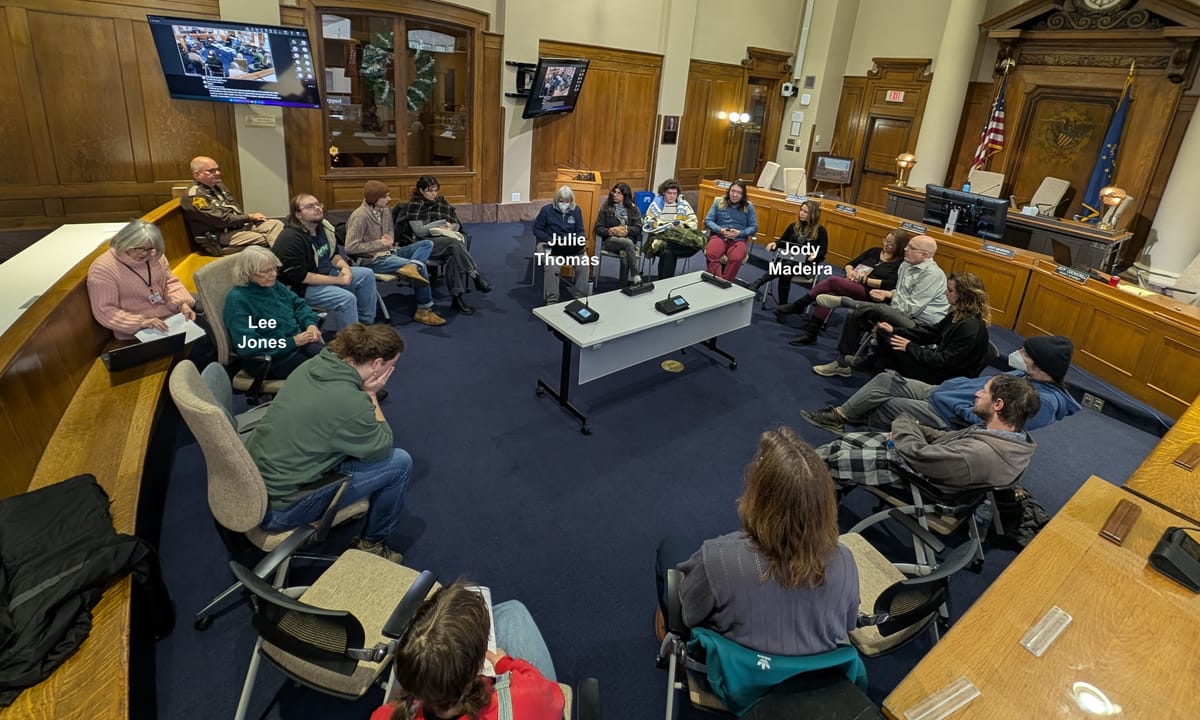
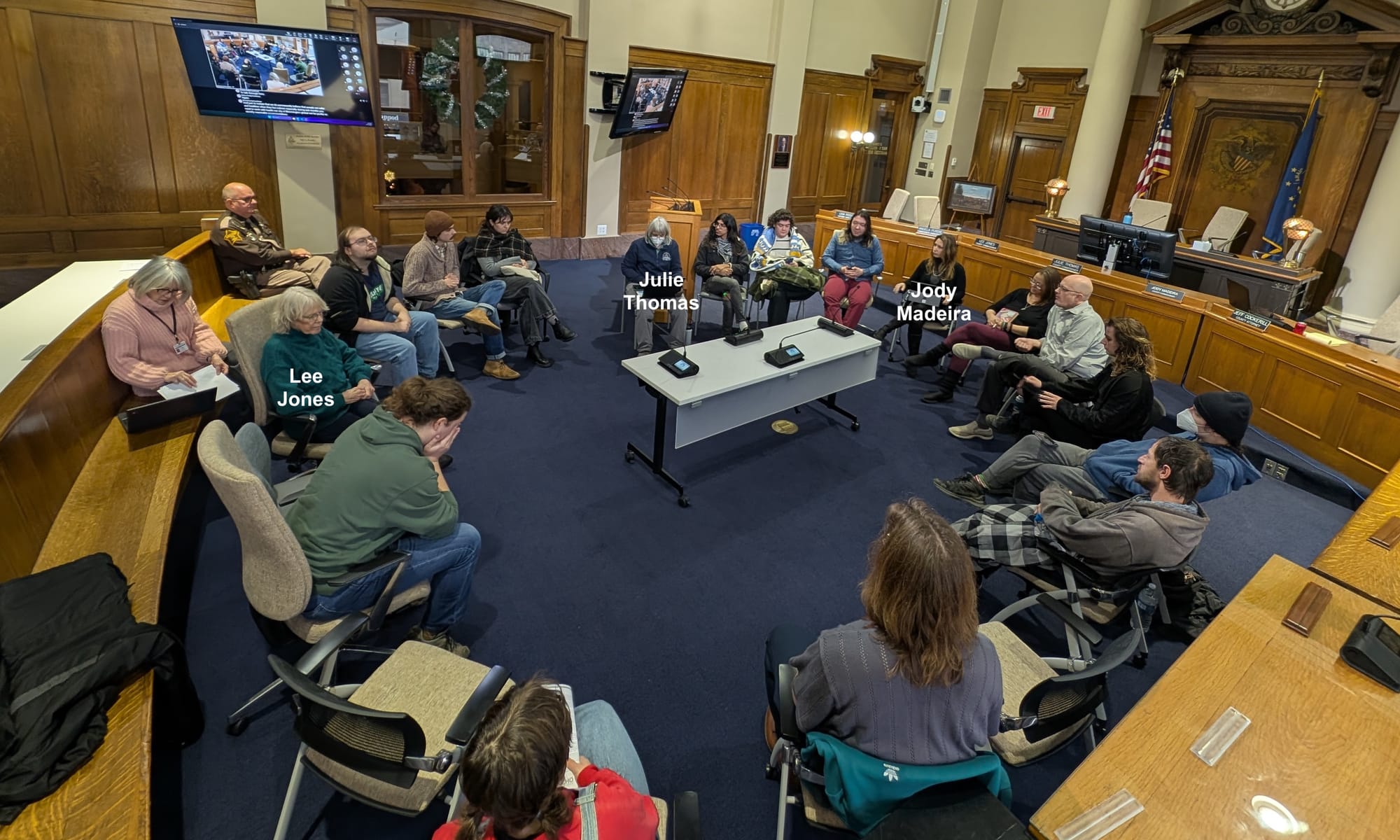
Monroe County commissioners confirmed on Thursday afternoon that a previously noticed removal of the homeless encampment at the county-owned Thomson property is now postponed indefinitely, with no active plan to clear the camp on Dec. 15 or on any specific future date.
The initial posting of the notice came on Dec. 1, with a Dec. 8 deadline to move. After their regular meeting last week was successfully shut down by advocates protesting the planned camp displacement, county commissioners relented and extended that timeframe a week, until Dec. 15.
Now it’s not certain when the commissioners will insist that the 40 to 50 people living at the Thomson encampment have to leave. But it looks certain that eventually the people who have been living there, in some cases three years or more, will have to find a new place to call home.
The difference between this recent, now-abandoned attempt to clear the encampment and future actions by commissioners could be a 30-day timeframe, instead of just a week, for giving notice that residents of a camp have to leave. That was one likely outcome of the “community conversation” that commissioners held on Thursday afternoon, after their regular morning meeting.
Sitting in a circle with protestors in the Nat U. Hill Room, all three commissioners—Julie Thomas, Lee Jones, and Jody Madeira—responded to a request from protestors for at least a 30-day notice by saying they supported that longer timeframe.
But the longer period for notice won’t be official until commissioners take a vote on it at a regular meeting—something that could come as soon as next week, on Dec. 18, which is their last scheduled regular meeting of the year. But based on Thursday’s discussion, it’s possible that commissioners will want to draft a protocol that encampasses more than just the time-frame for a notice.
Indefinite postponement
The news of the indefinite postponement came at the “community conversation” on the topic of homelessness. But it had been foreshadowed at the start of the commissioners regular meeting three hours earlier. President of the board of commissioners, Julie Thomas, led off her remarks on the topic with arguments for removing the camp:
We fervently believe people are safer and healthier when they live indoors, especially during the winter months. We have worked with HealthNet, the city of Bloomington, and local not-for-profits and community groups, to identify reasonable accommodations for people who currently reside on the Thomson property. Let’s be clear, there are people trespassing on county property, and there are no appropriate public health, sanitary facilities present.
But then Thomas gave a key reason why the commissioners initially delayed for one week and why no removal of the camp would be undertaken anytime soon:
The sheriff has indicated that he will not remove people from the Thomson property. At this juncture, our hands are tied. We fear the worst, but we hope for the best.
The bitter cold was a factor cited by Monroe County sheriff Ruben Marté when he said on Tuesday this week that he had not supported enforcement of the county’s no-camping ordinance for the planned Dec. 8 action. The same principle of not putting people in harm’s way applied to the Dec. 15 deadline, he said. During the extreme cold, forcing people to move would put them in harm’s way, he said.
In her remarks at the start of Thursday’s regular meeting, Thomas said the encampment is a symptom of a broader community issue. She said that the county council and the city of Bloomington, the mayor’s office, and the city council all need to work together.
It was during the community conversation in the afternoon that Thomas said any enforcement action would be delayed “indefinitely.”
Timelines, dates, protocols for clearance
At the community conversation, activists pressed for a firm commitment of no eviction until some specific time. But county attorney Jeff Cockerill highlighted what the county government considers to be two main constraints on committing to a firm no‑eviction pledge through a date like April 1.
First, the camp is on county‑owned land inside the city of Bloomington, and is not in compliance with the city’s land use and zoning rules. Cockerill said that if the commissioners pledged in writing to do nothing until a date certain, “and the city says, ‘You’re violating our zoning,’ that’s outside their control.” Second, Cockerill pointed to the possibility of future “instability” at the camp. From his perspective, a written promise to take no action “no matter what” would prevent commissioners from acting if conditions changed and some action was needed.
It does not sound like the city of Bloomington is currently contemplating any enforcement action of its own in connection with the Thomson encampment—given that the mayor’s office says that the city will not have a role in any plans for enforcement at the Thomson site by the county government. Responding to an emailed B Square question, city communications director Desiree DeMolina wrote: “The City will not have any enforcement role in the County’s plans for the Thomson encampment.”
DeMolina’s response continued, “The City of Bloomington follows a defined process for encampment response, which requires longer lead times for notification, collaboration with service providers to assist camp residents, and storage of their belongings.” DeMolina added, “We do not participate in actions that do not follow our agreed-upon protocols and City police will not be deployed to enforce County-initiated timelines or directives at that location.”
At least for the timeframe of posted notice, the city of Bloomington follows something akin to the guidance from South Central Housing Network (SCHN) on the topic, which calls for at least 30-day notice. Also a feature of the SCHN guidance for closures is the idea that encampment residents should be paid to help clean the encampment.
SCHN is the entity that developed the Heading Home plan in 2014, and Heading Home of South Central Indiana is a nonprofit formed more recently, with startup funding from the city of Bloomington and Monroe County governments, and subsequently with support from Lilly Endowment through the Community Foundation of Bloomington and Monroe County.
During Thursday afternoon’s community conversation Erin Reynolds-Nylund, who is Heading Home’s housing solutions director, weighed in through the Teams electronic platform describing the guidance for shutting down an encampment, if that turns out to be the choice that’s made. She described it as not exactly a “protocol” but a guide to doing it in a “dignified and humane way.” If a camp has to be closed, the guide lays out who is mobilized, “if it has to happen at all,” she said. Reynolds-Nylund added, “I totally agree: Evictions, especially in winter, are undignified and put a lot of people … in a bind and risk their safety.”
Heading Home
During the Thursday afternoon community conversation, commissioner Thomas expressed dissatisfaction generally with the outcomes achieved by Heading Home. She said, “We put in millions of dollars to try to address this problem, and I am utterly disappointed at the results we’ve had so far.” Thomas continued, “I’m going to be honest about that, because I don’t think the community has received what it should have received.”
Thomas called for a conversation with members of the county council, the county commissioners, city council, and the mayor. She said, “Let’s start this conversation all over again and tackle this in a way that will actually address it.” Thomas pointed to various service providers like Wheeler Mission and Beacon, Inc., who are all “competing against one another for money, and then they’re less efficient as a result.” Thomas said, “The idea was Heading Home is supposed to overcome those inefficiencies by working together.”
Responding to a question from The B Square, Heading Home executive director Mary Morgan wrote: “It seems the county [government] isn’t aware of all the work we’ve done in the past four years as we’ve tackled system changes to address homelessness. Systems don’t change overnight.” Morgan added, “I’m glad they’re taking a closer look now at the guidance we helped develop in 2023 to create a more coordinated, respectful approach to encampments. We look forward to partnering with the county in any way we can.”
Sale of Thomson property
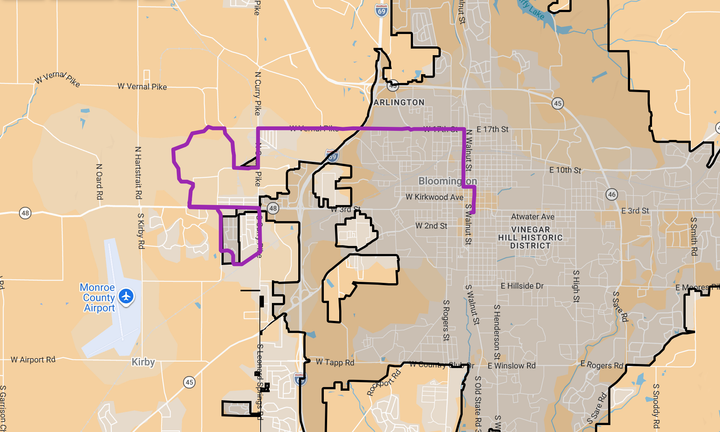
During Thursday’s community conversation, the inevitability of the removal of the encampment got some airtime, when Thomas talked about the idea that the Thomson property is likely to be sold at some point. One reason to sell the land, Thomas said, is that the county government has no purpose for it, and the proceeds could help fund the planned new jail and justice center.
The proposal to make a public offering of the Thomson property was on a late-October county council agenda but was postponed—at the same meeting when the council rejected the appropriation needed to purchase the North Park property for a new jail and justice center. The council has not yet taken up the question of making a public offering of the Thomson land.
Under Indiana state law, one of the key steps in the procedure for a local government to sell a piece of property is to get two appraisals. Last year, Monroe County got an appraisal by First Appraisal ($5.065 million) and this spring from JLL Valuation & Advisory Services, LLC ($4.28 million).
Activists challenged Thomas’s contention that the county government has no useful purpose for the Thomson property, saying that some of their constituents are currently using the property to shelter themselves. County attorney Jeff Cockerill pointed out that a sale could not be accomplished quickly, giving an estimate of at least three months time to get through the mechanics of selling the property.
At the next regular meeting of the county commissioners, on Dec. 18, the topic of a 30-day notice period for any encampment removal is expected to get at least some discussion, if not a formal vote.
[Note: The reporter is the spouse of Mary Morgan, executive director of Heading Home of South Central Indiana.]


Comments ()