
Monroe County income tax panel asks state for flexibility, stops short of suggesting 2029 rates
Monroe County’s local income tax task force unanimously asked state lawmakers for more flexibility in the tax overhaul set for 2029, but recommended no specific rates. Uncertainty over revenue, consolidations and possible legislative changes led the panel to hold off on detailed recommendations.

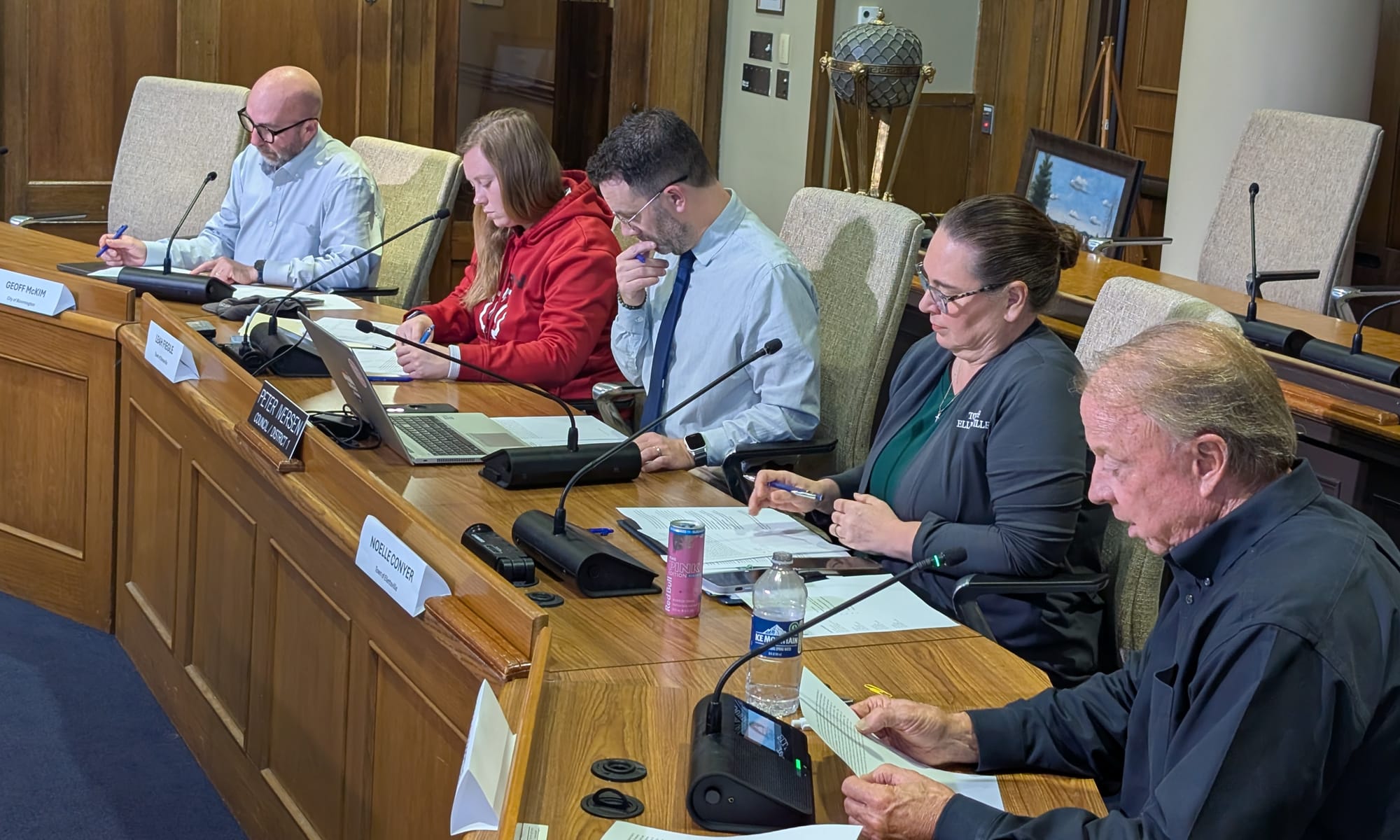
Monroe County’s Municipal Unit Strategic Taskforce (MUST) voted unanimously Friday (Oct. 23) to ask Indiana lawmakers for more flexibility in the state’s overhaul of the local income tax system, without recommending specific tax rates for 2029.
In their adopted statement, the four members of the panel agreed unanimously that too much remains uncertain. The uncertainties include how much taxable income would be available within individual municipalities, how Ellettsville’s future municipal boundaries might change, and what revisions lawmakers might make to the legislation next year.
The statutorily specified members of the MUST for Monroe County are: county councilor Peter Iversen, Bloomington controller Geoff McKim, Ellettsville clerk-treasurer Noelle Conyer and Stinesville clerk-treasurer Leah Fiegle.
The overhaul stems from Senate Enrolled Act 1 (SEA 1), adopted in 2025, which reduced anticipated property tax revenue for local governments and restructured the local income tax (LIT) system. House Enrolled Act 1210, passed this year, postponed implementation of the new income tax framework until 2029 and created the MUST process to gather recommendations from counties.
The result is a shift in the state’s approach to local government financing, with greater emphasis on income taxes as a source of revenue to sustain services traditionally supported partly by property taxes.
That shift could go further. At a September event in Warsaw, Republican legislative leaders floated a plan to eliminate property tax bills on owner-occupied homes by using local income tax revenue to provide a full credit. The proposal would not eliminate the property tax system entirely.
Under the framework that is scheduled for 2029, the general local income tax expenditure rate could reach 2.9%, divided among county services, municipal services, fire and emergency medical services, and other taxing units, including libraries and townships. The county council would control most of those rates, while municipalities would have options for imposing their own rates or participating in a shared countywide municipal rate.
Monroe County’s current LIT rate is 2.14% for 2026. The rate is scheduled to increase to 2.205% on Jan. 1, 2027, following the Monroe County Council’s Sept. 8 vote to increase the special-purpose rate for juvenile services.
At its first meeting last month, the task force had considered financial models showing how a shared municipal rate could help Bloomington preserve existing income tax revenue and offset an estimated $2.43 million loss in property tax revenue.
But Friday’s approved statement stopped short of endorsing that approach. Instead, the panel asked legislators to consider increasing the 0.2% rate cap for non-municipal taxing units, allowing counties more freedom to divide that revenue among eligible units, or both. Non-municipal taxing units include townships, libraries and transit corporations, among other eligible units. Each unit type is capped at 0.05%
The statement adopted on Friday singles out the separate 0.05% limits for townships and libraries as a problem. It says townships would need a rate of 0.31%, distributed based on population, to recover their existing revenue. That exceeds even the overall 0.2% cap for all non-municipal units combined.
The panel also requested continued flexibility in distributing fire and EMS revenue, and authority to include school corporations in future income tax distributions without reducing the overall 2.9% rate ceiling.
The MUST statement asks lawmakers for clearer rules governing annexations and government reorganizations, which could change the population and income base used to calculate distributions. It also calls for adjusted gross income (AGI) data for every taxing unit before decisions are made on rates.
One significant discussion centered on the phrase “made whole,” which appeared twice in the draft statement.
Greg Guerrettaz, with Financial Solutions Group, which is the county government’s financial planning consultant, said that the phrase “made whole” could encompass replacing existing income tax revenue alone, or also making up property tax revenue lost under the state’s reforms. Ellettsville clerk-treasurer Noelle Conyer objected to the expression “made whole,” saying it could mislead the public about the task force’s intent. Conyer emphasized that local income taxes come from working residents.
Conyer’s concern was one that Bloomington controller Geoff McKim echoed in describing the shift in tax burden from property owners to workers. McKim said that the draft’s reference to recovering existing LIT revenue sufficiently clarified what was meant by “made whole.”
The final statement, however, uses broader wording. It asks that future legislation allow local governments to “recover current revenues at the time of imposition.” The wording does not explicitly say whether that means income tax revenue alone or includes lost property tax revenue. The expression “made whole” also remains in the separate calculation of what townships would need, with a parenthetical defining it in terms of revenue at the time of imposition.
The distinction has an impact. In the earlier financial model, Bloomington’s revenue target included both its estimated $41.32 million in existing LIT revenue and $2.43 million in projected property tax losses, for a total of $43.74 million.
The implications of the new distribution system were also illustrated by comments from two Bloomington Transit board members.
Board chair James McLary told the panel that Bloomington Transit has received about $3.8 million annually from the city’s economic development local income tax revenue. The money has helped finance new buses and other capital investments, but the loss of that support could also threaten existing service.
Newly appointed board member Zach Ammerman added that about $1.1 million of that annual city contribution supports operating expenses, with the remainder directed to capital. The operating portion supports Sunday service, microtransit and two staff positions.
What is and isn’t included in the idea of “made whole” matters because Bloomington Transit also receives a separate, much smaller income tax distribution as a direct distribution that does not come through the city of Bloomington. Under the county financial consultant’s earlier model, that direct distribution would increase from about $724,000 to $810,000. But the calculation does not guarantee continuation of the separate $3.8 million annual city contribution, which is provided under an agreement that expires at the end of 2027.
McKim pointed out that the new SEA 1 framework could provide ways to increase transit funding and potentially support broader countywide service. No specific rate for transit or any other unit was recommended on Friday.
Conyer said after the vote that she was disappointed the panel could not provide lawmakers with more specific guidance on rates. She stressed that the county council will ultimately make those decisions under whatever framework the legislature adopts.
The report is due to the state by Nov. 2. The MUST panel could reconvene as Indiana lawmakers revise the income tax legislation during the 2027 session. But there’s no date set for the next meeting.



Comments ()