
Monroe County jail notebook: Population count dips below one functional capacity benchmark
Monroe County’s jail population fell from 247 to 227 over 25 days. But the snapshots mask heavy turnover: 220 people left, with a median stay of 3 days. The Aug. 14 count dipped below the ACLU’s 229-person capacity estimate, but remained 41 above Sheriff Ruben Marté’s 186-person figure.


Monroe County’s jail population was down to 227 on Friday (Aug. 14), which is 20 fewer people from a week earlier. It’s also the lowest daily count in the 25-day period since The B Square started systematically tracking the numbers.
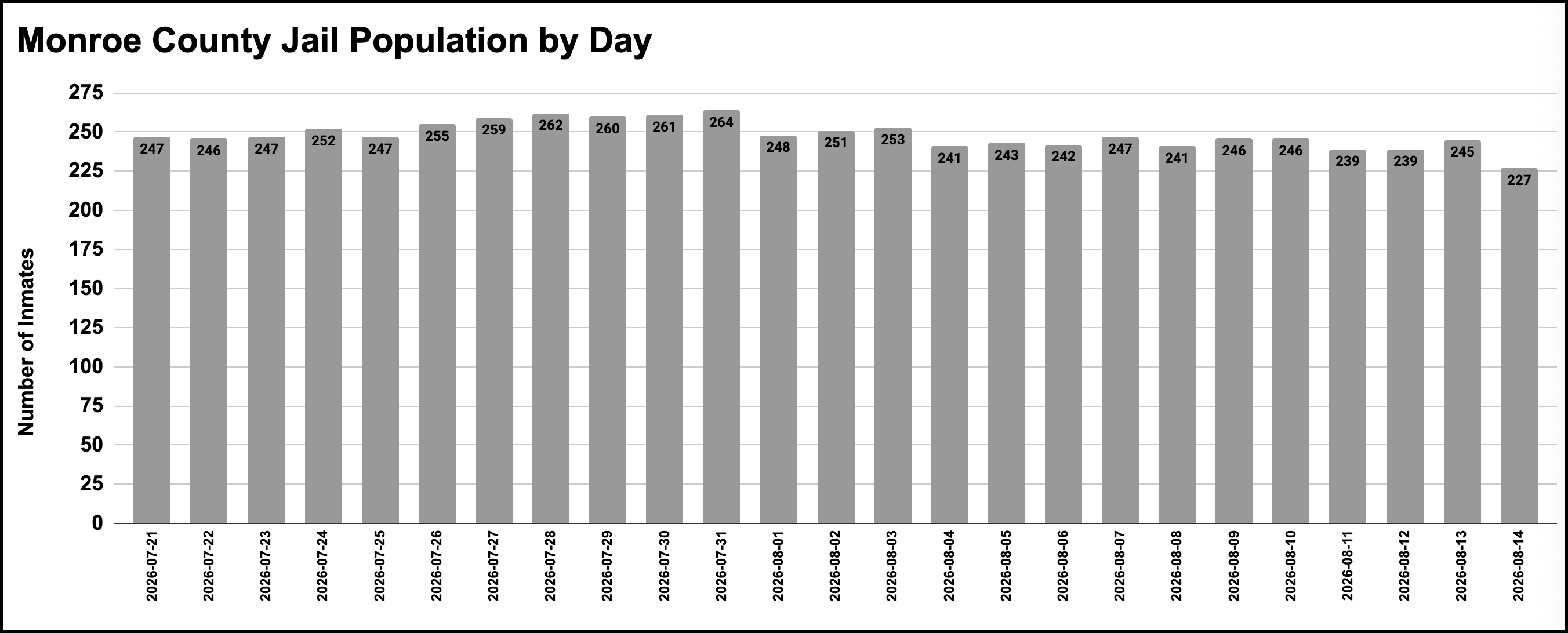
The difference of 20 people does not reflect the total activity at the jail. During the 25 days from July 21 through Aug. 14, 220 people left the jail. Their median length of stay was 3 days.
On July 21, the jail held 247 people. Of those, 175 were still there on Aug. 14. That means 72 of the people who were in jail at the start of the period had left by the end.
At the same time, 52 people who arrived after July 21 were still incarcerated on Aug. 14. The 175 who were there at both endpoints and the 52 who arrived after the start and remained and the end account for the Aug. 14 population of 227.
The 220 departures reflect the amount of turnover that took place between the two snapshots. It includes people who arrived after July 21 and then left again before Aug. 14.
The average population over the 25 days was about 248.
For the first time during the most recent 25-day period, the Aug. 14 count of 227 put the jail below one of the two functional-capacity figures that have been cited in the recent debate over overcrowding.
In the recent federal lawsuit filed on behalf of jail inmates, the ACLU calculated the jail’s functional capacity at slightly more than 229 people, based on 80% of what they describe as its available beds. At 227, Friday’s population was just below that number.
Monroe County sheriff Ruben Marté has given a lower figure for functional capacity. His July overcrowding report started with 294 reported beds, subtracted housing that he said cannot be treated as general-population space, leaving 233 available general-housing beds. To that number, he applied the same 80% principle yielding a functional capacity of 186.
By the sheriff’s measure, the Aug. 14 jail population was still 41 people above functional capacity.



Comments ()