
Monroe County jail project focus shifts to site, amid disagreement on financing outlook
Monroe County commissioners say the maximum budget for a new jail in the short term is $171 million, while councilors see $118 million as more realistic. Using the same financial analysis, officials diverge over funding limits—even as both sides agree the next key decision is where to build.
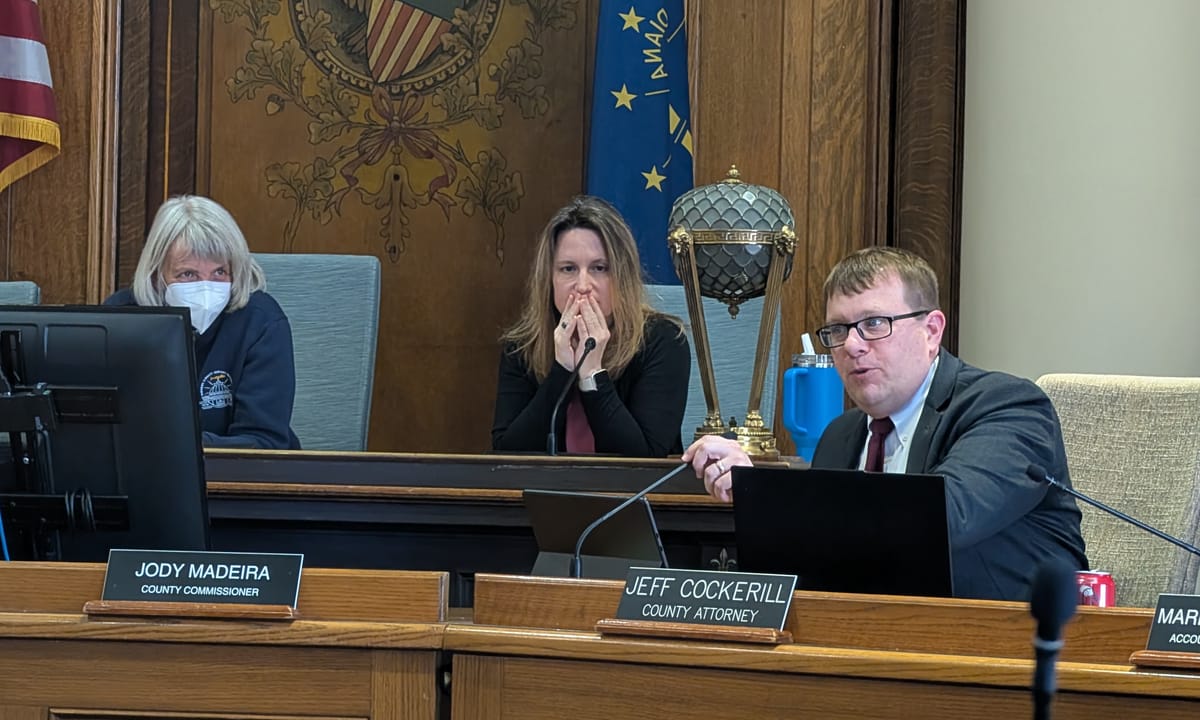
Two days after the Monroe County council adopted a resolution highlighting tighter financing constraints for a new jail and justice complex, county commissioners say that the jail portion of the project still appears financially achievable under current limits.
But looking at the same financial analysis from Financial Services Group (FSG), commissioners and councilors are about $50 million apart in their thinking about the budget for a new jail.
At their Thursday work session, commissioners focused on a maximum budget of $171 million. That’s even while councilors seem to have targeted $118 million as the practical budget for a new facility.
Still, the councilors and commissioners seem to be in agreement on at least one thing—that the focus of the next conversation should be: Where should the new facility be built?
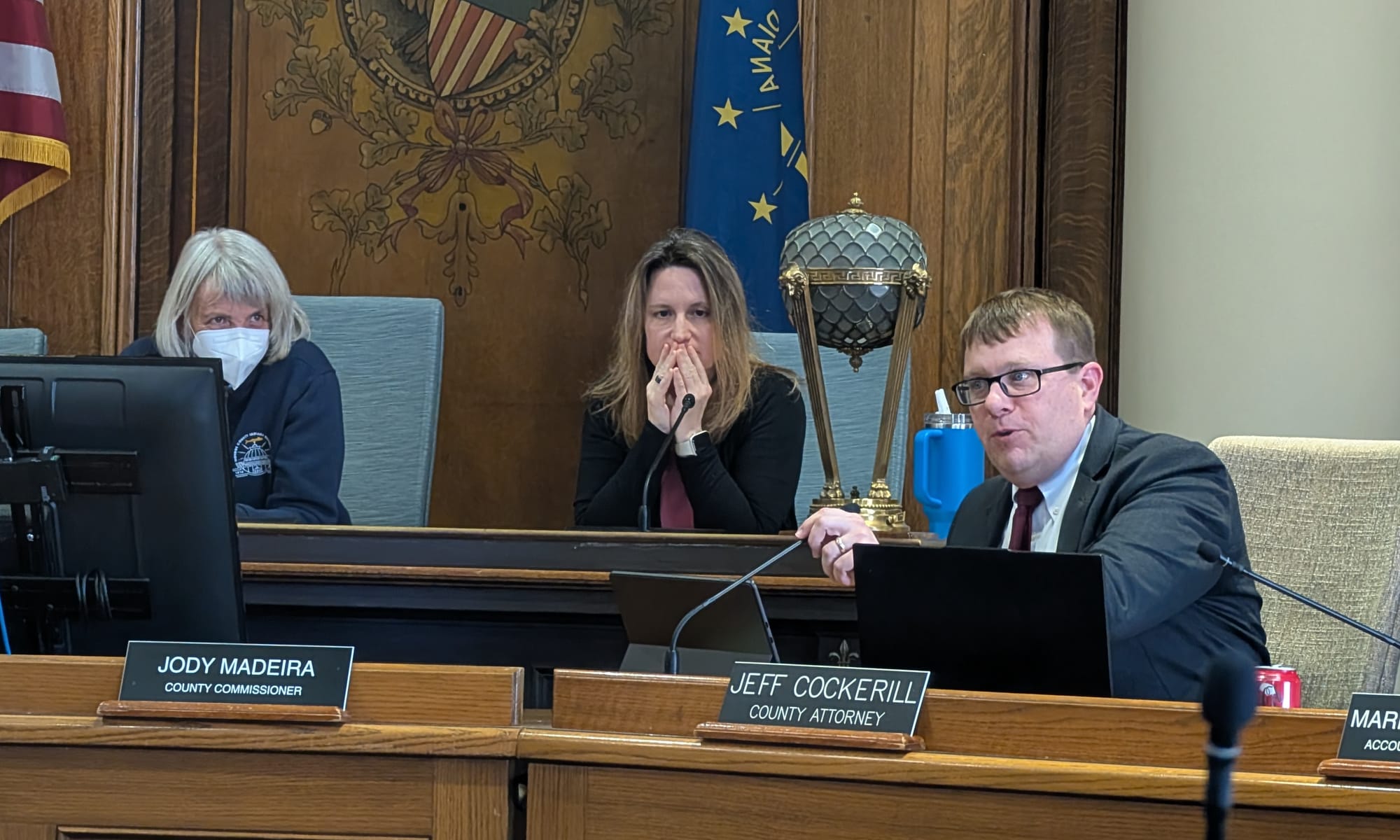
At Thursday’s work session, county attorney Jeff Cockerill said even if a co-located justice complex was not immediately affordable, the question of whether the county government can, in the short term, afford a new jail, has been answered: Yes. That is, according to Cockerill’s math, the county does not need to wait until 2029—when a 25% statutory constraint on pledging of local income tax expires—in order to move ahead with construction.
The urgent timeline remains impacted by the 2008 federal lawsuit over jail overcrowding conditions. The county faces an April 15 deadline tied to its current settlement agreement with the American Civil Liberties Union over that lawsuit.
Cockerill based his optimism on the response he got from WGS, which is the construction manager for the project, when he asked if just the jail component could be built for less than $170 million: Yes. (The letters in the acronym come from three different construction companies who are working as a kind of joint venture–Weddle Bros. Building Group, Garmong Construction, and Smoot Construction.)
Now, Cockerill said, the question is: Where is the jail going to go? Commissioner Julie Thomas was keen to establish that she wants a location that has enough acreage to accommodate a one-story jail—but not only that. Thomas said, “I think it’s foolish for us to plan only for a jail.” She added, “I’m only going to personally be able to support something that will lead to co-location in the near future.”
Commissioner Jody Madeira urged colleagues not to reduce the project simply to minimize upfront cost. “The question isn’t whether we can afford a modern jail,” Madeira said. “It’s whether we can afford the predictable cost of building and maintaining an outdated one.” Madeira said the facility has to include space for medical care, mental health treatment, education, and rehabilitation programming.
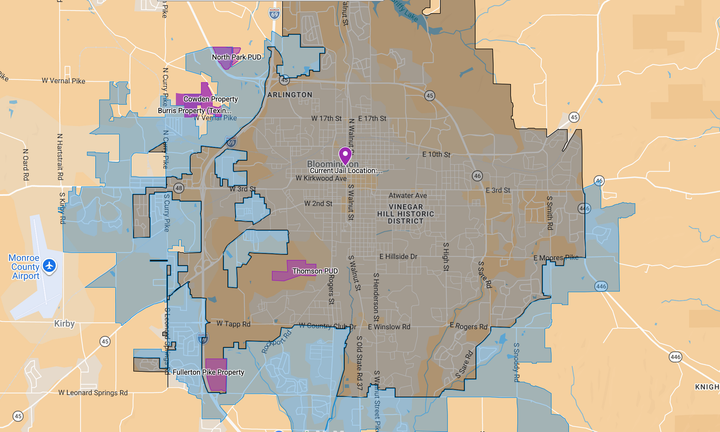
Cockerill reported meeting this week with Bloomington city planning officials and Indiana University real estate representatives to identify potential sites.
A decision on location is now in front of elected officials only after the council’s unanimous vote in late October 2025, to reject the appropriation needed to close the real estate deal on North Park.
In a statement to The B Square late Thursday, after the work session held by commissioners, county council president Jennifer Crossley wrote: “Commissioner Thomas and the other commissioners have consistently told us after the council voted no on North Park that the ball was in our court. This past Tuesday night, we grabbed the ball, and made the shot with our resolution.”
Crossley added, “The council looks forward to continuing to exercise our leadership and collaboration abilities with all three commissioners, other key officials in the county, as well as city officials, to embark on the next chapter in this project, which should be location; and I believe the council looks forward to having this discussion very soon.”
Even if the next focus of councilors and commissioners is location, their respective notions of what the budget is—just for the jail portion of the project—seem pretty far apart. That’s even though the commissioners relied on the same financial analysis from Financial Services Group (FSG) that was attached to the council’s Feb. 24 resolution.
Councilors seemed to be focused on the total bonding capacity for the jail and justice center project after applying a standard 1.25 debt-service coverage requirement to the available local income tax revenue, which was $118 million.
But commissioners, advised by Cockerill, are looking at a maximum potential budget of about $171 million. That total combines roughly $135 million in total bonding capacity with about $36 million already sitting in three different tax funds.
Cockerill detailed three existing local income tax funds that could be used for jail construction: $23,475,066 in the county’s economic development income tax (EDIT) fund; $7,108,463 in the jail local income tax fund; and $5,721,462 remaining from a bond anticipation note issued for earlier jail planning.
The combined balances of those funds is $36.3 million, which could be applied to land acquisition, design, or construction. Added to the estimated $135 million bond capacity, that yields a theoretical maximum project budget of $171,304,991.
Here’s how Cockerill gets to $171 million as the maximum budget:
Cockerill stressed that the $171-million figure represents a ceiling, not a target. “I would not feel comfortable recommending we go to the max,” he said, noting that draining reserves entirely would leave little margin for unexpected costs or other county needs.
County councilors see the EDIT fund as a way to keep basic county government operations going, not as money to be used for jail construction. And the jail LIT fund balance is not necessarily something that has to be spent on new jail design and construction—under state law, jail LIT revenue can also be spent on jail operations. Only the BAN Capital fund has to be spent on the jail project.
On Tuesday night, during the presentation from FSG, councilor David Henry seemed to anticipate the arithmetic that county commissioners might apply to the numbers on the page and tried to head it off.
“Those additional funds could be used for other projects in the county,” Henry said. He continued, “I don’t want to give the impression that this new number plus those LITs would equal some larger project …” He added, “Understand that those other available LITs, we may be using for other things.”
Comments ()