
Monroe County judges underscore support for co-located jail, justice system
Monroe County judges Catherine Stafford and Mary Ellen Diekhoff urged jail planners to keep courts, jail, sheriff, clerk, prosecutors and public defenders close together, citing safety, cost, constitutional access, remote-hearing limits and the county’s commitment to alternatives to incarceration.
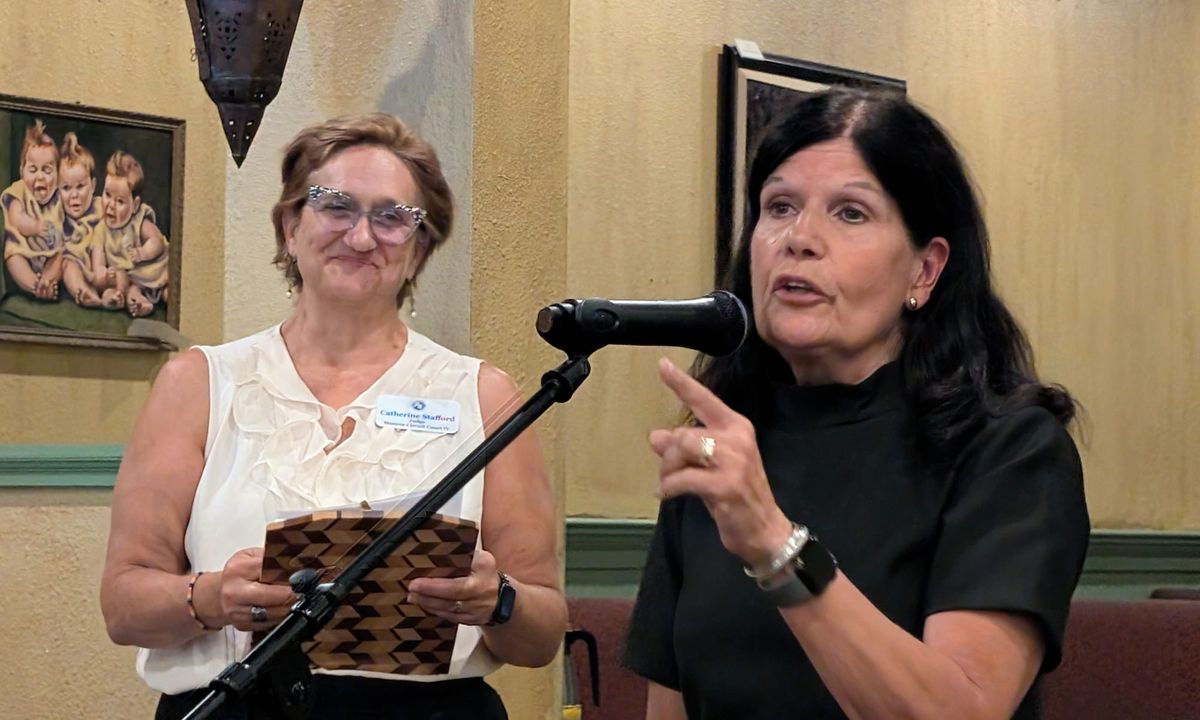
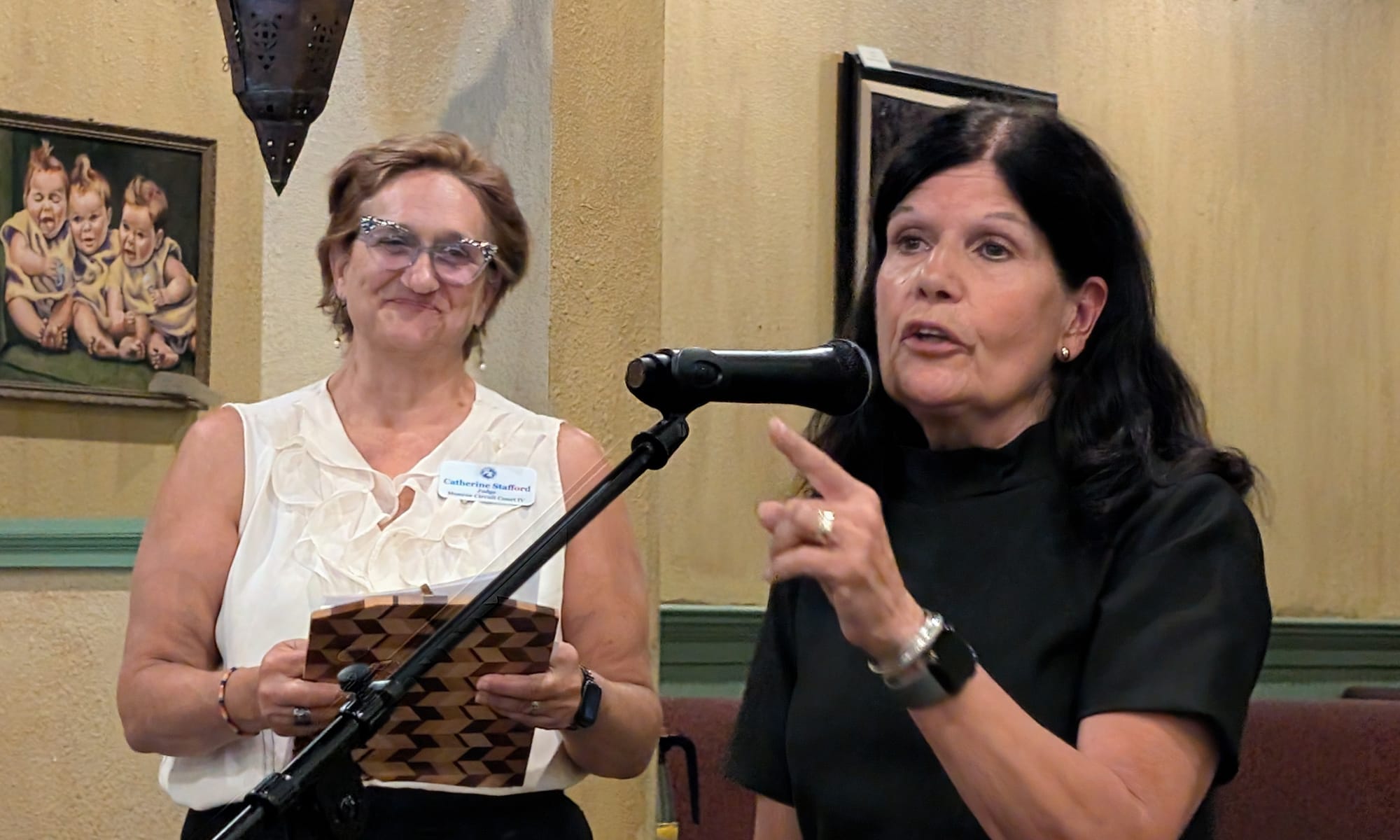
When two Monroe County circuit court judges addressed the Democrats Club at DeAngelo’s for its regular lunch meeting Tuesday (June 16), they talked about the divided responsibilities for the branches of county government, stressing that they would be careful to stay in their “lane.” But their lane runs parallel to the county’s latest effort to solve its long‑running jail problem.
Judges Catherine Stafford and Mary Ellen Diekhoff were speaking to the lunch group just five days after a joint city-county meeting, where some officials agreed to form a fast-acting subgroup to recommend a site for a new jail. Stafford told the lunch group that the board of judges has been invited to designate a member to serve on that panel, but has not yet reacted to that invitation.
“We have not had a meeting to discuss that or vote on that yet, so I don’t know what we’re going to do about it yet,” Stafford said. “Obviously, we’re going to wait and let democracy take its action, even among us, because that’s how we should work.”
The working subgroup has its first meeting set for Thursday (June 18) at 6 p.m.
At the Tuesday lunch, the strongest message from the two judges for the subgroup had less to do with which site it chooses than with the plan for building, and how close together they keep all the pieces of the justice system.
“The board of judges agreed unanimously that … the jail, the sheriff’s office, the clerk of court, and the courts, the board of judges, and all of the people who report to the board of judges … probation et cetera, [plus the prosecutor and the public defenders] … should be as closely co‑located as possible,” Stafford said. That underscored a previously well-known position held representatives of the judicial branch of Monroe County government.
Vignette from the 2008 lawsuit
Even if neither Stafford nor Diekhoff would be found guilty of committing “news” at Tuesday’s lunch, Diekhoff revealed a bit of her own history with the 2008 lawsuit against Monroe County over jail conditions. That’s the lawsuit that prompted the question of where and how big to build a new jail. The lawsuit was dismissed a little over a week ago, which now means the county could face new litigation over current crowded conditions.
Diekhoff has served more than two decades on the bench starting in 2005. Diekhoff said she’d recently discovered her own handwritten notes from the ACLU lawsuit, about 17 years ago, which resulted in a finding that the county’s jail was not maintaining constitutional conditions. The notes were taken during a meeting in a conference room, where ACLU attorneys, county lawyers, outside counsel, the sheriff and the judges all wrestled with how to keep the jail constitutional, while a longer‑term fix was debated.
“It was decided that we needed to do something,” Diekhoff said. She continued, “However, that conversation began with trying to fix the constitutionality of how [the jail] was functioning, not necessarily: Next year, you are going to build a jail!”
The notes document how an agreement on an inmate cap was reached, which was reflected in the settlement agreement, which governed how the jail was administered through a week ago. Diekhoff described how the agreement, with its inmate cap, entailed the practical work of monitoring the jail population.
Each judge kept lists of who was in custody and, when the count crept over the cap they would “look at who is in that jail and who we can get out, to keep that number below that cap—because to do that caused that jail to remain constitutional as far as spacing, and gave everybody time to look at something else.”
Incarceration rates
The formal cap and the related ACLU oversight are now gone, Diekhoff said, but the court’s underlying philosophy has not shifted. Monroe County government and its community, Diekhoff said, believes in alternatives to jails. She pointed to the four problem-solving courts that Monroe County operates: the veterans court, the drug court, the mental health court, and the re-entry court.
“This is a county and a community that believes in alternatives to prisons and jails, and believes in rehabilitation. That is what we do. That is what we have always been committed to—had prosecutors, the current one included, who is also of that ilk,” Diekhoff said. She added, “We have a community that supports that. Some communities do not, and that is why we have four problem-solving courts, and some communities do not.”
Using data gathered by state senator Shelli Yoder several years ago, Stafford underscored the effect of that philosophy on the numbers: Monroe County ranks seventh‑lowest in Indiana for incarcerated people per capita. “We are 0.17 filled [jail] beds per [each person in Monroe County’s] population,” she said. She said she was “pretty darn impressed” with the judges like Diekhoff in the criminal division, the prosecutor and the public defenders who work together to sort out agreements.
Diekhoff took direct aim at one recurring fear in the public conversation—that a new facility will simply invite the county to lock up more people. “If the ACLU has dropped a lawsuit… are we going to incarcerate everybody in Monroe County?” Judges in Monroe County have not taken that approach, she said.
Diekhoff put it like this: “We have never done that. We would not start doing that. We would not do that. Why would we do that?” To reverse course and start filling a bigger jail for its own sake “would take an entire change of philosophy” and a sudden disregard for the facility’s constitutionality, something that she described as impossible to imagine in Monroe County.
Diekhoff pointed to Vigo County as a cautionary example for local officials now moving toward site selection. After being ordered by a federal court to build a new jail, Vigo went ahead, and now faces fresh litigation over the adequacy of the new facility. “I am just saying,” Diekhoff told the audience.
Colocation of jail, other elements
Stafford framed co‑location as a practical question of safety, cost, and constitutional rights.
She said secure passageways between lockup and courtrooms minimize the risk of escapes, and reduce staff injuries and transport costs, Stafford said. She pointed to the fact that people have a constitutional right to attend proceedings against them. “Is it easy to have court without the defendant there? It is not. We aren’t allowed to. It’s not constitutional,” Stafford said. She noted that people in jail often need to appear not only in criminal matters, but also in civil cases such as divorces, evictions, and protection orders. “If there is a delay in that transfer, that makes it very difficult.”
Further buttressing the support from judges for a co-located justice center, Stafford said she is “100% opposed” to splitting the courts—for example by sending criminal courts, prosecutors, and public defenders to a remote site while keeping civil dockets downtown.
In support of maintaining a co-located facility, Stafford also pointed to the structure of the county’s court system as a “unified” court “Monroe County is one of two counties in the state that has what’s called a unified circuit court,” she said. Rather than each judge operating a separate little bureaucracy, she described it like this: “We come together as a unit.” Stafford said the judges can’t operate without their court reporters and shared administrative staff—to which the judges need equal access.
Diekhoff pushed back against the idea, often floated in the broader debate, that the county could put courtrooms out at a new jail site and rely heavily on video connections for the rest.
Diekhoff said the COVID pandemic had taught the lesson that video‑based criminal hearings are “a complete and total nightmare.” Early in the pandemic, the court tried remote initial hearings with video from the jail. “It frequently didn’t work,” Diekhoff recalled, and it was nearly impossible to give defendants confidential time with their lawyers. For most of what happens in criminal court, she said, Indiana Supreme Court rules simply do not allow routine use of remote appearances.
“For initial hearings that are supposed to be open and easily accessible to the public,” she added, “I don’t really think that that’s very secure… We do not think that is going to work. It will be very expensive, and it’s going to be very, very difficult to use.”
Jail design
The judges declined to take a position on specific sites now under discussion, which include the Thomson property on Rogers. Stafford made clear that, from her perspective, there is room on the Thomson site for a co-located justice center, if county officials choose it. The Thomson parcel is around 86 acres, she said, and currently the courts, clerk, and jail are functioning “on a quarter of a city block.”
“I think all of it could fit with no problem on 86 acres,” she said. “Let me be 100% clear. I’ve designed it as a frustrated architect using my CAD program on my iPad many times, many ways. I can get it in five or six acres with a one‑story jail and zero problems.”
Stafford also used Tuesday’s appearance to critique earlier building concepts, especially those developed for the North Park site, as falling short of what Monroe County ought to expect in terms of design and public health.
“I think our community shared values include urban infill, local design, and green design,” Stafford said. “I’m surprised that we are considering this whole project without LEED principles.” She added, “I’m shocked that this project has not discussed solar energy or geothermal energy. I’m shocked that it is not discussing building health and employee health. Where is the local limestone? The local art?”
After years of mold and mechanical problems in the existing justice building, including repeated closures of offices and, at times, the entire structure, Stafford said, “We need a design where the jail toilets and laundry don’t leak into the rest of the building, and where the HVAC condensate is properly dealt with.”
She noted she and other employees of the justice building had been required last year by county commissioners to remove every houseplant from their work spaces, but there are still mold problems in the building. “The plants were not the problem,” Stafford said.
Looking ahead
In their closing remarks, the judges turned to the general civic atmosphere. Diekhoff said that in all her years in the justice system, she has “never seen it as bad as it is now” in terms of people’s unwillingness to talk to each other and to assume good faith.
Diekhoff pointed to the fact that human beings make things complicated. She put it like this: “People are messy,” she said. “They are not roads to be fixed, they are not stop signs to be put back.” She asked those in the room to “be patient, ask questions politely, disagree politely, and don’t accuse people of things. Honestly, do you really think people are sitting at home thinking ways to be evil? Stop. I don’t think so.”
Stafford echoed that sentiment with a line said was a paraphrase of she credited to court commissioner Bret Raper: “You’ve got to love your kids more than you hate your ex.” Stafford’s adaptation of Raper’s sentiment in the context of jail planning: “You’ve got to love your county more than you hate your fellow politicians.”


Comments ()