
New Bloomington sewer policy targets ‘strategic’ sites like airport property
A quiet policy change by Bloomington’s utilities service board in January is now emerging as part of the city’s economic development strategy. Officials say extending sewer service to select “strategic” sites, like the county airport, could help attract employers and major investment.
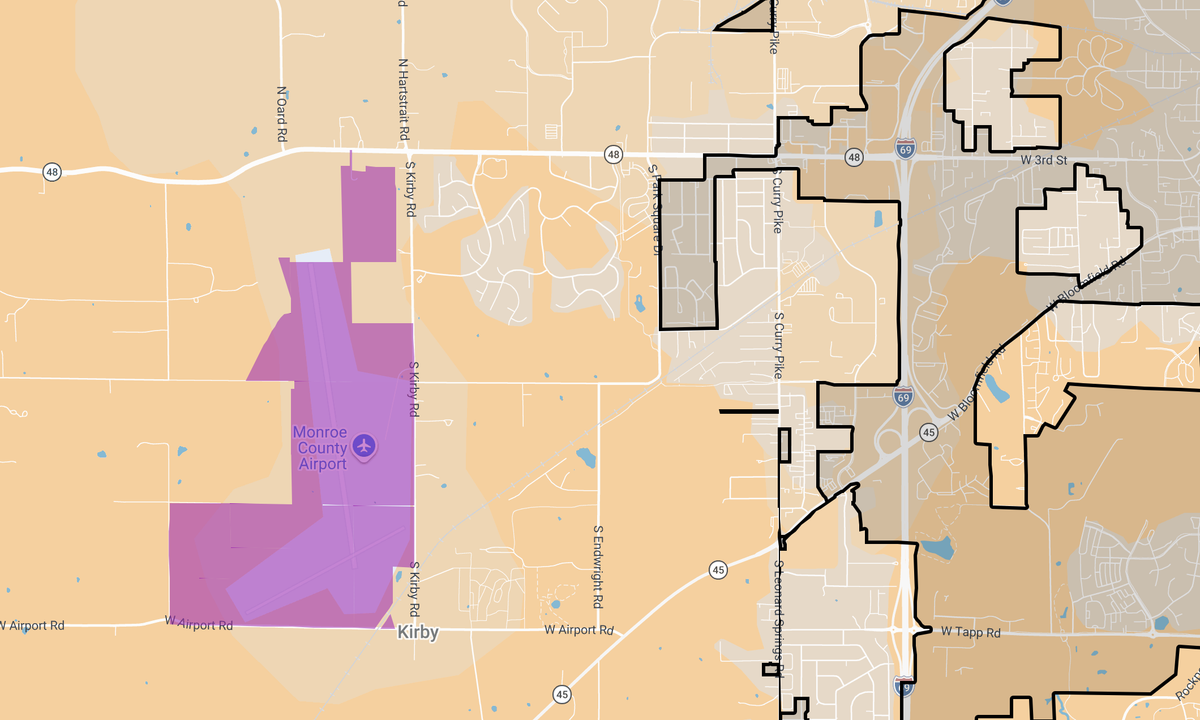
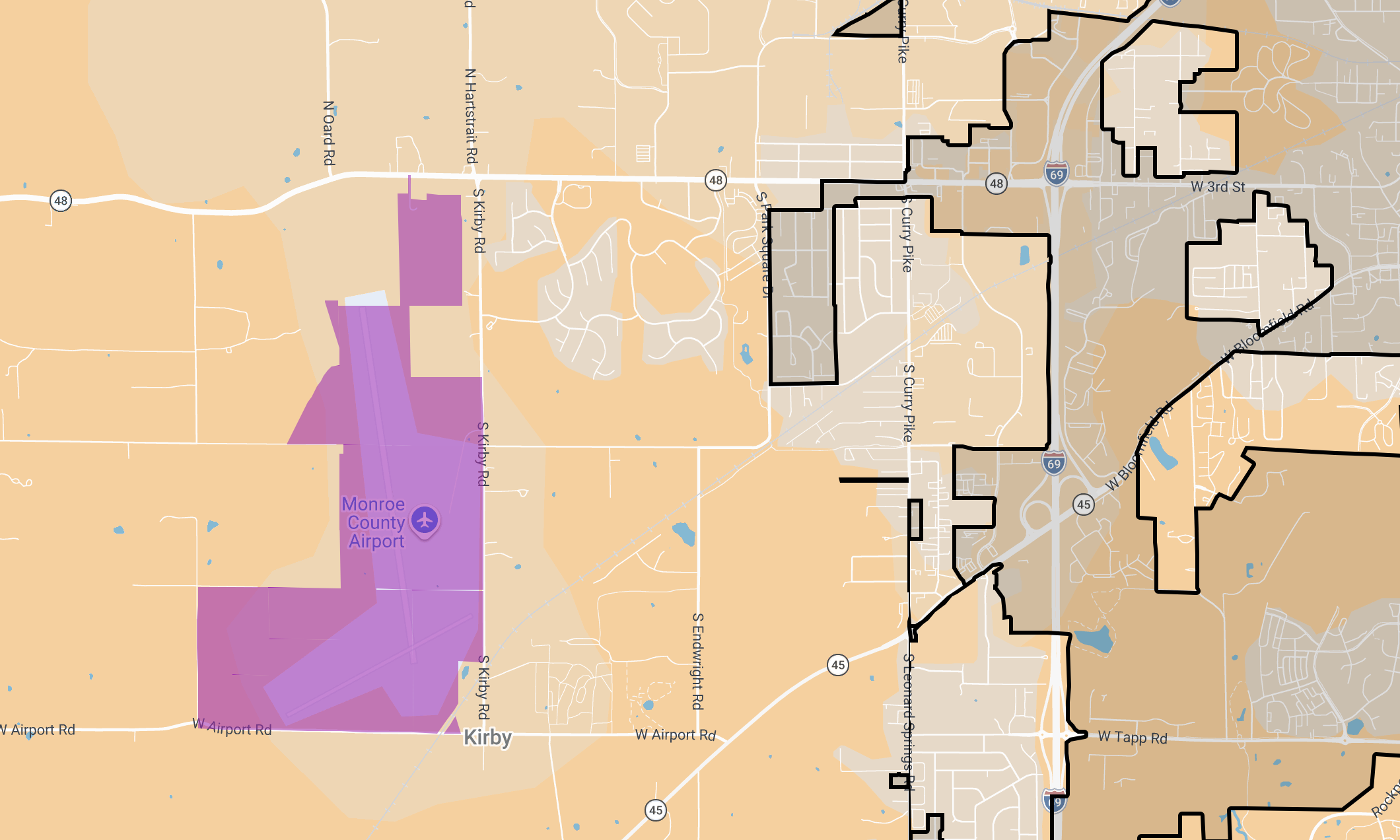
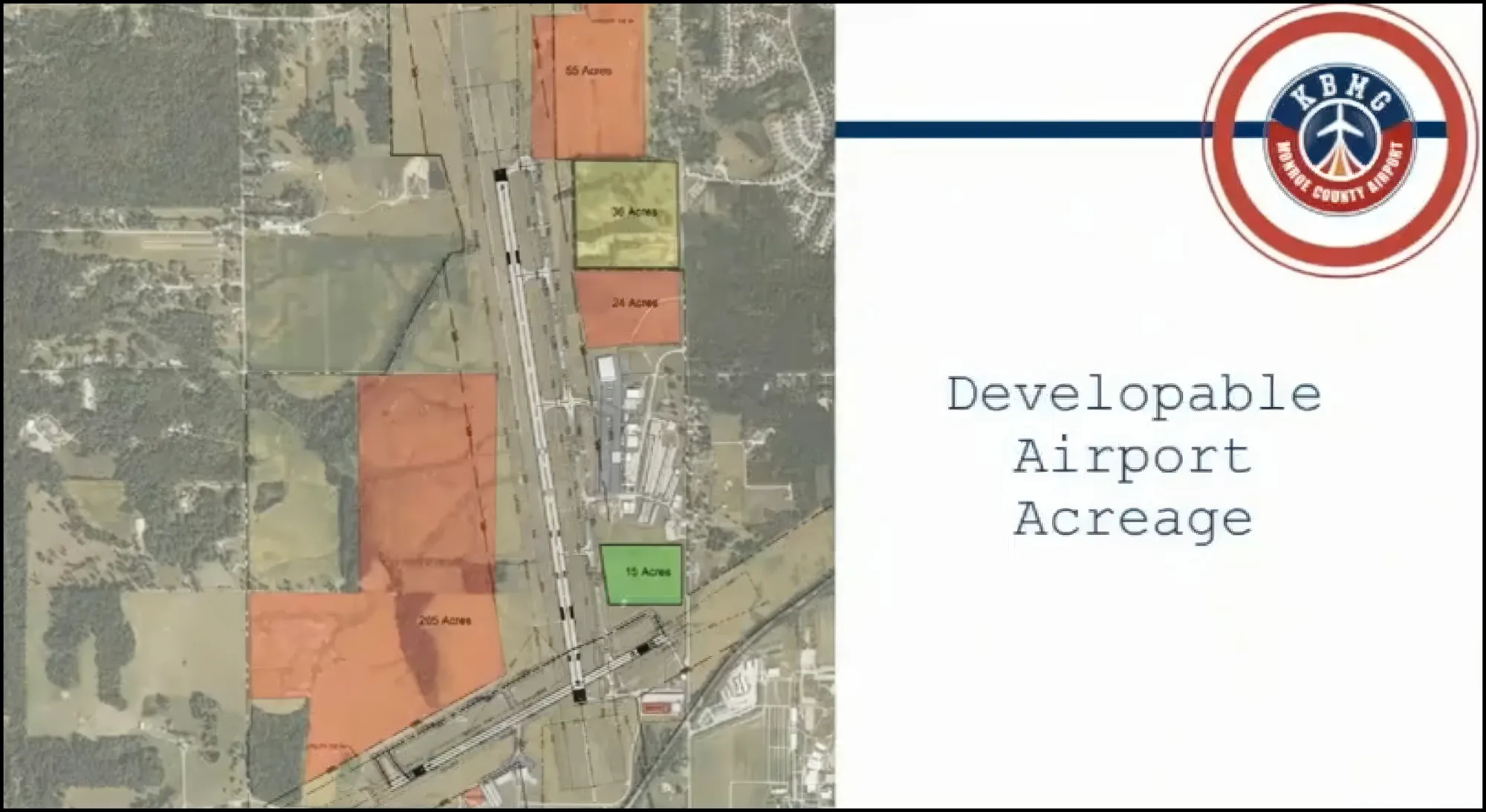
Left: The parcels shaded in purple were named in a March 13 "will serve" letter from city of Bloomington utilities (CBU) saying that the parcels have been designated as strategic economic development sits, and are eligible to be served with city sewer service, provided some conditions are met. Right: A slide from a July 22, 2025 presentation to the city council identifying developable acreage near the county airport.
A major policy change that was approved without fanfare by Bloomington’s utilities service board (USB) in January of this year is now emerging as a key piece of the city’s economic development strategy. At its Jan. 29 meeting, the USB approved a new pathway to extend sewer service outside city limits, one that applies to only to projects designated as “strategic economic development sites.”
Even though that policy shift made sewer service available outside the city limits on a very limited basis, the change was a dramatic reversal to the previous policy. The earlier position had been adopted by former mayor John Hamilton and continued after Kerry Thomson took over the mayorship at the start of 2024.
Under that policy, property owners had to agree to have their land annexed into the city before sewer service would be provided. The policy stemmed from the city’s long-running attempt, starting in 2017, to annex a large swath of territory around the city. A significant part of the city’s annexation has now failed as the result of successful litigation against it. The other part of the annexation litigation is still pending.
The fact that lack of sewer access outside the city is a big barrier to economic development came into sharp focus last summer, when airport officials presented a new airport master plan to the Monroe County council. It emerged during the master plan presentation that the lack of sewer access is preventing development on nearly 200 acres of airport property. Airport officials said it could attract defense, aerospace, and technology employers tied to Crane and Indiana University.
It was on July 22, 2025 when Allen Boyd, who is vice president of Monroe County’s board of aviation commissioners, told county councilors: “The biggest limiting factor and challenge we have right now is sewer.” Existing Bloomington sewer lines already serve industrial buildings near the airport, he said, but several hundred yards of additional line are needed to make nearby parcels “shovel ready.”
Boyd said four companies over the last two years backed off from considering development near the county airport after discovering sewer was unavailable. That represented more than $400 million in potential investment and more than 500 jobs, he said. Those companies liked the airport’s proximity to Crane, the aviation setting, and Bloomington’s workforce, he said, but stalled when they reached the utilities portion of their due diligence. “It’s electricity, yes, water, yes, internet, yes, sewer, oops, no,” Boyd said.
The concern about a lack of sewer service blocking economic development was reflected in the reasoning USB members gave in January for rewriting Section 24.2 of the utility service rules. At that time, city attorney Chris Wheeler said the city needed “some flexibility” to support major economic-development projects outside city boundaries despite the city’s long-running annexation disputes and the city’s policy against routinely extending utilities beyond its limits.
Under the revised policy, sewer extensions outside the city can be approved for projects identified by Bloomington’s department of economic and sustainable development as “strategic economic development sites.” But that’s only if the projects also make payment-in-lieu-of-taxes agreements under state law.
Wheeler described the change at the USB’s Jan. 29 meeting as intentionally narrow and aimed at major employers rather than residential development, citing the hypothetical example of an Amazon distribution center locating in Monroe County, but outside city limits.
By May, economic and sustainable development department director Jane Kupersmith was describing the new sewer policy as “a huge, huge win” for the city’s ability to compete for major projects. She told the Bloomington economic development commission (EDC) at its meeting this past Tuesday (May 19) that the annexation fight had effectively frozen parts of the community’s development pattern and created the perception that Bloomington was blocking growth.
Under state law, the EDC is a five-member group that reviews and recommends tax abatements, oversees economic development financing, and helps support projects intended generally to promote business growth, investment, and job creation. The members of Bloomington’s EDC are Isak Nti Asare, Liz Feitl, Tim Henke, Vanessa McClary, and Kurt Zorn.
Kupersmith revealed at the EDC’s May 19 meeting that the Monroe County airport had already been designated as a strategic site and had been sent a “will serve” letter from city of Bloomington utilities (CBU) to help market airport property to prospective employers. The date on the letter was two months before: March 13. The city sent out a news release about the “will serve” letter on May 20, the day following the EDC meeting.
Kupersmith’s remarks to the EDC came the context of the USB’s new policy that assigns responsibility for determining “strategic economic development sites” to the city’s economic and sustainable development department. She was there in part to ask the EDC help define those sites.
At the EDC’s May 19 meeting, members did not not vote on criteria, or designate any specific sites. What they did do was give informal direction that ESD staff should develop a rubric for identifying strategic sites, that certain obvious sites (such as the airport area) could be pre-identified as strategic, and that the EDC should hold a separate working session with key players. The idea would be to look at utility maps, refine the wage and investment metrics, and talk through site selection.
The July 22 airport presentation last year underscored why city officials see the new sewer policy as important. At that meeting, airport officials said alternatives to city sewer, like industrial septic systems or standalone treatment plants, are too expensive for many business prospects. One treatment-plant option for a recent prospect was estimated at $1.5 million to construct, with annual operating costs around $100,000. For a company considering a $10 million facility, they said, those additional costs can quickly push projects elsewhere.
The broader strategy for the city is aimed at reducing uncertainty for employers evaluating Monroe County sites. John Fernandez, who is CEO of Amplify Bloomington, works on employer attraction efforts tied to the Trades District. Fernandez told the EDC at its May 19 meeting that uncertainty over infrastructure access can derail projects before they even get started. “Not knowing whether you’re going to be served or not, you just might as well not even submit the site,” he said.


Comments ()