
New incumbent, familiar name square off in Perry Township Democratic Party primary
Pre-primary filings show little money in the Perry Township trustee race, even if the stakes are big. Incumbent Leon Gordon seeks to continue in office, while Levi Combs appeals to his father's legacy.
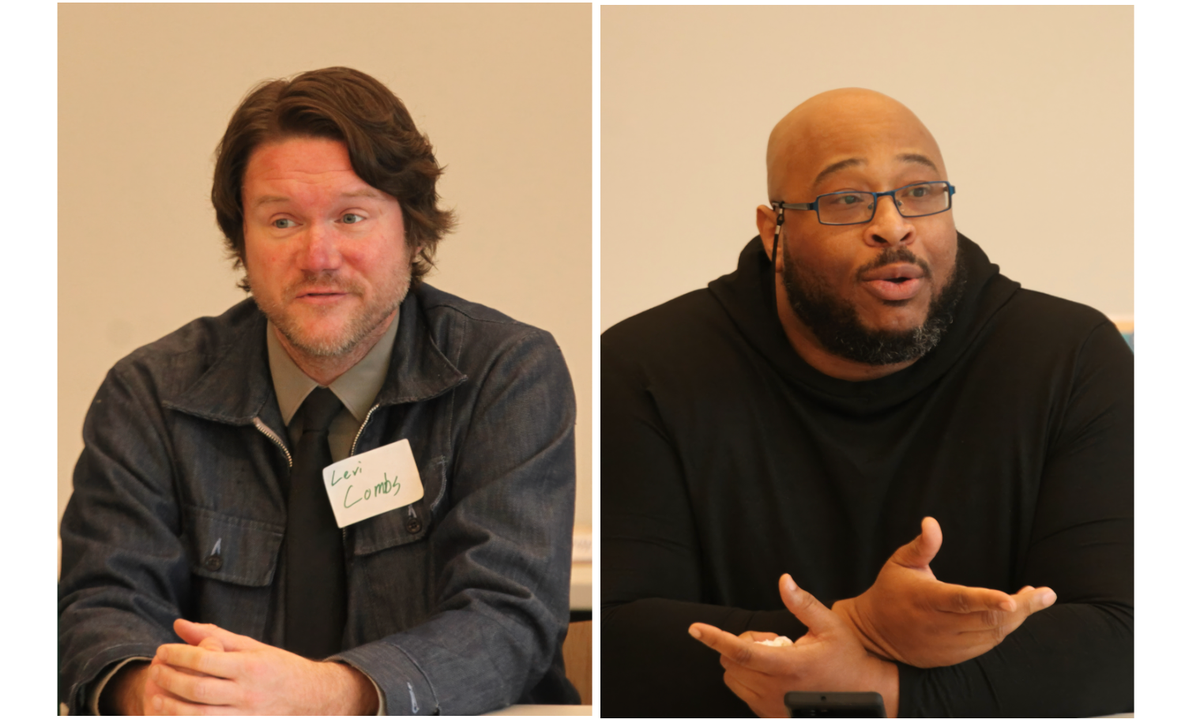

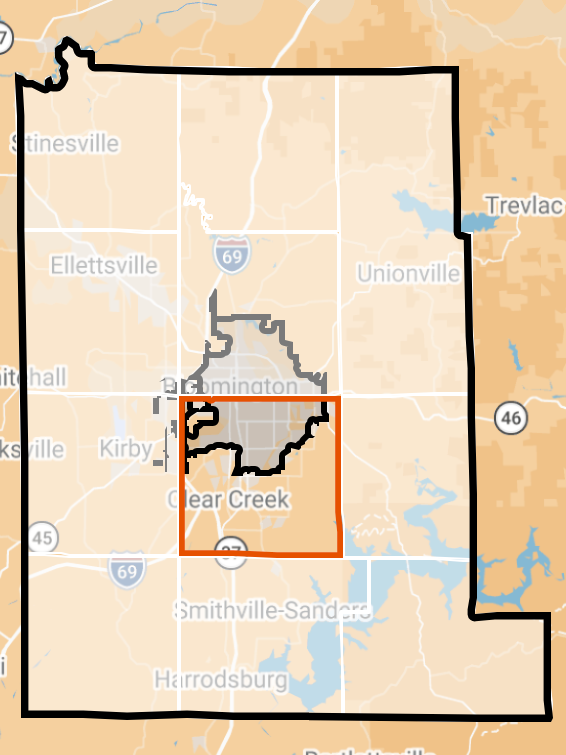
B Square file photos from a March 7 candidate forum. Left: Levi Combs. Right: Leon Gordon. (Dave Askins, March 7, 2026) Middle: Perry Township includes the southern half of the city of Bloomington. Map by The B Square.
In the closing stretch before the May 5 primary, the only actual news from any of Monroe County’s local campaigns has come on paper, with the required pre‑primary campaign finance filings, which were due Friday a week ago (April 17). Those reports show the Democratic Party’s primary for Perry Township trustee to be relatively quiet when measured by money donated.
The Leon Gordon campaign reported $1,365 raised, most of it contributed by himself, which has been spent mostly on yard signs and voter lists. The Levi Combs campaign reported $326 dollars raised, and that was from a single in-kind contribution.
But the race itself isn’t captured just by the financial numbers. Gordon was selected by a Democratic Party caucus in January, to fill the vacancy left by the death of longtime Perry Township trustee Dan Combs, who was Levi’s father. Dan Combs held the office for roughly four decades and built a reputation for aggressive use of township government as a tool for poor relief and housing stability.
Levi was one of three candidates in the caucus, which was decided by 26 precinct committee chairs. The tally was: Gordon, 15; Combs, 8; and Eric Petry, 3. Gordon will serve as township trustee at least through the end of 2026.
By staying in the primary race, Levi Combs is now appealing to all of the township voters in the Democratic Party’s primary, to put him in the office his father held.
Gordon is asking voters to let him keep the job of trustee, which he stepped into a couple months ago.
The B Square Bulletin checked in with both candidates this week.
Levi Combs
Levi Combs is confronting fallout from a recent report in the Herald-Times that surfaced an arrest in 2025 for operating‑while‑intoxicated, and disclosure that the city of Bloomington public works director terminated his employment in 2021 for reporting to work under the influence of alcohol, a violation of a policy spelled out in the city’s employee handbook.
The B Square received an email message with information about the OWI case, and a copy of the termination letter from a source late Tuesday evening (April 21). Early Wednesday morning, The B Square filed a formal records request with the city of Bloomington, to authenticate the termination letter. Indiana’s records law makes certain items in personnel files public, including work history and the status of disciplinary actions up to and including discharge. By the end of the day Friday, the city still had not responded to the B Square’s records request. The Herald-Times published its report on Combs at 5 p.m. on Wednesday.
In an interview with The B Square on Thursday, Combs confirmed some key facts, which were his discharge in 2021 from his position with public works for being under the influence of alcohol while on the job, and that the OWI case led to six months of probation. The probation period ends next Monday (April 27). His final in‑person probation meeting was scheduled for 2 p.m. Friday at the county probation office on 7th Street. The point of that last check‑in, Combs said, was mainly to confirm that he completed an eight‑week relapse‑prevention course through Centerstone, and that he has paid all court and probation fees.
Combs described a treatment path that included two 30‑day inpatient stays at Boca Recovery Center in Bloomington—first focused on alcohol use, then on overlapping mental‑health issues. Later he spent time at a program at Silicon Beach Treatment Center in the Los Angeles area.
Combs said he doesn’t track his sobriety by day counts and instead relies on a routine of periodic online recovery meetings, and staying in touch with people he met in treatment, in Bloomington and in California. He has also participated in AA‑style meetings at the 12/24 Club in Bloomington, but says his current focus is more on staying in a stable routine.
Combs says he is not currently working a job, in part because he has been helping his mother manage the house and paperwork after his father’s death. When he was arrested on the OWI charge, he was on his way into work at Lowe’s on the west side of Bloomington. Now he says he is between jobs, a little wary of taking a new position just weeks before a primary that, if he wins, could put him in a full‑time public office next January.
On the campaign side, Combs says he has begun knocking doors, starting in his own near‑campus neighborhood east of Third Street Park. He says many of the neighborhood’s residents are students who are not registered to vote locally. He says if voters at the door recognize him as “the guy who got arrested” and ask why they should vote for him anyway, he has an answer: The arrest does not define his character or his capacity to serve, and that he brings inherited institutional memory from growing up in a household where his father was immersed in Perry Township business.
“I still believe that I can get out there and represent the people of Perry Township, near the level that my father was able to represent them,” he said. He added that he wants to keep Perry Township among the state’s higher‑performing townships and work with neighboring townships and the Indiana Township Association as state‑level conversations about township mergers continue.
Leon Gordon
For his part, Leon Gordon told The B Square on Friday he is balancing a campaign with duties as the sitting trustee. Gordon said his campaign is effectively a one‑person operation, supported by a small circle of advisers who help track filing deadlines and offer tactical advice about early voting, mailings and canvassing.
He has begun using Democratic Party voter‑file software to better target door‑knocking. Supporters he’s known through previous community work have let him place signs in their yards. Gordon said he has spent some time greeting voters outside the early voting polling location at the North Showers building and has canvassed at the farmers market, but he says he has been spending business hours working in the township office.
Gordon says the trustee’s office staff have embraced him “with open arms.” He is still learning the day‑to‑day work, but is already helping to enhance it, he says. There are daily case conferences where he and staff review each application for township assistance. They discuss not just whether to approve a rent, utility or other payment, but how to use that moment as a window of opportunity to connect a family with longer‑term support. He compares the meetings to team staffing sessions he participated in during his earlier work at New Hope for Families.
Gordon points to some changes in the way the office is operating since he started. He has encouraged staff to offer information about other resources even when an applicant doesn’t know to ask, such as township food vouchers and pantry access, or outside programs like Growing Opportunities and other grants that can help stabilize housing and employment. He says staff now routinely reach out to partner agencies when they see a case that could benefit from joint support, rather than handling each application in isolation.
After attending an Indiana Township Association training on township assistance, he said he became more deliberate about where state law leaves room for trustee discretion. One example he cited was extending the internal deadlines the office had used for giving landlords a definitive answer about whether the township would help cover back rent. In at least one case, he said, keeping a commitment open longer gave a family time to assemble the remaining funds and avoid eviction, with help from both the township and other charities.
Gordon has also held what he describes as culture‑building meetings. He has conducted a staff survey aimed at surfacing ideas for improvements and new initiatives. He has started talking with staff about a strategic plan, but says he is deliberately cautious about rolling out major changes before the primary result makes clear whether he will remain in office past the end of the year.
One of those ideas that will have to wait a minute is mobile outreach efforts, such as setting up information tables at places like Kroger so staff can meet residents where they already are.
“With May 5 hanging over us, I’m managing my bandwidth,” he said. “Making it past that day will allow me to spread my wings,” including on mobile access, he added. Until then, he says, most of his time is spent on the existing work of township assistance and on what he describes as bonding with staff and strengthening ties to other social‑service agencies.
Primary Election Day is May 5.



Comments ()