
North Park dead as jail site after Monroe County council repeats clear rejection, search for alternate location now urgent
Monroe County’s proposed North Park jail site appears finished after the county council voted 1–6 on the purchase agreement, then 6–0 to deny it outright. The decision leaves the county without a selected site and facing likely renewed litigation over jail conditions.
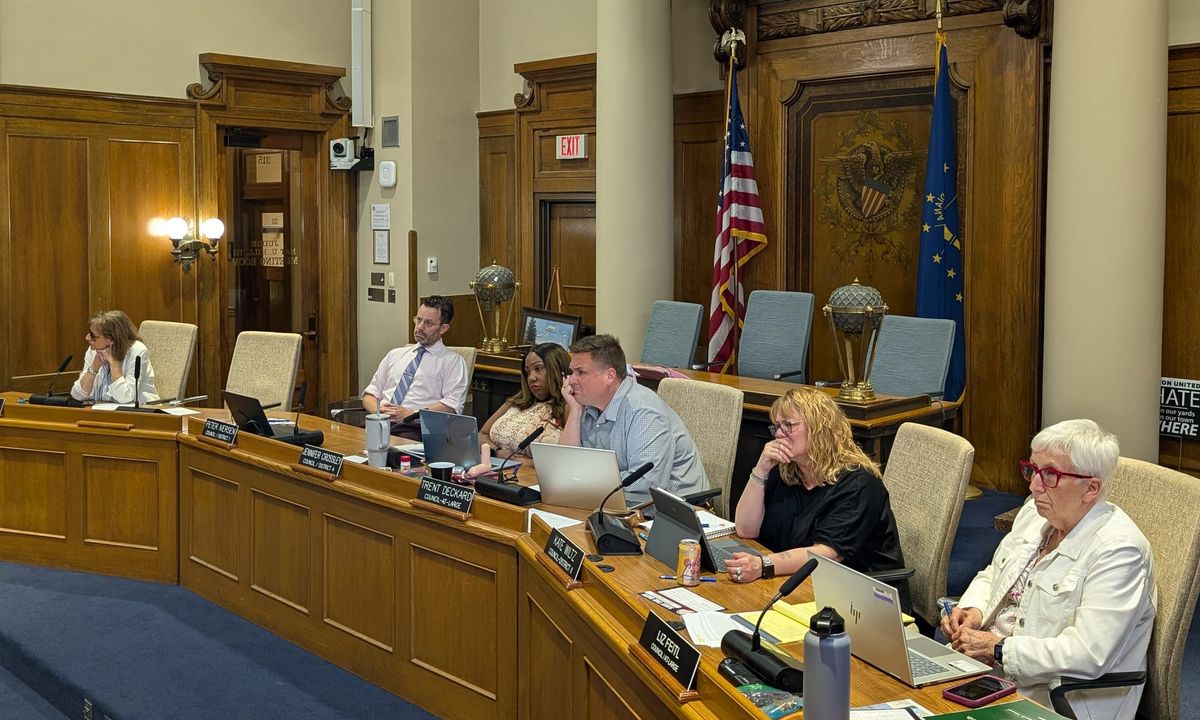
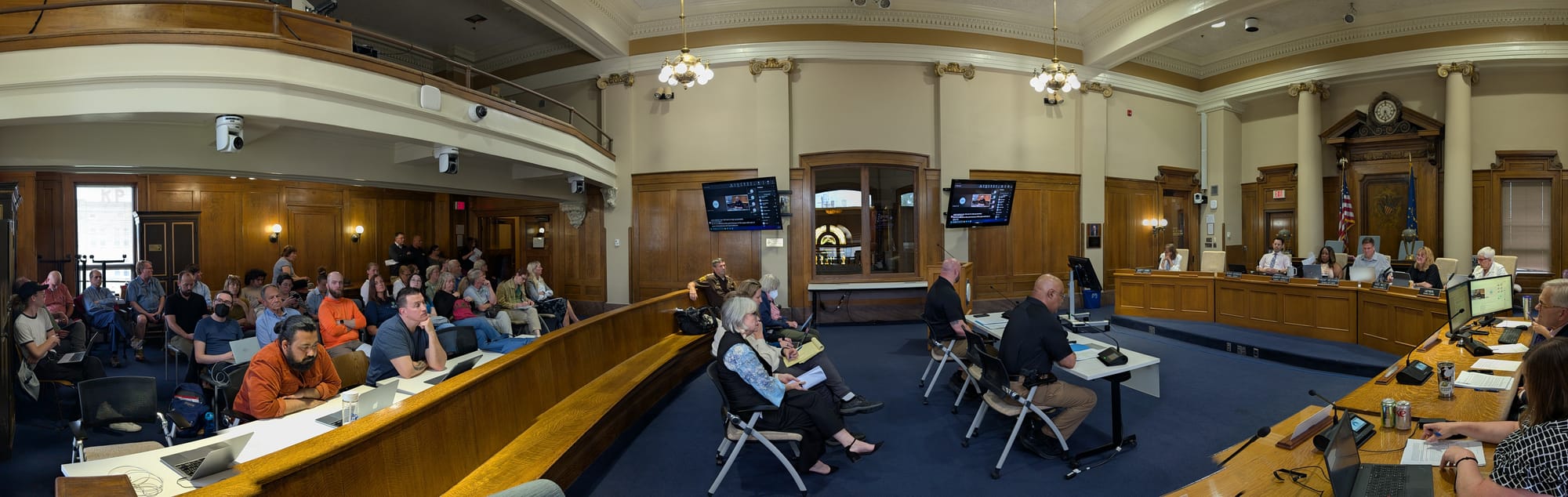
North Park as a site for a new Monroe County jail now seems clearly dead. The purchase agreement for the land just northwest of Bloomington on SR 46 failed to pass the county council on Tuesday (May 26) by a 1–6 vote.
The council went a step further and considered a motion to deny the ordinance, which passed 6–0. It was almost an exact repeat of the events of late October last year, when the council took a unanimous vote against approving an appropriation, then took another unanimous vote to deny it.
Tuesday’s vote came two weeks after its most recent meeting, when the same ordinance failed to pass after a 1–5 vote. After Tuesday’s vote, the settlement agreement with the ACLU, which is related to a 2008 lawsuit over unconstitutional and unsafe conditions at the Monroe County jail, looks like it’s certain to expire on its May 29 end date.
At that point, the county will be open to fresh litigation, which county attorneys think is certain to come. The settlement agreement’s most recent extension indicated no further extension would be granted, unless a purchase agreement for North Park was approved.
Presentation from commissioners, sheriff
On Monday, North Park got a boost in the form of a joint statement from the board of county commissioners, Bloomington mayor Kerry Thomson, city council president Isak Asare, and county council president pro tem Peter Iverson. That set the stage at Tuesday’s meeting for sheriff Ruben Marté and commissioners Jody Madeira and Julie Thomas to start things off with a presentation in favor of the North Park purchase agreement.
Marté seemed resigned to the fact that there was little he could say that hadn’t been said already to convince the room. He began by referring to his previous visits to the council, and touching on some of the points he’s made in the past—lack of space at the current facility, inability to provide necessary care, including difficulty quarantining inmates who are sick.
“If I'm going to come to you and ask you for certain things, I need you to understand why,” Marté said. “I could tell you right now, the [jail population] numbers are concerning to me right now, as they're creeping up. It really is. I won't get too deep into that right now, but, I assure you, it is, and we cannot keep up trying to help someone with programs, if the numbers keep up and our staff numbers remain the same.”
Marté stressed to the council the need to act fast to relieve the jail staff who were “doing the very best that they can under the circumstances.” “Not to move forward at the present time is literally putting a tremendous amount of more stress on the staff that are already stressed to a point that concerns me,” he said.
Madeira outlined what she believes would come next if the ordinance failed. “They [ACLU] will file immediately and they will seek summary judgment. Summary judgment isn't a request for further negotiation or dialog—it’s a request for a court to decide the ultimate legal question without a trial, because the facts aren’t meaningfully in dispute,” she said.
“If summary judgment is granted, the only remaining question is what remedy a federal court will impose on Monroe County,” Madeira said. During litigation, Madeira said, “We stop acting as one county and start acting as separate legal adversaries. The commissioners, the sheriff, and the council will each retain separate attorneys, file separate briefs, and present separate arguments. And from what I've seen of the record from the past 17 years, the ACLU will prevail.”
Madeira asked each councilor to stand together and to end this issue before a federal court ends it for the county. “Not because we're forced to, but because we’re capable of governing, because the people living and working in that jail are neighbors, and they deserve better, and because the residents of this county deserve a government that can make hard decisions together, rather than be driven apart by litigation,” she said.
Thomas stressed that it is the council’s responsibility to make this decision. “It’s not clear to me why the council would abdicate its responsibility and rights at this moment to a federal judge who can make a range of decisions. … Two-thirds of the elected bodies that are required to choose the property have done so—it’s the sheriff's office and the board of commissioners. If the purchase of North Park is not supported today, we're going to be squandering both time and money, and that money that's going to be squandered is a sunk cost, it's not a capital investment into anything,” Thomas said.
Public comment
Public comment on the day was a continuation of the sentiments expressed in previous weeks, with almost all members of the public urging the council to continue voting against the proposal. The commissioners were the target of public ire as well, with some accusing them of ignoring messages and “doubling down” on a bad site.
One of the most compelling moments of the evening came when Misty James, assistant director of New Leaf, New Life, told some stories of former inmates and their struggles after being released from jail. “I had a client who was released from a rural county jail in the middle of the evening. He walked from that county to here, it took him nine hours to get here. The weather conditions were terrible,” she said. “He met me at my desk that day, and he took his glove off of his hand, and his hand was so frostbitten that we couldn’t continue with the appointment, and that we had to take him to the hospital because of his exposure.”
James then told the story of a girl who was a victim of the opioid crisis. An overprescription of oxycodone eventually turned into a heroin addiction that led to homelessness and sleeping outside for over five years. She went to jail several times, and when she was released for the last time, what made the difference was that the jail was just two blocks away from where she was going.
“That person was me. It was me. I walked from the county jail door, two blocks,” she said through tears. “If I had to walk from Ellettsville, you think I would have went? If I had to find a way from another county, you think I would have went?” James asked.
Steve Volan, a former Bloomington city councilmember, pointed fingers at the commissioners, saying they ignored the will of the council. “Either the commissioners aren’t competent to fulfill their duties, or they've been dealing with you in bad faith. They’re counting on you to overlook their failure of imagination, their incompetence, their many years of unwillingness to brook dissent,” he said. Volan called on commissioners to resign.
Former Bloomington mayor John Hamilton used the public mic on Tuesday to underscore the points he made against the North Park location in a statement released the day before.
County council comment
By the time council commentary started, it was clear that any councilor who voted yes would be doing so against tremendous pressure of public opinion expressed at the meeting.
Councilor Peter Iversen spoke first, explaining why he would be voting in favor of the purchase. “I have done what I feel is my due diligence. I have discussed this vote with as many constituents as I can, from as many diverse backgrounds as I can,” he said. Voting no, Iversen said, means looks into the eyes of those hundreds of people that slept in the jail last night and says that you are still forgotten.” He added, “A litigation option has no timelines.”
When Iversen eventually stated that his plan was to vote yes, a few shouts of “No!” were heard from the crowd. But Iversen’s early affirmation did not gain momentum, as one by one, all the other councilors explained that they would be voting the proposal down, to enthusiastic applause from the audience.
Justifying his position, Trent Deckard said, “I’m sure that many people will say voting no extends the problem, and that’s fair. I’ll take that. I’ll take that punch on the chin. But respectfully, that zero sum kind of argument is what’s killing us in politics, and in this county, particularly when we’re in a time when people are not only counting us on to move, but honor a constitution which says you have to move.”
Kate Wiltz said that a vote against the proposal should be interpreted as the council wanting a solution, but that North Park is not the right solution.
Liz Feitl drew on her experience with unions where the idea is to represent a constituency. She said in that context she had to vote no. Feitl said that her focus was to move ahead. “We have to figure out right now, going forward, and make a commitment to do so to remedy the situation at the same time, while we find another site immediately and go forward,” she said.
David Henry, who joined the meeting remotely, focused on the fiscal burden. “The community deserves the full debate someday as to why and how we got here, but the only thing I’ve got to worry about tonight is the fact that the taxpayers of this community, especially working people, they’re going to be asked to pay not for one but two phases. And a project that will eventually reach $400 million with interest over 20 years is too much of a burden,” he said.
Marty Hawk looked ahead to next steps: “This is not just a no to North Park. This is a yes to moving forward in the future, and we need to make a decision on another location, and I mean quickly,” she said.
Council president Jennifer Crossley wrapped up the council’s commentary with a call for collaboration. “I was a no back in October. I was a no back a couple of weeks ago. And I’m still a no. But again, here’s where I can say yes: I can say yes to true active collaboration. I can say yes to really getting down in the trenches … where we can come back in a room and say: Let's figure this out.” she said.
The council’s first vote was on approval of the ordinance, which failed 1–6. After a short recess, Wiltz brought up the possibility of also voting to deny the ordinance. The outcome of the vote to deny the ordinance was 6–0. The tally did not add to seven, because Henry had left the remote connection by then and did not participate in the vote.
Iversen, who voted in favor of approving the ordinance and later to deny it as well, said that he had not changed his mind on the basic question, but he understands the will of the council, and wanted to move forward with the community.
If there was any ambiguity left about North Park before Tuesday night, the council’s final 6–0 vote to deny the purchase agreement erased it. The county’s long and bruising jail debate now enters a new phase—one with no site selected, no legal protection, and no clear roadmap or timeline. But there seems to be a clear consensus among decision makers that whatever comes next, it will have to come fast.
Next steps
During council comment time at the end of the meeting, Kate Wiltz responded to one of the statements from commissioner Jody Madeira before the vote, when Madeira said: “This vote will define how Monroe County is remembered on this issue—not the years of studies installed decisions, but what we choose to do right now.”
Wiltz said she hopes the council will be remembered as “as people who knew the importance of deliberation and intentional system change” and who “thought outside of the typical parameters of how we do things.” She called on county commissioners to “seize the day” and convene a joint meeting with city officials and the sheriff.
Wiltz put it like this: “I’d really like to call on the commissioners to seize the day and perhaps call a meeting where we, or at least some of us, could participate with them and the mayor and the common council and the sheriff to really just talk about the possibilities and not the past but the future and do it this week … Let’s just look toward to what we can do.”
After the meeting, Wiltz told The B Square she thinks getting a meeting of city and county officials scheduled, not the meeting itself, could be achieved by week’s end.
For Trent Deckard, the next steps include selecting some other site besides North Park—one that could get four votes on the county council and two votes from commissioners.
Deckard told The B Square one of the specific next steps for him would be to ask Bloomington mayor Kerry Thomson if the city “had any seriousness toward Fullerton.” That was an allusion to the Fullerton Pike property on the far southwest corner of the city, but still inside Bloomington, which was rejected for rezoning by the city council in late 2022. It’s a site that Deckard thinks warrants further consideration.
And Deckard’s planned question for the mayor could be based on remarks Thomson gave at the April 22 meeting of the Bloomington Press Club. Thomson appeared to indicate that Fullerton Pike could be revisited as a jail site, when she said, “[T]he Fullerton Pike possibility got turned down in the zoning process by the old city council—old meaning the last phase we had a significant turnover ... So we have a different conversation to have about Fullerton.”
One of the challenges related to the Fullerton Pike property is the potential delay from the necessary rezoning approval process, which is under Bloomington’s jurisdiction. After Tuesday's meeting, Deckard floated the idea of dis-annexation as a way around that. In that scenario, the city would follow the statutory process to alter the city boundaries so that Bloomington no longer includes the Fullerton Pike property. That way, any rezone would fall to a decision of the county commissioners. Under state law, it looks like dis-annexation would require a petition from the property owner.
After Tuesday’s meeting commissioner Jody Madeira told The B Square, one next step would be to contact ACLU attorney Ken Falk and let him know how the county council vote on the North Park purchase agreement turned out. She also said Monroe County would need to get ready for what she thinks is certain litigation. There’s a question about whether the county's insurance would cover legal representation. After Tuesday’s meeting county attorney David Schilling noted that there would be three parties potentially who need representation—the sheriff, the commissioners, and the county council.
Madeira said a next step includes talking with the other two commissioner colleagues, saying she’s just one of three votes. One future step needs to be to move forward with a design for a jail at some other location besides North Park, but that design work can’t move forward right now, because no site has been selected, which means site selection is a step that has to come first, Madeira said.
Another next step, said Madeira, is simply to keep talking—internally among commissioners, and externally with the county council and city of Bloomington officials.
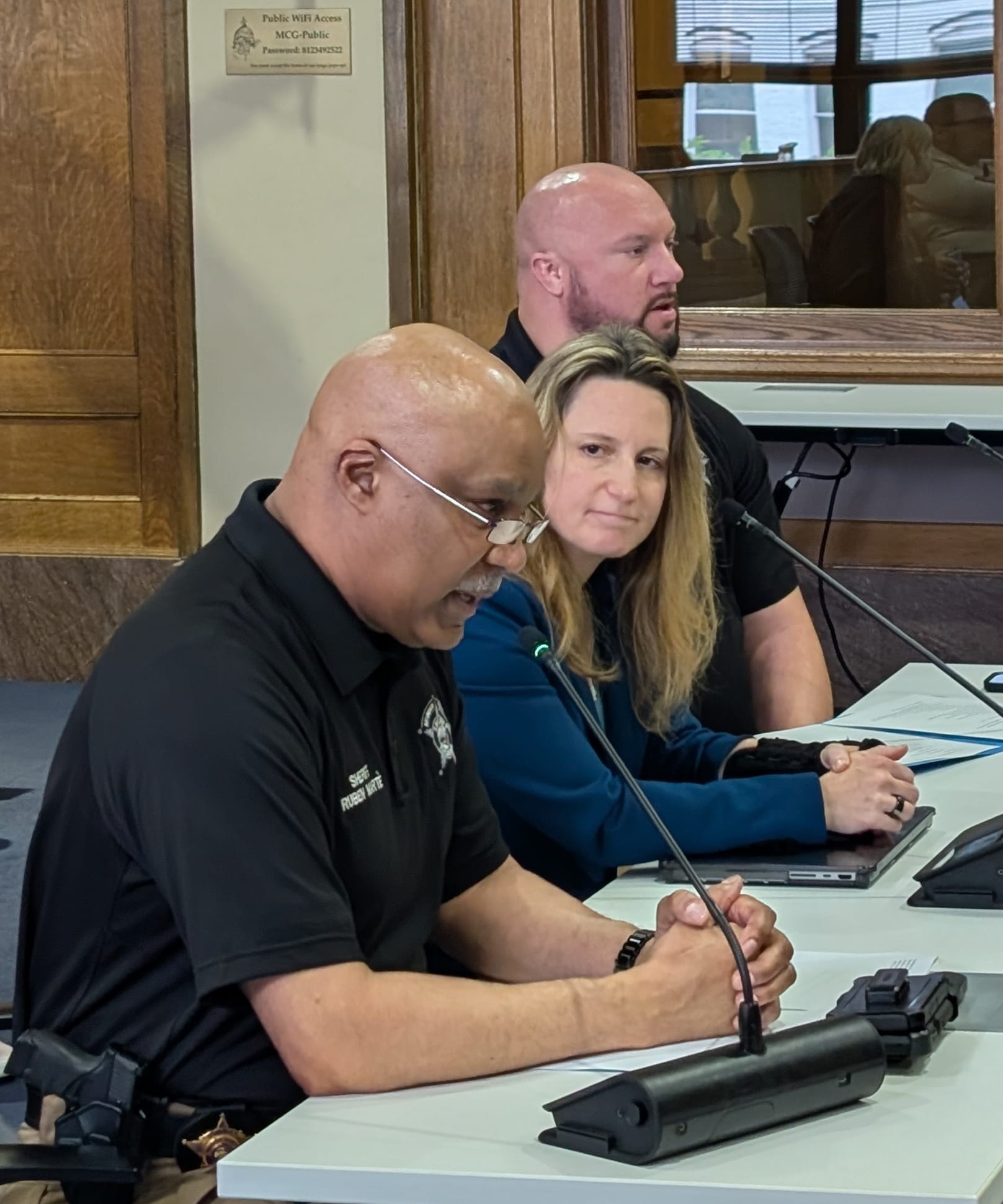
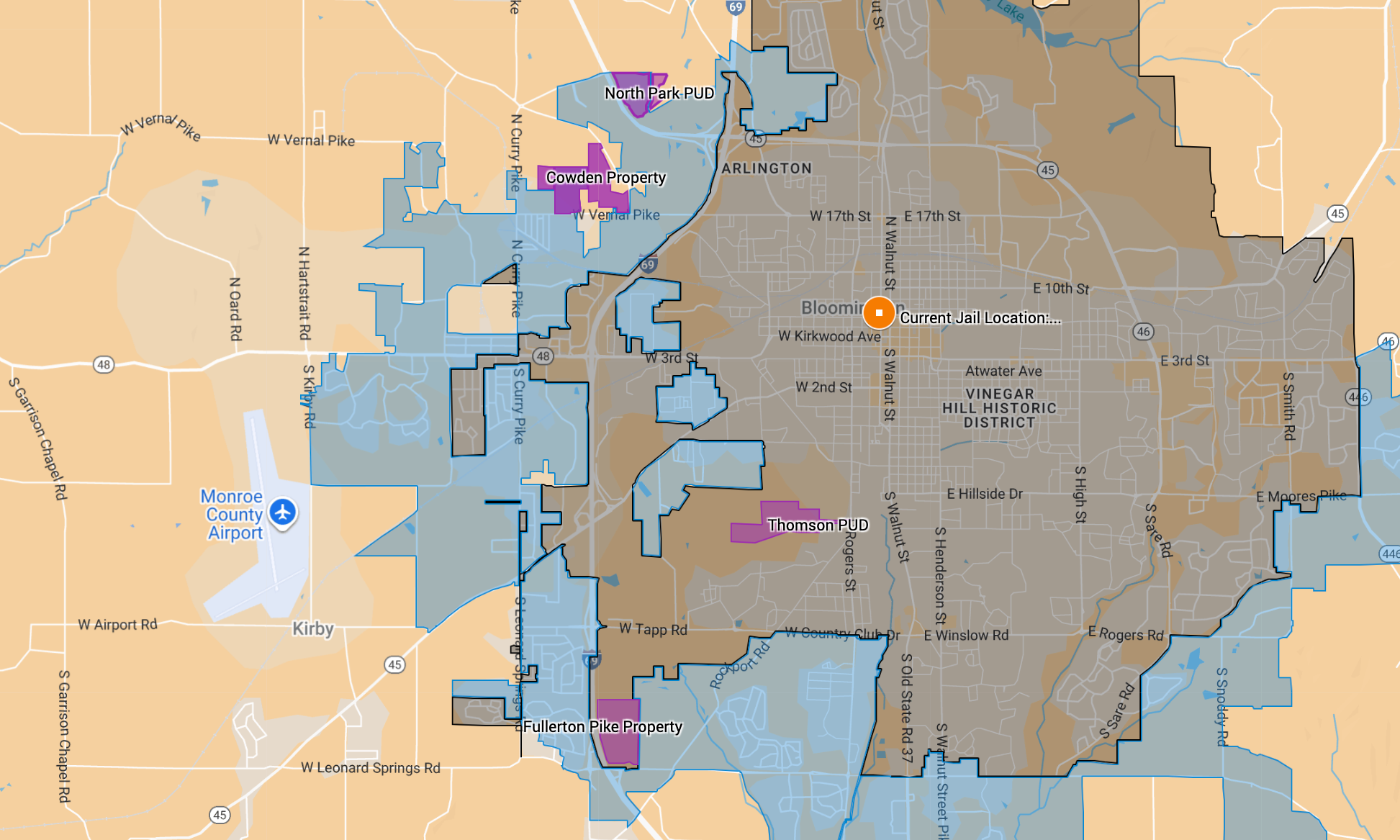
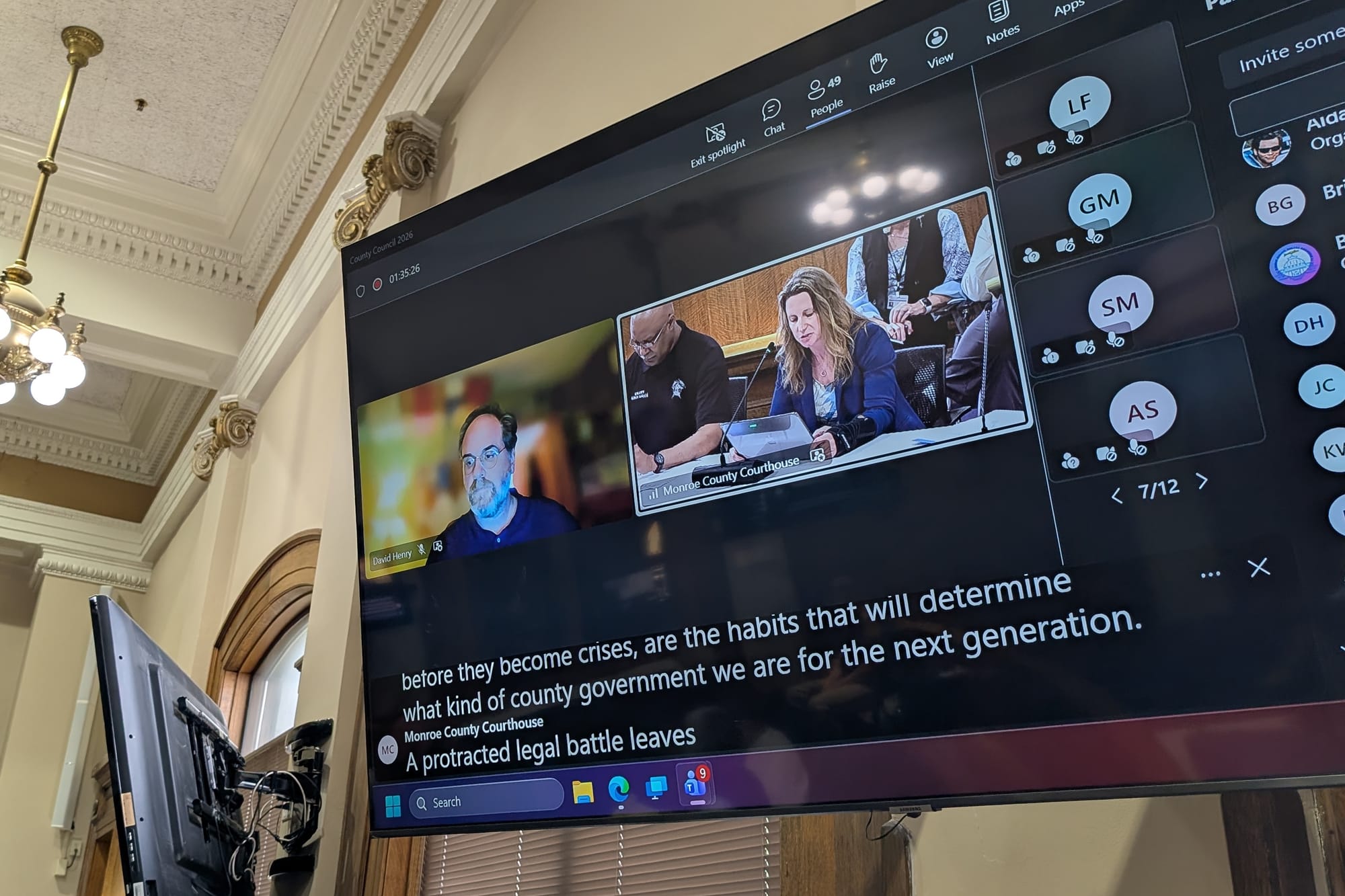
Left: Sheriff Ruben Marté, commissioner Jody Madeira, and jail commander Kyle Gibbons address the county council. Middle: Map by The B Square. Purple properties have been given serious consideration by Monroe County official as the site of new jail. The orange dot is the location of the current jail. The blue areas are all a part of pending litigation involving their annexation into the city of Bloomington. [link to dynamic map] Right: Councilor David Henry joined Tuesday’s meeting from a remote connection. Here Henry is listening to Madeira address the council.


Comments ()