
Pillar Arts eyes former Herald-Times building for regional creative arts hub
As MCCSC moves to sell the former Herald-Times building, Pillar Arts is pitching a $16 million regional creative hub at the site, supported in part by a $4 million READI grant request. MCCSC says it has no update on the sale process.
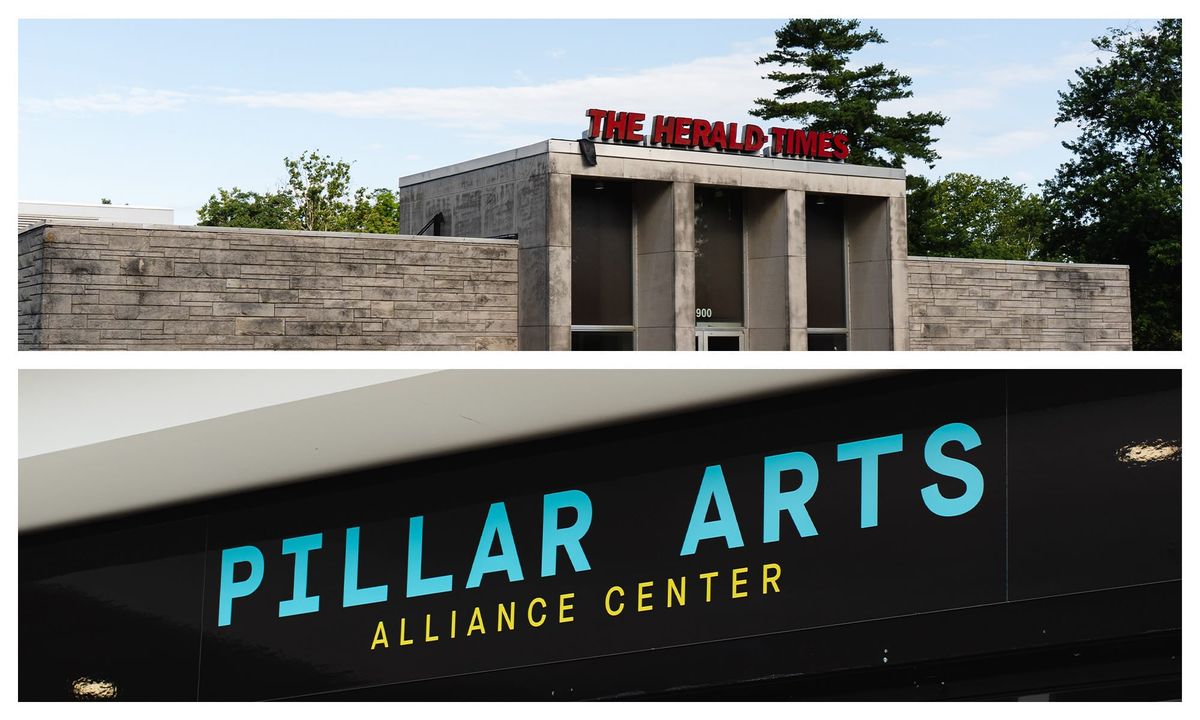
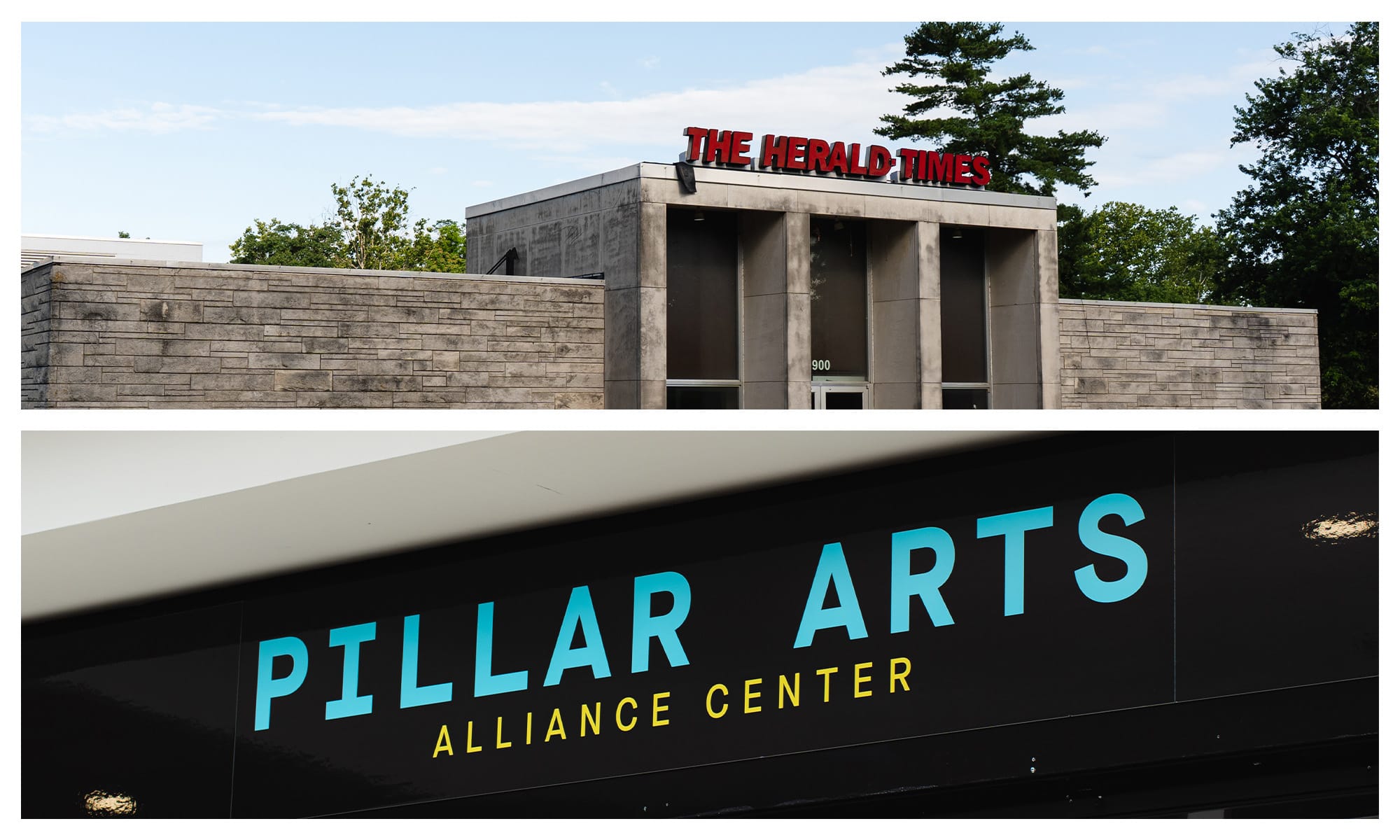
In March, trustees of the Monroe County Community School Corporation (MCCSC) voted unanimously to sell the former Herald-Times (H-T) building, which the district has owned since 2023.
As the district moves to sell the property, a local arts organization is pitching a plan to give the building new life.
In January, MCCSC collected community feedback about the property’s use. The board summed up community comments as a roughly even split between using the property for a school-related purpose and selling it. Citing financial challenges, the board voted unanimously to begin the process of selling the property.
The financial challenges forming the backdrop to the decision include the district’s two-year plan to reach financial sustainability. MCCSC chief financial officer Matt Irwin told the board initial estimates for necessary repairs and building improvements were around $35 million.
A notice indicating the district’s intent to sell, as required by law, was posted on April 8.
On Tuesday (June 23), a spokesperson from MCCSC wrote in an email to The B Square: “We do not have an update on the sale process of the former HT building at this time.”
Background: Former Herald-Times property
At the end of 2022, MCCSC purchased the property at 1900 S. Walnut St., which was the former headquarters of the Herald-Times, where reporters, editors, and staffers worked, and where newspapers were printed. Acquired during previous superintendent Jeff Hauswald’s tenure, the property cost the school district just under $3 million.
Since then, the building has been used as an overflow storage space for school materials and equipment, and the parking lot has held school buses. Zoned commercially, the property had an assessed value of about $1.42 million in April of this year.
The B Square got a look inside the building earlier this year.
One potential future: A regional arts center
One organization with its eye on the former Herald-Times property is Pillar Arts, the new name of the Arts Alliance of Greater Bloomington, a non-profit organization supporting artists in the Bloomington area. Pillar Arts currently operates two physical spaces: the Arts Alliance Center in the College Mall, and the By Hand Gallery in the Fountain Square Mall downtown.
In April, Pillar Arts submitted its application to the READI 2.0 Arts & Culture Initiative, which is a $65 million statewide granting program supporting arts- and culture-driven projects. The program is administered by the Indiana Economic Development Corporation with the Indiana Arts Commission. According to the program timeline, award notifications will be issued on July 1.
Pillar Arts is requesting a $4 million grant from READI to put towards an “Integrated Arts Creative Hub.” From its website:
Pillar Arts proposes the Integrated Arts Creative Hub, a 52,000-square-foot, purpose‑built creative anchor facility in Bloomington, Indiana, centered on the adaptive reuse of the former Herald‑Times building at 1900 South Walnut Street. For two generations at least, this landmark served as the home of Bloomington’s daily newspaper and sits at the southern gateway to downtown Bloomington, anchored by the B‑Line Trail and adjacent to Switchyard Park.
The Integrated Arts Creative Hub will serve all 11 counties of the Indiana Uplands, bringing together gallery and exhibition space, a public café and culinary test kitchen, a professional performance and event hall, artist studios and flexible creative workspaces, and entrepreneurship and workforce development programs within a single, public‑facing destination. Designed as an active social commons, the facility will support daily community use while providing the professional infrastructure needed for creative careers to grow.
The total project, which would occupy the former Herald-Times building, is budgeted at $16 million. According to the website that Pillar has set up for its proposal, the $4 million would cover property acquisition, in addition to feasibility studies, architectural and engineering development, project staffing, governance and fundraising consulting, programming and marketing, and more.
Pillar Arts executive director Charles Pearce, who is the first to hold that position in the organization, told The B Square this week that during his time with the organization, it has gone through significant growth and change. He started serving as executive director in November 2024.
That growth included inheriting the By Hand Gallery, improvements at the Arts Alliance Center, and financial growth. In 2025, the organization generated about $249,000 in revenue, and paid $99,000 of it to artists. According to a 2025 impact report, the organization has seen a seven-fold increase in its consolidated cash balances over the previous five years. “We want to grow our strategic savings,” Pearce said. “We’re entering economically volatile times, the way people buy and spend on art is changing, ... we’re seeing an increased demand for arts- and skill-based classes and workshops, so for us to have financial savings helps us pivot into these things.”
While the organization had 159 members in 2025 who pay membership fees, Pearce said a lot of the revenue comes from the retail gallery spaces, where artwork is available for sale. Artists pay the organization monthly fees for displaying their pieces in the galleries, and the organization receives about a 15% commission on art sales. Artists can use volunteer hours to pay their monthly display fees. This organization-artist relationship, Pearce said, also creates a healthy pressure for artists to evolve their artwork as needed, and encourages natural rotation of art pieces on display.
Pillar Arts is still figuring out how its two spaces work together, Pearce said. But Pillar leases both spaces and the organization is seeking physical stability: “Having seen how we’ve had to move in the mall multiple times has always given us a bit of anxiety about: How much can we invest in a space, if we relocate frequently?” Pearce said. He said the organization has been looking for a revenue-positive retail arts center that doesn’t rely on recurring donations. “We can’t just be out there asking for philanthropic giving over and over again,” he said.
The vision, according to Pearce, is a facility with art spaces and studios, but also revenue-generating aspects including food and beverage. Those commercial elements, he indicated, would feed into the arts mission by making it a routine part of community life: “And now you’ve got [a] really great community ritual that brings people into creative spaces,” he said, “and you have solved a big piece of your revenue problem for building.”
He continued, “This has been such an interesting idea ... we’re not the first ones to come up with it, and we're not even the first ones in Bloomington to talk about it.” The city of Bloomington commissioned an Arts Feasibility Study in 2022, which is cited in the Pillar Arts proposal. The website says the study formally documented a lack of sufficient accessible, flexible, and affordable space for independent creative work in Bloomington, “concluding that existing venues are either too small, too inflexible, or largely unavailable to non-university artists.”
When the READI grant opportunity opened up, Pearce and the organization began writing a proposal for the general concept, without a specific site yet in mind. About a week into the drafting process, the MCCSC board voted to sell the former H-T building. “Wouldn’t it be amazing,” Pearce said, “if an arts non-profit could rescue a building from the school corporation that has real consequence and history in our community, to activate it in a way that helps everyone?”
The Herald-Times building is attractive to Pillar Arts for several reasons, according to Pearce. Among its draws are the building’s more than 77,000 square feet, its location, a parking lot with more than 170 spaces, and easy access, especially for people with limited mobility. Pearce also liked the property’s proximity to Switchyard Park and to Bloomington High School South, which could loop in the younger community. The building also contains office space, storage, loading docks, and large open spaces without columns, offering flexibility.
Pearce said the organization is working to reach out to MCCSC. An MCCSC spokesperson said in an email responding to a B Square question on Tuesday (June 23) that the district “do[es] not have a comment on Pillar Arts.”
“If we don’t raise $16 million,” Pearce said, “we will do something else. We will evolve our plan based off of how much we bring in.”
[Editor's note: One of the letters of support submitted with the Pillar Arts READI grant application was written by editor and publisher of The B Square Bulletin, Dave Askins.]
[Added July 2, 2026 at 3:17 p.m. In an email to Pillar newsletter subscribers on July 2, 2026, Pearce announced that Pillar’s application was not successful: “We did not receive a READI award. The Indiana Economic Development Corporation & Indiana Arts Commission (IEDC & IAC) offered us capacity building support, and feasibility studies. I've graciously accepted the additional resources; I am hopeful the additional support will benefit us all, and lead to a better future for artists and Pillar Arts.” ]

Comments ()