
RDC bets on Hopewell South engineering as rezone heads back to plan commission for second hearing
Bloomington’s plan commission is likely to vote Feb. 9 on rezoning 6.3 acres of the former IU Health hospital site for the Hopewell South PUD. Meanwhile the Bloomington RDC is already moving a ahead with a $424,000 preliminary engineering contract, OK’d on Monday.
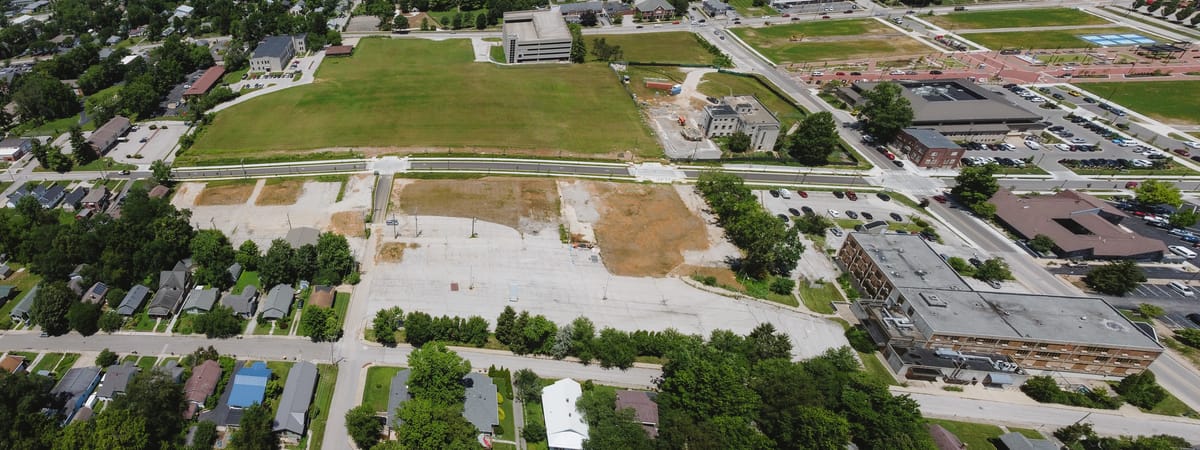
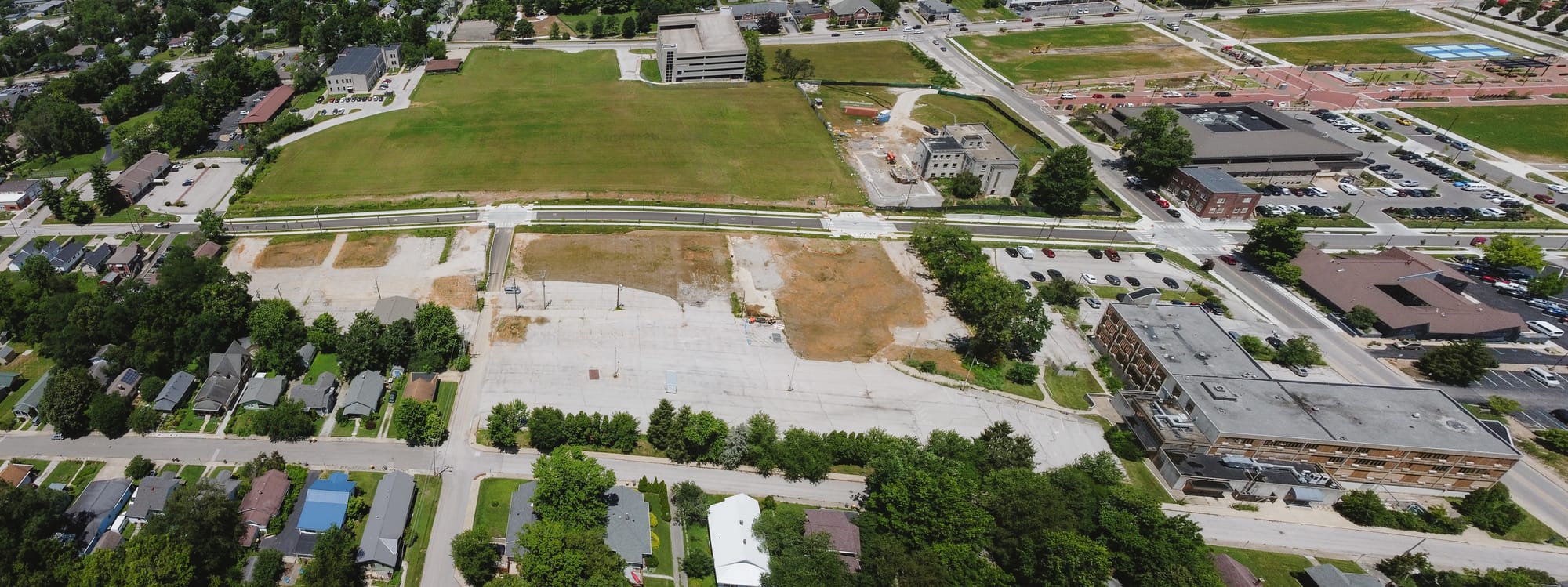
Set for a pivotal decision next Monday (Feb. 9) is Bloomington’s plan to turn part of the now vacant area in and around the former IU Health hospital site at 2nd and Rogers streets into a dense, mostly owner-occupied neighborhood called Hopewell South.
That’s when the city’s plan commission will take a second look at a rezone proposal for Hopewell South, and likely take a vote on its recommendation to the city council about the rezone.
It’s the city’s redevelopment commission (RDC), as the owner of the Hopewell South real estate, that is asking the plan commission to consider the rezone.
Ahead of the plan commission’s recommendation and the city council’s final decision, expected sometime in March, the RDC this Monday (Feb. 2) approved the funding for a $424,200 preliminary design contract with CrossRoad Engineers to design roadway improvements, internal streets and lanes, water and sewer networks, and stormwater system for Hopewell South.
The risk that significant changes could be made by either the plan commission or the city council—which could mean reworking the engineering design, adding to the cost—was a big source of concern for RDC members on Monday.
They got assurances from city project engineer Kendall Knoke that he would give them bi-weekly updates on how the work was going. Knoke also told them that much of the work at the very start would need to be done the same way, no matter what changes might be undertaken by the policy-making bodies. That was enough to allay most of the concerns, but RDC member John West still voted against the resolution that funded the CrossRoad Engineers contract, which had already received approval last week from the board of public works. It passed on a 4–1 vote.
That was enough to allay most of the concerns, but RDC member John West Randy Cassady still voted against the resolution that funded the CrossRoad Engineers contract, which had already received approval last week from the board of public works. It passed on a 4–1 vote.
Plan commission: Initial discussion on Hopewell South PUD
At its Jan. 12 meeting, the Bloomington plan commission reviewed the RDC’s petition to rezone about 6.3 acres—blocks 8, 9 and 10 near West First and Rogers streets—to a PUD (planned unit development), which is commonly described as a kind of custom zoning. The land is south of 1st Street across from the former main campus of the former IU Health Hospital site.
The PUD would replace standard R4 zoning and the existing Transform Redevelopment Overlay (TRO) with a custom ordinance and preliminary plan. The west side would largely follow R4-style residential rules with major modifications, while the east side, which includes the former Bloomington Convalescent Center building (714 S. Rogers St), would follow mixed-use standards and could accommodate uses such as a potential police headquarters.
The concept calls for a mix of single-family homes, duplexes, triplexes, four-plexes and a handful of small multifamily buildings, totaling around 100 units. City staff and consultant Alli Quinlan with Flintlock LAB, say smaller homes on smaller lots are key to lowering prices. Buyers would choose from a pre-approved “housing catalog” of plans already vetted by planning and building staff, allowing lots and permits to move quickly and potentially creating a model that could be used elsewhere in the city.
To increase buildable area, the PUD proposes zero internal setbacks, no maximum impervious-surface limit on one parcel, and narrower streets than the transportation plan typically allows. It would also introduce 20-foot-wide public “lanes,” narrower than standard streets, to function like alleys while still carrying addresses.
Some homes would front onto green space and pedestrian paths instead of streets. A central landscaped spine would double as park space and stormwater infrastructure, with a mix of underground detention and surface green features coordinated with city utilities.
Affordability and accessibility drew the most scrutiny. The draft Hopewell South PUD requires at least half of homes, at first sale, to go to buyers under 100% of area median income (AMI), and at least 15% of all units to be permanently income-limited to households under 120% of AMI.
Commissioners asked whether the project could meet stronger AMI targets for PUDs generally in the city’s Unified Development Ordinance (UDO)—which had at the time of the plan commission’s early January meeting not yet been enacted by the city council. But at the council’s Jan. 14 meeting the council passed an ordinance that changes the UDO:
- Tier 1 incentives will require 15% of units to be restricted to people earning 90% of AMI.
- Tier 2 incentives will require 15% of units to be restricted to people earning a mix of below 70% and below 90% of AMI.
A Tier 1 project can exceed the base zoning height limit by one additional floor, capped at 12 feet. A Tier 2 project can exceed the height limit by two additional floors, capped at 24 feet. That is, in order to build taller, the developer has to make some of the units available to people earning less than the previous standards. The Hopewell South PUD could not have to meet the new UDO affordability standards for PUDs—because the Hopewell South area plan was filed with the planning department ahead of the enactment of the new standards.
Impact of plan commission Hopewell South deliberations on city council UDO concerns
At the plan commission’s first hearing on the Hopewell South PUD, held in early January, commissioner Steve Bishop zeroed in on the tension between permanent affordability and conventional mortgage finance.
He flagged the fact that strong deed restrictions—of the sort the UDO currently requires for PUDs—are often at odds with how loans are underwritten and sold into the Fannie Mae and Freddie Mac secondary markets. He said that if you make the restrictions too tight, you may unintentionally shut typical buyers out of mainstream mortgage products. Bishop is Bloomington Market President for First Financial Bank.
Bishop’s concerns led to the drafting of another UDO amendment that Bloomington mayor Kerry Thomson floated at the city council’s Jan. 14 meeting, and could get formal consideration at this Wednesday’s (Feb. 4) city council meeting.
Hopewell infrastructure
While the city’s plan commission and the city council are mid-process settling the zoning questions, the RDC was briefed Monday (Feb. 2) on the prospect of some homebuilding in Hopewell South getting started by April of this year and infrastructure work underway by August.
The early start for some of the houses could come right along 1st Street, assistant city attorney Dana Kerr told RDC members. It would be for four lots that simply need a lot line adjustment in order to get started with construction.
RDC member John West was keen to find a way to guard against the risk of committing money and spending money on preliminary engineering design with CrossRoad—when there is still a chance that the parameters of the project could change, depending on what the plan commission recommends and the city council decides. West was not alone in voicing that concern, as it was shared by RDC president Deborah Myerson and RDC member Randy Cassady.
The assurance of regular updates from Knoke in the city engineering department seems to have been enough to keep West Cassady from putting up greater resistance, but he registered his concern with a no vote.
Comments ()