
Bloomington sets $7.59M minimum for College Square as hotel plans remain unsettled
Bloomington’s redevelopment commission will consider a public offering Monday (April 20) for the 2-acre College Square site, with a $7.59 million minimum price. The move comes as the CIB seeks a 30-day pause to negotiate a land swap tied to a convention center host hotel proposal.
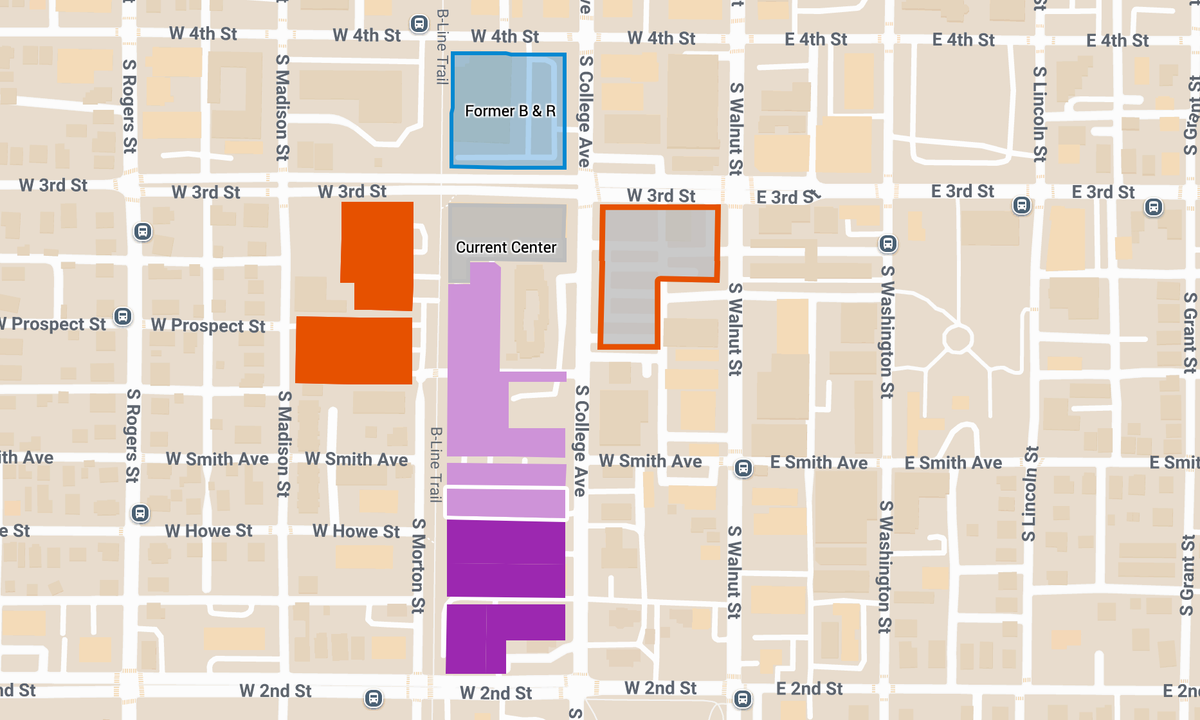
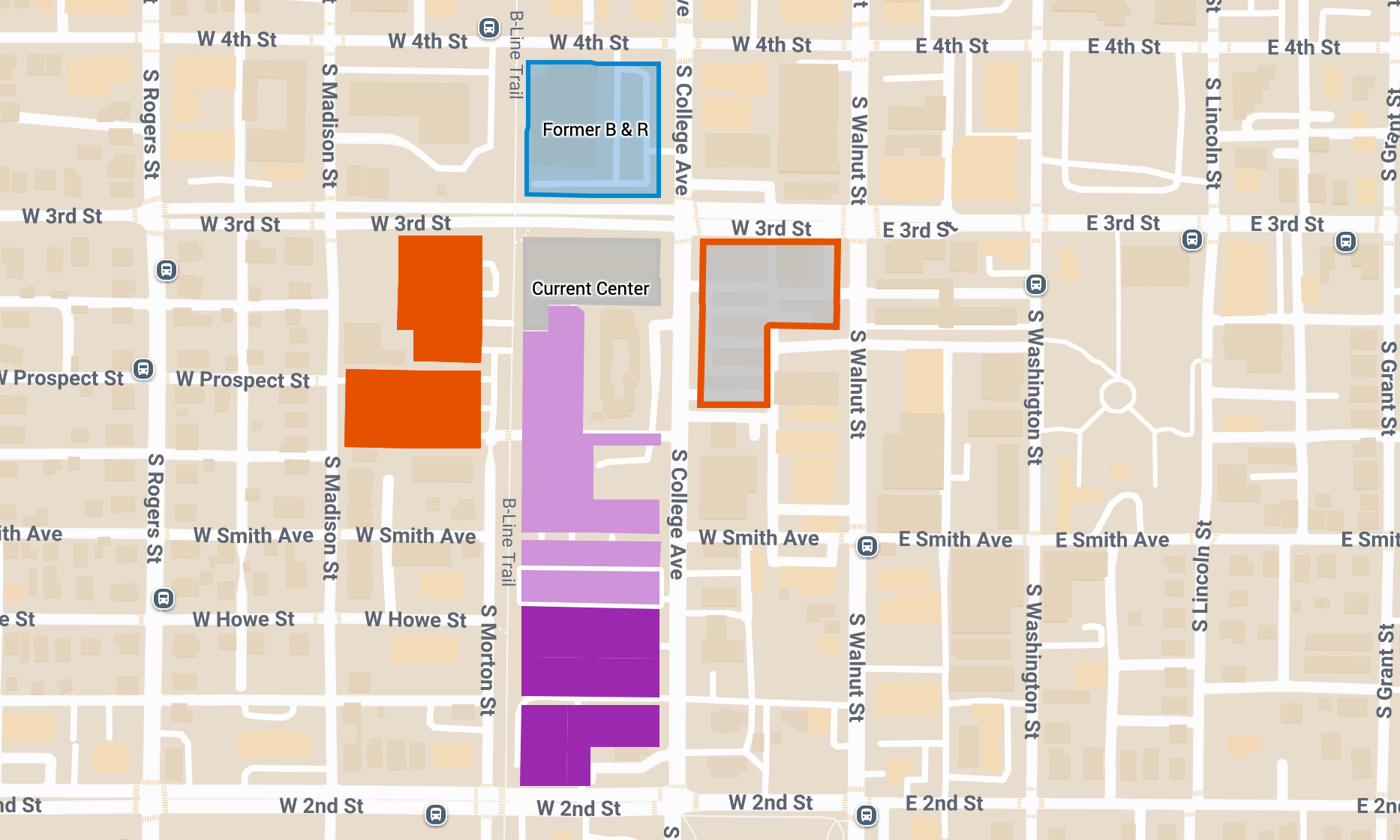
A public offering of the downtown Bloomington real estate at 4th Street and College Avenue, which is owned by Bloomington’s redevelopment commission (RDC) appears on the RDC’s regular meeting agenda for Monday (April 20).
The 2-acre parcel in question is named College Square, but is known informally as the former Bunger & Robertson lot, which was purchased in 2019 by the RDC, when John Hamilton was mayor, for just shy of $7 million. The public offering to be considered on Monday sets the minimum offering price set at $7.59 million, the average of two appraisals.
Approval of the public offering is not something the Monroe County capital improvement board (CIB) wants to see as soon as Monday. The CIB made an effort this past Wednesday (April 15) to convince the RDC to hold off for 30 days on the public offering, in order to negotiate a land-swap idea tied to the convention center host hotel.
The CIB is looking to swap the Seminary Pointe block, which has now been transferred by the county government to the CIB, to the Bloomington RDC in exchange for the College Square real estate. The CIB wants to offer the real estate to a host hotel developer.
Dora Hospitality was selected as the CIB preferred hotelier and negotiated with the Bloomington RDC for over a year, before those talks concluded without a deal. The sticking point was price—Dora Hospitality said its project was not economically feasible without a contribution of the real estate at nominal or no cost.
The offering sheet makes clear that the RDC will not consider proposals that would construct student housing, but would consider condominium housing that offers ownership options for residents. Generally, the offer sheet describes the parcel as intended for mixed use, putting it like this: “[T]he RDC prefers mixed‑use projects that leverage Bloomington’s economic strengths in life sciences, technology and innovation, defense technology, destination tourism, and higher education.”
Still, the RDC’s offering sheet also explicitly mentions the possibility of a host hotel project at College Square. But the scenario is one where a hotel developer responds directly to the public offering:
Proposals that include a host hotel for the Convention Center expansion project must also receive approval from the Monroe County Capital Improvement Board (CIB). Respondents shall be solely responsible for securing all necessary CIB approvals and providing such documentation to the Redevelopment Commission as a condition of award, negotiation, and closing.
It was immediately after Wednesday’s CIB meeting that CIB president John Whikehart emailed RDC president Deborah Myerson with a request that the RDC wait 30-days before makint its public offering.
The fact that the offering appears on Monday’s agenda means the RDC could decide at that meeting whether to go ahead immediately with the public offering, or grant the CIB’s request for a pause.
If the RDC moves forward with the offering, it does not seem to necessarily rule out the idea of a land swap with the CIB. Presumably, the CIB could respond to the RDC’s public offering with a specific land swap proposal.
Or the CIB could conclude that the College Square site is conclusively, for all time, off the table as a potential host hotel location. The CIB could then move ahead with a public offering of its own, for the Seminary Pointe block as a potential host hotel site. The College Square site is generally considered a better location for a host hotel than the Seminary Pointe site, because of its closer proximity to the courthouse square.
The potential land swap raises questions about relative property values. In a comment left on B Square coverage about the county government’s land swap, Amplify Bloomington CEO and former Bloomington mayor John Fernandez asked: “Has anyone seen appraisal for the land the County is transferring to the CIB?
A reply came from Geoff McKim, who is Bloomington’s controller: “[T]here is no recent appraisal. Presumably there was one when the Convention Center Building Corporation purchased the property back in 2010—but nothing current. Of course there would need to be one (or two) before the CIB could leverage the value of the property in any swap or sale to a public entity at least.”
The property that was transferred to the CIB was acquired by Monroe County in 2010 for $2.57 million using innkeeper’s tax revenues as part of a long-term strategy tied to convention center development. The property has commercial and residential tenants.
The residential tenants have been notified their leases, for apartments that are among the cheapest in the city, will not be renewed past July 7 this year. One of the arguments for the land swap is that the city of Bloomington would be in control of the Seminary Pointe property and could treat the real estate as an opportunity to develop or preserve affordable housing there.
The Bloomington RDC bought the College Square real estate in two separate transactions—one in 2019 and the other in 2023.
Based on the minimum price in the offering sheet, fresh appraisals appear to have been done since the those that were used for the RDC’s purchase of the property. Back then, the average of the two appraisals for the two parcels making up the property was $6,585,000. Here’s the breakdown:
Site details and environmental issues
The College Square site consists of three tracts totaling about two acres between 3rd and 4th streets along College Avenue. The property currently includes a one- and two-story office and storage building with about 39,000 square feet of space and sits adjacent to the B-Line Trail and the convention center area.
The offering packet notes that environmental studies have found that “environmental conditions do exist” on the property based on earlier Phase I and Phase II environmental site assessments. The RDC says it is working with the Indiana Department of Environmental Management (IDEM) to further evaluate the site.
The IDEM virtual file cabinet on the College Square site includes a Phase 2 Environmental Site Assessment, a Supplemental Phase 2 Environmental Site Assessment, and internal IDEM review memos from late 2025 by the agency’s Geological Services, Chemistry Services, and Risk Services sections.
The investigations found that soil on the site does not exceed standards for direct contact, meaning it is not considered a health risk under current state guidelines. But groundwater beneath the property contains petroleum-related compounds and metals above state screening levels, including benzene, arsenic and lead.
IDEM reviewers concluded that contamination in soil appears to be fully identified, but the extent of groundwater contamination has not yet been mapped. Additional sampling may be needed to determine how far the contamination extends and whether cleanup measures or land-use restrictions will be required as part of redevelopment.
According the Supplemental Phase 2 assessment by BCA Environmental Consultants, the site’s history includes gasoline filling stations operating from the 1920s through the mid-20th century, as well as battery service and railroad-related activities.


Comments ()