
Rokita backs Stinesville ICE agreement, but town board puts off up-or-down decision
Indiana AG Todd Rokita says Stinesville’s ICE agreement is valid without town board approval. Immigration attorney Christie Popp disputes his legal reasoning. On Tuesday, the board delayed a decision a month, and created a fund to receive the federal money. County commissioners drew criticism.
Indiana attorney general Todd Rokita has sided with the Stinesville police department in a local dispute over the department’s agreement with federal immigration authorities.
Rokita has concluded that the agreement was legally valid even though it was never approved by the town’s three-member elected board.
At its regular meeting on Tuesday (Oct. 6), the Stinesville town board was set to vote either to ratify or terminate the agreement. Instead, the board put off any decision until November. That’s after receiving Rokita’s six-page letter on the same day of the meeting.
Bloomington immigration attorney Christie Popp, who has previously questioned the legality of the agreement, disputed Rokita’s conclusions, telling The B Square his letter contains errors and contradicts the plain language of Indiana law.
The letter from Rokita was prompted by a Sept. 17 resolution adopted by Monroe County commissioners. The resolution questioned the authority of the Stinesville police department to enter into an agreement with U.S. Immigration and Customs Enforcement (ICE) without formal approval by the town board.
The dispute in Stinesville, a town of just 203 residents according to the 2020 census, has implications across Indiana.
Based on a B Square review a month ago, there were 45 agreements with ICE involving 42 Indiana state and local law enforcement agencies. Those numbers come from ICE data that was downloaded on Sept. 5. Of those agreements, 36 use the same Task Force Model that Stinesville signed.
That model gives trained local officers specified federal immigration-enforcement powers while carrying out ordinary police duties outside a jail. It is broader than ICE’s other models, which focus on people already in custody.
Some Indiana towns, including Waterloo and Andrews, have publicly voted to authorize participation. Others have signed agreements without a similarly clear record of approval by their elected governing bodies.
Rokita rejects legal argument by commissioners
Stinesville’s agreement with ICE was signed on ICE’s side on Feb. 10. For Stinesville it was signed by Shane Pittman, who was deputy police chief at the time.
Pittman has said he signed the agreement at the direction of the previous chief, who had told him the town board supported it. Board members have said they did not authorize the agreement.
The resolution approved by the county commissioners expressed disappointment that the agreement had been signed without a public vote. It requested that the town board suspend work under the agreement pending public deliberation, then take formal action to rescind, ratify or modify it.
The commissioners based their objections in part on Indiana’s Interlocal Cooperation Act, which governs agreements involving governmental entities and establishes procedures for public authorization and oversight. Rokita flatly rejected that interpretation.
His letter concluded that police chiefs and town marshals have sufficient operational authority to enter into 287(g) agreements on their own and that the Interlocal Cooperation Act does not apply.
Rokita also warned that local governments interfering with such agreements could violate Indiana law restricting local limitations on cooperation with federal immigration enforcement. His office could seek civil penalties of up to $10,000 for each violation.
The letter raises the possibility that Monroe County commissioners could improperly pressure Stinesville by threatening to withhold economic development funding. The county commissioners resolution doesn’t include such a threat and does not make county funding contingent on Stinesville terminating its agreement.
Popp pointed to that distinction in her commentary to The B Square about Rokita’s letter. “Contrary to [Rokita’s] assertion, nothing in the Monroe County Commissioners’ Resolution stated that funding to Stinesville would be contingent on the Town Board rescinding the MOU with ICE,” Popp said.
Popp characterized Rokita’s letter as “in many ways self-serving,” pointing to his broader efforts to require cooperation with federal immigration enforcement.
Dispute over the law’s plain language
Popp told The B Square she had identified several problems with Rokita’s interpretation.
The first is his repeated characterization of the agreement as having been signed by Stinesville’s police chief. Pittman, Popp noted, was the deputy chief when he signed it. “So even under Rokita’s own interpretation, the agreement is invalid,” Popp said.
Rokita also cites a state law giving police chiefs exclusive control of their departments. But Popp pointed out that the statutory language qualifies that authority by making it subject to the rules and orders of the appropriate safety board.
Another point of contention concerns the Interlocal Cooperation Act itself. Rokita argues that the law applies to agreements between local governments, not agreements between local police and federal agencies. Popp pointed The B Square to the wording of the act, which explicitly lists federal agencies among the governmental entities to which the chapter applies.
Popp also cited a separate provision specifically addressing interlocal agreements involving law enforcement. She rejected Rokita’s suggestion that applying the statute would effectively prevent Indiana police departments from entering into 287(g) agreements.
Her position is that the agreements are permissible, but must be authorized through the proper public process. “Requiring a state or local political subdivision to follow the statute and the democratic process when signing an agreement with ICE does not restrict cooperation with ICE,” Popp said.
She also stressed that federal law does not require local governments to sign 287(g) agreements.
Town board postpones vote, establishes fund
At Tuesday’s meeting, town attorney Darla Brown said she had prepared two alternative resolutions: One to ratify the ICE agreement and another to terminate it.
Rokita’s letter had arrived too late for her to evaluate his legal arguments before the meeting. She said she had not yet checked the citations in his letter.
With only two of the town’s three board members present, board president Scott McGlocklin favored waiting until November. “I personally am not comfortable with going either way tonight,” he said.
Brown had told the board at its Sept. 22 work session that it needed to decide publicly whether to continue or terminate the agreement. Rokita’s opinion calls into question the necessity of such approval.
The decision also has financial consequences for the small town.
Pittman has described the ICE program as an opportunity to obtain resources for a police department whose officers have often purchased their own equipment.
At Tuesday’s meeting, McGlocklin said the town had already received $122,500 in federal funds associated with its participation in the 287(g) program. The money has not been spent.
But the money needed to be deposited somewhere. So at its Tuesday (Oct. 6) meeting, the town board approved Ordinance 2026-11, establishing a Homeland Security Law Enforcement Support Fund to hold the money. The ordinance allows the fund to receive additional federal payments and reimbursements. But board members stressed that establishing the fund did not settle the underlying question of whether to continue the ICE agreement.
Pittman has also said the department applied for a federal grant that could fund two full-time officers and an administrative position for three years. That funding has not yet been awarded.
Parade sign adds to friction with county commissioners
The legal disagreement has also spilled into a more personal dispute between town and county officials.
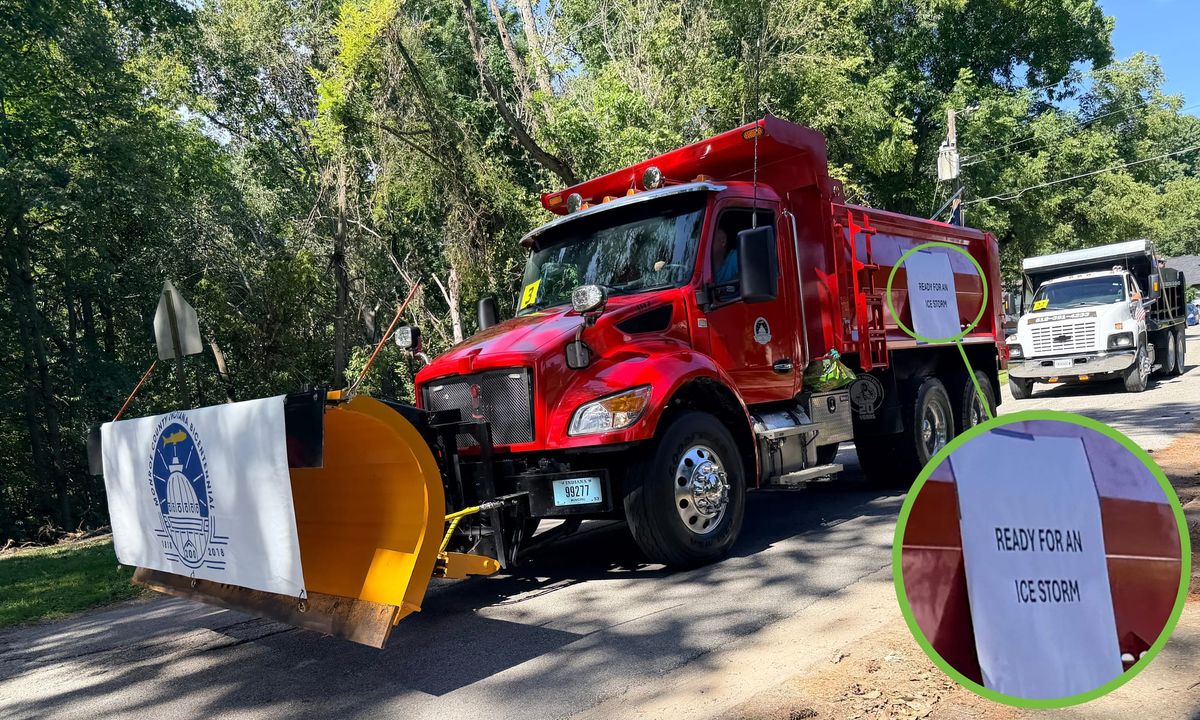
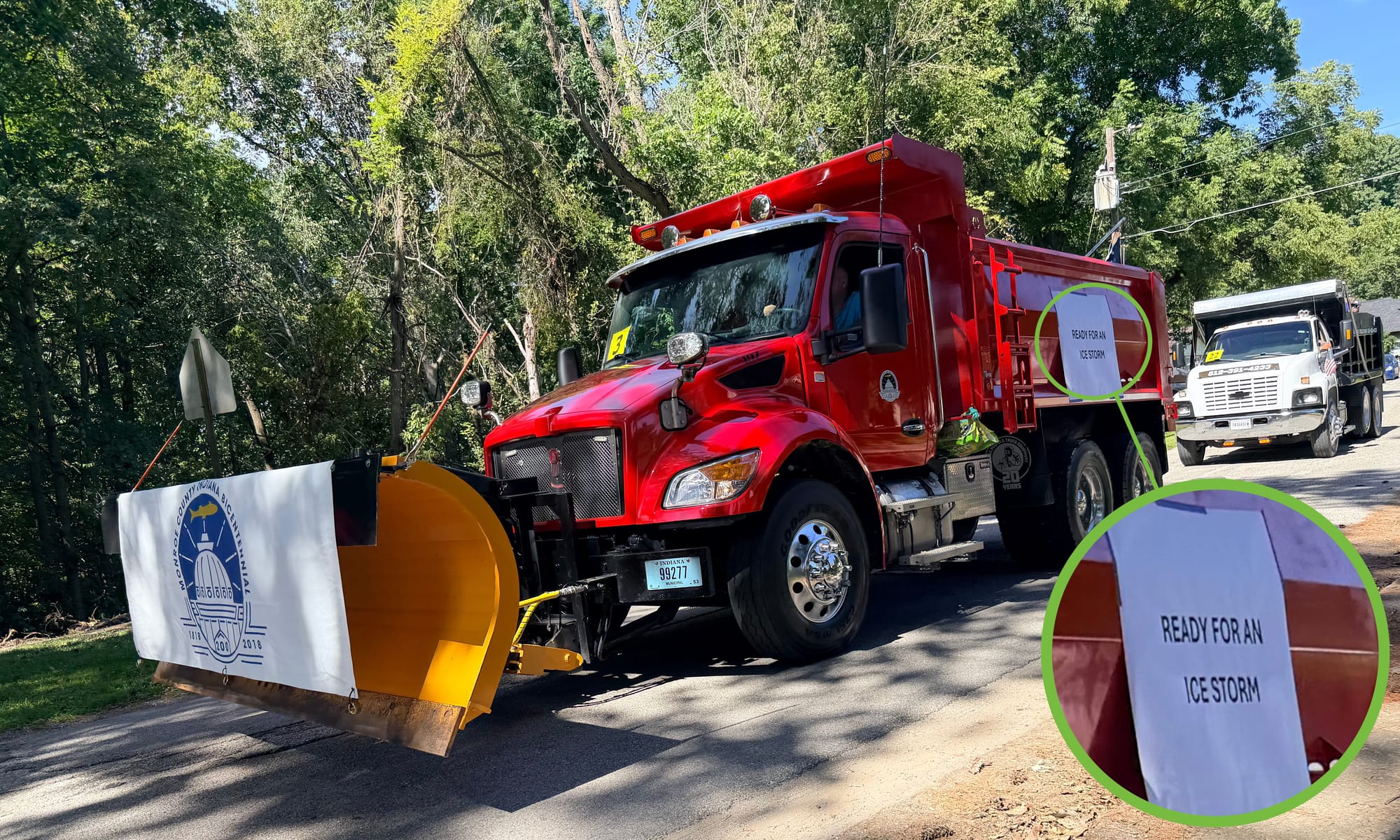
During Tuesday’s meeting, McGlocklin read a prepared statement criticizing Monroe County commissioners, both for their resolution and for what he described as a stunt involving a Monroe County snowplow truck in the Stinesville Stone Quarry Festival parade held on Sept. 26.
McGlocklin noted that the truck carried a sign reading, “ARE YOU READY FOR THE ICE STORM?”
He said the display was inappropriate and interpreted it as an effort by county commissioners to bully the town. “I want to make it perfectly clear: The Monroe County Commissioners will not tell this town how it will run,” McGlocklin said. He stressed that he was speaking for himself, not on behalf of the town board.
McGlocklin also complained that the county government owns two properties in Stinesville where weeds and grass have not been properly maintained. He said the town would issue notices requiring compliance with its ordinance, with citations or cleanup charges possible if the violations are not addressed.
Even though he conveyed his personal ire at the commissioners on Tuesday, McGlocklin has not firmly committed himself to either side of the ICE agreement. He said he disapproves of some of ICE’s activities, but also sees the federal money as a potentially important resource for the town’s police department.
For now, the ICE agreement remains in place, and the federal money remains unspent. And the town board has put off a decision until its November meeting.


Comments ()