
Support heard for renovation of Monroe County jail with added space using Curry Building
A jail-site panel heard public support Thursday for renovating the downtown justice center and expanding, by using the Curry Building. Members kept a July 13 deadline, and prepared to recommend a site from five remaining options after a few weeks of review.
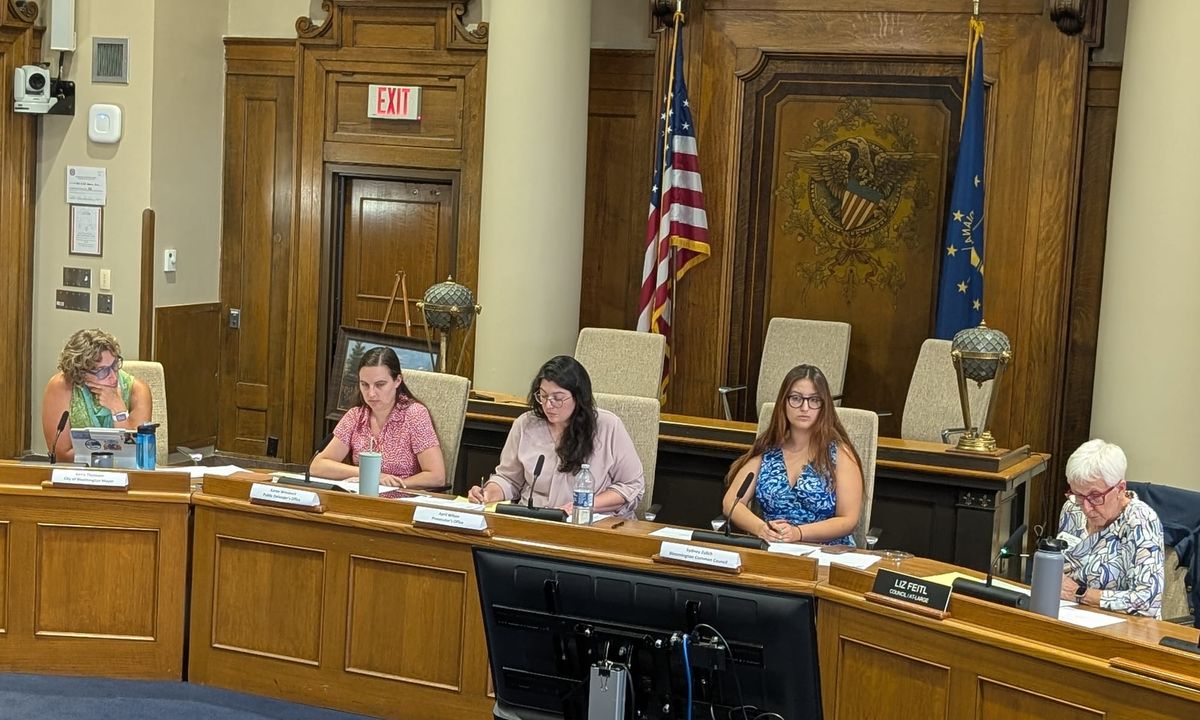
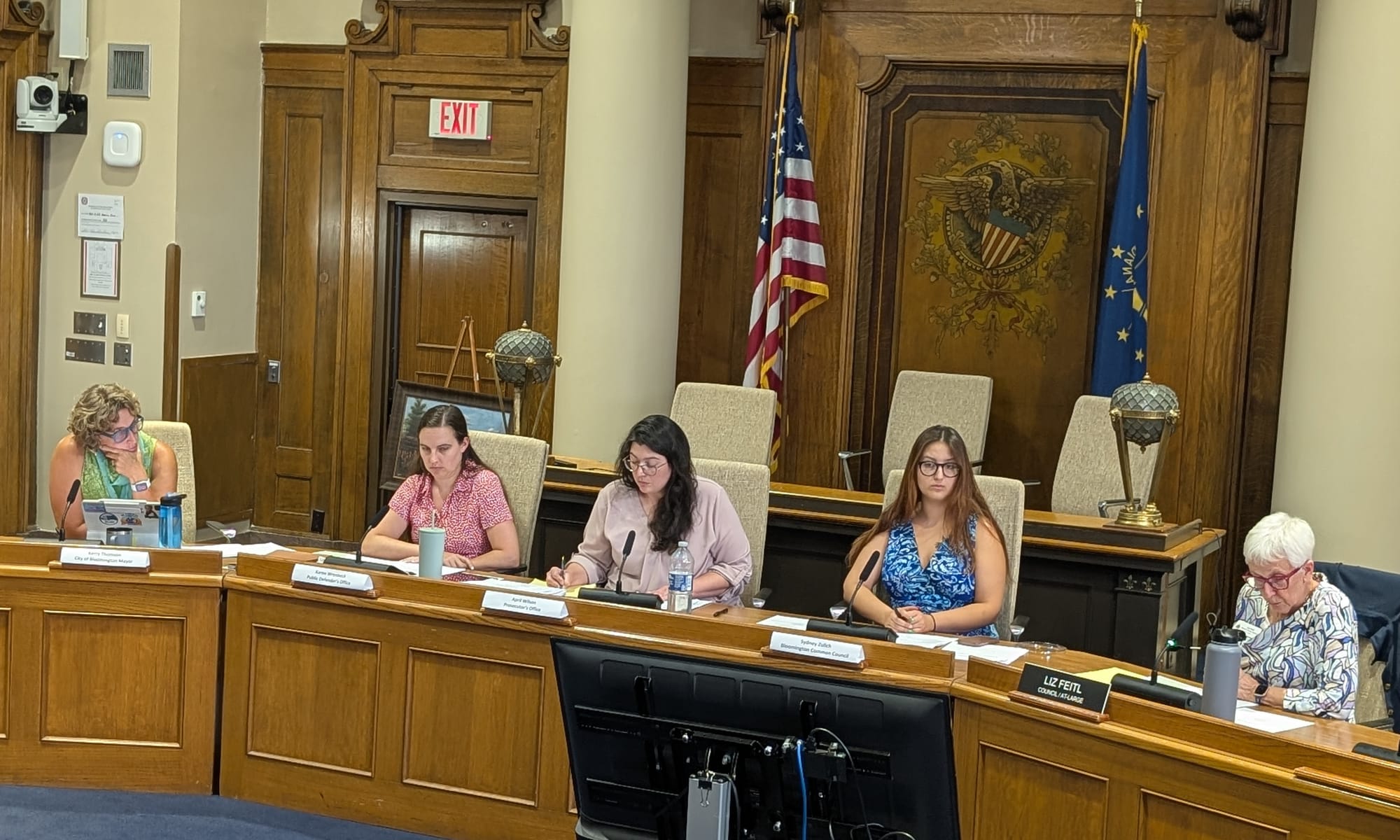
A group of city and county officials with a looming deadline for recommending a new jail site heard from the public at its penultimate meeting on Thursday (July 9).
The committee’s deliberations centered on five of the properties that had been discussed over the last few weeks, since the committee was formed on June 11.
Those scenarios included: renovation of the current justice center building with expansion using the Curry Building; Tapp Road North; Tapp Road South; the Thomson property (aka RCA property); and the Fullerton Pike property, which was rejected by Bloomington’s city council in for a jail rezone in late 2022.
From the public mic, as well as from some subcommittee members, there was support voiced for the idea of using the site of the county-owned Curry Building, in combination with renovation of the current justice center at 7th Street and College Avenue. Curry stands just to the west of the justice center.
The Collaborative Justice Project Working Subcommittee was doing its work following the county council’s May 26 rejection of an $11.375-million purchase of the North Park property, which left the county without a selected site after years of planning for a new jail. [Monroe County Jail Timeline]
At the same time, the county is emerging from nearly two decades of federal court involvement: A lawsuit over conditions at the downtown jail, filed in 2008, was dismissed June 8, but the dismissal left open the possibility of new litigation over jail conditions. Earlier in the day on Thursday, the same day the subcommittee met, county commissioners declared an overcrowding emergency at the jail.
At Thursday’s meeting, deputy prosecutor April Wilson floated the idea of extending the committee’s time past the July 13 deadline, but that idea didn’t get enough support from others to result in a change from the schedule. As county councilor Liz Feitl put it, who serves as the subcommittee chair, “I don’t feel like it’s this committee’s purview to change what it was we were charged to do.”
City council attorney Larry Allen fielded questions about some of the properties. Wilson inquired after the possibility of starting construction on the Thomson site while Duke Energy power lines are being moved. She also wanted to know if it’s possible to co-locate the entire justice system on the footprint of the Thomson site.
Allen’s assessment was that while the power lines, and a debris pile, present a significant barrier to carrying out full construction on the site, it did not prevent access to the site itself. Some level of site preparation work ahead of the construction may be possible as the power lines are being moved, according to Allen.
Wilson also got clarification from Allen about the square footage available in a scenario where the current justice building is renovated and the Curry Building is added as expansion space.
Allen noted that for that location, a rezone would be required in any case along with an exception for adding height: “Some variance with the rezone would be needed, but it is possible with that configuration of site to meet that square footage. It just would not be one floor,” Allen said.
Allen’s comment about “one floor” was a reference to the scenario that for some decision makers is seen as a requirement more than a strong preference—that the new jail be built as a one-story facility.
Bloomington mayor Kerry Thomson spoke about renovating the current justice center and adding adjacent buildings to the project. “It’s perhaps feasible to not disrupt the courts while we’re doing the initial build out on the additional building. So that’s all appealing, obviously, access to resources, transportation, etc., all of that is already there,” she said.
“I think a benefit also, which is not in our matrix, but we have lots of legal offices and other things that have been located close to this location. If it’s not a legal requirement, the number of beds that we build out now,” Thomson added. Thomson concluded: “I see this as a feasible site for a potential phased build out.”
Responding to a question about Wilson about the details of a phased build, Thomson suggested paying to get some outside expertise to get that kind of assessment. “We really could use even a small amount of money to hire somebody with a lot of construction experience to look at whatever our prioritized sites are. I would recommend somebody who doesn’t have a vested stake in building a portfolio project, but can simply assess what are the creative construction solutions at perhaps our top two sites and turn that around quickly,” she said.
A suggestion from city councilmember Sydney Zulich, supported by Thomson, was that subcommittee members arrive at their final meeting on Monday (July 13) session with individual rankings of the properties as a way to start the discussion.
Thomson also weighed in for making not just a top recommendation but also a ranking: “I know we need to pick a top property. My hesitation in stopping there is that if that top property gets eliminated, this subcommittee would perhaps necessarily have to get back together, and I think to complete our work, in my ideal world, we would send some ranking.”
Among those offering public comments at this meeting, support for the option to renovate the current facilities and adding the Curry Building emerged as a popular option.
Randy Cassady, speaking for himself, even though he’s recognizable as a member of Bloomington’s redevelopment commission, voiced his support for that option. “When we look at the existing jail and justice center, co-location in a near downtown area tends to keep the vibrancy, and it also keeps the health and safety of the population of the jail as they’re being released,” Cassady said.
Zach Ammerman urged the subcommittee to take more time, but supported the option to renovate the current facility alongside the Curry Building. “I know you’re in a time crunch that’s not of your own making, but you can ask for more time. That being said, of the five sites that you have that are remaining, I think there’s one clear standout to me—that’s the Curry Building plus renovation. The four other sites to me have all of the same problems as North Park,” Ammerman said.
Eric Spoonmore, president and CEO of the Greater Bloomington Chamber of Commerce, reminded the subcommittee that many of the constraints that were being spoken of were not part of the ACLU requirements for constitutional care. He put it like this: “I think it’s important to remind everybody that colocation, a single story jail, a prescribed timeline, are not requirements of anything that the ACLU has stipulated. We’ve heard from our commissioners and it’s frankly bizarre to me that they would put this narrative out there that we have to co-locate, that we have to have a single story, that we have a prescribed timeline,” he said.
“All I can say is that I know what one solution is not, and it’s not North Park. We have to move beyond that,” Spoonmore added.
His comments came in the context of the regular meeting of county commissioners earlier in the day, where they stressed that time and space are the two factors they will rely on in their choice of a new jail location. And those two factors still point to North Park, a site twice rejected by the county council in the last 10 months.
County commissioner Jody Madeira, who has been participating in the subcommittee’s work as a member of the public, if not formally by sitting at the table, spoke from the public mic on Thursday. She covered some of the same ground as she did in a written memo sent to subcommittee members on the topic of single-story design.
“Jail layout shapes everything inside it: whether officers can see and respond quickly, whether staff are positioned to interact directly with the people they supervise, whether incarcerated people experience constant noise, isolation, crowding, and stress, and it shapes whether the facility encourages order through human contact or relies on barriers, blind spots, and crisis response,” Madeira said. She continued: “Research is clear that older traditional jail designs, especially multi-level linear cell blocks with long quarters, poor sightlines, and remote surveillance, create serious problems.”
The group is set to meet at noon Monday, July 13, to vote on a recommendation.


Comments ()