
Supreme Court refuses to hear case; Bloomington’s annexation defeat in two areas now final
The Indiana Supreme Court declined review, which means the Indiana Court of Appeals ruling blocking Bloomington’s bid to annex two west-side areas will stand. Courts found the city failed statutory tests, and would impose steep tax hikes, handing remonstrators a win.
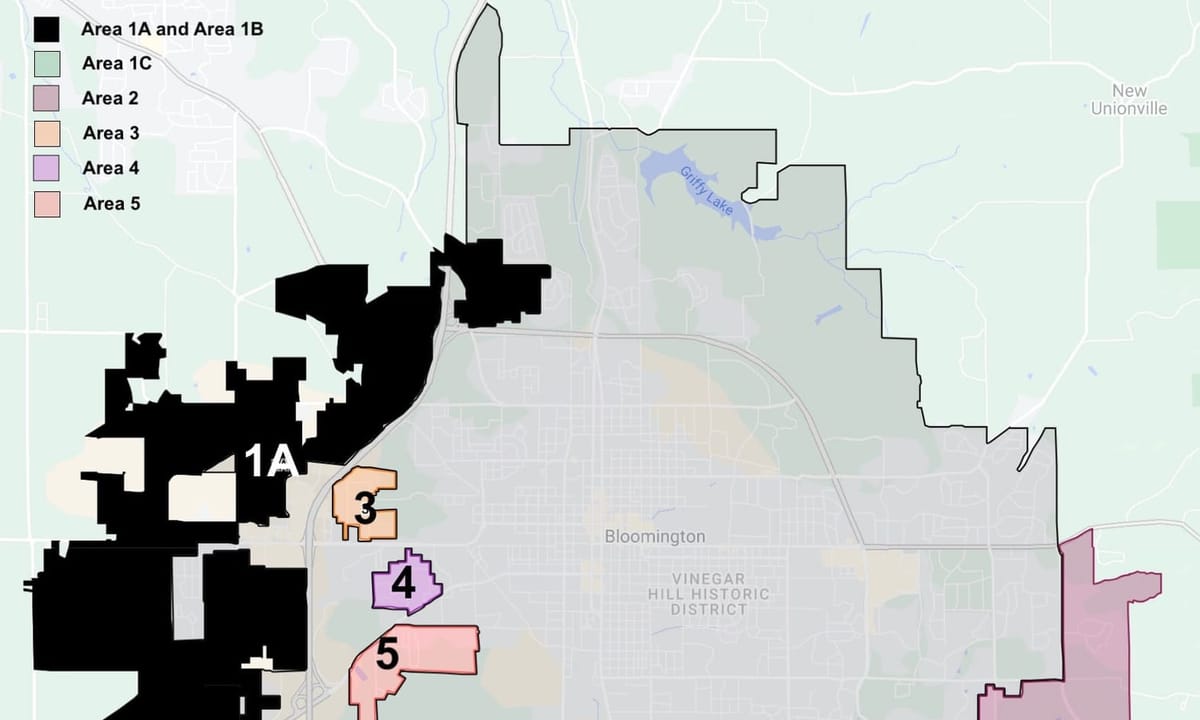
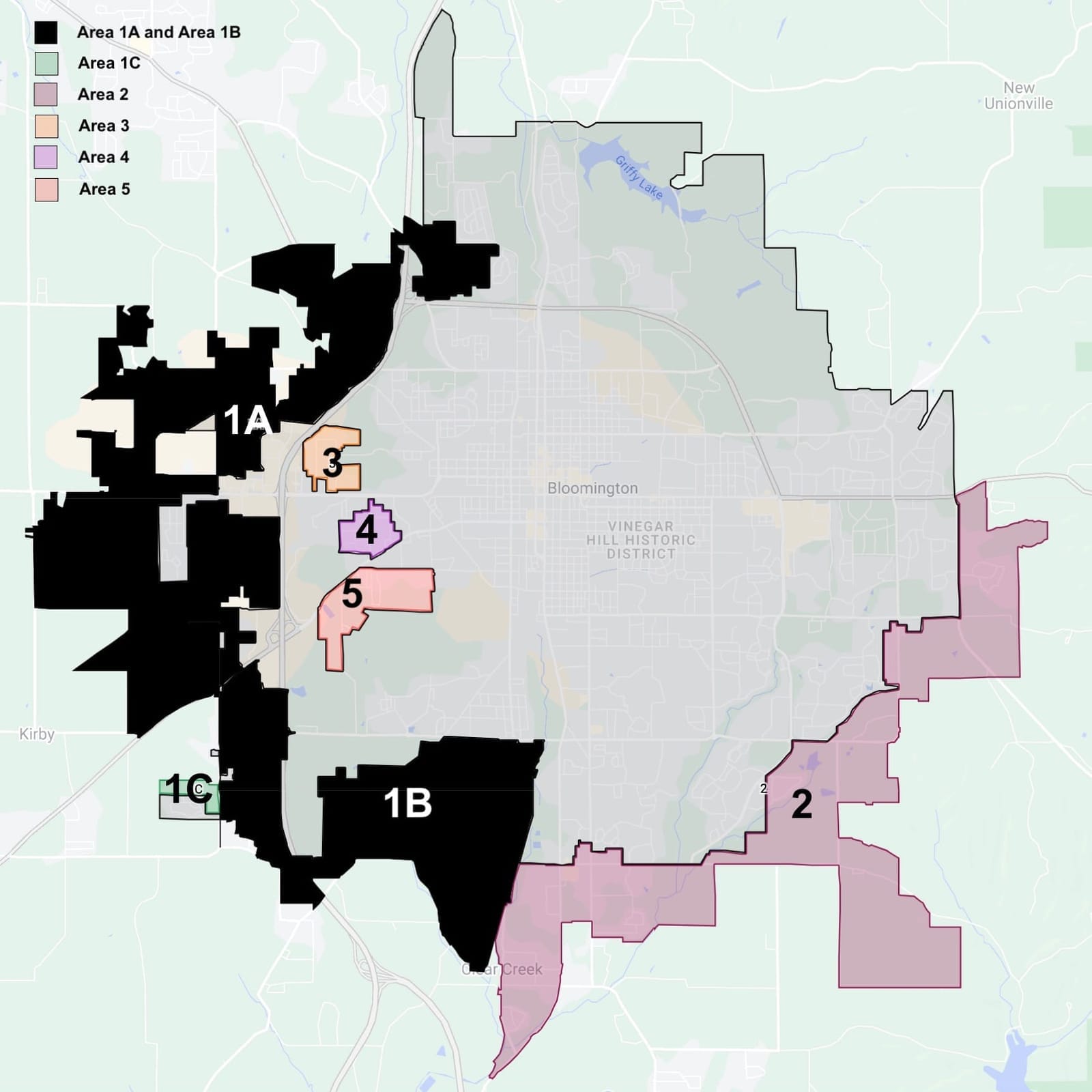
In an order issued at 1:33 p.m. on Tuesday (Feb. 10) the Indiana Supreme Court unanimously declined to accept Bloomington’s request that it review the decision of a court of appeals panel on the merits of annexing two areas west and south west of the city.
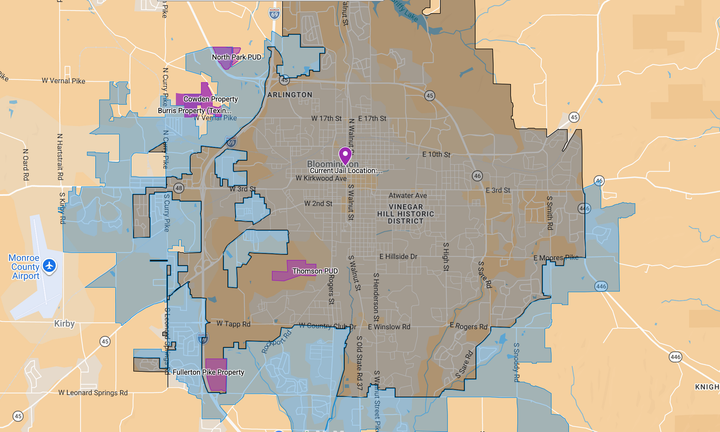
By refusing to accept transfer of the case, the state’s highest court left in place the Sept. 24, 2025 decision of a three-judge panel on the Indiana Court of Appeals, which affirmed a Monroe County circuit court ruling that blocked Bloomington’s attempt to annex two large pieces of land—Areas 1A and 1B. The trial court found the city failed to meet state statutory requirements for annexation, and the court of appeals panel agreed.
The areas are on the west and southwest sides of the city, and are home to over 10,000 residents based on the city’s most recent calculations.
On Tuesday, in a statement to The B Square, Margaret Clements, with County Residents Against Annexation, the group that organized the collection of remonstrance signatures, said: “The unanimous decision of the Indiana Supreme Court speaks for itself.” She added, “Nine judges have agreed with the remonstrators.”
Clements’s tally of nine judges comes from adding the trial court judge, Nathan Nikirk, to the three-member Court of Appeals panel, to the five-member Indiana Supreme Court.
Bill Beggs, the Bunger & Robertson attorney who represented the remonstrators in the case, told The B Square: “We appreciate the consideration of the court and are gratified with the decision.”
The long legal and political battle over Bloomington’s annexation plans, stretches back to waivers signed decades ago, legislative intervention in 2017 and 2019, and a five-day bench trial last year in Monroe Circuit Court.
Petitions against annexation (remonstrances) were signed by more than half of property owners in each of the two areas. After the state legislature voided many of the city’s old remonstrance waivers with a law enacted in 2019, about 61% of landowners in Area 1A and 57.5% percent in Area 1B successfully opposed annexation. That was enough to earn judicial review, but not enough to stop the annexation outright.
For this case, the status of the petitions was not at issue, because the city of Bloomington waived any constitutional arguments involving the petitions for Area 1A and Area 1B. In the other areas subject to the city’s annexation efforts, the city of Bloomington is separately pursuing a case based on the idea that the nullification by the legislature of annexation waivers violated the contracts clause of the Indiana state constitution.
For that separate litigation, oral arguments were to be heard by the Indiana Supreme Court on Oct. 30 last year. A decision could be rendered in the next few weeks, if not sooner.
If the Supreme Court were eventually to find in Bloomington’s favor in the constitutional case, it would mean that the only reason Area 1A and Area 1B escaped annexation was because the city waived the constitutional argument, in order to make its case on the merits sooner rather than later.
Last year, after the bench trial, Nikirk found that Bloomington had not proven either of the statutory “pathways” to annexation—showing either urban character or a need for development in the reasonably near future. It also determined that annexation would have a “significant financial impact” on landowners and was not in their best interests.
Judge Leanna Weissmann’s appellate opinion echoed those findings. She rejected the city’s proposed “hybrid” method of calculating population density and zoning percentages.
The court of appeals also agreed with the trial court’s conclusion that property owners would face steep tax increases. Residents of Area 1A, if annexed, would pay more than $11 million in additional property taxes in the first four years. The figure would be $9 million for Area 1B residents, which is an overall increase of about 40%, both courts concluded.
On the question of whether annexation was in the best interests of property owners, the court pointed to testimony that residents were generally satisfied with existing county government services, while Bloomington’s police, public works, and transit systems were already stretched thin.
Summing up the court of appeals opinion, Weissmann stressed the limited role of the court in an annexation case by citing a precedential case: “The judicial role [in annexation cases] is to decide whether the municipality has met the statutory requirements or flouted them. Courts may do no more; but we must do that much.”
Bloomington mayor Kerry Thomson’s office did not respond immediately to a B Square request for comment on Tuesday’s news out of the Indiana Supreme Court.
Comments ()