
ACLU interviews at Monroe County jail frame $30K legal request, reset for work group
Monroe County councilors voted 6–1 to appropriate $30,000 for sheriff Ruben Marté’s outside legal counsel as the ACLU prepares new jail litigation. The council also pared down a stalled jail-site working group from eight voting members to six before another try at convening.
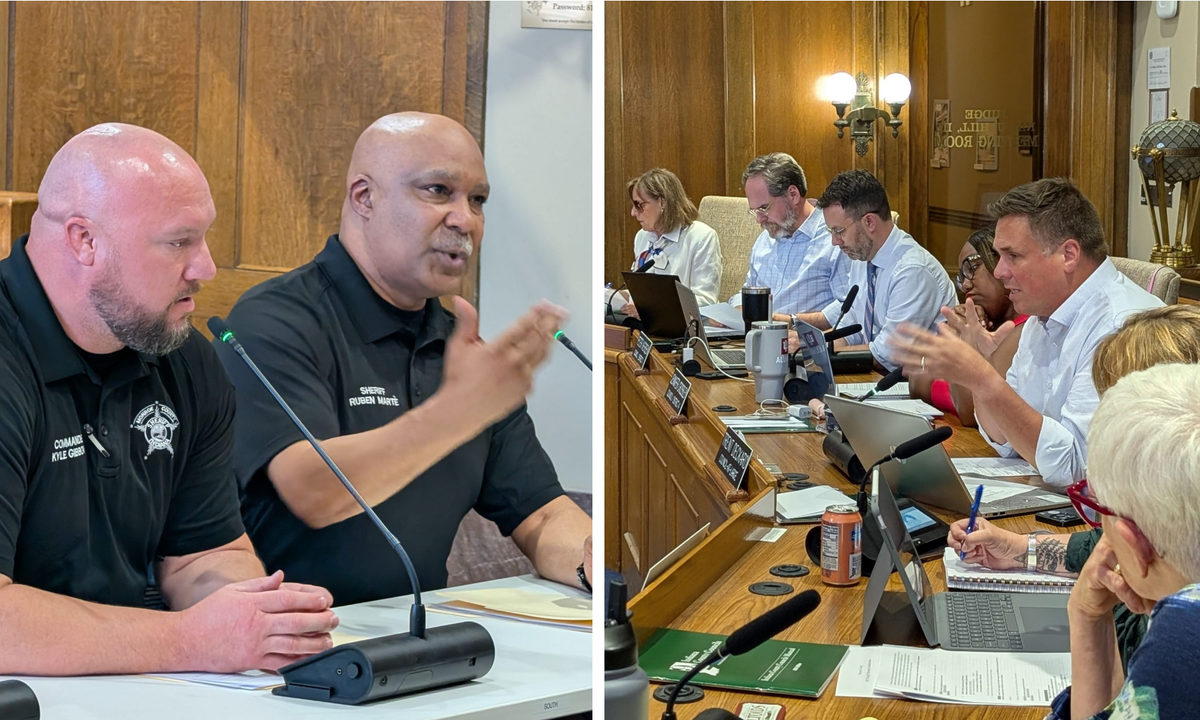
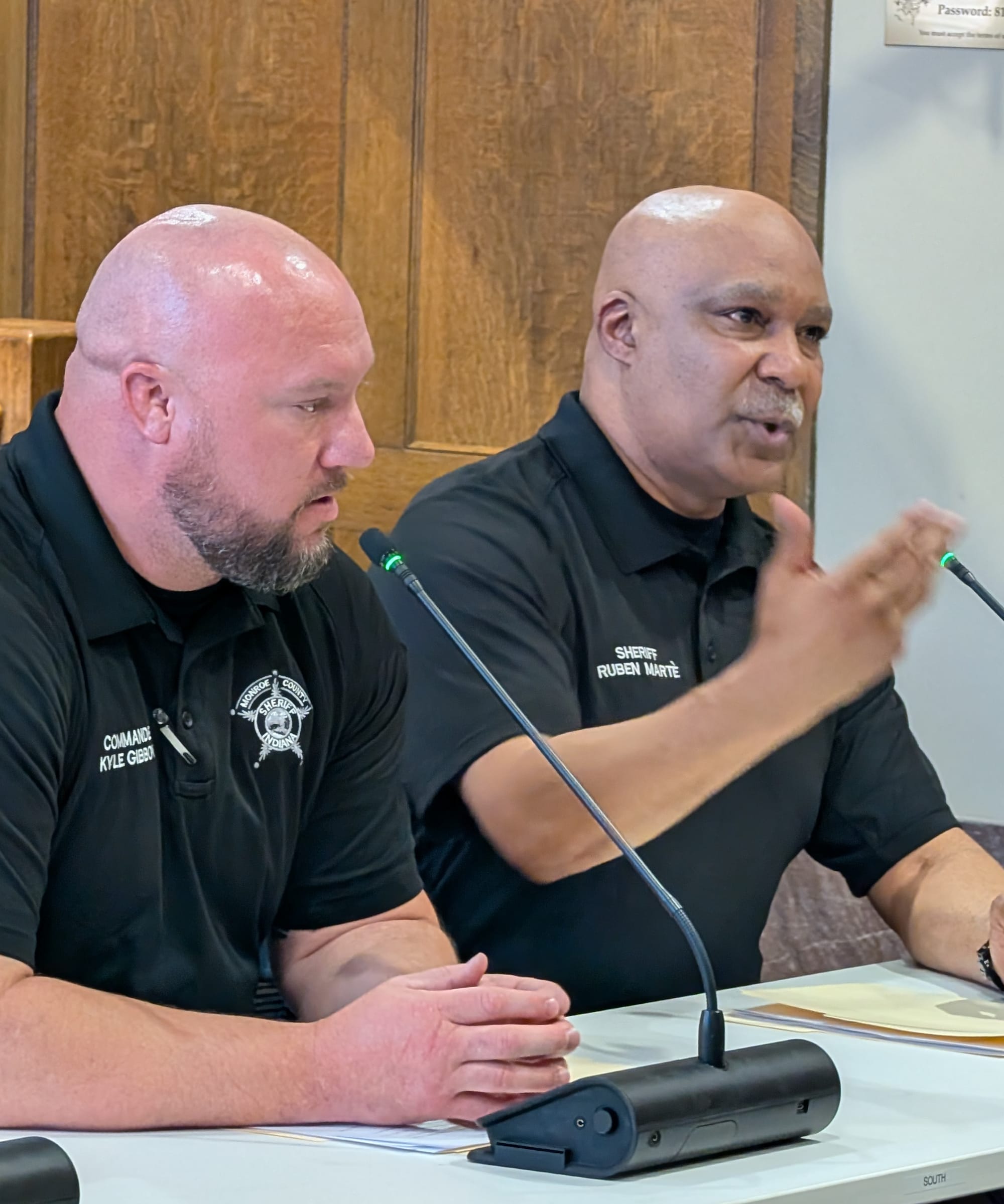
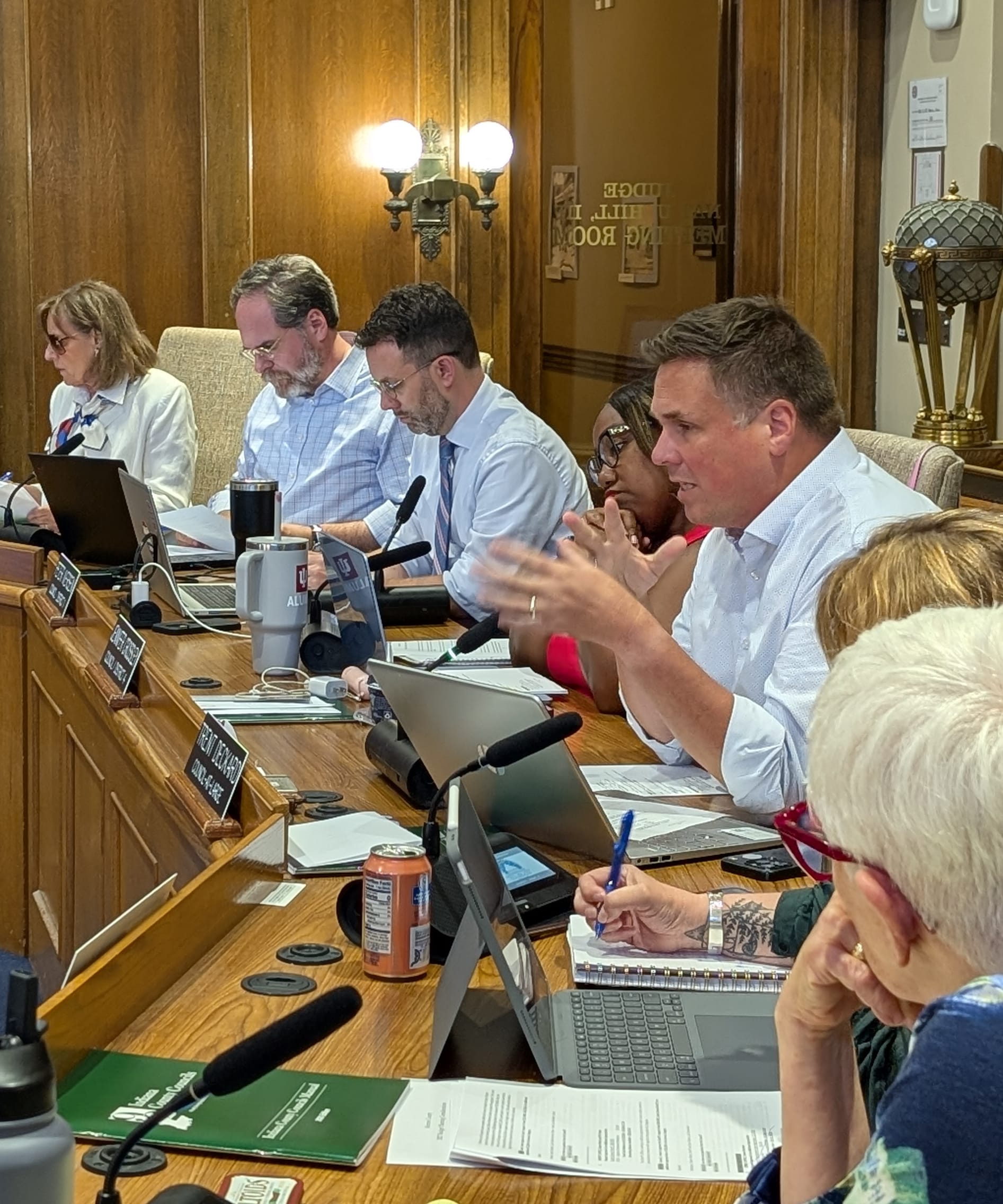
Left: Jail commander Kyle Gibbons and Monroe County sheriff Ruben Marté. Right: Monroe county councilors from far to near: Marty Hawk, David Henry, Peter Iversen, Jennifer Crossley, Trent Deckard, Kate Wiltz, and Liz Feitl. (Dave Askins, June 23, 2026)
The political rift over how to respond to a potential new lawsuit against Monroe County officials over conditions at the jail was a factor in two significant actions at Tuesday night’s (June 23) county council meeting.
On one front, councilors voted 6–1 to appropriate $30,000 in response to a request from sheriff Ruben Marté for his own outside lawyer, as the ACLU of Indiana is preparing fresh litigation over conditions at the county jail. That’s after the ACLU allowed a settlement agreement from a long-running 2008 lawsuit to expire.
The prospect of fresh litigation moved beyond speculation at Tuesday’s meeting, when Marté reported that lead ACLU attorney Ken Falk would visit the jail the next day to interview prisoners as potential plaintiffs in a new legal action.
On another front, the county council tightened up the membership of a joint city-county working group that is supposed to recommend a new jail site, shrinking its voting membership in hopes of avoiding the kind of quorum failure that derailed the group’s first meeting last week. The group will try again to meet on Wednesday (June 24).
County officials have settled on the idea of building a new jail as the solution to addressing overcrowded conditions at the existing facility. A split between commissioners and councilors over a choice of jail site emerged after North Park was twice rejected in a six-month span by the county council.
For the jail site working group, councilors assigned “ex officio” status to the sheriff’s office and the board of judges, which was consistent with clear indications from each that they would not be participating. The move reduced the number of members relevant for quorum from eight to six.
County officials are now trying to protect themselves in a potential new court case, while also finding a place to build a new jail, but without the public participation of the sheriff or the board of judges or, so far anyway, the county commissioners.
ACLU to interview jail prisoners
Marté opened his appropriation request on Tuesday by telling the council the ACLU’s next lawsuit is not hypothetical.
“As you know, litigation for the ACLU is certain to take place, reference the county jail,” Marté said, asking for an additional $30,000 in his budget’s “services” category to acquire outside counsel. He framed the request explicitly as a bid for parity with the council, which in April appropriated $30,000 for its own outside legal advice on jail-related issues, including anticipated ACLU action. “We are following your lead and are requesting an additional appropriation of 30,000 for the same purpose,” he said.
Jail commander Kyle Gibbons underscored the immediacy of the threat. “Tomorrow, [ACLU attorney] Ken Falk will be at the correction center in the morning, interviewing potential clients,” Gibbons told councilors.
Marté stressed that, unlike the council, he has already been a named defendant under the existing ACLU agreement governing jail conditions. “When I took over three and a half years ago, I was the one named as a defendant, and no one else has been,” he said. “So at this point it’s coming very fast for me.”
Insurance and who pays for whose lawyer
Councilor Peter Iversen pressed the point: If the county carries liability insurance, why does the sheriff need his own pot of money? “It’s my understanding that the county’s insurance covers litigation costs. Is this for costs that go above and beyond those?” Iversen asked.
County attorney Molly Turner-King answered that the administration is still trying to get clarity from the new insurance carrier, including whether it will provide counsel at all in a case that may seek injunctive relief, rather than damages.
Turner-King later added that the insurer has essentially said: “You have to get sued for us to make a decision, because we don’t know what that lawsuit is,” while the sheriff has legal questions right now.
Councilor Marty Hawk, the lone vote against the appropriation, said that county taxpayers risked paying for more than one attorney: “So, what are we going to do, running around with three and four different attorneys, all of us fighting with one another—this is not making a lot of sense to me,” She also questioned why the sheriff could not rely on counsel from the insurance company if he was the one named in the eventual lawsuit.
Marté pushed back on both points. He said the council’s own April appropriation for outside counsel specifically anticipated “potential future litigation involving ACLU,” even though council has not been named or approached. “All I’m doing is the exact same thing,” he said. “You have not been even named as a defendant at all, but I could tell you from day one I have.”
The sheriff and Gibbons also drew a distinction between the statutory “legal deputy” whose contract is already funded in the sheriff’s budget and the kind of specialist he now wants.
“I do not need to be told to be thankful.”
The sharpest exchange of the night came when Hawk suggested the sheriff should simply reallocate money inside his existing services budget within the same category and come back later if he needed to refill other lines. That is a workaround the council often urges departments to use for mid-year, unplanned expenses.
“Maybe what they need is a new line within their services,” Hawk said. “Then they can move it up and down within that, as they choose. We don’t need to do an additional appropriation …”
After a back-and-forth about internal transfers, Hawk tried to simplify her point:
Hawk: Take the line, just say thank you. We’ll put a line in place … ”
Marté: …You want me to say thank you? That’s what I heard you say to me??
Hawk: You can transfer the very day it gets under. You can do it. We don’t have to do it. You’re ready to go tomorrow. Isn’t that what you want?”
A short while later, Marté was candid with his thoughts about Hawk’s comment: “I do not need to be told to be thankful,” Marté said. He added, “That took a very offensive turn there.”
He repeated his view that the county council was now demanding a more complicated route for him than it had taken for itself for its own appropriation. “To be fair, you appropriated yourselves $30,000 and you haven’t been even named [in a lawsuit] …,” he said.
Councilor Trent Deckard urged the council to get to a vote, saying he expected the county would end up appropriating the same $30,000 at some point this year regardless of the path chosen. He warned that the back-and-forth risked draining energy from the larger jail crisis.
“I think that this energy could be well supplied into more fruitful things to get us out of our present dilemma, which sucks, and we gotta do,” Deckard said.
The motion passed 6–1, with Hawk the sole vote of dissent.
Legal fears reshape the jail site group
Later in the same meeting, the council turned to a resolution which rewrites the structure of the working group created June 11 to recommend a potential jail site. The rebranded “Collaborative Justice Project Working Subcommittee” saw its first scheduled meeting last Thursday implode for lack of quorum, after two members indicated they would not attend. Explicitly saying they would not be participating were the sheriff’s office and the board of judges.
Turner-King told the council she and Bloomington city council attorney Larry Allen had concluded the group must, in legal terms, be a county committee, with the city members participating in it rather than co-owning it. She also confirmed what many had inferred from statements that were now public: The sheriff and the board of judges have opted out of participating for now because of the potential pending litigation. As Marté put it in an email, his office needs “the opportunity to consult with litigation counsel before making any further public comments.”
The resolution adopted by the council Tuesday night reconstitutes the voting core as six officials: one county commissioner, the Bloomington mayor, one county council member, one Bloomington city council member, the prosecutor, and the public defender. Invited as ex officio members are representatives of the sheriff’s office and the judges, who will have no impact on quorum.
A county commissioner was left in the mix, even though commissioners have not appeared eager to appoint one of their members to participate. On May 29, before the working group was formed, board of commissioners president Julie Thomas wrote in an email message to county councilors: “The Commissioners have been advised that it would be premature to publicly discuss or evaluate additional properties before litigation counsel is retained.” Thomas continued, “Doing so could waste taxpayer funds by sending staff, officials, or consultants down paths that may not survive scrutiny in the Federal litigation process.”
On Tuesday, councilors also narrowed the working group’s mission, to focus on location only, in order to avoid the kind of sprawling debate that bogged down earlier efforts around three years ago.
The resolution adopted by the county council on Tuesday confirms what was promised at the June 11 joint session of city and county officials: The jail site working group is expected to come back with a recommended site within about a month, with a tentative report-back around July 13.
In a final tweak, the council designated its own appointee, councilor Liz Feitl, as chair and agenda-setter of the working group, as a way for the council to keep the work moving, even if others stay on the sidelines.
Legal counsel, public talks on jail siting
Tuesday night’s county council meeting highlighted the tension between a desire to start towards solving the jail overcrowding issue by picking a site for a new jail and a desire to protect the county’s legal position.
On one hand, the sheriff and commissioners have cited the need to ensure that anything said in public about jail siting is consistent with legal strategy as a reason to stay away from open working-group discussions about location. On the other hand, county officials will be under pressure to show progress on a new site even as the ACLU prepares to argue in federal court that the current jail is unconstitutional.
That tension was visible on Tuesday night, when councilor David Henry tried to link Marté’s request for an appropriation to pay for outside counsel to his refusal to sit on the jail-site working group.
“If we can get you an attorney to talk to, and if that would free up your office to come sit with us to try to … get to a solution, I mean, I think that’s an incentive for us to vote on that,” Henry said.
Henry then asked whether, if the appropriation passed and the sheriff could get legal counsel the next morning, if there would be “any other barriers” to participation by the sheriff’s office in the jail site working group.
Marté declined to take the bait. “I’m going to repeat myself—that I’m asking the council for an additional appropriation,” he said. He added, “This is not the time, at this point, for me to discuss the [jail site working group].”
By the end of the night, councilors had chosen to appropriate $30,000 for the sheriff’s outside counsel, and to reduce the members of the jail site working group from eight to six.
On Wednesday morning (June 24), ACLU attorney Ken Falk will be in the jail, talking to potential plaintiffs.
At 6 p.m. on Wednesday evening, the jail site working group [Collaborative Justice Project Working Subcommittee] will try again to convene its first meeting, with an eye towards recommending a site for a new jail by July 13.


Comments ()