
Monroe County council backs $30K for lawyers, questions new $135M jail financing plan
On Tuesday, the Monroe County council approved a $30K appropriation to pay for outside legal counsel. Councilors also reviewed $135M jail financing plan. No bonding decision was made, as councilors raised doubts about costs, scope, and timing.
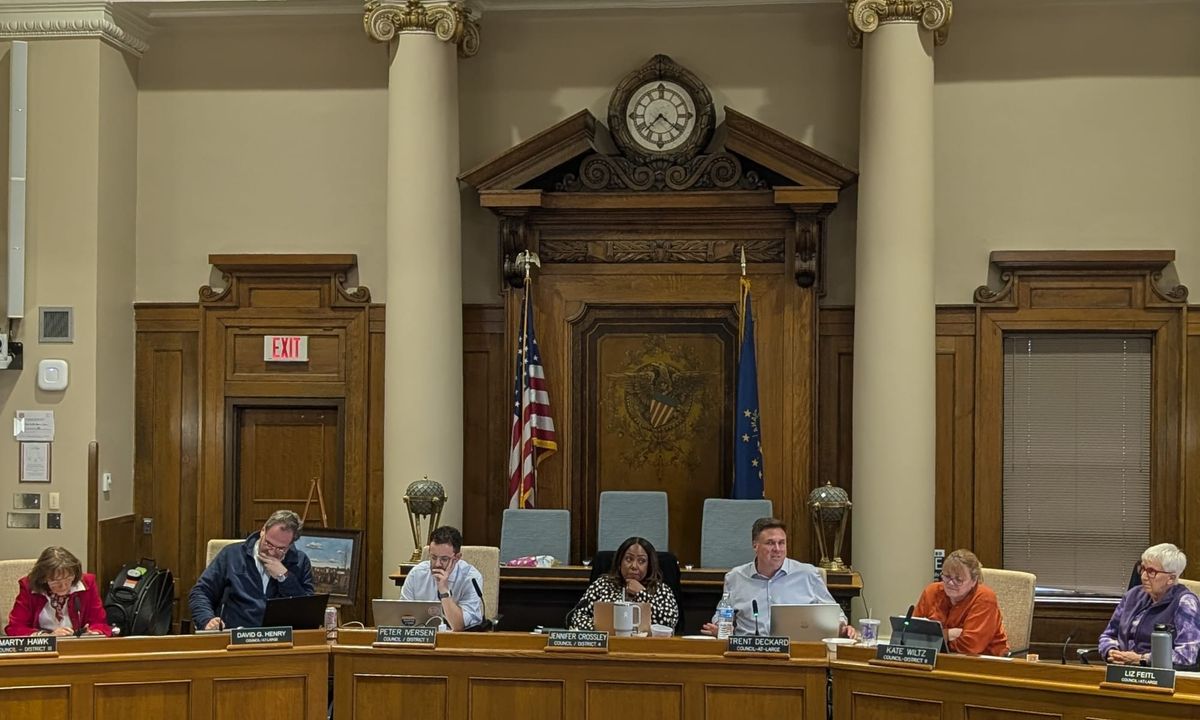
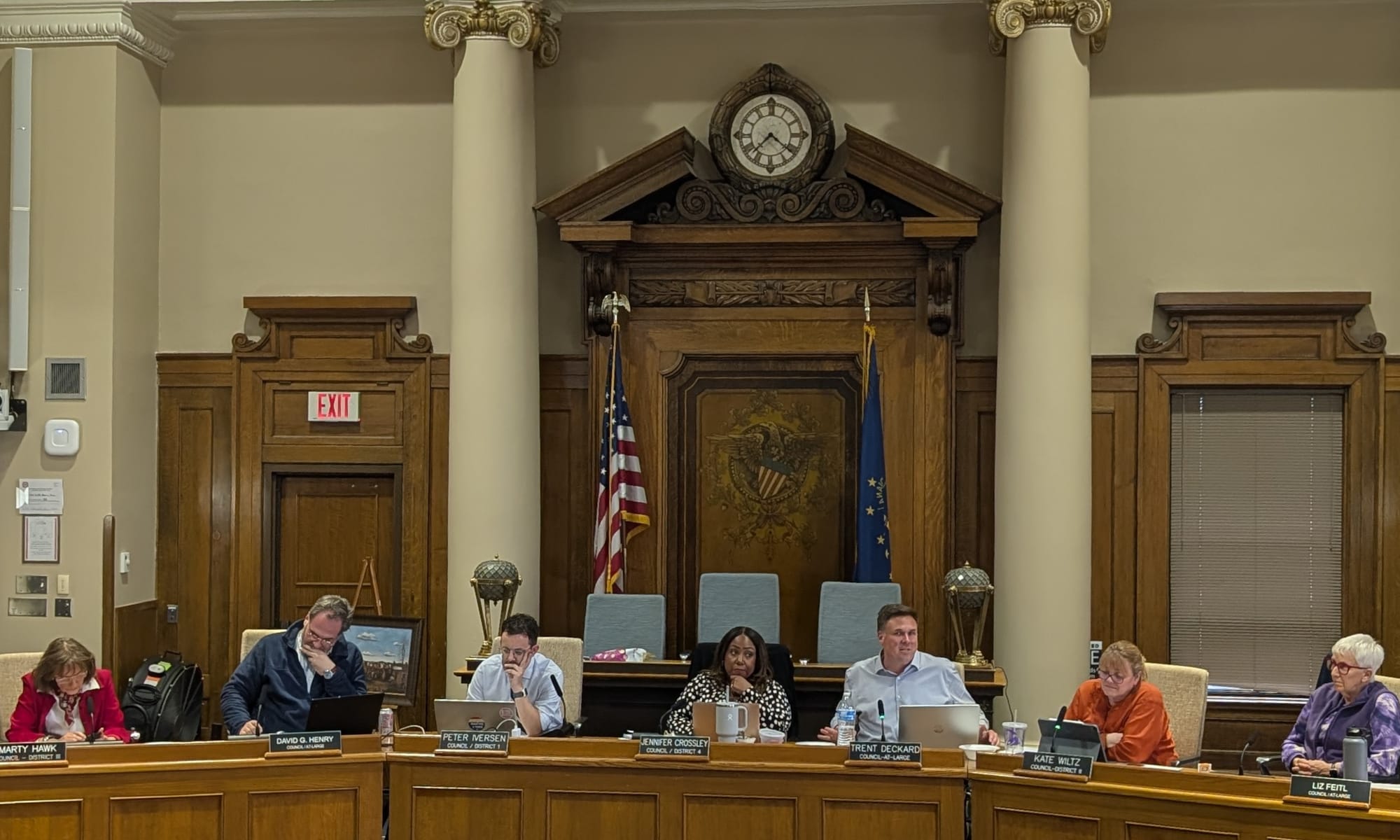
On Tuesday night, Monroe County’s long-running jail debate was the highlight of two separate agenda items. One was about issuing $135 million in bonds towards a new jail and justice center project, with a lot of uncertainty about whether that amount would cover a first phase. No decision was made Tuesday on the question of bonding.
But on a 6–1 vote, the council did take a step toward hiring its own outside legal counsel, as tensions rise with county commissioners over the jail project. Commissioners want to build the new facility at North Park, off SR46 northwest of Bloomington. Councilors have been strongly opposed to that site since October 2025. Dissenting on Tuesday’s vote about outside legal counsel was Trent Deckard.
The split vote was on an appropriation of $30,000, as a kind of a “placeholder” to retain outside counsel. Council president Jennifer Crossley said she wants independent advice, ahead of a council vote on a purchase agreement for the proposed North Park jail site, which could come as soon as May 12.
The county commissioners will have a purchase agreement for North Park on their agenda for this week’s regular Thursday morning meeting (April 30). The schedule of votes by the two elected bodies on a new North Park purchase agreement is outlined in the current settlement agreement extension for a lawsuit that was filed in 2008. The ACLU is representing prisoners at the jail over unconstitutionally crowded conditions.
From the public mic on Tuesday, there was some, but not uniform support for the idea that the council should retain outside legal counsel. Critics warned that spending more on lawyers, while other departments are under a hiring freeze, was a bad look for the council.
April Wilson, who was speaking in her personal capacity as a county resident, not as a deputy prosecutor for Monroe County, urged councilors to stop relitigating past slights and start negotiating directly with the commissioners and city leaders over location, cost, and design of a replacement jail. She put it like this:
I would like to share with you a phrase, though, that I frequently come back to as an attorney and in my personal capacity: Sometimes you can be right, or sometimes you can be married. … Appropriating this money is not a step towards solving the problem. Solving this problem means starting to have joint public meetings rather than speaking about through resolutions or on social media. It means sitting across from each other and talking about the budget and design rather than solely expressing frustration that you don’t know what the answer to that question is.
Hiring outside legal counsel
The motion that David Henry eventually made at Tuesday’s meeting was “to approve the additional appropriation of $30,000 for contractual legal services and to authorize the council president to identify and solicit proposals from qualified outside counsel and to bring a recommended engagement, including scope and terms back to council for approval with any contract to be executed in accordance with applicable Indiana law.”
Henry described it as a move that is meant to keep options open and simply explore possibilities rather than commit the council to a specific course of action. He framed his support as basically honoring a request from Crossley, as council president, who said she would benefit from advice of outside counsel in the meetings she attends with commissioners and the ACLU attorney. It’s also a precaution to help protect the council, if things escalate to a new lawsuit against Monroe County government by the ACLU. Crossley put it like this, “It is just seeking outside advice of what we should do, should we get to next‑level mayhem.”
The “mayhem” Crossley mentioned would stem from the council’s failure to approve a purchase agreement for North Park at one of its two regular meetings in May. That’s based on the lawsuit’s newly extended settlement agreement, which indicates the ACLU will not extend it again, if the council doesn’t approve a new North Park settlement agreement in May.
That presupposes the county commissioners approve the purchase agreement before the end of April. The settlement agreement is now set to expire on May 29. Once the settlement agreement expires, it would set the stage for fresh litigation based on current conditions at the jail. That’s the scenario county officials are looking to avoid.
Deckard was skeptical that retaining outside counsel was the right approach. During the meeting, he said, “I think it’s about figuring out … where do we go to get to the agreement?” After the council’s meeting, Deckard told The B Square he thinks the council should stick with problem solving for now instead of “lawyering up.”
At the beginning of the year, Deckard and Henry both declared their formal candidacy for the Democratic Party’s nomination for the District 1 county commissioner seat. Since then, Tuesday night’s vote on the appropriation for outside legal counsel was one of the very few, if not the only decision when the two have voted differently as councilors.
Crossley introduced the $30,000 item for discussion, describing it as a “placeholder” that would allow the council to move quickly, if it decides it needs its own lawyer in the escalating dispute with commissioners over the proposed North Park jail site. Crossley stressed that she was not trying to replace the county attorney who supports the council, and she was not questioning their competence.
But Crossley pointed out that when the same in‑house legal department serves both elected bodies, county council and board of commissioners, it creates an inherent conflict, if the commissioners and the council end up on opposite sides of litigation or a contract fight.
Councilor Peter Iverson also stressed that he does not question the competence of the county attorney who provides legal support to the council, when he pointed to Molly Turner-King saying, “We do have legal representation sitting right here—who’s from … where I’m sitting, is doing a fantastic job.”
Councilor Kate Wiltz indicated that she did not see the choice to move towards getting the outside legal counsel for the county council as a decision to take an adversarial stance towards the jail site issue. Wiltz said she trusts Crossley to “multitask,” which means searching for outside counsel, while continuing the broader, slower work of trying to get the commissioners and city officials to a common solution on location, design, and financing of a new jail. “I do trust that you can do many things at once—I’ve seen you do it,” Wiltz told Crossley.
From the public mic, more than one person was critical of the council’s willingness to appropriate extra money for council’s own outside legal representation while other departments are being told to tighten their belts.
Others echoed the call for collaboration, even as they backed the idea of separate counsel. Former county council president Eric Spoonmore, now CEO of the Greater Bloomington Chamber of Commerce, spoke through a remote Teams connection, said one of his “greatest regrets” from his time on the council was agreeing to give up a dedicated council attorney. Spoonmore called engaging outside legal counsel an “insurance policy.” Janet Johnson, a county resident, put it like this: “You need to have your own representation.” Johnson also urged “true negotiation and a good spirit” to get a jail deal done.
Jail bond plan: $135 million now, more decisions later?
Earlier in the same meeting, the council heard a presentation from Financial Solutions Group consultant Greg Guerrettaz, about how Monroe County might structure borrowing for a new jail and justice center. Working from the most recent jail concept estimates and the current state framework for local income tax (LIT), Guerrettaz modeled a $135 million bond issue. It would be backed primarily by the current economic development LIT and jail LIT, with a property‑tax pledge in the background to support the county’s credit rating.
The $135 million is far less than the most recent price tag that was described to county government for a co-located facility at North Park, which came in at around $225 million.
In the scenario presented by Guerrettaz, the county would finance the project through a building corporation, initially leasing the existing jail to support the bond issuance, then substituting the new facility once construction is complete. As a way to ease into the payments, Guerrettaz proposed smaller “interim lease rentals” in the first couple of years. At a 5% interest rate over 20 years, total principal and interest would come to roughly $223 million.
In the key table showing projected LIT revenues and expenses through 2030, Guerrettaz told councilors that it relied on the 2026 certified LIT as a base and assumed 5% annual revenue growth and 6% annual growth in certain LIT-funded expenses. Based on that table, the county could cover the new jail debt out of existing rates, without triggering an increase up to the maximum state-allowed 1.2% cap for a county’s LIT rate, when that becomes effective in 2029.
That 1.2% ceiling reflects changes enacted by the state legislature in SEA 1, which will restructure local income tax authority beginning in 2029. In Guerrettaz’s model, the county would need the equivalent of a 0.93% overall LIT rate to maintain the same level of revenue that it currently gets from different kinds of LIT, including economic development, and certified shares, among others. The statutory new ceiling for the one single type of LIT is 1.2%, which leaves “breathing room” of about 0.27 percentage points, Guerrettaz said.
“We feel very comfortable with getting to 2029,” Guerrettaz said, referring to the year when sweeping changes to Indiana’s local income tax system, which were enacted in Senate Enrolled Act 1 in 2025, are now scheduled to take effect. Lawmakers in 2026, through House Enrolled Act 1210, delayed those changes by a year. In addition to pushing implementation from 2028 to 2029, HEA 1201 made additional technical adjustments to the framework.
“Stalling anything off after that could totally change the picture,” Guerrettaz said, arguing that moving ahead on bonding this year would allow Monroe County to take advantage of relative stability in interest rates and state law before the new system takes hold.
Wiltz and others returned to a more basic problem: The county council still does not have an updated, agreed‑upon cost estimate or program for the new facility. The last public number from the county’s architects, presented in an earlier joint work session, was about $225,000 for a fully co‑located justice campus, including courts and related offices. The $135 million now being modeled is, at best, a first phase of that larger concept. But councilors have not seen a clear breakdown of what that first phase includes, or how the county would finance later phases.
Iversen said the last estimate received by the county council was for an architectural rendering for a co-located facility that contemplated a single phase. Iversen put it like this: “I have not seen an analysis that shows that $135 million is phase one.”
Wiltz portrayed the $135 million as essentially an arbitrary number: “Basically, we’re kind of saying, ‘OK, we’ll take, like, about half of that number and assume we’re building half of the project,’” Wiltz said, calling the situation “ridiculous” from a budgeting standpoint. “It’s just insane, because we don’t know what we’re buying and how much it costs,” Wiltz said.
The council took no formal vote on bonding Tuesday night, but the presentation sets the parameters for a decision that Guerrettaz suggested will need to be made within the next few months. That’s if the county wants to lock in financing under current conditions.
This week’s meeting of the county commissioners, when a new North Park purchase agreement is expected to appear on the agenda, starts at 10 a.m. on Thursday (April 30).


Comments ()