
Bloomington argues $37,500 cap on legal fees in annexation loss; remonstrators seek $200K
After losing its bid to annex Areas 1A and 1B, Bloomington is now disputing the legal fees it owes. Remonstrators seek nearly $200,000, while the city says state law caps reimbursement at $37,500. Special judge Nathan Nikirk will decide after proposed orders are filed July 8.


When the Indiana Supreme Court in February this year refused to consider the city of Bloomington’s appeal on its failed attempt to annex two territories west of the city, there was just one question left: How much does the city government owe in legal fees to those who brought the successful lawsuit against Bloomington’s effort?
Since 2016, the city of Bloomington has spent at least $2.18 million on outside legal services for annexation-related matters, which was paid to one law firm, Bose & McKinney. That doesn’t include any estimates for the city legal department’s staff time.
On Friday morning (June 5), Monroe circuit court special judge Nathan Nikirk heard 45 minutes of oral arguments on how much Bloomington should be required to pay in attorney fees to the residents who successfully blocked the city’s attempted annexation of Areas 1A and 1B.
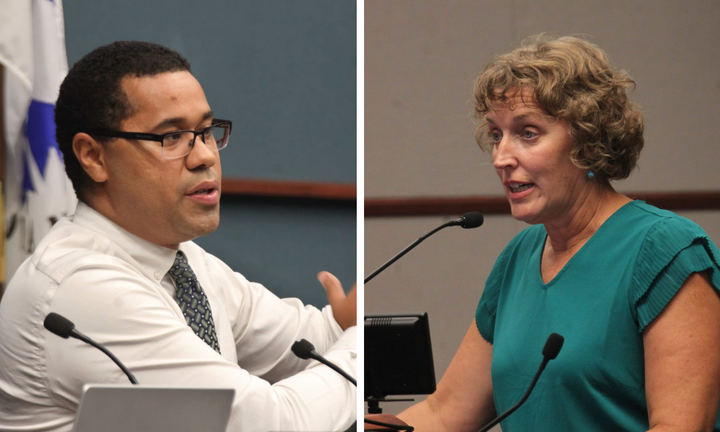
It was Stephen Unger and Andrew McNeil with Bose & McKinney who argued the city’s side on Friday morning. They’re pointing to the “plain language” in state law that says remonstrators in annexation cases can’t be reimbursed for more than $37,500.
William Beggs, attorney with Bunger & Robertson for the remonstrators, is asking for an award of attorney’s fees just under $200,000.
After each side had their say, and a chance for rebuttal, Nikirk said he’d take the matter under advisement and gave them until July 8 to file their proposed orders in the case. After that Nikirk will make a decision.
Unger seemed to imply in his remarks that the city’s actual position is that not even $37,500 is owed, but the city would accept a judgement of that amount. Anything more than that, however, and the city would appeal, based on what Unger said in court on Friday morning.
It was Nikirk who in August of 2024 gave the initial ruling against the city of Bloomington’s annexation attempts. Then came the decision by the court of appeals in September 2025 that upheld the ruling against Bloomington. When the Indiana Supreme Court in February this year declined to hear the case, that answered for good the question of whether the two territories would become a part of the city.
Beggs went first on Friday morning, and walked Nikirk through the history of the case, which was filed more than four years ago. It included a week-long bench trial over which Nikirk presided, which concluded about two years ago. The trial took place in the same courtroom as Friday morning’s oral arguments.
Beggs described how the case had involved “a lot of work by a lot of people on all sides.” Beggs represents County Residents Against Annexation, Inc. (CRAA) and the individual property owners who were remonstrators and named plaintiffs in the case.
In a petition filed in September 2024 and amended this week, the remonstrators asked the court to order Bloomington to pay the unpaid balance of their attorney’s bills—a figure Beggs put at $199,441.98, including time associated with Friday’s hearing. In the agreed stipulated facts that were filed with the court, the total amount that Bunger & Robertson has billed in the case is $377,292 and the total amount of attorney fees paid to Bunger & Robertson has been $177,850.
The request in front of the judge is now to award the difference between what has already been paid and the total billed amount.
Beggs emphasized that the parties had already stipulated that the amount and hourly rates were reasonable. The only thing to decide, Beggs said, is how to interpret the relevant state law.
IC 36-4-3-11.6 Attorney’s fees and costs for prevailing remonstrators
Sec. 11.6.
(a) This section applies to a remonstrance filed after June 30, 2015.
(b) If the court orders an annexation not to take place after a hearing under section 11 of this chapter, the remonstrators shall be reimbursed by the annexing municipality for any reasonable attorney's fees, including litigation expenses and appeal costs:
(1) that are incurred:
(A) after the date the annexation ordinance is adopted; and
(B) in remonstrating against the annexation; and
(2) not to exceed thirty-seven thousand five hundred dollars ($37,500)
Beggs told Nikirk that if it’s read in the context of the broader statutory scheme, the wording still allows the court to award more than a flat $37,500 in this case.
Beggs noted that the statute refers to “the remonstrators” in the plural, not a single remonstrator, and contemplates fee awards to the plural. The case involved two ordinances, one for each of the two territories (Area 1A and Area 1B) which were tried jointly over five days.
The findings and conclusions were separate for each of the two territories, Beggs said. The original petition was filed on behalf of 24 remonstrators, each of whom could have filed separate lawsuits that would later have been consolidated. Under that scenario, Beggs said, the potential aggregate fees would clearly exceed $37,500 and would support the award of the full unpaid balance of $199,442.
Beggs said at least a $75,000 award could be based on $37,500 for each annexation territory. As a last resort, Beggs acknowledged the court could adopt the view that only $37,500 could be awarded, but urged Nikirk not to read the statute that way.
Beggs framed the dispute as one of legislative intent and public policy. He argued that the General Assembly did not mean to allow a city with what he called an “apparently endless litigation budget” to pursue an “ill‑conceived annexation effort” without bearing the full consequences if residents prevailed.
Arguing for the city of Bloomington, Unger urged Nikirk to reject what he called “mental gymnastics” and stick to the “plain language” of the statute. Exasperated, Unger told Nikirk: “I don’t even know why we’re here today, your honor.”
Unger said the wording of the statute clearly applies to “the remonstrators” collectively, not to each landowner or each named plaintiff and ties reimbursement to “a hearing.” There was one case and one hearing, Unger said, so they are entitled to an amount “not to exceed $37,500.”
Unger said that any of the theories put forward by the other side would effectively erase the cap the legislature wrote into the statute. Unger noted that the only entity contractually obligated to pay the firm is CRAA, the nonprofit organization that coordinated the remonstrance effort.
Unger told the court that nearly all payments shown on the invoices from Bunger & Robertson came in from CRAA using donations made to it as a nonprofit, not as payments from individual remonstrators. He cited federal tax‑court authority for the idea that donors to a 501(c)(3) relinquish control over their contributions. By that logic, donors to CRAA are not “remonstrators” paying their own legal fees, but charitable contributors to a nonprofit. Unger said that affects how any “reimbursement” under the annexation statute should be understood.
Unger also was keen to point out that CRAA itself is not a landowner in the annexation territories and is not a remonstrator, which is something that is part of the joint stipulation of facts filed with the court: “CRAA is not a landowner within Areas 1A or 1B, and CRAA did not sign a remonstrance petition against either annexation.”
Unger did not make an explicit argument that CRAA did not qualify for reimbursement of attorney’s fees under state law (which provides for reimbursement to remonstrators), but appeared to take that position. Leading up to his remarks about CRAA’s status as a non-remonstrator, Unger told Nikirk that Bloomington would not appeal an order that the city pay $37,500, but if it came to considering amounts higher than that, he indicated that CRAA’s status as a non-remonstrator would be relevant.
Beggs responded that the CRAA engagement‑letter and donor‑status arguments miss the mark. He pointed Nikirk to Indiana cases holding that a party’s entitlement to a fee award does not depend on whether they have actually received or paid a bill.
Bloomington has another still-pending annexation case, involving a question of constitutional law, and five other territories. The Indiana Supreme Court still has not decided whether it will take the case, which Bloomington lost in the circuit court. A court of appeals panel upheld the circuit court ruling that a 2019 state law was, in fact, constitutional.

Comments ()